Tri Fold Rivets
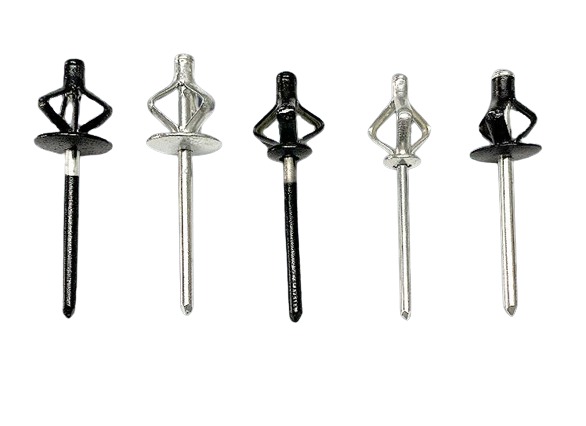
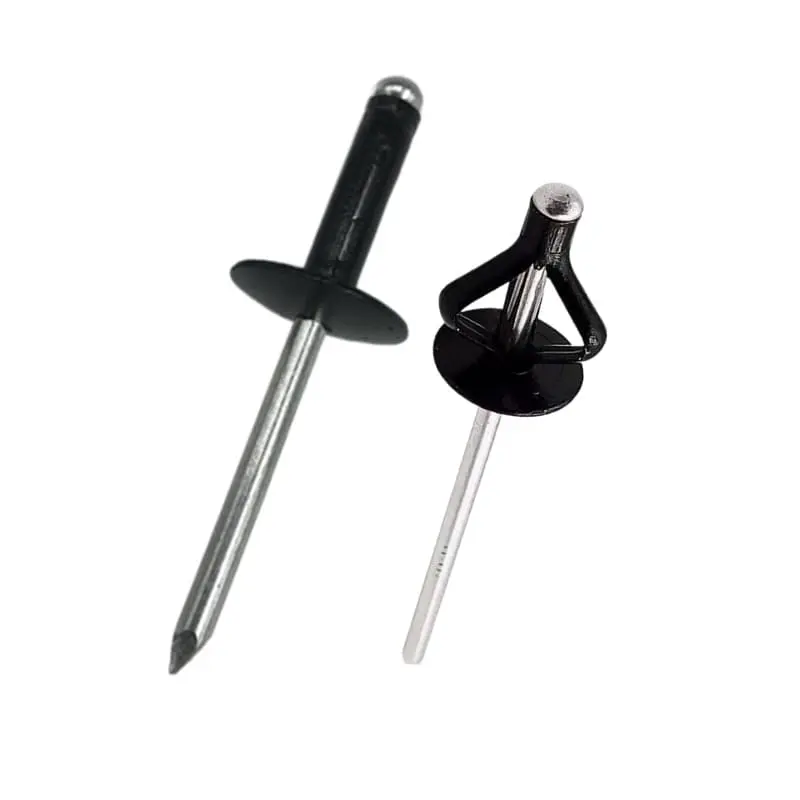
Rivmate’s Tri-Fold Rivets feature a three-lobed blind-side expansion design that provides a larger bearing surface for the joint, ensuring more even force distribution. This structure helps reduce stress concentration around the hole edges and enhances the reliability of connections in soft materials and thin sheets.
- Three-panel blind-side deployment structure
- Tri-Firm Watertight Option Available
- Suitable for plastics, fiberglass, and composite materials
Why Choose Our Tri Fold Rivets
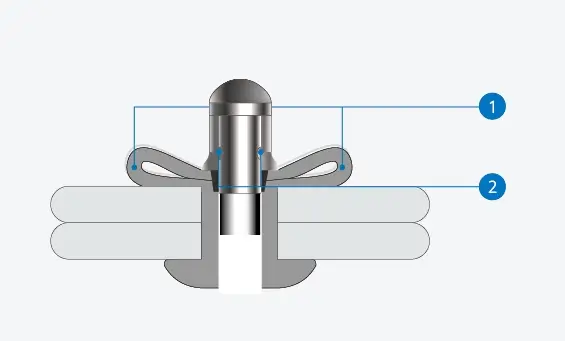
- The "cracked" tail molding disperses the mandrel pressure bear-ing load /riveting load on rear plate.
- The mandrel pressure bearing load /riveting load are dispersedon rear plate, which provides the high mandrel retaining force.
- The retained mandrel can avoid damage, electric leakage or ma-rowak sound and other problems caused by falling off of the man-drel.
- Multi-grip property adaptable to the scope of width of sheet mate-rial thickness.
- As an ideal selection for sheet materials, it can provide high man-drel retaining force.
Rivmate —— Your Professional Customized Tri Fold Rivets Manufacturer
Rivmate is a professional custom manufacturer of Tri-Fold Rivets. Our Tri-Fold Rivets feature a combination of aluminum rivet bodies and aluminum mandrels. They provide a reliable riveting solution for assembling plastics, fiberglass, composite materials, thin sheets, and lightweight panels.
Based on your assembly requirements, Rivmate can recommend the appropriate Tri-Fold Rivet sizes, head types, and packaging to provide efficient and reliable fastening solutions for your projects.
Tri Fold Rivets
Tri Fold Rivets are available in two types: Standard and Tri-Firm Blind Rivet (Watertight). Both types feature a three-flap design that creates a large support surface on the blind side. The Standard type is primarily used to improve tensile penetration resistance and enhance back-side support. The Watertight type adds sealing performance to this design, making it more suitable for waterproof and dustproof applications.
Tri Fold Rivets
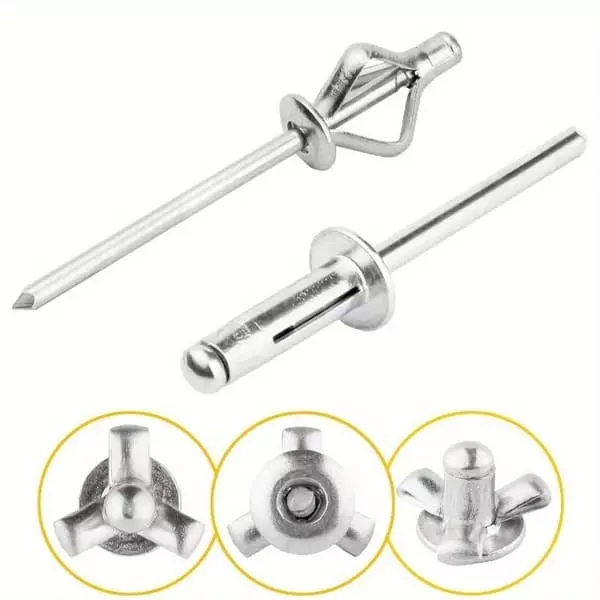
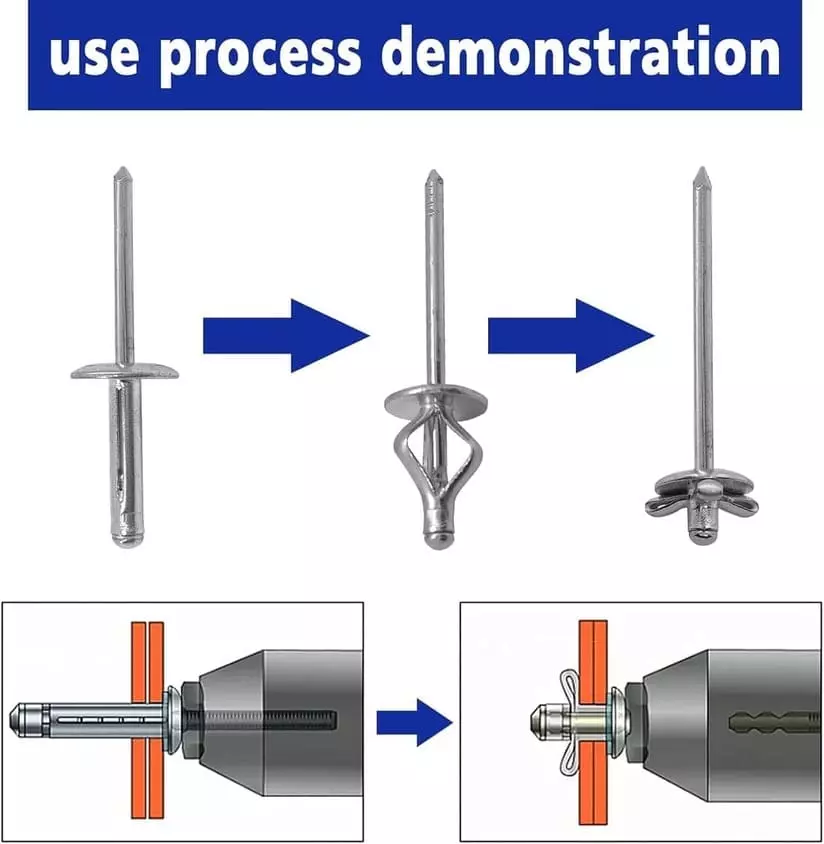
Tri Fold Rivets are blind rivets that form a three-fold structure on the blind side after installation. They provide a larger backing surface area, which helps distribute loads and reduce the risk of material damage. They are particularly suitable for joining plastics, fiberglass, and thin sheet materials.
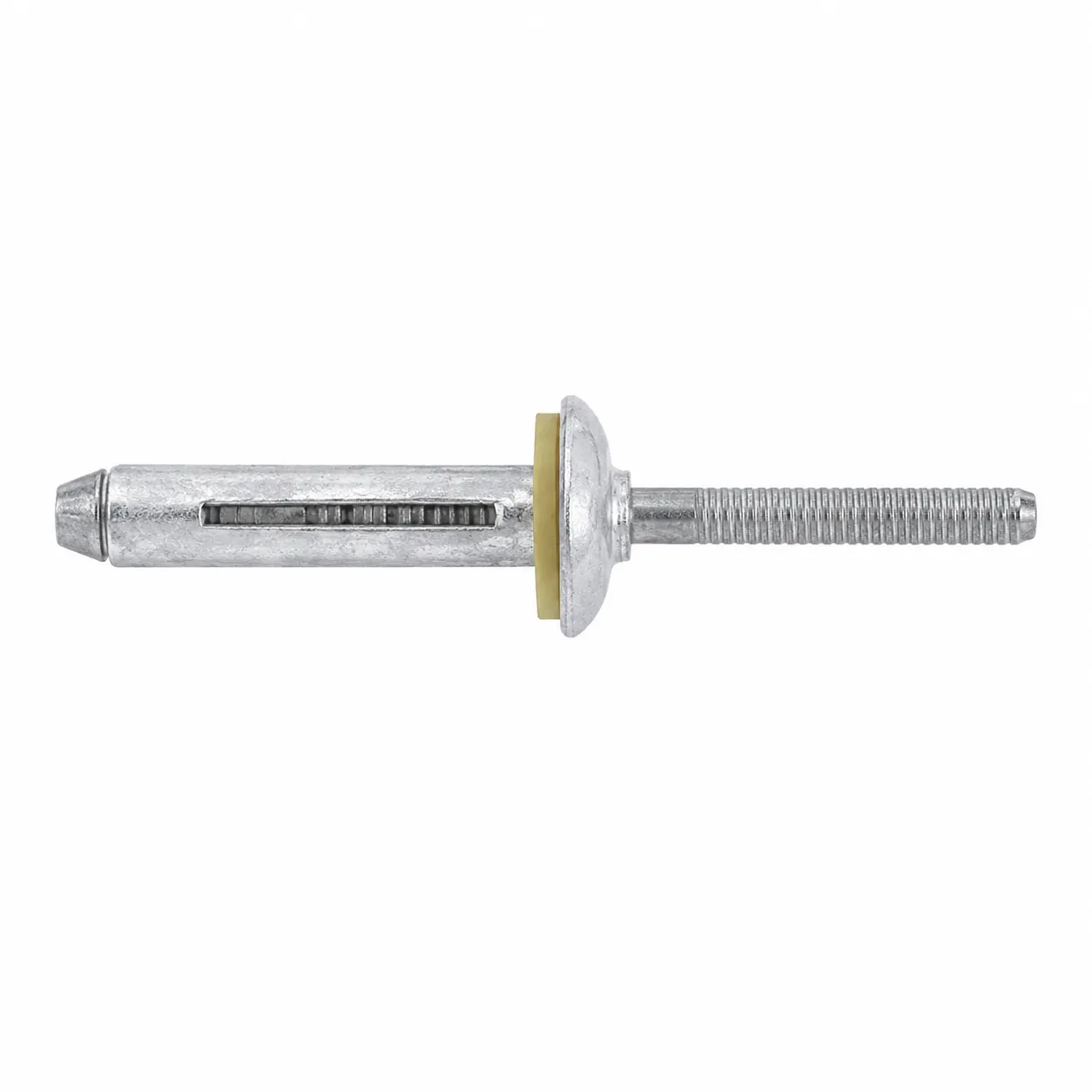
Tri-Firm Blind Rivet (Watertight)
a sealed blind rivet developed from the traditional Tri-Fold Rivet. When used with an EPDM gasket, it effectively reduces the risk of moisture, dust, and air penetrating through the connection holes. It is suitable for metal roofs, truck trailers, HVAC systems
Tri Fold Rivets by Material
Tri Fold Rivets feature a combination of an aluminum body and an aluminum mandrel, making them suitable for joining plastics, fiberglass, composite panels, thin aluminum sheets, and lightweight structures.
Aluminum body/Aluminum mandrel Tri Fold Rivets
Because aluminum-to-aluminum fasteners are lightweight and offer consistent formability, they are well-suited for use with soft materials. Once installed, the tail of the rivet expands into a three-lobed structure, providing a larger load-bearing surface on the blind side and reducing the risk of tearing or damaging the material.
Tri Fold Rivets by size
Rivmate offers a selection of Tri-Fold Rivets in sizes ranging from 4.0 mm to 7.5 mm. These various specifications are designed to meet your specific application needs.
4.0mm Tri Fold Rivets
This size has a smaller hole diameter, resulting in minimal impact on the material surface after installation. The riveting range is 1.0–7.0 mm. It is suitable for joining thin, lightweight plastic parts and decorative panels.
7.5mm Tri Fold Rivets
This is the largest model in the series. The riveting range is 0.8–19.1 mm. It can achieve the largest three-lobe spread area. It is suitable for large composite panels, thick fiberglass-reinforced plastic (FRP), and applications requiring high joint stability.
4.8mm Tri Fold Rivets
This size is the most commonly used specification. The riveting range is 1–12 mm. It provides an excellent balance between clamping force, contact area, and installation efficiency. It is suitable for most plastic assembly projects.
5.2mm Tri Fold Rivets
This size provides a larger blind-side support area. The riveting range is 1.3–19.1 mm. It enhances pull-out resistance and is particularly suitable for thicker fiberglass panels and composite panels
6.4mm Tri Fold Rivets
It helps further distribute the load and reduce the risk of material damage. The riveting range is 1.6–15.9 mm. Suitable for industrial equipment enclosures, RV exterior panels, and marine FRP components.
Tri Fold Rivets by head shape
The different head shapes of Tri-Fold Rivets primarily affect the front support area, the appearance after installation, and the ability to protect the material surface.
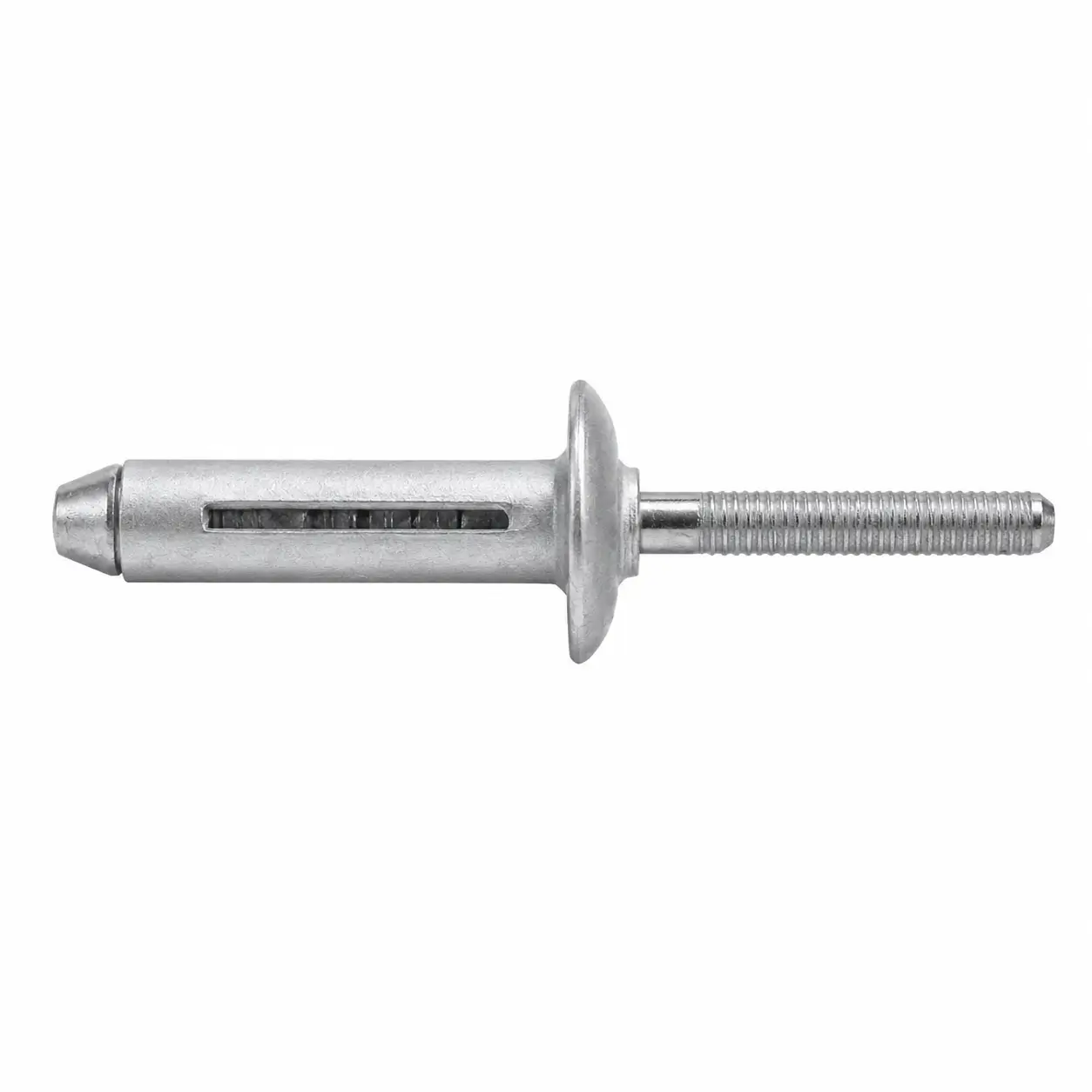
Dome Head Tri Fold Rivets
Round-head Tri-Fold Rivets are a common head style. After riveting, the head appears smooth and natural, and the joint offers excellent stability. They are suitable for applications that require both a high-quality surface finish and strong fastening strength.
Large Flange Tri Fold Rivets
Compared to standard head types, Tri Fold Rivets feature a wider brim. This provides better support for front surface of soft materials or thin sheets. It helps distribute localized stress during installation, reducing risk of damage to hole edges and material tearing.
All Aluminum Trifirm Rivet Specification Table
| No. | Art. Code | Part Number | Size | Diameter d | k Max | L Ref. | dk Max | P Min | dm Max | Hole Dia. | Grip Range | Tensile Ref. | Shear Ref. |
|---|---|---|---|---|---|---|---|---|---|---|---|---|---|
| 1 | AAT-0516 | AAT40140 | 4.0×14 | 4.0 / 5⁄32" | 1.7 | 16.0 | 8.3 | 27.0 | 2.4 | 4.2–4.4 | 1.0–3.0 | 750N | 550N |
| 2 | AAT-0523 | AAT40188 | 4.0×18.8 | 4.0 / 5⁄32" | 1.7 | 21.2 | 8.3 | 27.0 | 2.4 | 4.2–4.4 | 3.0–7.0 | 750N | 550N |
| 3 | AAT-0619 | AAT48160 | 4.8×16 | 4.8 / 3⁄16" | 2.1 | 18.1 | 10.1 | 27.0 | 2.9 | 5.0–5.2 | 1.0–4.0 | 950N | 750N |
| 4 | AAT-0625 | AAT48205 | 4.8×20.5 | 4.8 / 3⁄16" | 2.1 | 23.3 | 10.1 | 27.0 | 2.9 | 5.0–5.2 | 1.0–9.0 | 950N | 750N |
| 5 | AAT-0630 | AAT48250 | 4.8×25 | 4.8 / 3⁄16" | 2.1 | 27.1 | 10.1 | 27.0 | 2.9 | 5.0–5.2 | 4.0–12.0 | 950N | 750N |
5.2 Aluminum Bulbtight Trifirm Rivet Specification Table
| No. | Art. Code | Part Number | Size | D Max | E Max | F Max | H Max | L Max | P Min | W Max | Hole Dia. | Grip Range | Tensile Ref. | Shear Ref. |
|---|---|---|---|---|---|---|---|---|---|---|---|---|---|---|
| 1 | AATFS6604-6-3W | AATFS52175 | 5.2×17.5 | 5.2 | 3.4 | 20.9 | 11.6 | 17.9 | 25.4 | 2.95 | 5.3–5.5 | 1.3–4.8 | 1800N | 2700N |
| 2 | AATFS6604-6-4W | AATFS52191 | 5.2×19.1 | 5.2 | 3.4 | 22.5 | 11.6 | 19.5 | 25.4 | 2.95 | 5.3–5.5 | 1.6–6.4 | 1800N | 2700N |
| 3 | AATFS6604-6-6W | AATFS52222 | 5.2×22.2 | 5.2 | 3.4 | 25.6 | 11.6 | 22.6 | 25.4 | 2.95 | 5.3–5.5 | 4.7–9.5 | 1800N | 2700N |
| 4 | AATFS6604-6-8W | AATFS52254 | 5.2×25.4 | 5.2 | 3.4 | 28.8 | 11.6 | 25.8 | 25.4 | 2.95 | 5.3–5.5 | 7.9–12.7 | 1800N | 2700N |
| 5 | AATFS6604-6-10W | AATFS52286 | 5.2×28.6 | 5.2 | 3.4 | 32.0 | 11.6 | 29.0 | 25.4 | 2.95 | 5.3–5.5 | 11.1–15.9 | 1800N | 2700N |
| 6 | AATFS6604-6-12W | AATFS52318 | 5.2×31.8 | 5.2 | 3.4 | 35.2 | 11.6 | 32.2 | 25.4 | 2.95 | 5.3–5.5 | 14.3–19.1 | 1800N | 2700N |
6.4 Aluminum Bulbtight Trifirm Rivet Specification Table
| No. | Art. Code | Part Number | Size | D Max | E Max | F Max | H Max | L Max | P Min | W Max | Hole Dia. | Grip Range | Tensile Ref. | Shear Ref. |
|---|---|---|---|---|---|---|---|---|---|---|---|---|---|---|
| 1 | AATFS6604-8-4W | AATFS64202 | 6.4×20.2 | 6.39 | 4.0 | 25.5 | 14.7 | 20.5 | 25.4 | 3.9 | 6.4–6.6 | 1.6–6.4 | 2500N | 3780N |
| 2 | AATFS6604-8-6W | AATFS64234 | 6.4×23.4 | 6.39 | 4.0 | 28.7 | 14.7 | 23.7 | 25.4 | 3.9 | 6.4–6.6 | 3.2–9.5 | 2500N | 3780N |
| 3 | AATFS6604-8-8W | AATFS64265 | 6.4×26.5 | 6.39 | 4.0 | 31.8 | 14.7 | 26.8 | 25.4 | 3.9 | 6.4–6.6 | 6.4–12.7 | 2500N | 3780N |
| 4 | AATFS6604-8-10W | AATFS64297 | 6.4×29.7 | 6.39 | 4.0 | 35.0 | 14.7 | 30.0 | 25.4 | 3.9 | 6.4–6.6 | 9.5–15.9 | 2500N | 3780N |
7.5 Aluminum Bulbtight Trifirm Rivet Specification Table
| Head Type | No. | Art. Code | Part Number | Size | D Max | E Max | F Max | H Max | L Max | P Min | W Max | Hole Dia. | Grip Range | Tensile Ref. | Shear Ref. |
|---|---|---|---|---|---|---|---|---|---|---|---|---|---|---|---|
| Large Flange | 1 | AATFS6605-9-6W | AATFSLF7528019 | 7.5×28 | 7.75 | 5.33 | 32.8 | 19.4 | 28.2 | 25.4 | 4.5 | 7.8–8.2 | 1.1–9.5 | 4400N | 5600N |
| Large Flange | 2 | AATFS6605-9-10W | AATFSLF7534019 | 7.5×34 | 7.75 | 5.33 | 38.9 | 19.4 | 34.5 | 25.4 | 4.5 | 7.8–8.2 | 6.4–15.9 | 4400N | 5600N |
| Large Flange | 3 | AATFS6605-9-12W | AATFSLF7537019 | 7.5×37 | 7.75 | 5.33 | 42.1 | 19.4 | 37.7 | 25.4 | 4.5 | 7.8–8.2 | 9.5–19.1 | 4400N | 5600N |
| Dome Head | 1 | AATFS6603-9-6W | AATFS75280 | 7.5×28 | 7.75 | 4.83 | 32.8 | 15.9 | 28.2 | 25.4 | 4.5 | 7.8–8.2 | 0.8–9.5 | 4400N | 5600N |
| Dome Head | 2 | AATFS6603-9-10W | AATFS75340 | 7.5×34 | 7.75 | 4.83 | 38.9 | 15.9 | 34.5 | 25.4 | 4.5 | 7.8–8.2 | 6.4–15.9 | 4400N | 5600N |
| Dome Head | 3 | AATFS6603-9-12W | AATFS75370 | 7.5×37 | 7.75 | 4.83 | 42.1 | 15.9 | 37.7 | 25.4 | 4.5 | 7.8–8.2 | 9.5–19.1 | 4400N | 5600N |
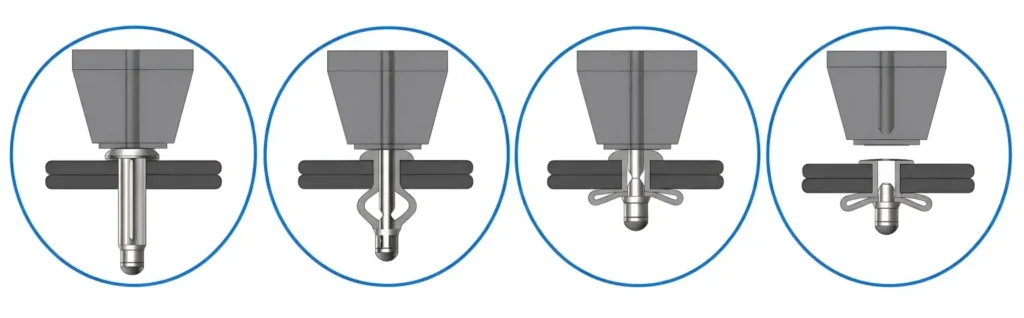
Steps of Blind Rivet Installation
- Insert the rivet into the pre-drilled hole, ensuring that the rivet head sits flush against the workpiece.
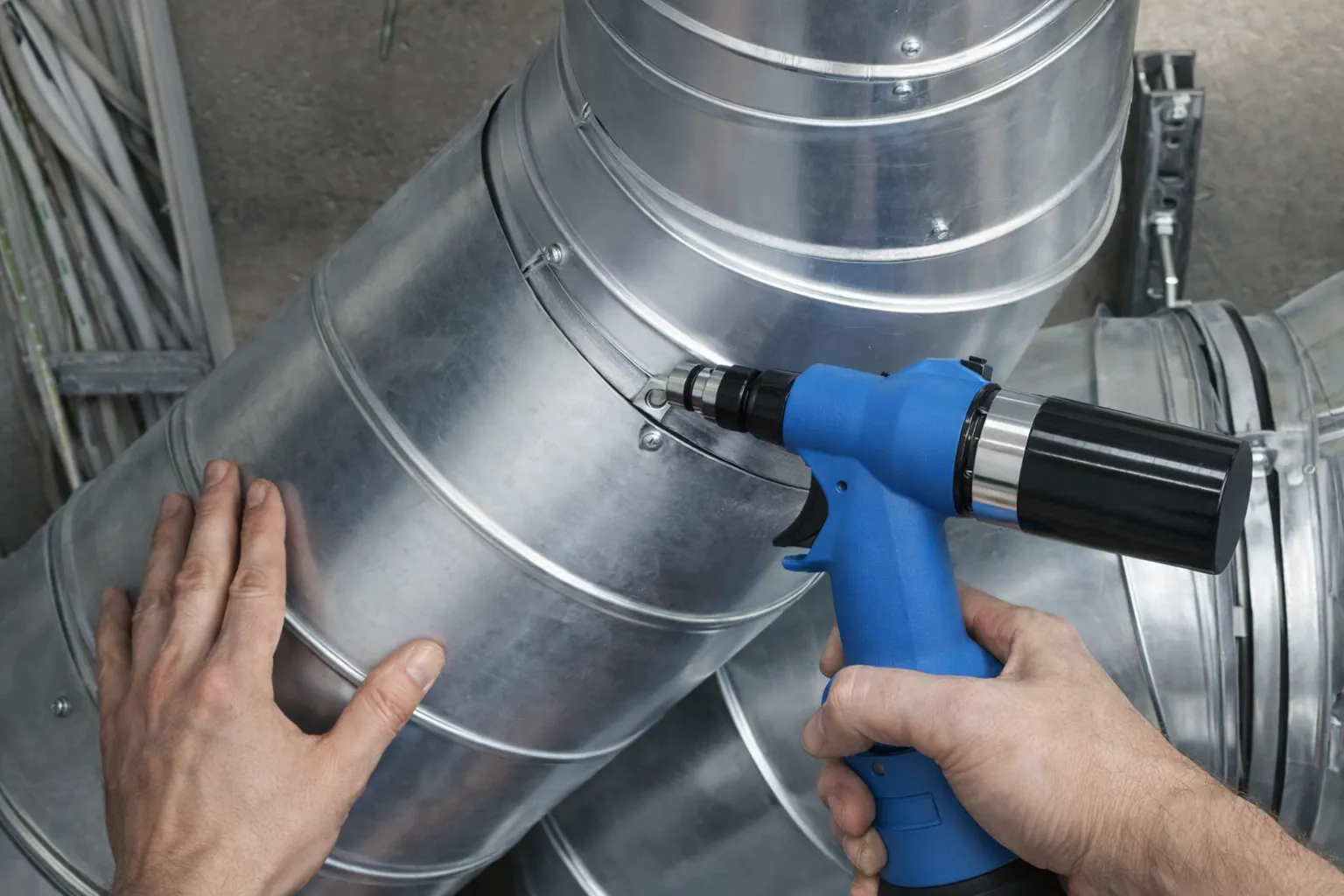
- Place the rivet gun’s nozzle over the rivet mandrel and hold the tool vertically.
- Activate the rivet gun and pull the rivet mandrel to expand the rivet body and secure the workpiece.
- Once the rivet mandrel breaks off, the riveting is complete. Check that the rivet is secure and flush.
Tri Fold Rivets Manufacturing You Can Trust
From aluminum material management to finished product inspection, Rivmate maintains strict control over every stage of the Tri Fold Rivet manufacturing process, including the quality of the rivet body forming, the precision of the mandrel fit, and verification of the three-flap deployment.
- IATF 16949 / ISO 9001-certified factory
- 100% strictly screened materials
- 13 testing procedures, 99.9% pass rate
Rather than focusing solely on product dimensions, we prioritize the actual performance of the rivets after installation, helping to ensure safer and more stable long-term performance in the joining of plastics, fiberglass, composite materials, and thin sheets.
Pop Rivet Cold Heading Machines
Rivet Assembly machines
Our Rivet Warehouse
Stable Bulk Supply for Tri Fold Rivets
To meet the fastening needs of various applications, Rivmate offers bulk supply solutions for Tri Fold Rivets in a wide range of specifications and head types. These rivets are widely used in the assembly of lightweight sheet metal and composite materials.
- A 36,000-square-meter factory
- With a rivet production capacity exceeding 2 billion units
- A 6,000-square-meter warehouse to meet all your rivet needs
Through customized packaging, OEM branding services, batch labeling management, and repeat order coordination, we help our customers establish a more stable, standardized, and reliable fastener supply chain suitable for long-term procurement.
Applications of Tri Fold Rivets
Tri-Fold Rivets are widely used in lightweight assembly applications such as RV trim panels, marine FRP components, HVAC sheet metal assemblies, and plastic housings. If both fastening and sealing functions are required, we recommend using Tri-Firm Blind Rivets (Watertight).
RV & Caravan Manufacturing
Tri-Fold Rivets are suitable for assembling lightweight panels in recreational vehicles. Examples include interior and exterior trim panels, lightweight body panels, and standard non-load-bearing panels. When the joint is exposed to rain, the Tri-Firm Blind Rivet (Watertight) should be considered as the preferred option.
Marine & Boat Components
These aluminum/aluminum tri-fold rivets are commonly used for securing interior components in certain light-duty vessels, fiberglass panels, and non-load-bearing cladding. Once riveted, they form a three-flange expanded structure, which effectively minimizes damage to the holes in the fiberglass.
Electrical Enclosures
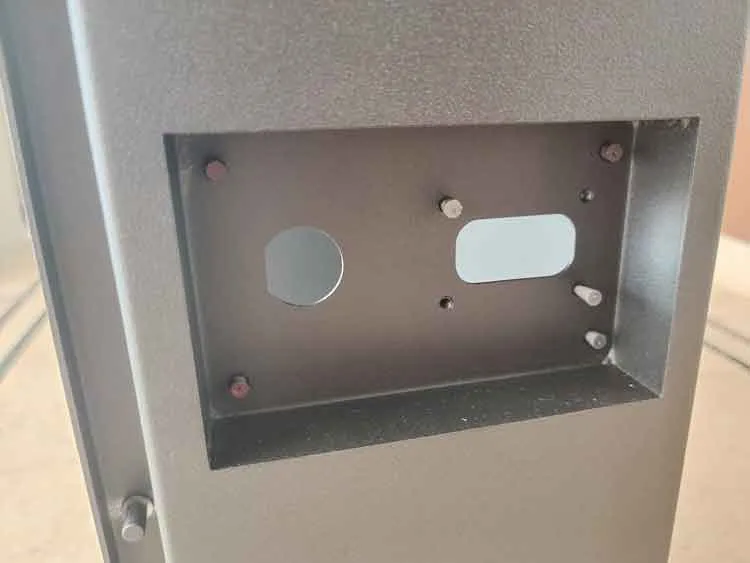
Tri-fold rivets are commonly used to secure lightweight panels, covers, insulating materials, and non-structural components inside electrical enclosures. Their three-fold design enhances rear-side load-bearing capacity and improves overall stability.
HVAC Thin Sheet Parts
HVAC equipment commonly uses components such as sheet metal enclosures, ventilation panels, lightweight covers, and protective guards. These components are typically non-load-bearing structures. Tri-Fold Rivets are suitable for joining certain types of sheet metal and lightweight panels. They can reduce hole deformation and improve rear support capacity.
Plastic Panels
Tri-fold rivets are particularly common in plastic component applications. Once installed, the rivet forms a three-fold structure on the blind side, which increases the contact area and distributes stress around the hole, helping to reduce the likelihood of plastic panels tearing or rupturing.
Get An Instant Quote Now
Where can I find industrial-grade tri fold rivets suitable for heavy-duty applications?
You can purchase industrial-grade Tri-Fold Rivets from a professional blind rivet manufacturing facility.
Rivmate offers Tri-Fold Rivets in a full range of sizes. For larger panels or applications requiring greater fastening stability, you can choose larger sizes such as 6.4 mm or 7.5 mm.
How to choose tri fold rivets for heavy fabric
We recommend selecting Large Flange Tri-Fold Rivets in sizes 5.2 mm, 6.4 mm, or 7.5 mm. If your application requires waterproofing, you may opt for Tri-Firm Blind Rivets (Watertight).
Before making your selection, we recommend carefully considering the fabric thickness, material strength, hole diameter, presence of reinforcement layers, direction of tension, and operating environment.
How to select tri fold rivets with rust-proof coatings for outdoor use
When selecting Tri-Fold Rivets for outdoor applications, it is recommended to prioritize an evaluation of material, corrosion resistance, usage scenarios, and sealing requirements.
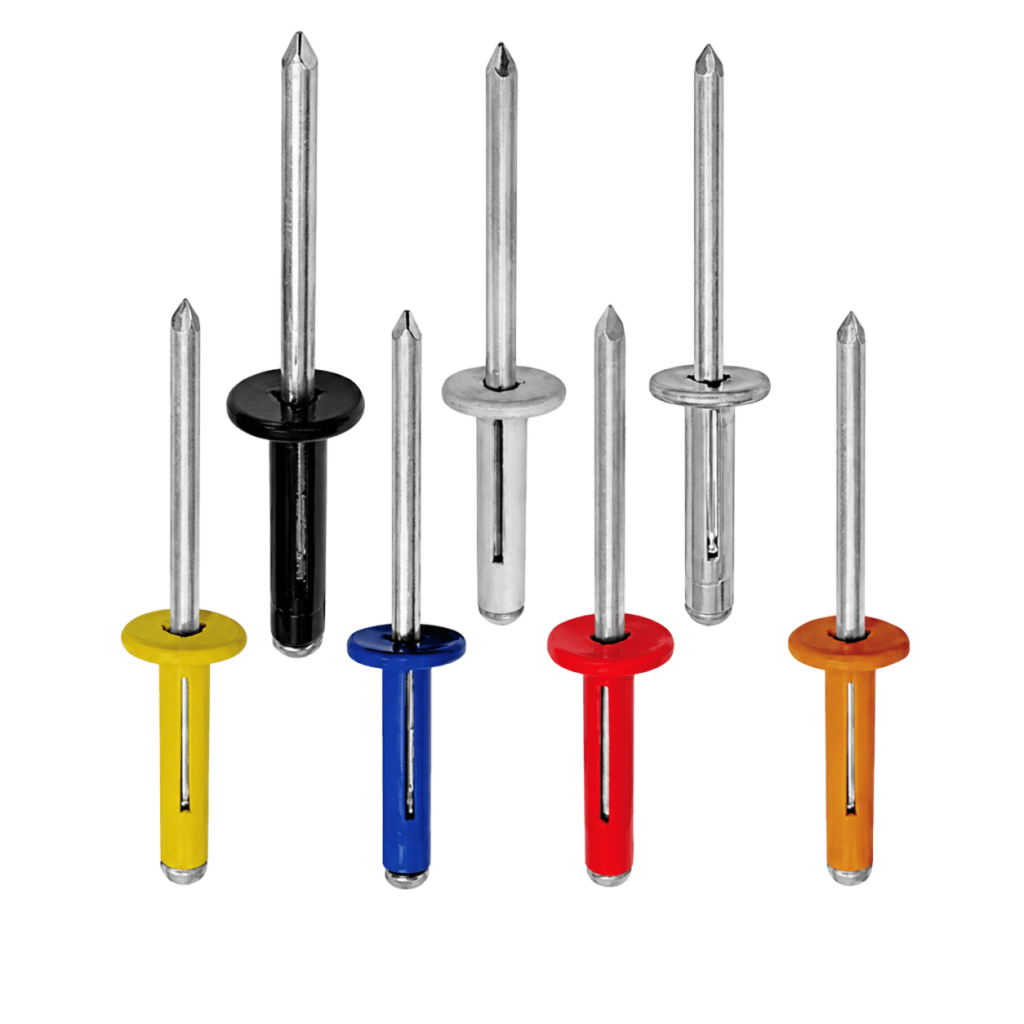
For standard outdoor environments, aluminum/aluminum Tri-Fold Rivets are a suitable choice. Depending on aesthetic and weather resistance requirements, you may select anodized, spray-painted, baked-enamel, or custom-colored coatings. If the application will be exposed to rain, dust, or humid air over an extended period, we recommend using Tri-Firm Blind Rivets (Watertight).
How to determine the correct grip range for tri-fold rivets?
You should first measure the total thickness of all materials to be joined, including the faceplate, backplate, shims, and gaskets.
The actual total thickness must fall within the rivet’s grip range to ensure a stable three-lobe expansion structure after installation.
What tri fold rivet options are recommended for marine applications
- Interior trim panels, plastic covers—Aluminum/Aluminum Tri-Fold Rivets
- FRP panels, FRP components—Large Flange Tri-Fold Rivets
- Composite housings—5.2mm / 6.4mm Tri-Fold Rivets
- Outdoor equipment enclosures, damp locations—Tri-Firm Blind Rivet (Watertight)
- Large-area FRP or composite panels — 6.4mm / 7.5mm Tri-Fold Rivets
Tri Fold Rivets
Let’s learn more about Tri Fold Rivets through this performance test video.
Rivmate Bulbtight Trifirm Blind Rivet: Tensile test
Rivmate Bulbtight Trifirm Blind Rivet: Mandrel retention test
Rivmate Bulbtight Trifirm Blind Rivet: Dimension test
Resource Center
Access helpful materials to support your project planning and product selection. Download documents for reference and on-site use.
Rivet Catalog
Browse our full blind rivet catalog including product types, specifications, and application examples.I am Trailer Box Description Text. You can change me anytime from settings.
Open End Blind Rivet Drawing
Download the technical drawings for the rivets, which include dimensions, internal structure, and basic product information
What are tri-fold rivets
This is a pop rivet that provides a larger back-face support area through a three-lobed expansion design.
By increasing the load-bearing area, it reduces material damage caused by localized riveting pressure. It prevents issues such as hole tear-through, cracking, and localized deformation. It is suitable for assembling soft materials, thin sheets, fiberglass-reinforced plastic (FRP), and composite materials.
What are tri-fold blind rivets used for?
1. For connecting plastic panels
Tri-Fold Blind Rivets are specifically designed for joining soft or brittle materials and are widely used on plastic panels such as ABS, PP, and PVC. Their unique three-flap design creates a larger support area on the blind side, which helps distribute installation stress more effectively than traditional rivets and protects the plastic substrate from damage.
2.For joining FRP components
Because fiberglass-reinforced plastic (FRP) is relatively brittle and rigid, issues such as chipping at the hole edges or crack propagation often occur during drilling and riveting. Tri-Fold Blind Rivets feature a three-petal deployment design that increases the load-bearing area on the back side and reduces stress concentration at the hole location, making them an ideal choice for joining FRP components.
3. For joining composite materials and sandwich panels
Composite panels are typically sensitive to stress at connection points during installation, making them prone to issues such as surface delamination, localized deformation, or poor fastening. The unique three-fold design of Tri-Fold Rivets creates a wider load-bearing surface on the back side, helping to distribute the load evenly and reduce the risk of material damage.
Comparison of pop rivets and tri-fold fasteners.
| Comparison Item | Pop Rivets | Tri-Fold Fasteners / Tri-Fold Rivets |
|---|---|---|
| 1. Blind-Side Formation | Usually forms a standard bulb or compressed deformation on the blind side after installation. | Forms a three-leg expansion structure on the blind side after installation. |
| 2. Blind-Side Bearing Area | Provides a relatively small bearing area, with stress concentrated around the hole. | Provides a wider blind-side support area, helping distribute load more evenly. |
| 3. Pull-Through Resistance | May cause pull-through when used on plastic, thin sheets, fiberglass, or soft materials. | Better suited for reducing pull-through risk in soft materials, thin sheets, and composite panels. |
| 4. Suitable Materials | More suitable for general metal sheets, sheet metal parts, and standard industrial fastening. | More suitable for plastic, fiberglass, composite panels, sandwich panels, and soft materials. |
| 5. Hole Protection | May cause hole deformation, surface dents, or cracking due to concentrated stress. | Helps reduce stress concentration around the hole and lowers the risk of cracking or local deformation. |
| 6. Hole Tolerance | Requires more accurate hole matching; oversized holes may lead to loose fastening. | More forgiving for slightly oversized holes, especially when used with a large flange head. |
| 7. Installation Method | Supports one-side installation and offers fast assembly efficiency. | Also supports one-side installation, making it suitable for structures where backside access is not available. |
| 8. Typical Applications | Metal sheet fastening, equipment housings, sheet metal assembly, and general industrial fixing. | RV panels, marine fiberglass parts, plastic panels, composite sheets, electrical enclosures, and signage panels. |
| 9. Waterproof Performance | Standard open-end pop rivets have limited sealing performance; closed-end types are better for sealing needs. | Standard Tri-Fold Rivets focus on pull-through resistance; for waterproof needs, Tri-Firm Blind Rivet (Watertight) is recommended. |
| 10. Selection Logic | Best for cost-sensitive applications, general metal fastening, and standard assembly work. | Best for solving pull-through, cracking, hole deformation, and unstable fastening in soft material applications. |
Installation steps for three-pronged fasteners.
Tri-Fold Rivets utilize a unique expansion and locking mechanism. Unlike traditional pop rivets, which create only a small expansion zone on the back side, Tri-Fold Rivets cause the tail of the rivet body to expand outward during the setting process. The three-flap design allows the rivet to conform closely to the blind side of the material, thereby creating a larger load-bearing surface.