Both pop rivets and rivet nuts are installed from a single side. Pop rivets provide a permanent, non-removable connection, whereas rivet nuts provide reusable threads.
This article compares pop rivets and rivet nuts from various perspectives to help you choose the most suitable fastening solution.
What Is a Rivet Nut?
A rivet nut is an internally threaded fastener that can be installed from one side of the workpiece. It is also known as a blind rivet nut, Nutsert, or Rivnut.
Rivet Nut Structure and Components
1. Head
Once installed, the head of the rivet nut sits flush against the front surface of the panel, preventing it from sliding further into the mounting hole.
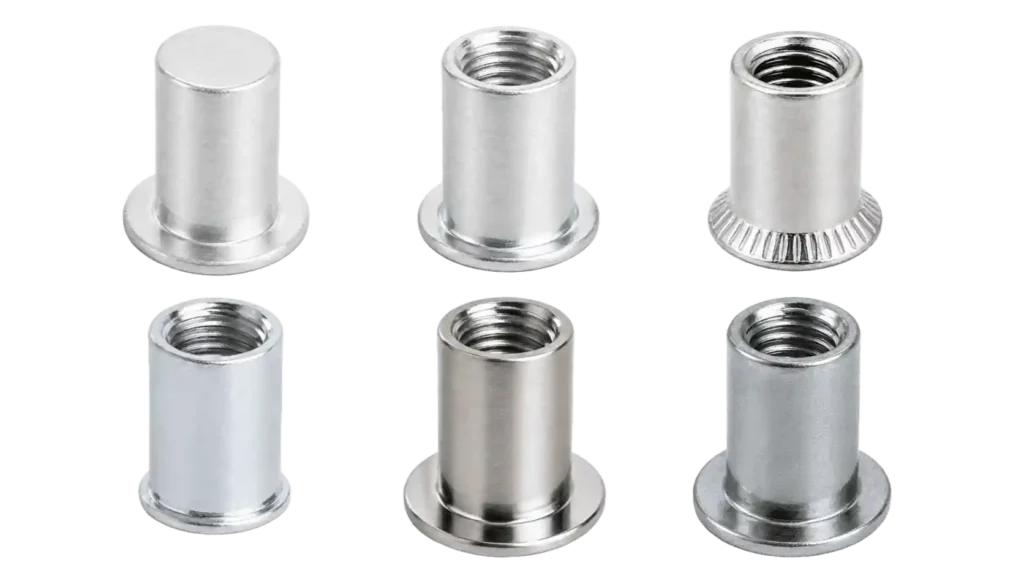
Common head types for rivet nuts include flat head, reduced head, and countersunk head.
2. Body or Shank
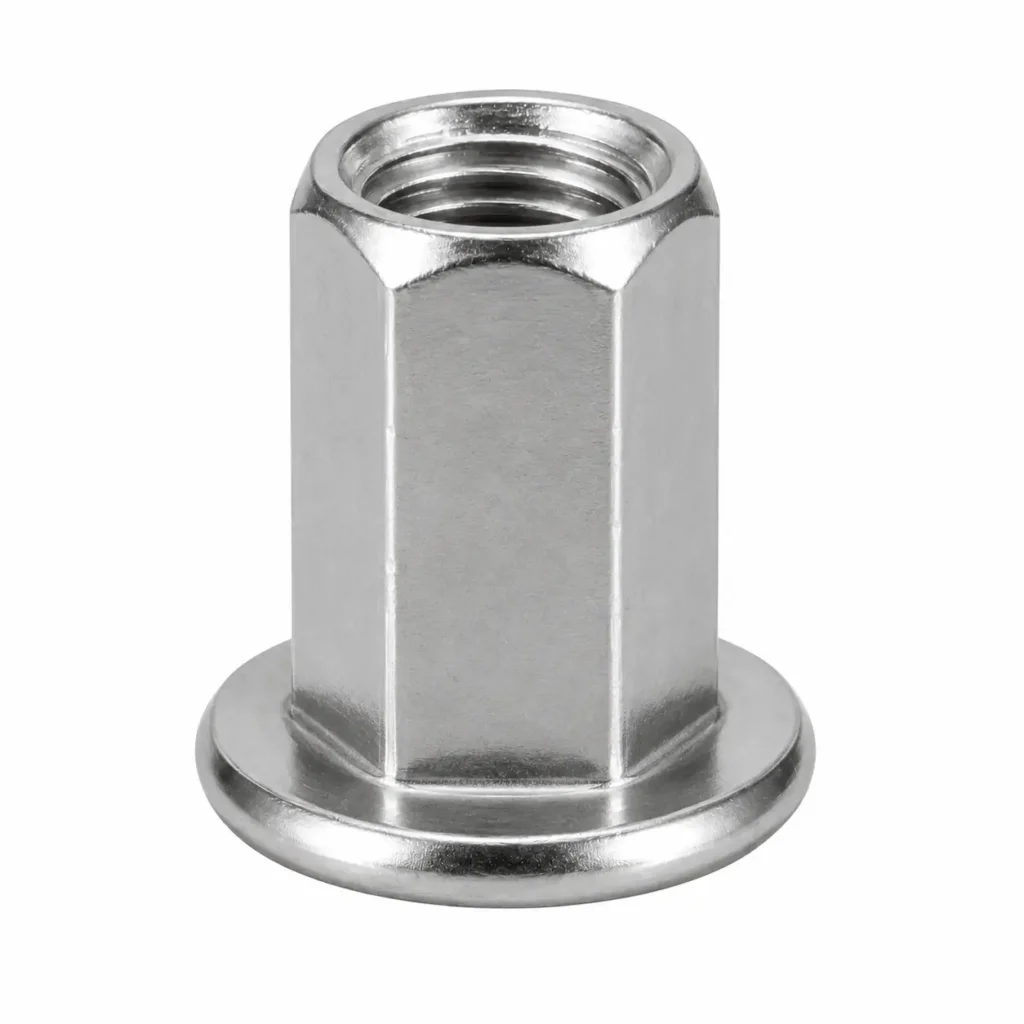
The nut body is the primary section inserted into the installation hole. Its shape influences the blind rivet nut’s resistance to rotation within the hole. Common shapes include smooth round bodies, knurled round bodies, half-hexagonal bodies, and fully hexagonal bodies.
3. Deformation Zone
The deformation zone is the area of the rivet nut designed to deform; upon installation, this section undergoes axial compression against the back of the panel and bulges outward.The dimensions of the deformation zone determine the rivet nut’s grip range.
4. Internally Threaded Section
The internal thread is used to connect to the threaded mandrel of the installation tool. Common thread specifications include M4, M5, M6, M8, and M10.
5. Open-End or Closed-End Design
Blind rivet nuts come in two tail configurations: open-end and closed-end. With open-end rivet nuts, the bolt can pass through the nut, whereas with closed-end rivet nuts, the bolt cannot pass through.
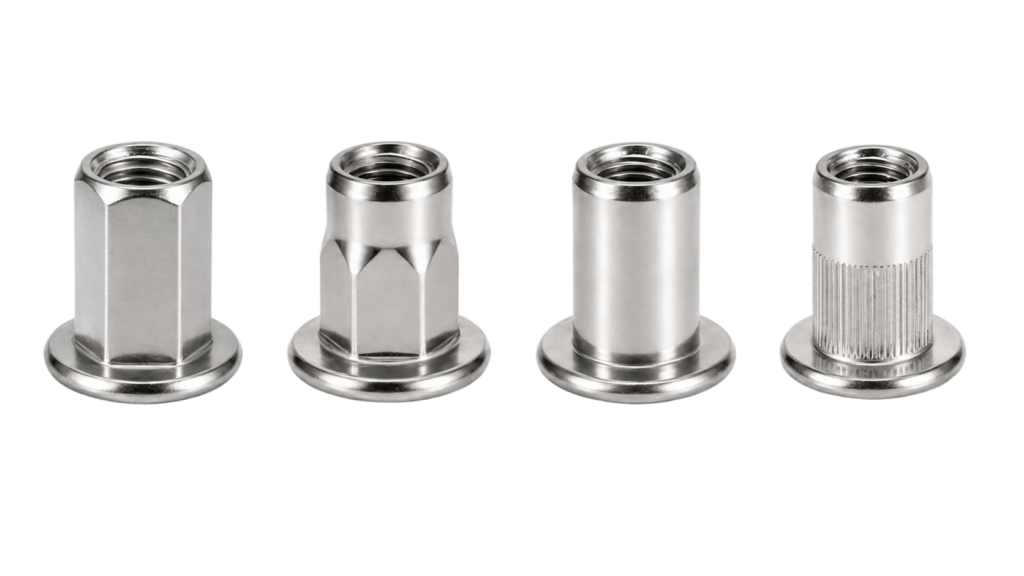
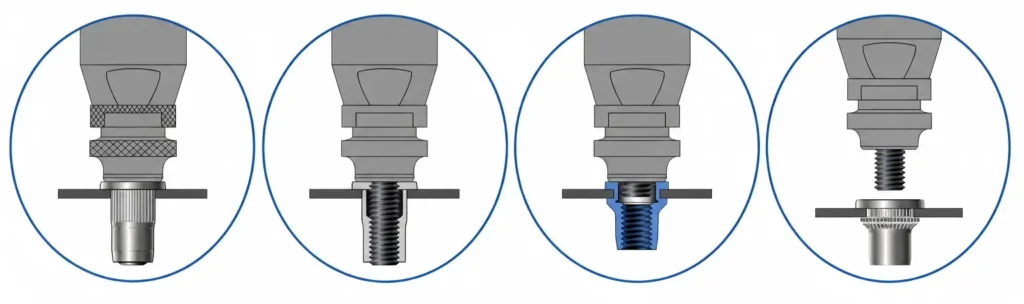
How Does a Rivet Nut Work?
Step 1: Prepare the Installation Hole
Step 2: Thread the Rivet Nut onto the Tool
Step 3: Insert the Rivet Nut into the Hole
Step 4: Pull and Deform the Body
Step 5: Stop at the Correct Setting Force
Step 6: Unscrew the Tool Mandrel
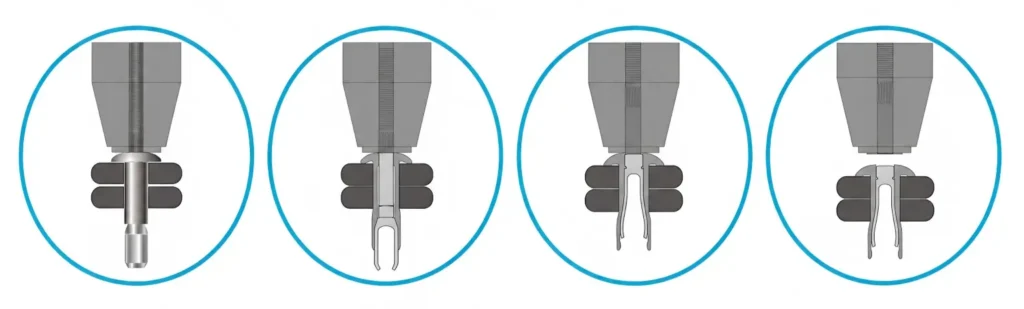
What Is a Pop Rivet?
A pop rivet is a mechanical fastener capable of permanently joining two or more layers of sheet material from a single side of the workpiece.
Pop Rivet Structure and Components
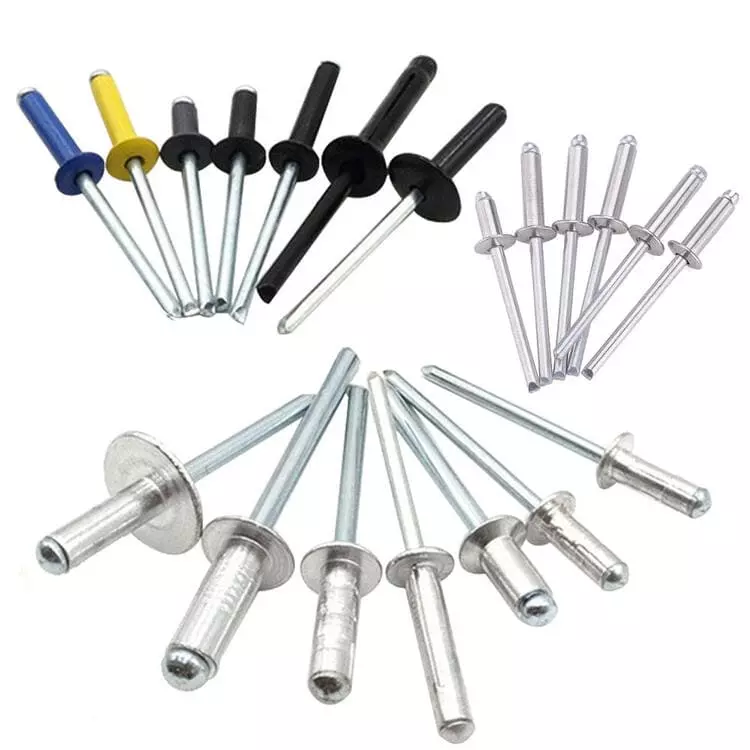
1. Rivet Head
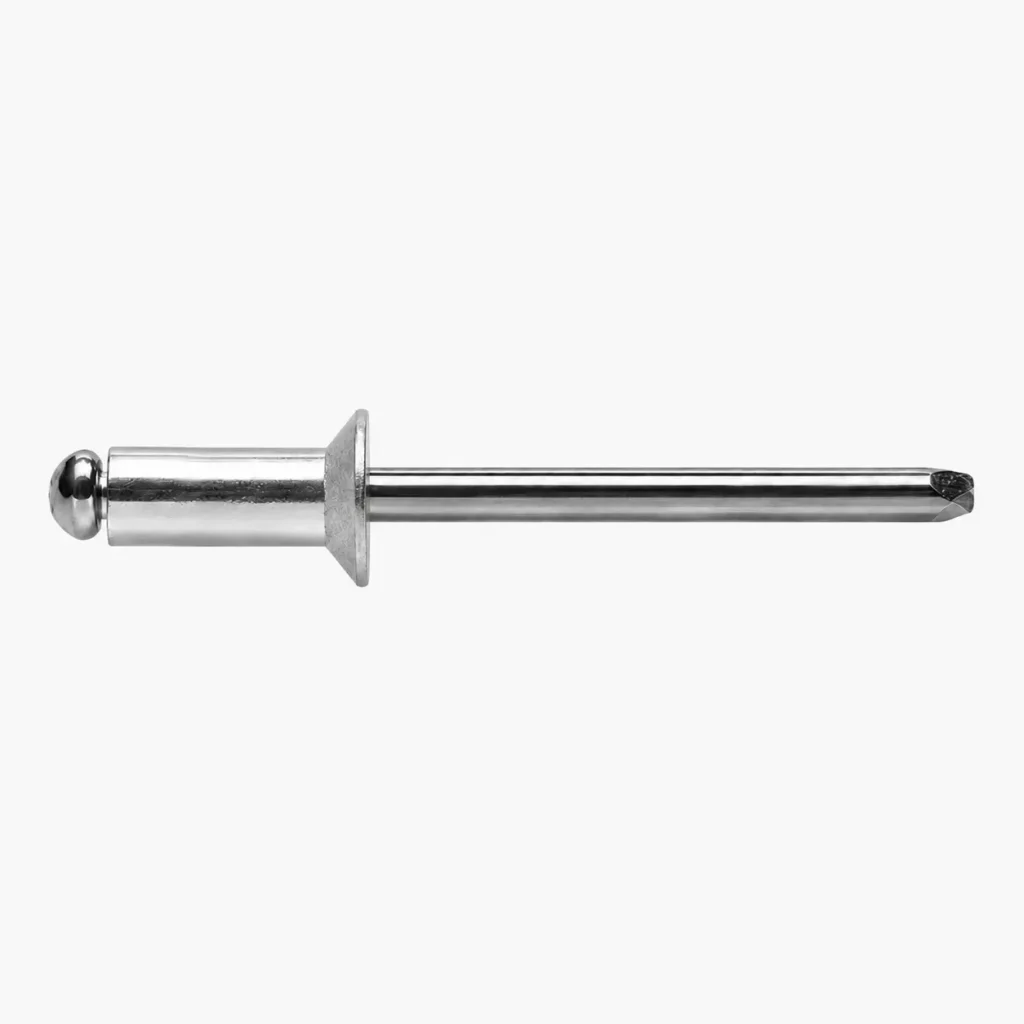
The rivet head sits against the front surface of the workpiece, preventing the rivet from passing completely through the mounting hole. Common rivet head types include round heads, countersunk heads, and large flange heads.
2. Rivet Body
The rivet body is the main part of a pop rivet that remains in the workpiece after installation.During the riveting process, the tail of the rivet body undergoes plastic deformation due to the action of the mandrel head.
3. Mandrel Stem
The stem is the slender section gripped by the riveting tool during installation. Once riveting is complete, the majority of the stem breaks off from the rivet body and is removed by the tool.
4. Mandrel Head
The mandrel head is located at the tail end of the mandrel. During the riveting process, the mandrel head causes the rivet body to expand and fold, forming a closed head on the back side of the workpiece.
5. Break Point
The designated breaking point on the core rod can also be referred to as a fracture groove. As the tensile force continues to increase, the core rod will break at this location.

How Does a Pop Rivet Work?
Step 1: Prepare the Installation Hole
Step 2: Select the Correct Grip Range
Step 3: Insert the Rivet into the Workpiece
Step 4: Place the Rivet Tool over the Mandrel
Step 5: Pull the Mandrel
Step 6: Form the Blind-Side Closing Head
Step 7: Break the Mandrel
Step 8: Complete the Permanent Joint
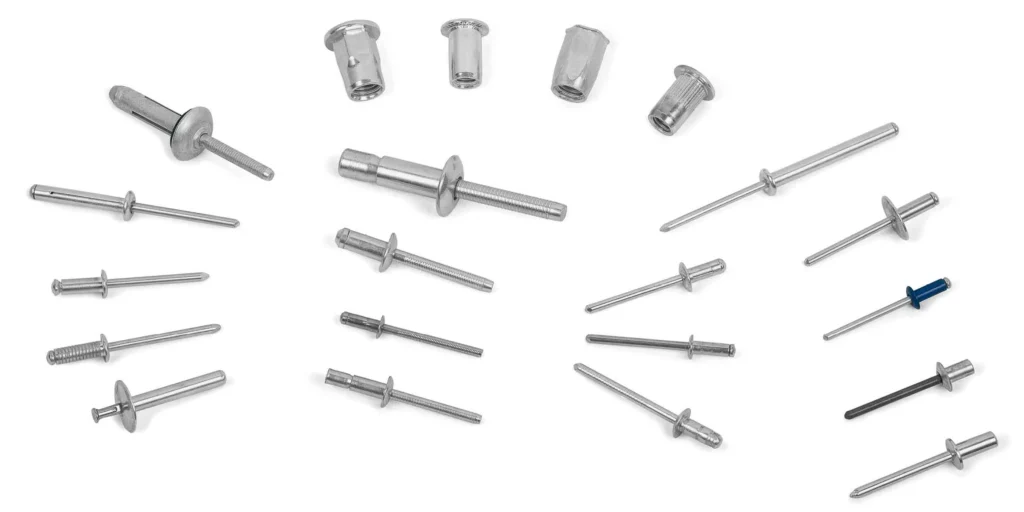
Rivet Nut Vs Pop Rivet Comparison Table
| Comparison Item | Rivet Nut | Pop Rivet |
|---|---|---|
| Primary Function | Creates an internal thread in thin sheets or enclosed structures. | Permanently joins two or more layers of material. |
| Connection Method | Requires a mating bolt to secure the component after installation. | Directly clamps the connected materials after installation. |
| Internal Thread | Provides a reusable internal thread. | Does not provide an internal thread. |
| One-Sided Installation | Yes. Access to the rear side of the workpiece is not required. | Yes. Access to the rear side of the workpiece is not required. |
| Disassembly | The mating bolt can be removed and reinstalled repeatedly. | Cannot be removed directly and normally must be drilled out. |
| Installation Principle | The rivet nut body collapses behind the sheet and clamps the material. | The rivet body deforms behind the sheet to form a blind-side closing head. |
What Is the Difference Between a Rivet Nut and a Pop Rivet?
1. Different primary functions
The primary function of a rivet nut is to create a secure internal thread on a sheet material, facilitating the repeated removal and reinstallation of bolts.
The function of a pop rivet is to directly join two or more layers of material together.
2. Different connection methods
The installation of a rivet nut involves two stages: first, the rivet nut itself is installed; second, a bolt is passed through the component to be mounted and threaded into the rivet nut.
A pop rivet is inserted directly through the layers of material; the riveting process is then performed, completing the connection.
3. Differences in disassembly
The mating bolt of a rivet nut can be unscrewed directly, allowing the panel to be reinstalled.
Pop rivets constitute a permanent mechanical connection; removing them requires destroying the rivet.
4. Different installation principles
When installing a rivet nut, the threaded mandrel of the tool is first screwed into the nut’s internal threads. The tool then pulls the mandrel outward. This causes the deformation zone of the rivet nut to compress axially and bulge outward against the back of the panel.
When installing a pop rivet, the rivet body is first inserted through the panel. The riveting tool grips the mandrel and pulls it backward. The head of the mandrel forces the tail of the rivet body to expand or fold against the back of the workpiece, forming a closed head on the reverse side.
5. Different assembly requirements
Rivet nuts are suitable when:
- Parts require periodic disassembly
- Access panels need to be installed
- Threads need to be created in thin sheet metal
- Standard nuts cannot be placed on the reverse side
- Handles, brackets, seats, or equipment accessories need to be installed
- Components may need replacement later
Pop rivets are suitable when:
- Two or more layers of material need to be permanently joined
- Frequent disassembly is not required later
- Installation is only possible from one side of the workpiece
- High-volume assembly speed is required
- A reduction in additional parts like nuts and bolts is desired
- The components being joined are primarily thin sheets, housings, air ducts, or covers
Rivet Nut Vs Pop Rivet Strength
Rivet nuts and rivets serve different purposes and operate on different principles; their strengths cannot be directly compared.
“Strength” of Rivet Nuts:
1. Pull-out resistance: When a bolt is subjected to outward pulling force, the rivet nut may be pulled out of the installation hole. Pull-out resistance refers to the nut’s ability to withstand this type of failure.
2. Spin-out resistance: During bolt tightening or removal, insufficient engagement between the rivet nut and the panel can cause the nut to rotate along with the bolt. Spin-out resistance refers to the nut’s ability to resist this rotation.
3. Internal thread and bolt strength: In a rivet nut assembly, the internal threads may suffer wear or deformation, while the bolt may fail due to tension or shear. A larger thread size does not necessarily guarantee a more stable connection.
4. Base material load-bearing capacity:
This refers to situations where the rivet nut remains intact, but the surrounding panel deforms or sustains damage. Such issues can result from various factors, including the engagement between the nut and the hole wall, the condition of the internal threads, or the bolt itself.
“Strength” of Pop Rivets
1. Shear strength: Shear strength represents the ability of the fastener to resist the sliding of joined sheets against each other along the interface.
2. Tensile strength: Tensile strength represents the ability of the pop rivet to resist the separation of two layers of material pulled apart along the axis of the rivet.
In summary, the strength of rivet nuts and rivets cannot be determined by a single parameter; rather, it is the result of a combination of factors. In practical applications, an accurate assessment of connection strength and suitability requires a comprehensive evaluation across multiple dimensions, including product dimensions, material properties, riveting range, head design, and structural characteristics.
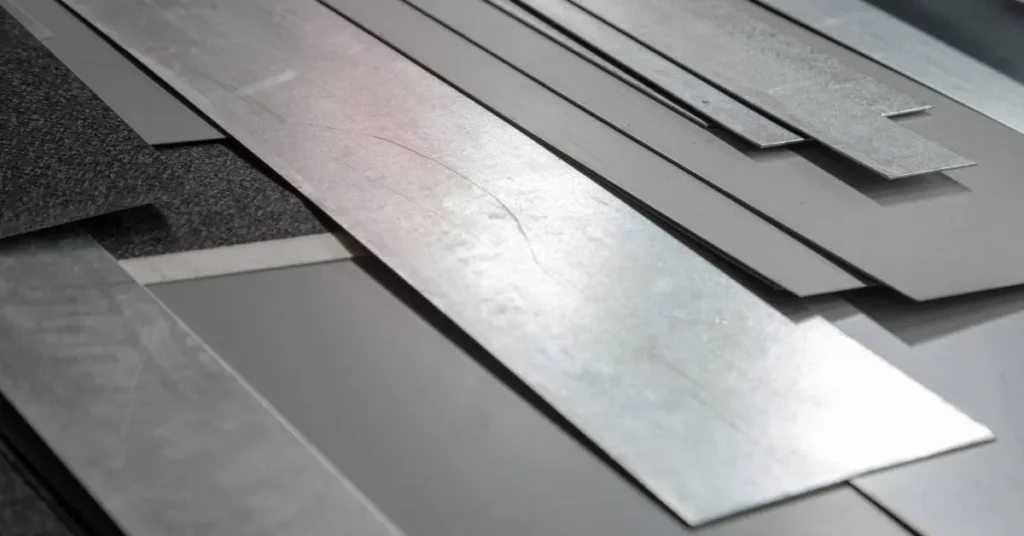
Rivet Nut Vs Pop Rivet for Thin Sheet Metal
First, determine whether your sheet metal requires a detachable connection or a permanent one.
Choose rivet nuts for detachable connections.
Choose pop rivets for permanent connections.
When selecting rivet nuts for thin sheets requiring a removable connection, focus on the following:
- Head style: Choose a flat head to distribute surface pressure over a larger area.
- Grip range: Ensure it covers the actual thickness of the thin sheet.
- Installation stroke or pulling force: Avoid excessive pulling force to prevent damaging the sheet material.
When selecting pop rivets for a permanent connection, focus on the following:
- Flange size: Choose a large flange to increase the bearing surface area, making it suitable for thin sheets.
- Rivet diameter: A medium diameter range is appropriate for thin sheets.
- Rivet type: Standard pop rivets are suitable for thin sheets; however, structural pop rivets should be chosen for high-vibration environments.
When Should You Use a Rivet Nut?
1. When reliable threads cannot be directly tapped into thin sheet metal
If the sheet is too thin, standard tapping cannot produce an internal thread of sufficient length. Installing a rivet nut creates a metal attachment point with a full internal thread on the thin sheet.
2. When the back side of the workpiece is inaccessible
Rivet nuts allow for single-sided installation; the installer only needs access to the front of the workpiece.
3. When parts require future disassembly or replacement
The rivet nut body is secured to the sheet metal, allowing for frequent disassembly; only the mating bolt needs to be removed during maintenance.
4. When weld nuts are unsuitable
While weld nuts also provide internal threads on sheet metal, rivet nuts are a suitable alternative when welding is not feasible, as they do not require melting the base material.
When Should You Use a Pop Rivet?
1. When installation is possible from only one side of the workpiece
Pop rivets are fasteners designed for single-sided installation. They allow for installation without requiring access to the rear of the workpiece for tools, nuts, or backing plates.
2. When permanently joining multiple layers of material
Pop rivets offer a convenient solution for permanently joining multiple layers of material, eliminating the need for rivet nuts or bolts.
3. When high-volume assembly efficiency is required
Pop rivets simplify the installation process by eliminating the need for rivet nuts or bolts, thereby significantly boosting production efficiency.
4. When welding is unsuitable
Pop rivet installation does not require melting the base material, avoiding the formation of a heat-affected zone and minimizing impact on the material.
5. When minimizing the risk of loosening due to vibration is necessary
Standard threaded connections may loosen under continuous vibration; selecting vibration-resistant pop rivets helps mitigate this risk.
6. When dust resistance or sealing capabilities are required
Closed-end rivets help prevent the ingress of moisture and liquids; when paired with sealing washers or sealants, they provide effective sealing performance.
How to Choose Between a Rivet Nut and a Pop Rivet
Whether using rivet nuts or pop rivets, a correct choice is essential to ensure a stable connection. Selection should take multiple factors into account to guarantee compatibility.
How to Choose a Rivet Nut
1. Confirm thread specifications: M4, M5, M6, M8, M10, M12.
The thread diameter and pitch of the rivet nut must match those of the bolt.
2. Confirm base material thickness.
Determine the thickness of the base plate to select the appropriate grip range.
3. Select the appropriate nut body shape: smooth round, knurled round, semi-hexagonal, or full-hexagonal.
Choose the shape based on the required torque resistance for the application.
4. Select the appropriate head style: flat head, reduced head, or countersunk head.
Choose the head style based on aesthetic requirements and the need for surface load-bearing and pull-through resistance.
5. Select the material based on load requirements: aluminum, steel, or stainless steel.
Aluminum is lightweight and suitable for soft or thin materials; stainless steel and steel are better suited for higher load-bearing capacities.

How to Choose a Pop Rivet
1. Determine the total thickness of the materials to be joined
When joining two or more sheets, the grip length (clamping thickness) should be the sum of the individual sheet thicknesses.
2. Select the rivet diameter based on the load: 2.4mm, 3mm, 3.2mm, 4mm, 4.8mm, 6.4mm
For lighter loads, choose smaller diameter pop rivets (e.g., 2.4mm, 3.2mm).
For heavier loads, choose larger diameter pop rivets (e.g., 4.8mm, 6.4mm).
3. Select rivet body and mandrel materials: Aluminum, Stainless Steel, Steel, Monel, Copper
Choose the material based on the application environment, weight requirements, load-bearing capacity, and corrosion resistance.
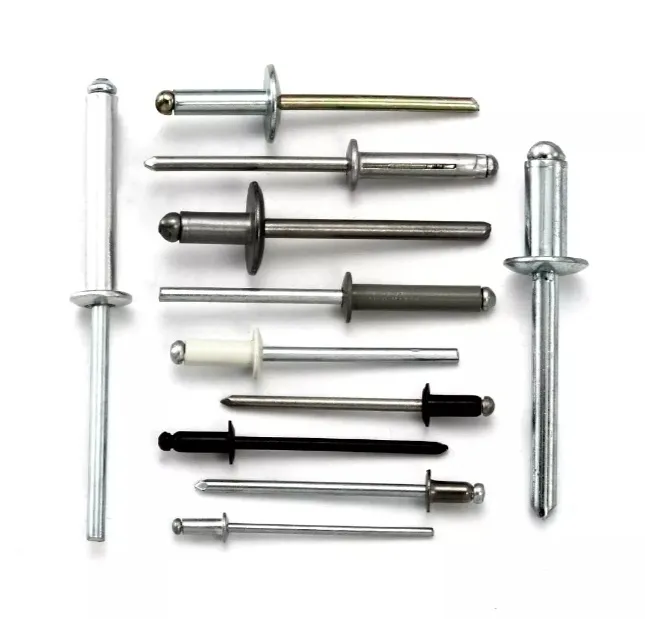
4. Select the head style based on the application: Dome Head, Large Flange Head, Countersunk Head
Dome head: Suitable for general industrial assembly.
Large Flange Head: Increases the bearing surface area on the front side.
Countersunk Head: Suitable for applications requiring a flush surface finish.
5. Select the rivet structure based on operating conditions
Different environments require different rivet types.
Open-end pop rivets: Suitable for joining standard thin sheets.
Closed-end pop rivets: Suitable for applications requiring a seal against moisture or dust ingress.
Multi-grip pop rivets: Suitable for assemblies with varying material thicknesses.
Structural pop rivets: Suitable for applications involving high shear, tensile, or vibration loads.
6. Check installation hole size and location
Remove significant burrs from the installation hole. Ensure the hole diameter is neither too large nor too small.
7. Select the installation tool: Manual, electric, pneumatic, or hydropneumatic equipment
Small-sized pop rivets are suitable for manual tools. Large-sized, high-strength rivets are suitable for electric or pneumatic tools.
Rivet Nut Vs Pop Rivet Cost
Quick Cost Comparison: Rivet Nut Vs Pop Rivet
| Cost Item | Rivet Nut | Pop Rivet |
|---|---|---|
| Unit Fastener Cost | Higher | Lower for standard pop rivets |
| Additional Components | Requires a mating bolt, and some joints also require washers. | No additional nut or bolt is required. |
| Installation Steps | Install the rivet nut first, then secure the component with a bolt. | The connection is completed immediately after riveting. |
| Installation Tool | The tool is more complex and requires a matching threaded mandrel. | A standard pop rivet gun has a simpler structure. |
| High-Volume Assembly Cost | Depends on rivet nut installation speed and subsequent bolt assembly efficiency. | Lower for high-volume permanent assembly. |
| Disassembly Cost | The mating bolt can be removed and reinstalled. | The rivet must be drilled out and replaced. |
| Maintenance Cost | More economical for locations requiring servicing or component replacement. | Higher when frequent disassembly is required. |
| Best Overall Value | More economical for removable threaded connections. | More economical for permanent sheet-metal connections. |
Rivet Nut Vs Pop Rivet Vs Bolt Vs Welding
| Comparison Item | Rivet Nut | Pop Rivet | Bolt | Welding |
|---|---|---|---|---|
| Primary Function | Creates an internal thread in thin sheet material. | Permanently joins two or more layers of material. | Clamps components together through a threaded connection. | Creates a metallurgical bond between materials. |
| Removability | The mating bolt can be removed and reinstalled. | Cannot be removed directly and generally must be drilled out. | Can be removed and reinstalled repeatedly. | Generally cannot be removed without damaging the joint. |
| One-Sided Installation | Yes. | Yes. | A standard bolt-and-nut connection generally requires access to both sides. | Depends on the welding process and joint location. |
| Internal Thread | Yes. | No. | Requires a nut or an existing threaded hole. | No. |
| Heat Effect | No welding-related heat effect. | No welding-related heat effect. | No welding-related heat effect. | Produces heat effects, depending on the welding process. |
| Additional Fasteners Required | Requires a mating bolt. | No additional fastener is required. | Often requires a nut, washer, or threaded hole. | No mechanical fastener is required. |
| Suitability for Thin Sheet | Suitable for creating a threaded mounting point. | Suitable for permanent sheet-metal joints. | Hole-edge strength and rear-side installation space must be considered. | Thin sheet may experience burn-through or thermal distortion. |
| Typical Applications | Access panels, handles, brackets, and removable components. | Ductwork, enclosures, cover panels, and sheet-metal assemblies. | Mechanical structures, equipment installation, and adjustable connections. | Frames, sealed structures, and continuous joints. |
Common Mistakes When Choosing Rivet Nuts or Pop Rivets
1. Failure to determine the purpose of the connection beforehand
Rivet nuts are used to provide internal threads.
Pop rivets are used to directly clamp two or more layers of material together.
2. Focusing only on diameter while ignoring the grip range
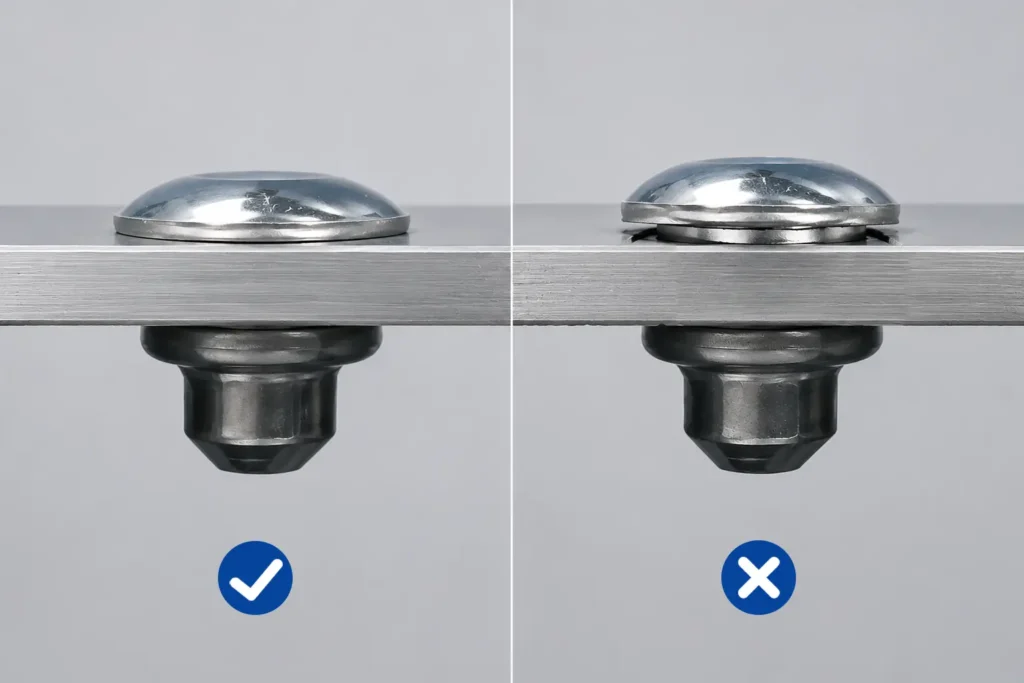
If the sheet thickness falls outside the specified grip range, it can lead to issues such as a loose joint or abnormal bending of the rivet body.
3. Ignoring installation hole size and type
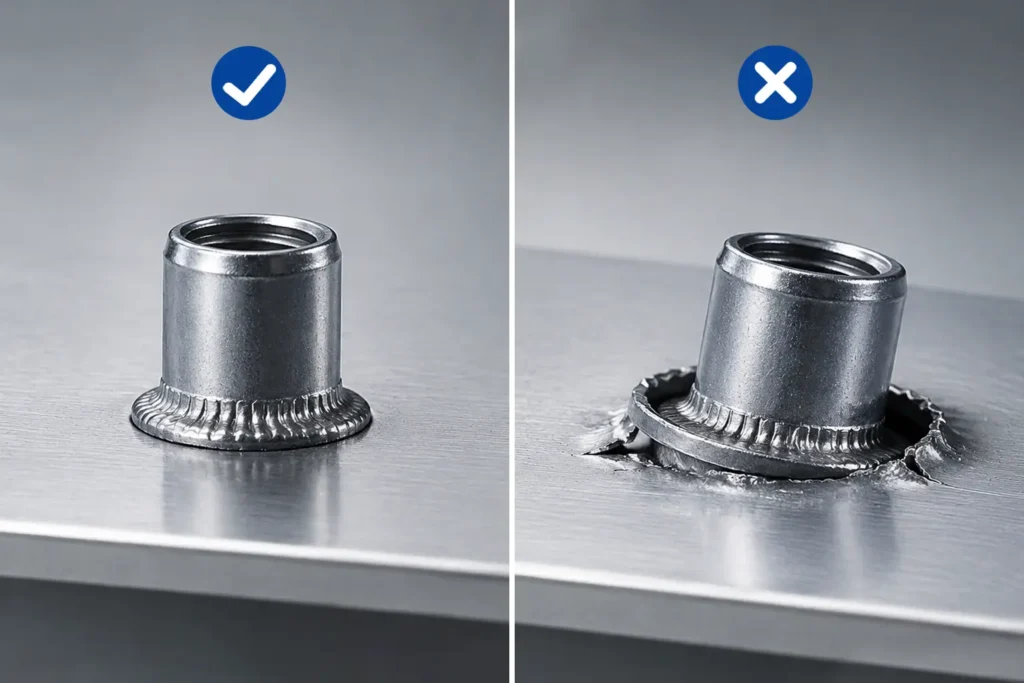
Holes that are too large or too small, or hole types that do not match, compromise connection stability, leading to problems like loosening, misalignment, or spinning.
4. Assuming larger dimensions automatically mean a stronger connection
The strength of rivet nuts and rivets depends on multiple factors; size alone is not a reliable indicator of strength.
5. Comparing only fastener strength while ignoring sheet material strength
Selection must consider both fastener strength and the strength of the sheet material; otherwise, the fastener might pull through the sheet.
6. Choosing unsuitable material combinations
Material selection must account for the operating environment and the sheet material itself—for example, avoiding materials prone to corrosion in highly corrosive environments.
7. Using the wrong head style for thin sheets or soft materials
An incorrect head style can cause the rivet head to pull through the sheet material; the appropriate head style must be selected.
8. Ignoring the rivet nut’s resistance to rotation
Overlooking this can cause the rivet nut to spin along with the bolt during tightening, resulting in connection failure.
9. Applying excessive torque to the bolt in a rivet nut
Higher bolt torque is not always better; mismatched torque can damage internal threads and cause stripping.
10. Mistaking standard open-end pop rivets for waterproof rivets
Standard pop rivets cannot provide a 100% watertight seal. To improve water resistance, options include using closed-end pop rivets, sealing rings, sealants, or surface waterproofing treatments.
How to Choose a Rivet Nut and Pop Rivet Manufacturer
- Verify the completeness of product specifications
- Focus on checking raw materials and batch traceability
- Check for stability in the manufacturing process
- Confirm the manufacturer possesses the necessary testing capabilities
- Conduct sample validation prior to volume procurement
- Evaluate batch consistency, not just sample quality
- Assess capabilities regarding product customization and engineering support
- Evaluate production capacity, lead times, and continuity of supply
- Do not select a supplier based solely on the lowest price quote
Information Required for a Rivet Nut or Pop Rivet Quotation
The more complete the inquiry information, the faster and more accurate the quotes you receive will be. This minimizes back-and-forth communication and prevents suppliers from basing their quotes solely on appearance or approximate dimensions.
Rivet Nut Inquiry Template
- Product:
- Thread Specification:
- Base Plate Thickness:
- Workpiece Material:
- Nut Material:
- Body Shape:
- Head Type:
- Tail Type:
- Installation Hole:
- Surface Treatment:
- Bolt Tightening Torque:
- Operating Environment:
- Purchase Quantity:
- Packaging Requirements:
Pop Rivet Inquiry Template
- Product:
- Type:
- Rivet Diameter:
- Total Material Thickness:
- Workpiece Material:
- Rivet Body Material:
- Mandrel Material:
- Head Style:
- Installation Hole Diameter:
- Operating Environment:
- Load Requirements:
- Tooling:
- Order Quantity:
- Packaging Requirements:
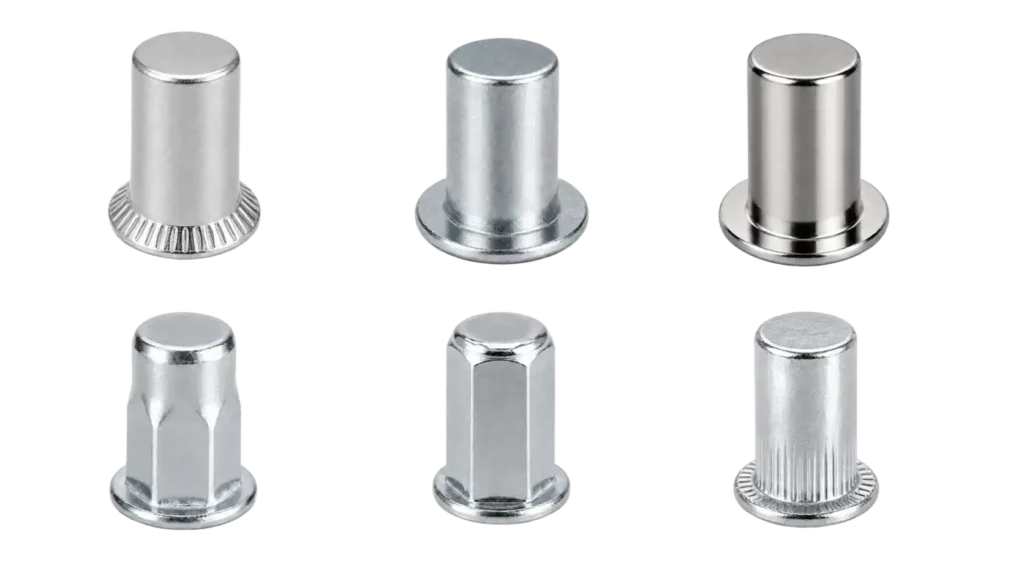
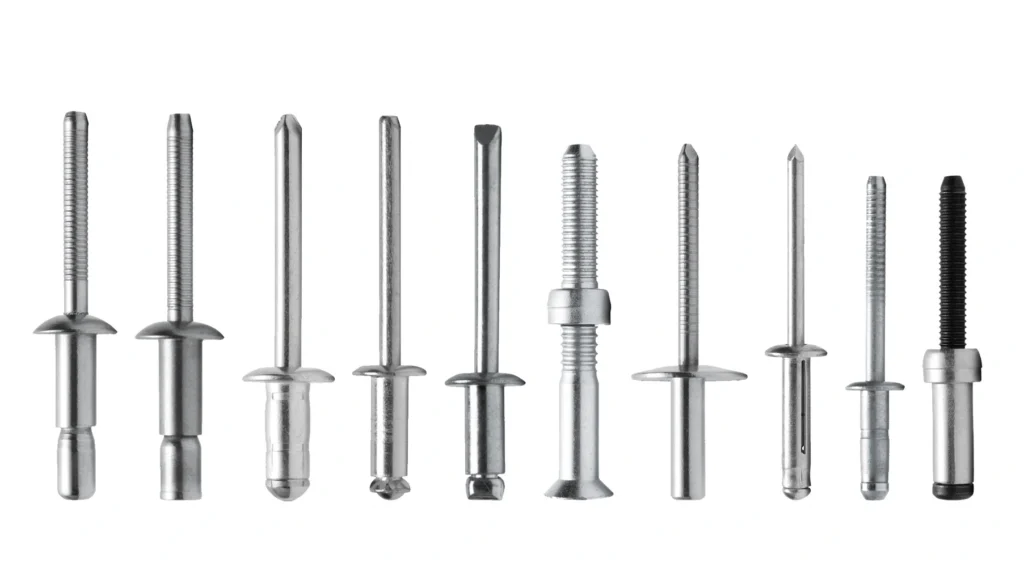
Rivmate Rivet Nut and Pop Rivet Manufacturing Capabilities
Rivmate operates a production and quality management facility spanning approximately 40,000 square meters, providing diverse fastening solutions to global clients with high-volume riveting needs. Our product portfolio includes a wide range of rivets and rivet nuts.
Rivmate has established a testing laboratory in accordance with IATF 16949:2016 standards, delivering reliable testing and calibration data to clients and industry peers while ensuring strict adherence to product quality requirements. The entire production process—from raw materials to finished fasteners—undergoes at least 13 critical quality control stages. We have implemented multiple safeguards to prevent non-conforming products from reaching the market.
We offer comprehensive, non-standard customization solutions tailored to specific client requirements, supporting a wide variety of rivet sizes, materials, colors, head shapes, and structural designs. We consistently provide high-quality products to industries such as industrial manufacturing, construction, HVAC, solar mounting systems, automotive components, trucks and trailers, home appliances, electrical cabinets, and telecommunications equipment.
Frequently Asked Questions About Rivet Nut Vs Pop Rivet
Is a Rivet Nut the Same as a Pop Rivet?
They are different.
Rivet nuts provide reusable internal threads for bolted connections.
Blind rivets allow for the direct, permanent joining of two or more sheets of material.
Which Fastener Is Better for Thin Sheet Metal?
Both rivet nuts and blind rivets are suitable for thin sheets; your choice depends on the application.
Choose rivet nuts if the thin sheets need to be disassembled frequently.
Choose blind rivets for quick, permanent connections.
Can Rivet Nuts and Pop Rivets Be Removed?
Bolts used with rivet nuts can be repeatedly removed and reinstalled, but the nut body itself requires destructive removal; blind rivets also require destructive removal.
Do Rivet Nuts and Pop Rivets Require Different Tools?
Yes, rivet nuts and pop rivets require different installation tools.
Installing rivet nuts requires a tool equipped with a threaded mandrel, whereas installing pop rivets requires a pop rivet gun. Since the two fasteners differ in structure and installation principle, the tools used for them are naturally different.
Can Rivet Nuts Be Installed Without a Special Tool?
No. Installing rivet nuts requires specialized tools. Otherwise, the pulling force cannot be accurately controlled, leading to insufficient or excessive deformation of the rivet nut, which ultimately damages the panel and causes the connection to fail.
Are Pop Rivets Waterproof?
Certain blind rivets, such as closed-end types, offer improved water resistance, though they cannot guarantee a 100% hermetic seal. To maximize waterproofing performance, you can use them in conjunction with sealing washers or sealants, along with specialized surface waterproofing treatments.
Can Stainless Steel Rivets Be Used in Aluminum Sheets?
Yes, stainless steel rivets can be installed on aluminum plates. However, galvanic corrosion may occur if the installation environment is humid or exposed to salt spray.
Conclusion: Rivet Nut or Pop Rivet—Which One Should You Choose?
The choice between rivet nuts and pop rivets should be based on the intended application: select rivet nuts when internal threads and detachable connections are required, and choose pop rivets for rapid, permanent connections.
Proper selection helps minimize issues such as loosening, spinning, pull-through, and stripped threads, thereby reducing the need for rework and enhancing the reliability of the entire assembly. Do not base your decision solely on strength or price; factors such as sheet thickness, installation hole diameter, grip range, material, load requirements, operating environment, and installation tools must also be considered.
Work with a IATF 16949 Certified Blind Rivet Manufacturer
Get High Quality Rivets Instead of Huck and Avdel Rivets
Rivmate Rivet
Rivmate is one of China’s top three manufacturers of pop rivets. The company is IATF 16949 certified and offers high-strength structural pop rivets that serve as alternatives to Huck and Avdel products.
Explore Rivmate Cases
Rivmate Rivet
Rivmate is one of China’s top three manufacturers of pop rivets. The company is IATF 16949 certified and offers high-strength structural pop rivets that serve as alternatives to Huck and Avdel products.

Hey There, I'm Allen!
I am the founder of Rivmate. For over two decades, we have specialized in the manufacture of blind rivets, providing our customers with reliable riveting solutions. Need riveting services? Feel free to contact us.