
Blind Rivet VS Pop Rivet - The Differences You Need to Know
Table of Contents
In the field of industrial fastening, “Blind Rivet vs Pop Rivet” is a concept that is often confused. “Blind Rivet” is a technical definition, referring to a mechanical fastener that can be operated on one side and achieves locking through the stretching of a core shaft; while “Pop Rivet” originated as a trademark name registered by the British Tucker Company and later became the general term for this type of rivet. This article will comprehensively analyze the differences between “Blind Rivet vs Pop Rivet” and help you make the right decisions in your projects.
What Is a Blind Rivet?
Blind Rivet is a type of permanent mechanical fastener that can be installed from only one side. This design enables it to achieve a secure connection even when the backside of the workpiece cannot be accessed, and thus is widely used in industries such as automobiles, aviation, construction, and electronics.
Structurally, the blind rivet consists of two parts: the rivet body and the mandrel. During installation, the mandrel is pulled, causing the tail of the rivet body to expand and firmly clamping the connecting material. When the mandrel breaks, a part of it remains inside the rivet body, forming a reliable mechanical lock.
The greatest advantage of blind rivets lies in their Blind Side Installation. The installer does not need to touch the back of the connection piece. By using a dedicated rivet gun, the riveting can be completed within seconds. This feature makes them particularly useful in enclosed structures, narrow spaces, or automated production lines.
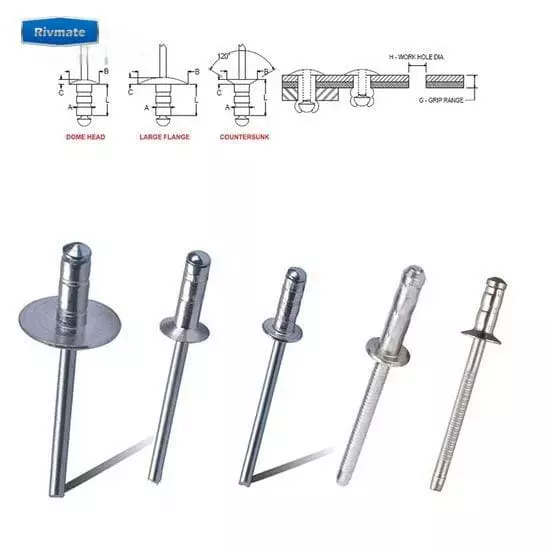
In terms of performance standards, industrial Blind Rivets typically comply with the following international specifications:
- ISO 14589 – Standard for mechanical performance testing;
- ISO 15973 – Requirements for the strength of structural rivets;
- DIN 7337 – General dimensions and installation standards for blind rivets.
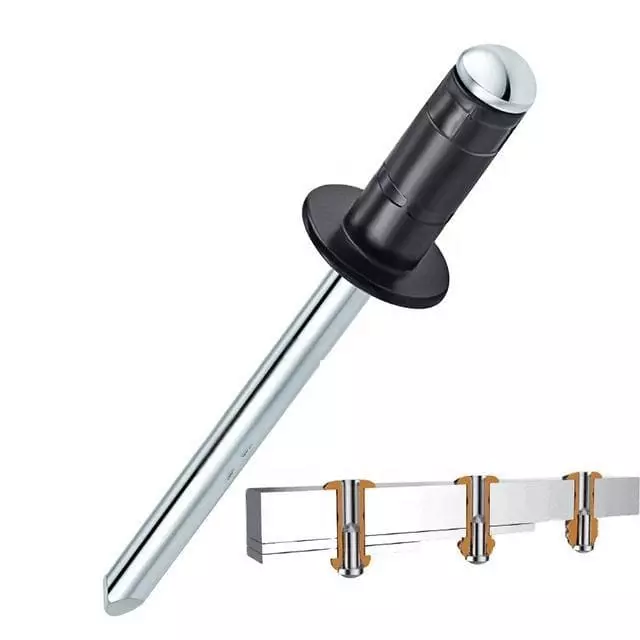
Pop Rivet (a type of blind rivet) was a trademarked name introduced by the British company George Tucker Eyelet Company in the 1930s. It initially referred to a riveting system they invented that could be installed from only one side. The company was later acquired by the well-known fastener brand Avdel, and “POP®” gradually became the common name for blind rivets.
In other words, all Pop Rivets are also considered as Blind Rivets, but not all Blind Rivets are Pop Rivets.
The term “Pop Rivet” is more of a general industrial term, referring to all blind rivets that achieve locking by breaking through the core shaft.
In practical applications, Pop Rivet is renowned for its simple structure, low cost, and quick installation. It is highly suitable for use in sheet metal processing, light industrial equipment, electronic enclosures, and DIY repair scenarios. Users only need to use a manual or electric riveting gun to complete reliable mechanical connections in just a few seconds.
Blind Rivet vs Pop Rivet: Key Differences
| Comparison Item | Blind Rivet | Pop Rivet |
|---|---|---|
| Definition | A type of fastener designed for single-side (blind-side) installation, used for industrial-grade permanent joining. | A branded term derived from the trademark “POP®”, commonly used to refer to blind rivets. |
| Application Scenarios | Industrial assembly, structural fastening, automotive manufacturing, construction applications. | DIY projects, repair work, and general sheet metal assembly. |
| Standardization Level | Regulated under ISO / DIN / SAE international standards. | Primarily a commercial term, not a standardized classification. |
| Strength Rating | Includes high-strength structural, sealed, and multi-grip variants. | Typically used for light to medium-duty applications. |
| Installation Tools | Compatible with manual, pneumatic, and cordless rivet guns. | Commonly installed using manual rivet guns. |
| Typical Industries | Automotive, aerospace, railway, energy equipment, and heavy industry. | Light manufacturing, household appliances, and maintenance sectors. |
From a technical perspective, “Pop Rivet” is actually the commercial name for “Blind Rivet“. “Pop” was originally just a brand name, but due to its high popularity, it has now become a commonly used term in the industry.
In industrial manufacturing, “Blind Rivet” is a more standardized and comprehensive term. It not only includes ordinary open-type rivets, but also extends to series such as “structural type, waterproof sealed type, multi-clamping range type“, which can meet the usage requirements of high-strength scenarios in fields like automobiles, construction, and rail transportation.
Blind Rivet & Pop Rivet Types & Performance
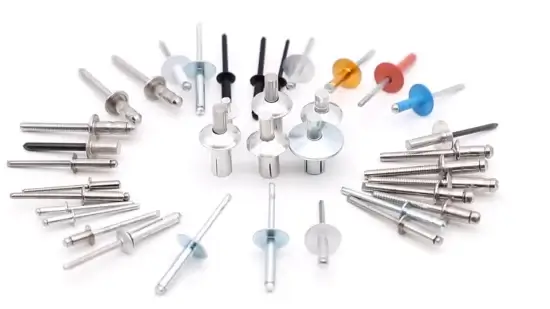
In modern manufacturing, Blind Rivets and Pop Rivets are not merely a single connection method; rather, they have evolved into various technical solutions based on structural requirements and working conditions. Different types of rivets possess distinct mechanical properties, sealing capabilities, and assembly characteristics. Choosing the appropriate type is crucial for ensuring structural safety and improving production efficiency.
| Type | Key Features | Applications |
|---|---|---|
| Open-End Rivet | Lowest cost, highly versatile, and fast installation. The mandrel partially remains after break-off, suitable for non-sealed joints. | Interior panels, lightweight sheet metal structures, home appliances assembly. |
| Closed-End Rivet | Sealed tail design providing waterproof and dustproof performance. Prevents corrosion and liquid ingress. | Automotive chassis, outdoor equipment, electronic enclosures. |
| Structural Rivet | Locking mandrel design ensures high tensile and shear strength with excellent vibration resistance. | Bridges, construction machinery, railway vehicles, heavy-duty structures. |
| Multi-Grip Rivet | Designed to accommodate multiple material thicknesses, reducing inventory and part variation. | Modular assembly, automotive production lines, quick repair applications. |
① In cases where structural strength is prioritized (such as in vehicle frames and mechanical equipment), Structural Rivet should be used.
② If the connection piece has requirements for sealing or waterproofing, the Closed-End Rivet is the preferred choice.
③ For automated assembly lines or rapid production, the Multi-Grip Rivet is recommended, as it simplifies the management of parts.
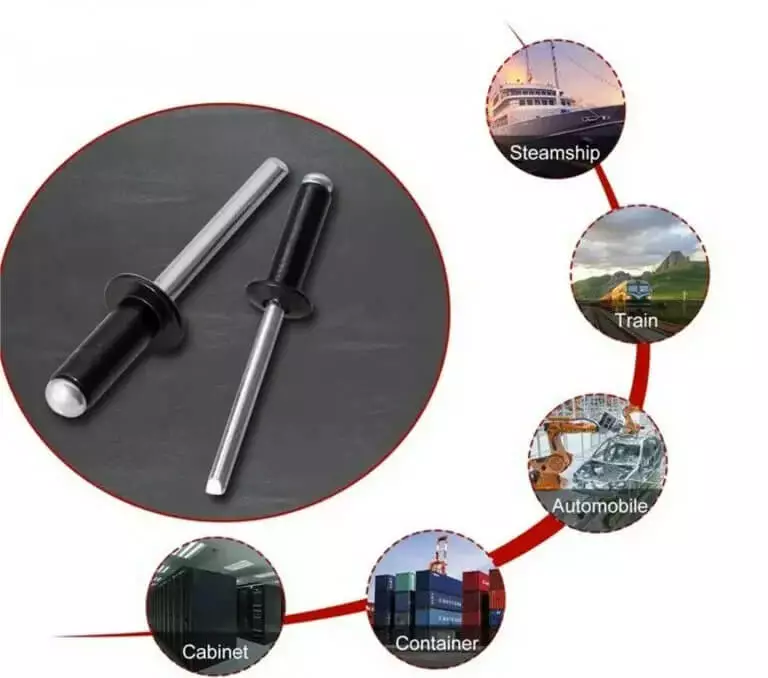
In the automotive industry, blind rivets are used for assembly of the vehicle body frame, chassis, doors and battery pack shells. Compared to welding, riveting does not cause heat affected zone (HAZ), thus avoiding material deformation. Especially in the structure of electric vehicles, sealed-end (Closed-End) or structural (Structural) rivets can provide high shear strength and waterproof performance.
In the construction and bridge industries, rivets are widely used in steel structure assembly, curtain wall support, and metal roofing systems. The sealed / waterproof rivets can achieve a sealing effect that prevents rain, dust, and corrosion, thereby reducing long-term maintenance costs.
Rivmate 316 stainless steel waterproof rivets have passed the ASTM B117 1000-hour salt spray test certification and are suitable for coastal construction projects.
③ Electronics & Enclosures
In electronic manufacturing, blind rivets are used to connect metal casings, heat sinks and mounting brackets. Their installation is quick, has low vibration and no thermal impact, making them highly suitable for automated production lines. Additionally, copper or aluminum rivets can ensure conductivity and meet the requirements for electrical grounding.
The marine environment demands extremely high corrosion resistance and waterproofing performance. Sealed stainless steel or Monel rivets can effectively prevent salt fog corrosion and leakage problems. They are commonly used in ship body assembly, deck structures, guardrails, and outdoor metal equipment. The Rivmate Marine Series sealed rivets perform exceptionally well in high-humidity environments and have stable 25-year corrosion resistance.
Rivmate Expert Guide to Choosing the Right Rivet
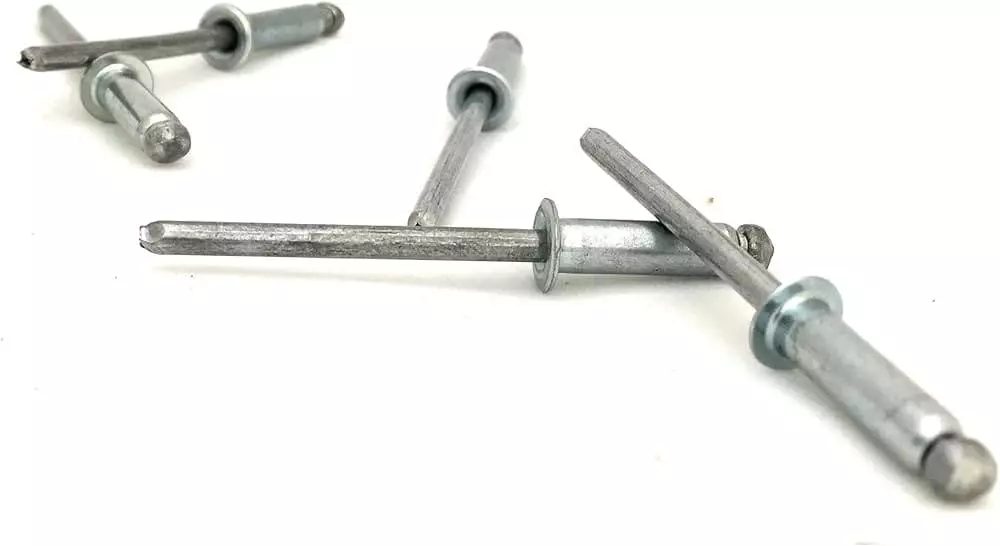
In different assembly scenarios, the selection of the appropriate type of rivets directly affects the structural strength, durability and assembly efficiency of the product.
Light-Duty Assembly
If the project prioritizes lightweight design and cost reduction, such as in the cases of sheet metal, household appliances, and electronic enclosures, it is recommended to use Rivmate Open-End Pop Rivets. These rivets are easy to install and have strong versatility, making them suitable for mass production and on-site repairs.
High-Strength & Corrosion Resistance Applications
For applications involving vehicle body structure, chassis, bridges or coastal environments, Rivmate Structural Rivets or Closed-End Rivets are recommended. Structural rivets offer high shear strength and vibration resistance, while closed-end rivets prevent water vapor and salt fog from penetrating, effectively extending the lifespan of the connections.
Automated or Mass Production
On modern production lines that require high production speed and consistent quality, it is recommended to use Rivmate Cordless / Pneumatic Riveting Tools in conjunction with a high-speed feeding system. This combination can increase assembly efficiency by 40% and ensure that each connection point achieves the same locking force.
Rivmate Cordless Rivet Gun is compatible with 4.0 – 6.4mm rivets and is widely used in automotive assembly lines and the structural assembly of new energy battery packs.
FAQ
Q1: Are Blind Rivets and Pop Rivets the same thing?
Yes, but there is a conceptual difference. Pop Rivet was originally the registered brand name of George Tucker Eyelet Company in the UK, and now it has become the general term for Blind Rivet.
All Pop Rivets are Blind Rivets, but not all Blind Rivets are called Pop Rivets.
Q2: Which is stronger — Blind Rivet or Pop Rivet?
The two have exactly the same structural performance, and the key factor lies in the type and material. If the Structural Blind Rivet is used, its shear strength can reach 12–14kN, which is much higher than that of the general-purpose Pop Rivet.
Q3: Can I use Pop Rivets for automotive or structural applications?
Sure, but you need to choose the correct model. The regular Pop Rivet is mostly used for light assembly, while for automotive or structural scenarios, it is recommended to use closed-end or structural rivets to ensure anti-vibration and anti-corrosion performance.
The Rivmate Automotive Blind Rivet Series has been certified to meet the ISO 14589 and SAE J491 standards, and can be applied to the structures of vehicle bodies, chassis and battery packs.
Q4: What tools are used for installing Blind Rivets?
Installation is typically carried out using manual, pneumatic or cordless electric riveting guns. For industrial production, Rivmate recommends using HydroLock hydraulic riveting system or Cordless Power Rivet Tools, which can ensure consistent and efficient pull riveting.
Q5: Does Rivmate provide certified industrial rivets?
Sure. All industrial-grade rivets from Rivmate comply with the ISO/DIN/ASTM international standards, and come with material traceability and performance test reports. Our products are widely used in automotive manufacturing, railways, ships, construction, and the new energy sector.
Upgrade Your Assembly with Rivmate Blind Rivet Solutions

Blind Rivet and Pop Rivet have no fundamental differences in principle. Both are efficient mechanical fasteners that can be operated from one side. The difference lies in their naming and application levels: Pop Rivet is a commercial term, while Blind Rivet is an industrial standard term.
In the modern manufacturing field, Rivmate has achieved a comprehensive upgrade in the strength, corrosion resistance, sealing performance and installation efficiency of the Blind Rivet system through precise design and material optimization.
Visit the Rivmate Engineering Fastening Center to learn about Rivmate’s entire series of Blind Rivet and Pop Rivet systems.
Reference
How to Remove and Replace a Rivet Nut
How to Remove and Replace

How to Install Rivet Nuts
How to Install Rivet Nuts
Top 10 Blind Rivet Nut Manufacturers in World | Rivmate Fastener
Top 10 Blind Rivet Nut Ma
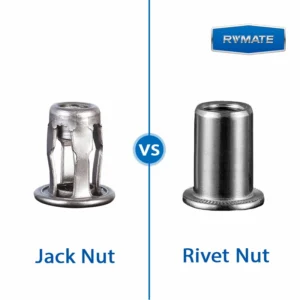
Jack Nut vs Rivet Nut
Jack Nut vs Rivet Nut : W