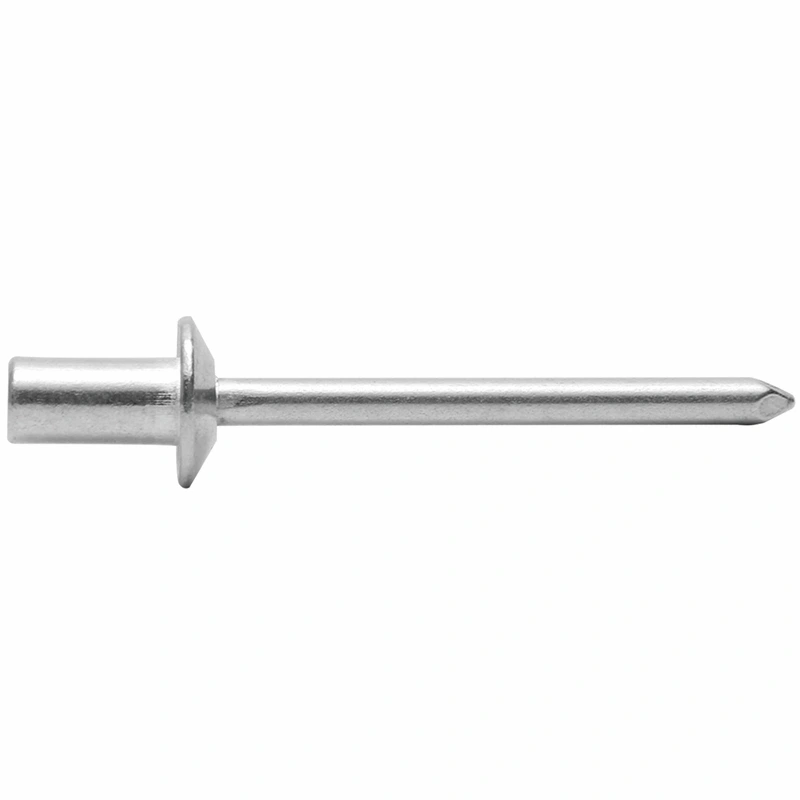
A closed-end rivet is a fastener designed for single-sided installation. Unlike open-end rivets, the closed-end rivet features a sealed tail, which minimizes the ingress of liquids, moisture, or dust through the rivet body.
Offering superior sealing capabilities, closed-end rivets are suitable for applications such as trucks and trailers, HVAC and heat exchange equipment, electrical control cabinets, electronic device housings, and ventilation systems.
What Is a Closed End Rivet?
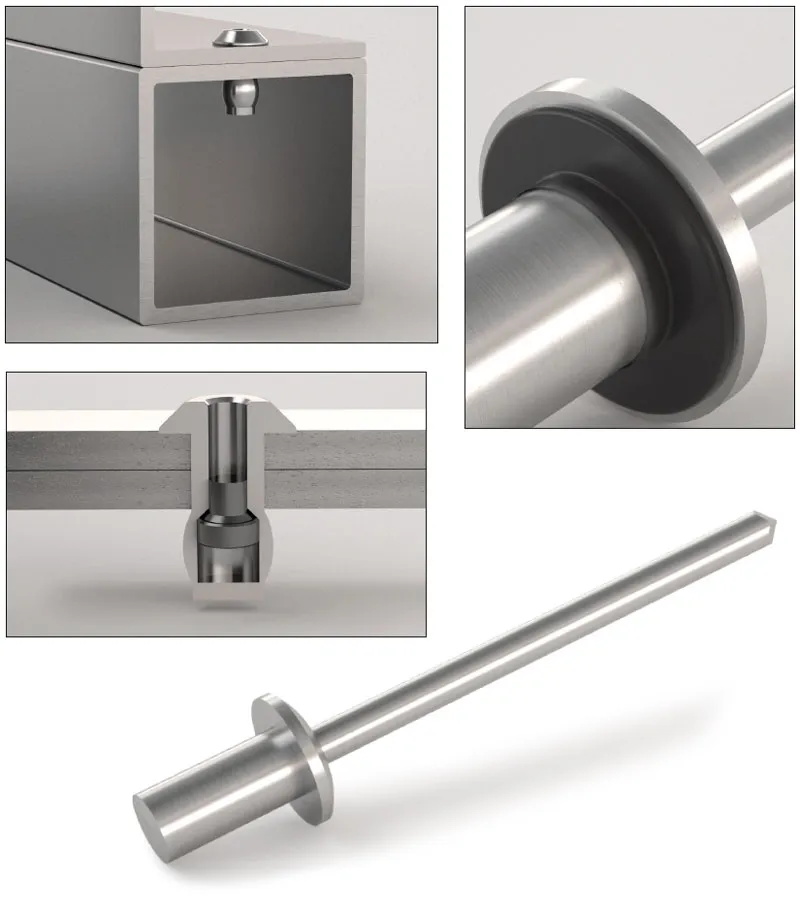
The closed-end rivet features a design where the end of the rivet body near the mandrel head is sealed, enclosing the mandrel head within the body. This effectively blocks paths through which liquids or gases might otherwise permeate the interior of the rivet.
Is a Closed End Rivet the Same as a Closed End Rivet Nut?
Closed-end rivets and closed-end rivet nuts are two different types of fasteners.
- Closed-end rivets are used to join two or more layers of material directly and permanently;
- Closed-end rivet nuts create an internally threaded feature that allows a bolt to be screwed in repeatedly.
We recommend choosing a closed-end rivet if your priority is directly joining sheets of material, and a closed-end rivet nut if you need to create internal threads in the material.
Closed End Rivet vs. Closed End Rivet Nut
| Comparison Item | Closed End Rivet | Closed End Rivet Nut |
|---|---|---|
| Main Function | Directly joins multiple layers of material. | Creates an internal thread in thin sheet materials. |
| Internal Thread | No | Yes |
| Requires a Bolt | No | Yes |
| Connection Type After Installation | Usually a permanent connection. | The rivet nut is permanently fixed, but the bolt can be removed. |
| Main Components | Rivet body and breakable mandrel. | Rivet nut body with an internal thread. |
| Installation Tool | Blind rivet gun. | Rivet nut installation tool. |
| Does the Core Break During Installation? | The mandrel usually breaks. | The tool mandrel normally does not break; it is unscrewed and reused. |
| Common Specification Format | Rivet diameter, length and grip range. | Thread size, hole size, length and grip range. |
| Typical Applications | Permanent sheet assembly, sealed enclosures and automotive sheet metal. | Access panels, equipment brackets, enclosures and removable components. |
How Does a Closed End Rivet Work?
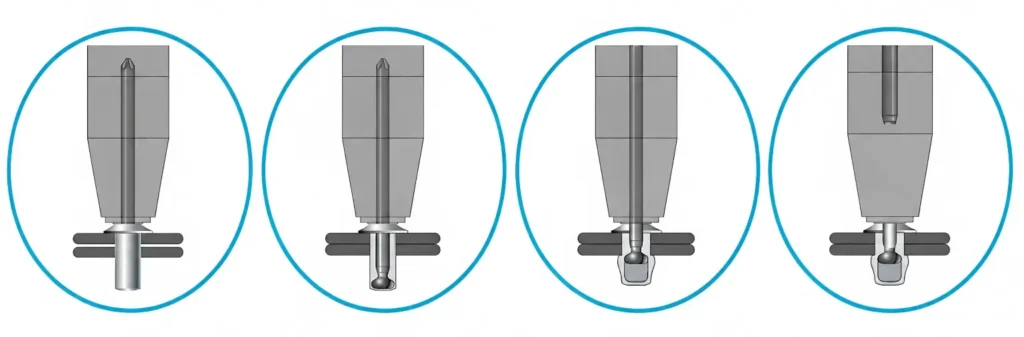
Step 1: Insert the rivet into the installation hole. You need to machine matching mounting holes and insert closed-type blind rivets into the holes.
Step 2: Clamp the rivet gun onto the mandrel and pull. You need to keep the nozzle pressed tightly against the rivet head, perpendicular to the workpiece, and close to the workpiece.
Step 3: The mandrel head presses to close the rivet body. As the gun pulls the mandrel outward, the mandrel head compresses the closed, cup-shaped tail end.
Step 4: A closed head forms on the back of the workpiece. As you continue to pull the core rod, the closed end rivet thickens and expands, forming a closed head.
Step 5: The material is tightened and a connection is formed. The material on the back is pulled toward the rivet head on the front, clamping the materials securely.
Step 6: The mandrel snaps at the preset break point. Once the rivet body has fully deformed, the mandrel breaks at the designated point, completing the riveting process.
How Does the Closed End Design Improve Sealing?
- The closed end seals the rivet’s internal channel.
The tail of the rivet body is sealed, enclosing the mandrel head within the body and preventing the passage of liquids or gases.
- Rivet body formation helps minimize the gap at the hole wall.
Upon setting, a closed head forms on the reverse side of the workpiece; the rivet body fits more snugly against the installation hole, reducing voids.
- Clamping force improves the fit between the rivet head and the workpiece.
Clamping force ensures the rivet head sits tightly against the workpiece, reducing gaps and enhancing sealing performance.
Are Closed End Rivets Waterproof and Airtight?
Closed-end rivets prevent the passage of liquids and gases through the rivet body itself; however, the riveted joint is not necessarily completely sealed.
Leakage can also occur via other paths at the riveting site:
- The clearance between the rivet body and the installation hole
- The gap between the rivet head and the sheet surface
- The interface between the two joined sheets
- Channels formed by hole-edge burrs, scratches, or sheet deformation
- Gaps caused by long-term corrosion or vibration.

How can the sealing effect be further improved?
- Ensure the correct installation hole size
- Select the appropriate grip range
- Ensure the rivet head sits flush against the material
- Use the correct installation tool
- Add auxiliary sealing measures (sealant, sealing washers, or specialized sealing coatings)
Based on our 15 years of manufacturing experience, for applications requiring high sealing performance, we recommend that you conduct a sealing test on the actual joint. These include:
- Air pressure retention testing;
- Hydrostatic testing;
- Water column testing;
- Vacuum leak testing;
The test subjects should be the complete riveted assemblies.
What Are the Limitations of Closed End Rivets?
- Absolute sealing of the entire riveted joint cannot be guaranteed.
While the body of a closed-end rivet is sealed, gaps may still exist at the joint interface.
- “Closed-end” does not imply a high-strength structural rivet.
Closed-end rivets are not classified as structural rivets and have limited strength ratings; they are unsuitable for heavy-duty structures subject to high fatigue loads.
Rivmate has conducted professional strength tests on closed-end rivets:
- Strict requirements for grip range and installation hole dimensions.
Each type of closed-end blind rivet has a specific grip range. The total thickness of the materials being joined must fall within this range. Please refer to the grip range chart in the Rivmate catalog for specific specifications.
- Higher cost and difficult to remove after installation.
Closed-end rivets create a permanent connection; removing them requires destroying the rivet body.
What Materials Are Closed End Rivets Made From?
Closed-end rivets are available in four materials: aluminum, steel, stainless steel, and copper. A closed-end blind rivet is not made from a single material; rather, it is composed of materials for both the rivet body and the mandrel.
Aluminum Closed End Rivets
Aluminum closed-end rivets feature a rivet body made of aluminum, with a mandrel made of steel, stainless steel, or aluminum.
They are lightweight and easy to form but offer lower strength; We recommend using it for thin sheets and lightweight workpieces.
Steel Closed End Rivets
Steel closed-end rivets feature a rivet body and mandrel made of steel.
They offer higher strength than aluminum versions but are susceptible to corrosion; We recommend using this for joining ordinary steel workpieces.
Stainless Steel Closed End Rivets
Stainless steel closed end rivets are made of stainless steel.
The core rod can be made of stainless steel. Stainless steel closed end rivets have good corrosion resistance. It is recommended for use in high-humidity environments.
Common Rivet Body and Mandrel Combinations
| Material Combination | Main Advantages | Main Limitations | Typical Applications |
|---|---|---|---|
| Aluminum Body / Steel Mandrel | Lightweight, economical and offers moderate strength | The steel mandrel may corrode in humid or corrosive environments | HVAC equipment, home appliances and general sheet metal assemblies |
| Aluminum Body / Stainless Steel Mandrel | Lightweight with improved mandrel corrosion resistance | Higher cost and potential galvanic corrosion between dissimilar metals | Outdoor aluminum panels, vehicle components and equipment enclosures |
| Aluminum Body / Aluminum Mandrel | Very lightweight and requires relatively low installation force | Lower mechanical strength than steel or stainless steel combinations | Signs, lightweight aluminum panels and soft-material assemblies |
| Steel Body / Steel Mandrel | Good balance between mechanical strength and cost | Relies on plating or other surface treatments for corrosion protection | Steel enclosures, machinery panels and general industrial sheet metal |
| Stainless Steel Body / Stainless Steel Mandrel | High strength and good corrosion resistance | Higher cost and greater installation force requirements | Outdoor equipment, high-humidity environments and washdown applications |
| Copper Body / Steel or Stainless Steel Mandrel | Good electrical conductivity and decorative appearance | Limited strength and potential galvanic corrosion with dissimilar metals | Electrical components, copper sheet assemblies and decorative joints |
What Head Styles Are Available for Closed End Rivets?
There are three common head styles for closed-end blind rivets: dome head, large flange head, and countersunk head. The head style primarily affects the bearing surface area on the front side of the rivet, the appearance after installation, and the level of protection provided to the sheet material.
Dome Head Closed End Rivets
Dome head closed-end rivets feature the most common head style, with a balanced head diameter and height.
Dome head closed-end rivets are suitable for general industrial fastening applications where there are no specific requirements for surface finish or high load-bearing capacity.
Countersunk Closed End Rivets
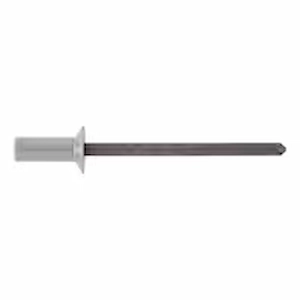
Countersunk closed-end rivets feature a conical head. A countersunk hole must be prepared prior to installation; once installed, the rivet head sits flush with the workpiece surface.
Countersunk head rivets are suitable for industrial fastening applications where a flush, smooth surface finish is required.
Large Flange Closed End Rivets
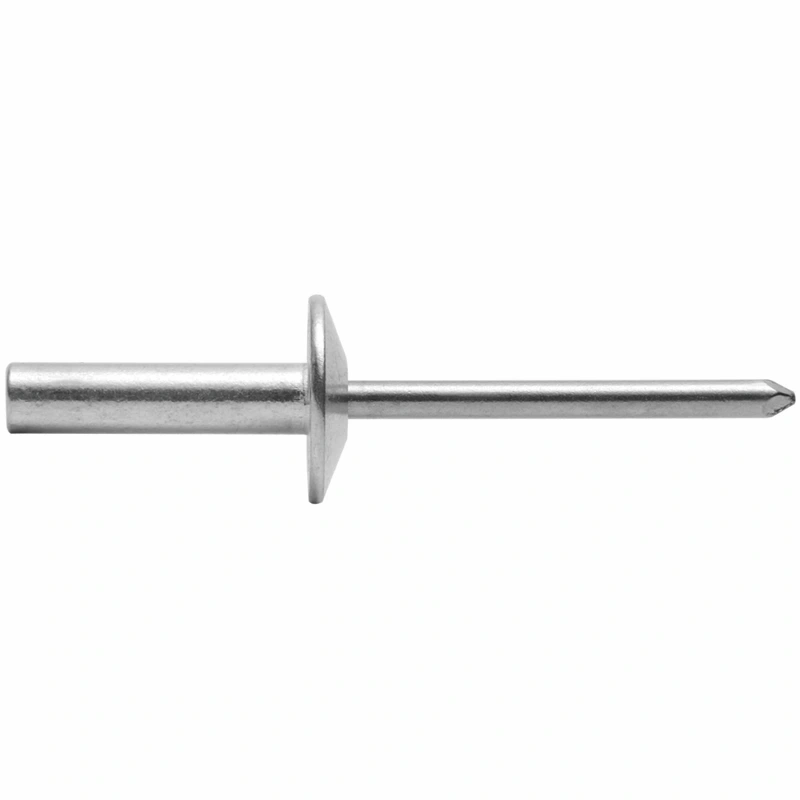
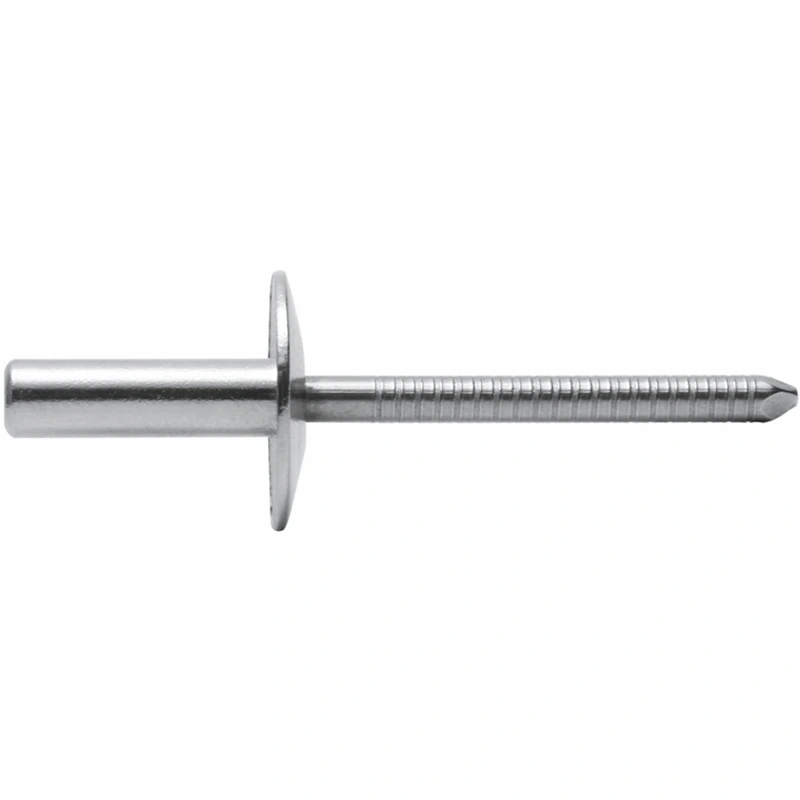
Large flange closed-end rivets have the largest head diameter. The larger head distributes the load, reducing the risk of the rivet pulling through the sheet material.
Large flange closed-end rivets are suitable for use with thinner or softer sheet materials.
| Head Style | Main Function | Best Suited For |
|---|---|---|
| Dome Head | Provides a versatile connection while balancing load distribution and installation space. | General sheet metal, equipment enclosures and standard assemblies. |
| Countersunk Head | Reduces surface protrusion and creates a flush or nearly flush finish. | Exterior panels, sliding surfaces and areas with limited clearance. |
| Large Flange Head | Distributes the load over a wider area and helps prevent thin or soft materials from being pulled through. | Thin sheet metal, plastics, composite materials and oversized holes. |
Where Are Closed End Rivets Used?
Closed-end rivets offer excellent sealing properties and provide a permanent, single-sided fastening solution. They are commonly used in industries such as vehicle equipment, HVAC, electrical equipment, and outdoor enclosures.
1. Passenger Cars and Commercial Vehicles
Vehicles are exposed to rainwater and condensation during use and require moisture protection.
Common application areas include:
- Vehicle underbody
- Wheel arches
- Door panels
- Body sheet metal
- Equipment compartments
2. HVAC
HVAC systems require the control of air leakage and moisture. Closed-end blind rivets prevent moisture from entering through the rivet.
Common application areas include:
- Unit casings
- Ductwork components
- Fan housings
- Refrigeration equipment
3. Electronic equipment
Electronic components are housed within electronic devices, necessitating the exclusion of moisture, metal dust, and other contaminants. Closed-end blind rivets not only maintain an effective seal but also ensure that the broken mandrel does not fall into the internal components.
Common applications include:
- Side and back panels of electrical cabinets;
- Device housings;
- Fan shrouds and protective covers;
- Outdoor control boxes;
- Telecommunications equipment enclosures.
4. Outdoor Enclosure
Outdoor enclosures are constantly exposed to rain, and their connection points require protection against rust and water leakage; stainless steel closed-end blind rivets offer an excellent solution to this issue.
When the panels are also made of metal, you must be mindful of galvanic corrosion occurring between dissimilar metals.
How Do You Select the Correct Closed End Rivet?
From the perspective of long-term stability, when choosing a suitable closed end rivet, you need to consider multiple factors such as clamping range, aperture, strength, material, head type, and tools. Only by evaluating these aspects can you choose a product that best meets your project’s requirements.
Closed End Rivet Selection Checklist
| Information to Confirm | Selection Purpose |
|---|---|
| Materials Being Joined and Their Surface Treatments | Select a suitable rivet body material and minimize the risk of corrosion. |
| Thickness of Each Material and Total Joint Thickness | Determine the correct grip range for reliable rivet formation. |
| Installation Hole Diameter and Tolerance | Ensure proper rivet setting, joint strength and sealing performance. |
| Shear and Tensile Loads | Determine the required rivet diameter and mechanical strength. |
| Operating Environment | Select the appropriate aluminum, steel or stainless steel material combination. |
| Surface Appearance and Load-Distribution Requirements | Choose a dome head, countersunk head or large flange head. |
| Waterproofing or Airtightness Requirements | Determine whether auxiliary sealing measures and leakage testing are required. |
| Available Blind-Side Space | Confirm that sufficient space is available for the closing head to form correctly. |
| Installation Tool Specifications | Confirm that the tool pull force, nosepiece and stroke are compatible with the rivet. |
| Future Disassembly Requirements | Determine whether a rivet nut and bolt or another removable fastening method would be more suitable. |
Closed End Rivet Size and Specification Guide
Aluminum Body / Carbon Steel Mandrel
| Diameter d | Part No. | Size | Body Length L (nom.) | Grip Range | Recommended Hole Size | Dome Head Max. | Countersunk Head Max. | Large Flange Max. | Mandrel Diameter dm (max.) | Mandrel Reveal P (min.) | Typical Ultimate Strength | ||||
|---|---|---|---|---|---|---|---|---|---|---|---|---|---|---|---|
| dk | k | dk | k | dk | k | Tensile | Shear | ||||||||
| 3.2 (1/8″) |
ASF32065 ASFC32065 ASFLF3206510 | 3.2 × 6.5 | 6.3–7.3 | 0.5–2.0 | 3.3–3.4 | 6.4 | 1.3 | 6.2 | 1.3 | 9.8 | 2.0 | 1.85 | 26.0 | 1350 N | 1100 N |
|
ASF32080 ASFC32080 ASFLF3208010 | 3.2 × 8.0 | 7.8–8.8 | 2.0–3.5 | ||||||||||||
|
ASF32095 ASFC32095 ASFLF3209510 | 3.2 × 9.5 | 9.3–10.3 | 3.5–5.0 | ||||||||||||
|
ASF32110 ASFC32110 ASFLF3211010 | 3.2 × 11.0 | 10.8–11.8 | 5.0–6.5 | ||||||||||||
|
ASF32125 ASFC32125 ASFLF3212510 | 3.2 × 12.5 | 12.3–13.3 | 6.5–8.0 | ||||||||||||
| 4.0 (5/32″) |
ASF40080 ASFC40080 ASFLF4008012 | 4.0 × 8.0 | 7.8–8.8 | 1.5–3.5 | 4.1–4.2 | 8.3 | 1.6 | 8.3 | 1.6 | 12.5 | 2.2 | 2.25 | 27.0 | 2200 N | 1600 N |
|
ASF40095 ASFC40095 ASFLF4009512 | 4.0 × 9.5 | 9.3–10.3 | 3.5–5.0 | ||||||||||||
|
ASF40110 ASFC40110 ASFLF4011012 | 4.0 × 11.0 | 10.8–11.8 | 5.0–6.5 | ||||||||||||
|
ASF40125 ASFC40125 ASFLF4012512 | 4.0 × 12.5 | 12.3–13.3 | 6.5–8.0 | ||||||||||||
|
ASF40150 ASFC40150 ASFLF4015012 | 4.0 × 15.0 | 14.8–15.8 | 8.0–10.5 | ||||||||||||
| 4.8 (3/16″) |
ASF48080 ASFC48080 ASFLF4808016 | 4.8 × 8.0 | 7.8–8.8 | 2.0–3.5 | 4.9–5.0 | 9.9 | 2.0 | 9.8 | 2.0 | 16.5 | 2.5 | 2.75 | 28.0 | 3100 N | 2200 N |
|
ASF48095 ASFC48095 ASFLF4809516 | 4.8 × 9.5 | 9.3–10.3 | 3.5–5.0 | ||||||||||||
|
ASF48110 ASFC48110 ASFLF4811016 | 4.8 × 11.0 | 10.8–11.8 | 5.0–6.5 | ||||||||||||
|
ASF48130 ASFC48130 ASFLF4813016 | 4.8 × 13.0 | 12.8–13.8 | 6.5–8.0 | ||||||||||||
|
ASF48145 ASFC48145 ASFLF4814516 | 4.8 × 14.5 | 14.3–15.3 | 8.0–9.5 | ||||||||||||
|
ASF48160 ASFC48160 ASFLF4816016 | 4.8 × 16.0 | 15.8–16.8 | 9.5–11.0 | ||||||||||||
|
ASF48180 ASFC48180 ASFLF4818016 | 4.8 × 18.0 | 17.8–18.8 | 11.0–13.0 | ||||||||||||
|
ASF48210 ASFC48210 ASFLF4821016 | 4.8 × 21.0 | 20.8–21.8 | 12.0–16.0 | ||||||||||||
|
ASF48250 ASFC48250 ASFLF4825016 | 4.8 × 25.0 | 24.8–25.8 | 14.0–19.0 | ||||||||||||
| 6.4 (1/4″) | ASF64125 | 6.4 × 12.5 | 12.3–13.3 | 1.5–6.5 | 6.5–6.6 | 13.0 | 2.5 | — | — | — | — | 3.75 | 30.0 | 4900 N | 3600 N |
| ASF64140 | 6.4 × 14.0 | 13.8–14.8 | 3.0–8.0 | ||||||||||||
| ASF64160 | 6.4 × 16.0 | 15.8–16.8 | 5.0–10.0 | ||||||||||||
| ASF64195 | 6.4 × 19.5 | 19.3–20.3 | 8.5–13.5 | ||||||||||||
| ASF64240 | 6.4 × 24.0 | 23.8–24.8 | 13.0–17.5 | ||||||||||||
ASF = Dome Head Sealed Blind Rivet;
ASFC = Countersunk Head Sealed Blind Rivet;
ASFLF = Large Flange Sealed Blind Rivet.
Material combination: aluminum rivet body with carbon steel mandrel. The 6.4 mm series in the catalogue is listed only with dome-head part numbers.
What Are the Common Closed End Rivet Problems?
When issues arise after the installation of closed-end rivets, the cause is rarely the rivet itself. Factors affecting riveting strength and sealing performance include incorrect grip range, unsuitable hole diameter, mismatched tools, improper installation technique, and inappropriate material selection.
Common Closed End Rivet Problems and Solutions
| Problem Symptom | Items to Check First | Common Corrective Action |
|---|---|---|
| Water or Air Leakage After Installation | Hole diameter, rivet head contact and joint sealing | Correct the hole diameter and add an auxiliary sealing measure. |
| Loose or Rotating Rivet | Grip range, hole diameter and tool stroke | Select the correct rivet length and inspect the installation tool. |
| Incomplete Blind-Side Formation | Material thickness, hole alignment and tool angle | Adjust the rivet specification and improve the installation process. |
| Premature Mandrel Breakage | Grip range, hole alignment and tool compatibility | Eliminate off-axis loading and use the correct rivet specification. |
| Mandrel Does Not Break | Tool pull force, stroke and jaw condition | Use a compatible installation tool and maintain or replace worn jaws. |
| Rivet Head Does Not Sit Flat | Hole burrs, panel flatness and installation angle | Deburr and clean the hole, then install the rivet perpendicular to the surface. |
| Panel Cracking or Rivet Pull-Through | Head style, material thickness and installation load | Use a large flange head or select a lower-load fastening solution. |
| Corrosion After Installation | Material combination and operating environment | Select more compatible materials and add corrosion-resistant isolation or protection. |
How Are Closed End Rivets Tested?
Tensile and shear testing of closed end rivets
Riveting tests on closed end rivets
Mandrel break strength testing of closed end rivets
Dimensional testing of closed end rivets
How to Choose a Reliable Closed End Rivet Manufacturer
When selecting a reliable manufacturer, you cannot simply compare prices and lead times. The manufacturing of closed-end rivets involves multiple stages;
You can evaluate potential manufacturers based on the following aspects:
- Manufacturing Capability: Process controls for rivet body, mandrel, assembly, and sorting
- Quality System: ISO 9001 and IATF 16949 certification
- Product Standards: Specific ISO, customer drawing, or corporate standards
- Performance Testing: Shear, tensile, mandrel break, and installation/forming tests
- Sealing Capability: Test medium, pressure, duration, and allowable leakage
- Material Management: Material grade, surface treatment, and batch traceability
- Batch Consistency: First-article inspection, in-process inspection, outgoing inspection, and statistical control
- Engineering Support: Selection based on sheet material, hole diameter, load, and environment
Prototype Validation: Support for trial installation under actual operating conditions and performance testing - After-sales Support: Anomaly analysis, traceability, and corrective actions

Rivmate Closed End Rivet Solutions
As a professional manufacturer and supplier of closed-end rivets, Rivmate offers not only the products themselves but also comprehensive fastening solutions tailored to our customers’ needs. We provide customization options—including material, head style, diameter, and surface finish—to ensure a precise match for your specific applications.
We maintain strict quality control throughout the entire process, from sample approval and specification selection to mass production, ensuring consistent product quality across batches. Please provide your drawings, material thickness, hole diameter, application details, and order quantity so we can tailor a countersunk blind rivet solution and provide a quote for you.
FAQs
Which type of sealed blind rivet is best for marine applications?
For most marine applications, we recommend using stainless steel sealed blind rivets.
In addition to providing an effective seal against marine moisture and salt spray, these rivets offer superior resistance to the pitting and crevice corrosion commonly encountered in marine environments.
What is the load-bearing capacity of closed-end blind rivets?
The tensile strength of closed-end blind rivets is approximately 1,300–8,000 N, and the shear strength is approximately 1,150–6,000 N.
Can the surface finish or coating of closed-end blind rivets be customized?
Depending on specific customer requirements, we typically recommend common surface treatments such as zinc plating, colored passivation, black passivation, zinc-nickel alloy coating, anodizing, painting, and colored coatings.
Work with a IATF 16949 Certified Blind Rivet Manufacturer
Get High Quality Rivets Instead of Huck and Avdel Rivets

Rivmate Rivet
Rivmate is one of top 3 blind rivets manufacturers in china. The company is IATF 16949 certified and offers high-strength structural blind rivets that serve as alternatives to Huck and Avdel products.
Explore Rivmate Cases
Rivmate Rivet
Rivmate is one of top 3 blind rivets manufacturers in china. The company is IATF 16949 certified and offers high-strength structural blind rivets that serve as alternatives to Huck and Avdel products.

Hey There, I'm Allen!
I am the founder of Rivmate. For over two decades, we have specialized in the manufacture of blind rivets, providing our customers with reliable riveting solutions. Need riveting services? Feel free to contact us.