Pop rivets are a fast, single-sided fastener commonly used in sheet metal parts, enclosures, ductwork, trailers, plastic/composite panels, and other industrial assembly applications.
How Do Pop Rivets Work?
The principle behind pop rivets is actually quite simple: using a specialized tool called a rivet gun, the central mandrel is pulled, causing the outer rivet body to deform and bulge on the back of the workpiece, ultimately clamping two or more layers of material together.
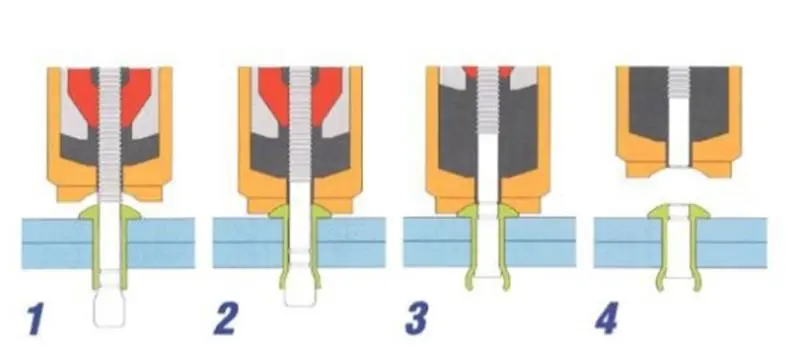
Here is a step-by-step guide to the installation process:
Step 1: Before installing a pop rivet, you need to punch a hole through two or more layers of material.
Step 2: Insert the body of the pop rivet into the hole.
Step 3: Clamp the exposed mandrel with the rivet gun
When the rivet gun is activated, it pulls on the central mandrel, pulling the mandrel outward.
Step 4: The tail end of the rivet shell bulges outward
As the mandrel is pulled outward, its head moves inward toward the rivet shell, compressing the tail end. At this point, the tail end begins to deform: some bulge outward; some fold inward; some expand outward. The forming process varies depending on the type of pop rivet.
Step 5: The mandrel breaks at the predetermined break point
As the pulling force continues to increase and the riveting is nearly complete, the mandrel will break at the predetermined break point.

You can think of a pop rivet as a “metal fastener that is operated from one side and automatically deforms to lock into place on the back.” Unlike a bolt, you don’t need to place a nut on the back, nor do you need to operate it from both sides at the same time; simply pull it with a rivet gun from the front, and the pop rivet will secure itself on the back.
What is a pop rivet used for
Pop rivets are fasteners primarily used to join two or more pieces of material together. They are particularly suitable for securing thin sheets, sheet metal, enclosures, ductwork, vehicle panels, cabinets, home appliances, and in areas where access to the back is difficult.
| Pop Rivet Application Guide | ||
| Main Use | Typical Scenarios | Why Pop Rivet Fits |
| Thin sheet & sheet metal joining | Sheet metal enclosures, cabinets, ducts, aluminum/galvanized panels | Clamps thin sheets without weak threads; less deformation than welding. |
| One-side installation | Closed boxes, ducts, vehicle panels, equipment housings | Front-side installation only; no rear nut or wrench needed. |
| Cold fastening instead of welding | Coated sheets, painted parts, thin panels, aluminum, plastic, composites | No high heat; helps avoid coating damage, burn-through, and distortion. |
| Mixed-material joining | Aluminum + steel, metal + plastic, metal + wood, metal + composite panels | Mechanical fastening does not require weld-compatible materials. |
| Permanent fixing | Ducts, appliance housings, nameplates, guards, outdoor brackets | Good for long-term joints that do not need frequent disassembly. |
| Fast batch assembly | HVAC, appliances, electrical cabinets, truck/trailer panels, metal furniture | Simple process and efficient for repeated connection points. |
| Vehicle & trailer panels | Truck bodies, trailer panels, trims, brackets, light reinforcements | Suitable for thin panels; choose structural rivets for vibration or load. |
| Light attachments | Nameplates, sign panels, trims, small brackets, cover plates | Quick and stable fixing for non-heavy-load parts. |
Pop rivets are an excellent choice when it’s inconvenient to use screws and nuts, welding isn’t suitable, or you simply need a permanent connection.
Parts of a Pop Rivet

A pop rivet consists primarily of two main parts: the rivet body and the mandrel.
- The rivet body is the part that remains in the workpiece and actually clamps the material.
- The mandrel is the part that is pulled by the rivet gun during installation, helping to deform the rivet body.
Breakdown of Main Components
① Rivet Body
The rivet body is the hollow section on the outside of the pop rivet.
- Head
The head is the part visible on the front of the workpiece. Once installed, it sits flush against the material surface, preventing the rivet from protruding through the hole. - Shank / Body
The body is the tubular section in the center of the rivet, which passes through the hole in the workpiece. - Tail End
This is the portion of the rivet head that deforms on the back side after it passes through the workpiece.
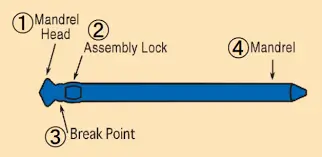
②Mandrel
The mandrel is the slender metal rod in the center of a pop rivet. It plays a crucial role during installation, but is not typically left protruding from the rivet once installation is complete.
The mandrel is not intended to serve as a permanent fastener; rather, it is gripped by the rivet gun during installation to drive the rivet body into shape.
- Mandrel Stem
This is the slender, exposed section that the pop rivet gun grips and pulls outward. - Mandrel Head
This is the end of the mandrel closest to the tail of the rivet body. During installation, it presses against the inside of the rivet body, causing the rivet shell to deform. - Break Point
The break point is a predetermined weak spot on the mandrel. As the rivet gun continues to pull and the riveting is completed, the mandrel breaks at this point. This is why the mandrel snaps with a “pop” during pop rivet installation.
What Materials Are Pop Rivets Made Of?
Pop rivets can be made from materials such as aluminum, steel (carbon steel/iron), stainless steel, copper, brass, and Monel.
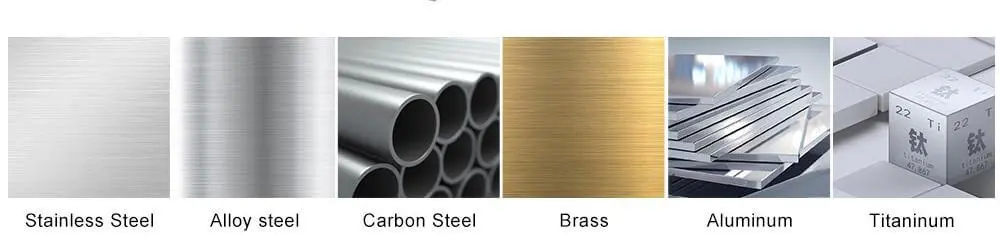
However, I generally don’t just look at “what material the rivet is made of”; I also consider two specific components:
- What material is the rivet body made of?
- What material the mandrel is made of
| Pop Rivet Material Selection Guide | |||
| Pop Rivet Material | Main Advantages | Key Considerations | Common Applications |
| Aluminum | Lightweight, easy to install, cost-effective | Lower strength; not suitable for all load-bearing applications | Thin sheet, appliances, ducts, signs, light structures |
| Steel / Carbon Steel | Higher strength, moderate cost | Requires anti-rust surface treatment | Industrial sheet metal, steel panels, brackets, equipment housings |
| Stainless Steel | High strength, excellent corrosion resistance | Higher cost; requires higher installation force | Outdoor use, humid environments, stainless panels, industrial equipment |
| Copper | Good electrical conductivity, special appearance | Higher cost; not the highest-strength option | Electrical applications, decorative parts, copper sheet connections |
| Brass | Good appearance, some corrosion resistance | Less common for general industrial fastening | Decorative parts, instruments, light-duty connections |
| Monel | Very strong corrosion resistance | High cost; mainly for special applications | Marine, chemical, highly corrosive environments |
When selecting pop rivet materials, don’t just ask, “What material is this pop rivet made of?” You should also ask, “What material is the rivet body made of? What material is the mandrel made of? What material will it be riveted to? And in what environment will it be used?” These factors can make a significant difference.
When selecting a pop rivet size, you should consider not only the “diameter” or “length,” but also the rivet diameter, grip range, hole size, and the total thickness of the materials to be joined.
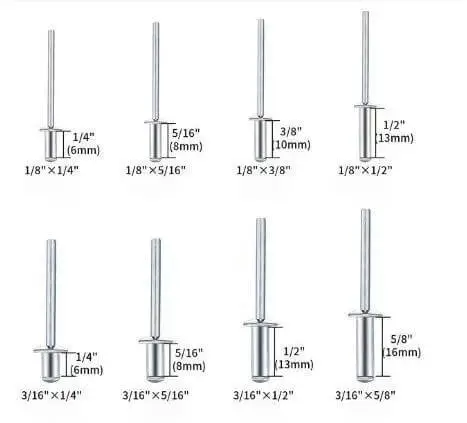
How do I go about choosing the right size step by step?
- Measure the total thickness
- Select a rivet with a grip range that covers the total thickness
- Select the diameter based on the applied force
- Confirm the hole diameter: Refer to the rivet specification table to determine the recommended hole diameter.
- Confirm whether the tool can apply sufficient force: Generally, the larger the size and the harder the material, the greater the force required.
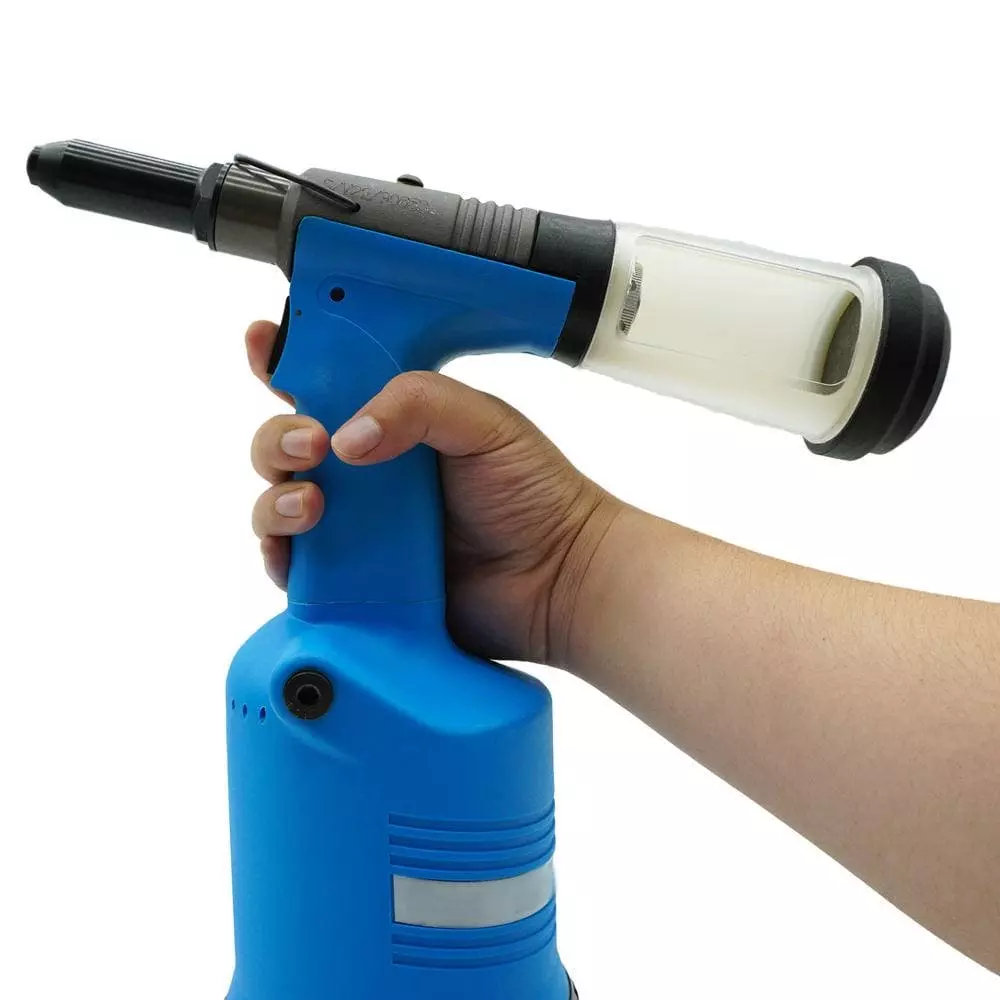
The basic steps for using a pop rivet gun are as follows: First, drill a hole; then insert the pop rivet into the hole; next, place the pop rivet gun over the mandrel; pull or press down firmly on the tool to deform the rivet body on the back of the workpiece; finally, the mandrel breaks off, and the riveting is complete.
Common Mistakes When Using a Pop Rivet Gun:
- Rivets are too short: When rivets are too short, the back side does not form properly, resulting in insufficient clamping force. It may appear to be installed, but it may not actually be secure.
- Rivets are too long: Rivets that are too long can cause excessive bulging on the back side, unstable forming, poor rivet appearance, and, paradoxically, poor clamping force.
- Incorrect hole diameter: If the hole is too large, the rivet will rattle. If the hole is too small, insertion will be difficult and may even damage the rivet body.
- Pulling the rivet gun at an angle: This affects the formation and can easily damage the surface.
- Mismatched nozzle
- Insufficient tool pulling force
The basic steps for installing pop rivets on sheet metal are: select the correct rivet size → drill holes of the appropriate diameter in the sheet metal → insert the pop rivet → use a pop rivet gun to pull the mandrel → the rivet body deforms on the back side to clamp the sheet metal → check that the rivet is secure.
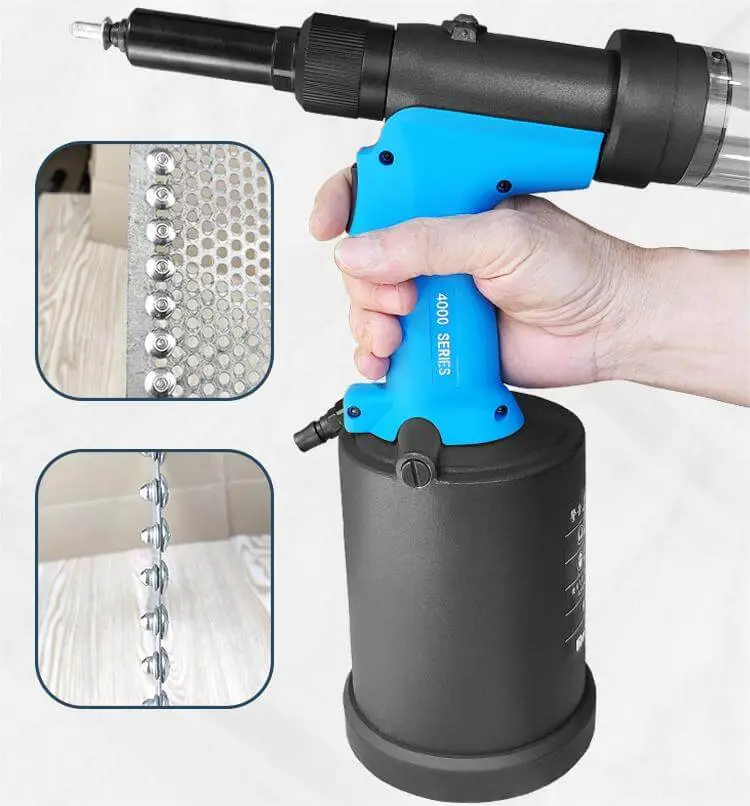
The basic steps for installing pop rivets on sheet metal are: select the correct rivet size → drill holes of the appropriate diameter in the sheet metal → insert the pop rivet → use a pop rivet gun to pull the mandrel → the rivet body deforms on the back side to clamp the sheet metal → check that the rivet is secure.
Steps for Installing Pop Rivets
Step1: Measure the total thickness of the metal sheet
Add up the thicknesses of all material layers to determine the correct clamping range.
Step 2: Select the appropriate rivet
Choose the correct rivet diameter, material, head type, and clamping range.
Step 3: Drill holes of the recommended size
The hole diameter must match the rivet specifications. An incorrect hole diameter can cause the rivet to become loose or fail.
Step 4: Insert the rivet
Place the rivet body into the hole and ensure the rivet head is flush with the surface of the metal plate.
Step 5: Use the rivet gun
Hold the tool vertically and pull the rivet mandrel until it breaks at the predetermined breaking point.
Step 6: Inspect the finished joint
Verify that the rivet head is flat, the back is well formed, and the metal plate is securely clamped.
In short, installing a pop rivet does not involve simply hammering it in; instead, you first drill a hole, then use a rivet gun to pull the mandrel out, causing the rivet head to bulge out from the back of the sheet metal and clamp the sheet in place.
Are pop rivets permanent or removable?
Pop rivets are typically classified as permanent fasteners, not removable fasteners.
Once installed, they hold the materials together by deforming the rivet body; they cannot be unscrewed like a screw or bolt.
The permanent nature of a pop rivet stems from its installation method. During installation, the rivet gun grips the mandrel and pulls it outward. The mandrel’s tip compresses the rivet body, causing the tail end of the rivet body to deform, expand, or bulge on the back of the workpiece. This ultimately creates the following structure:
- The deformed rivet body on the back side grips the workpiece
- The material in between is clamped
- The mandrel breaks off at the predetermined breaking point
Different Types of Pop Rivets
Pop rivets can be classified into many types based on their structure, sealing properties, strength, riveting range, suitable materials, and applications.
| Type | Key Advantages | Common Uses |
| Open End Blind Rivet | Cost-effective; easy installation | Doors/windows, HVAC ducts, appliances, general sheet metal |
| Closed End Blind Rivet | Better sealing performance | Electrical cabinets, containers, buses, outdoor enclosures |
| Multi-Grip Rivet | Wide grip range; good hole-filling ability | Variable sheet thickness, hole misalignment, vibration applications |
| Structural Blind Rivet | High tensile and shear strength; good mandrel retention | Trucks, trailers, equipment, structural assemblies |
| Peel Rivet | Suitable for soft materials | Wood, plastic, composite panels, interior trim |
| Lantern / Bulb Rivet | Distributes clamping force; protects materials | Thin sheets, soft materials, RVs, speakers |
| Countersunk Rivet | Flush finish; clean appearance | Electronic equipment, electrical cabinets, visible panels |
| Locking Rivet | Good vibration resistance; reduces mandrel loosening | Frames, chassis, trucks, heavy equipment |
Standard pop rivets are suitable for general fastening; closed-end rivets are better suited for waterproof sealing; multi-grip rivets are suitable for varying panel thicknesses; structural rivets are suitable for strength and vibration resistance; peel rivets and lantern rivets are better suited for plastic, wood, and soft materials.
Open end vs closed end pop rivets
- Open-end pop rivets are better suited for general fastening applications; they feature a simple design, are widely used, and are relatively cost-effective.
- Closed-end pop rivets are better suited for applications requiring waterproofing, dustproofing, or leak prevention, as the closed-end design of the rivet head provides superior sealing performance.
① Advantages of open-end
- Simple design
- Relatively cost-effective
- Available in a wide range of sizes, making them easy to source
- Easy to install
- Suitable for connecting many common thin plates
- Practical for general fastening applications
②Advantages of Closed-End Rivets
- Better sealing performance than open-end rivets
- More suitable for waterproof and dustproof applications
- Reduces the ingress of liquids, dust, or gases through the rivet center
- Suitable for applications such as enclosures, housings, vehicle bodies, and shipping containers
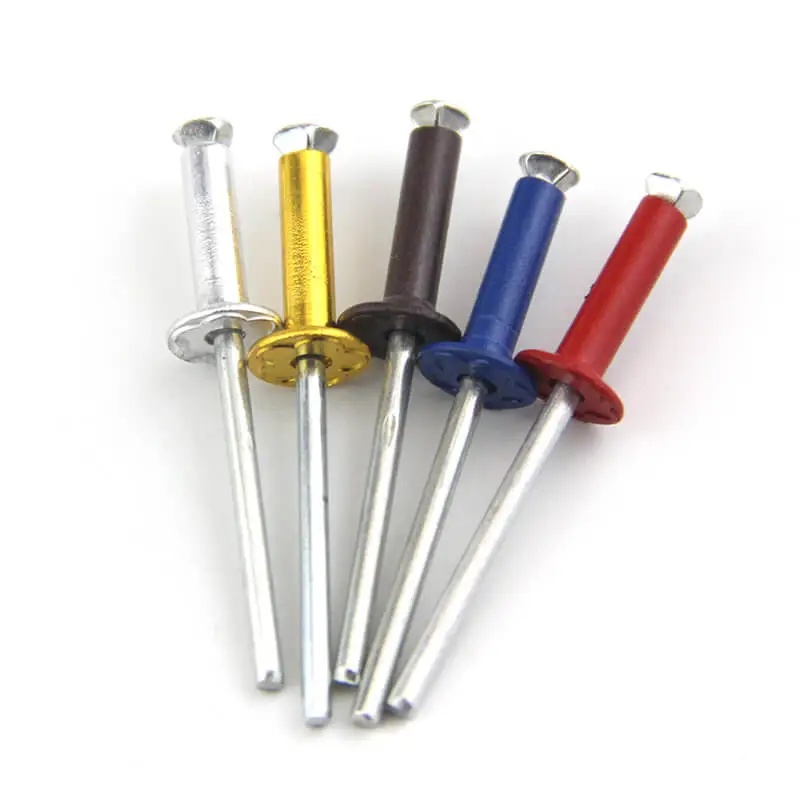
If you’re simply securing two thin plates together, an open-end connection is usually sufficient; however, if the connection point is likely to be exposed to water, dust, or moisture, or if you want to prevent leaks or air ingress through the holes, I would opt for a closed-end connection.
Why Use Pop Rivets Instead of Screws or Bolts?
When working in environments where access to the back is difficult, the material is thin, welding is not suitable, the assembly is not intended to be frequently disassembled, or quick assembly is required, it is best to prioritize pop rivets over screws or bolts.
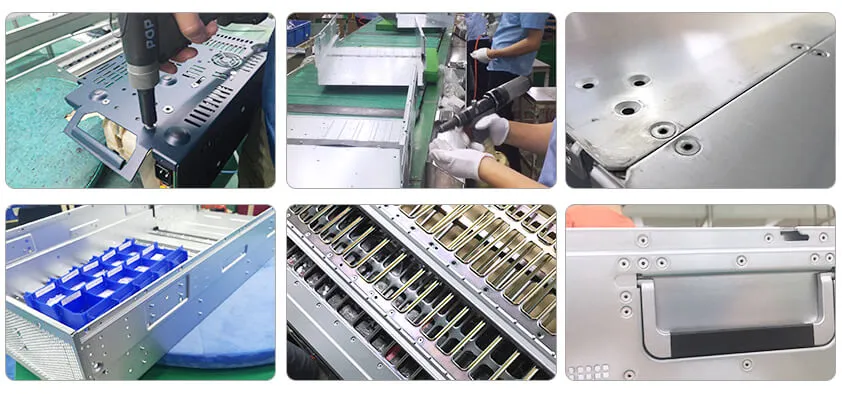
- Pop rivets can be installed from one side, even when the back is inaccessible
- Pop rivets are ideal for joining thin sheets
- Pop rivets are quick to install, making them suitable for mass assembly
- Pop rivets are not easily disassembled by hand
- Pop rivets are more resistant to vibration-induced loosening, provided the correct type is selected
- Pop rivets do not require a back nut, resulting in a cleaner appearance and more compact design
Screws and bolts are better suited for applications that will require disassembly, maintenance, or adjustment in the future, while pop rivets are better suited for joints that need to remain permanently fixed after installation and will not be frequently disassembled.
FAQ About Pop Rivet
Are pop rivets waterproof?
Not all are waterproof; closed-end/sealed rivets are better suited for sealing, but it still depends on the hole diameter and the quality of the installation.
Pop rivets vs screws: which is better?
Don’t make absolute comparisons; pop rivets are suitable for permanent fastening, while screws are suitable for removable repairs.
What is the difference between pop rivets and regular rivets?
Pop rivets can be installed from one side. Regular rivets usually need access to both sides.
What are pop rivets used for in industrial applications?
They are used for sheet metal, ducts, cabinets, trailers, and enclosures. They are good for fast, one-side installation.
Can pop rivets be used for plastic or composite materials?
Yes, but the rivet type must be selected correctly. Large flange, peel, or bulb rivets are often better.
Are pop rivets suitable for outdoor or marine environments?
Yes, but the rivet type must be selected correctly. Large flange, peel, or bulb rivets are often better.
Are pop rivets vibration-resistant?
Standard pop rivets handle general use. For strong vibration, use structural or locking rivets.
What specifications should I check when buying pop rivets?
Check diameter, grip range, material, head type, hole size, tensile strength, and shear strength.
Work with a IATF 16949 Certified Blind Rivet Manufacturer
Get High Quality Rivets Instead of Huck and Avdel Rivets

Rivmate Rivet
Rivmate is one of China’s top three manufacturers of pop rivets. The company is IATF 16949 certified and offers high-strength structural pop rivets that serve as alternatives to Huck and Avdel products.
Rivmate Rivet
Rivmate is one of China’s top three manufacturers of pop rivets. The company is IATF 16949 certified and offers high-strength structural pop rivets that serve as alternatives to Huck and Avdel products.