What is a pop rivet?
A pop rivet is a fastener that joins two or more perforated parts by deforming itself.
Its most notable feature is that it can be installed from one side of the workpiece; unlike screws, it cannot be repeatedly removed once installed. It is classified as a one-way rivet.
Structure of Pop Rivets
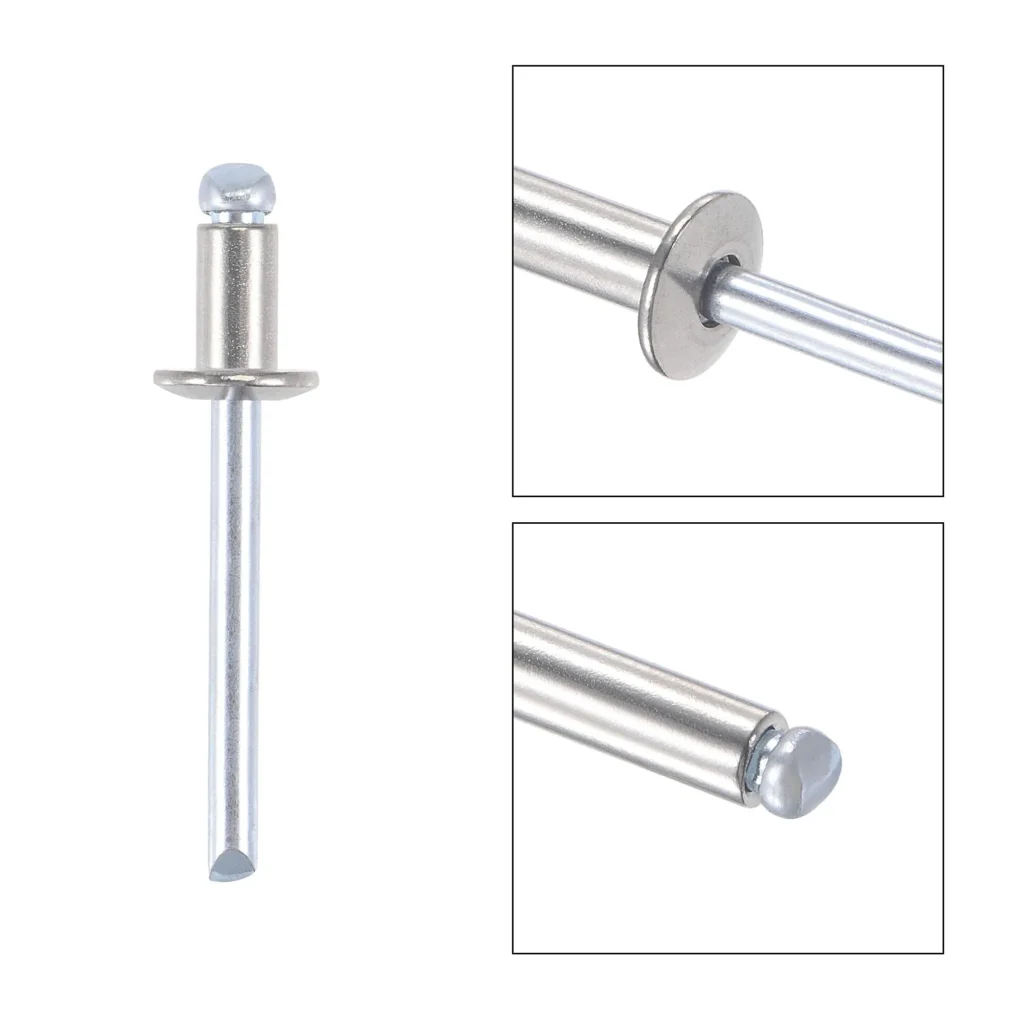
A pop rivet consists of two parts: the rivet body and the mandrel.
The rivet body is the metal shell surrounding the rivet that we see. It is the main component that actually performs the joining function, consisting of the rivet head, the cylindrical body, and the tail.
After a rivet is set, the original cylindrical rivet head is pulled and deformed, forming a large bulge. This bulge grips the material and distributes the load. At the same time, it provides connection strength and prevents loosening. Therefore, the part that actually remains in the workpiece is primarily the rivet head.

The slender metal rod in the center of the rivet is the mandrel. The mandrel’s primary function is to provide tensile force. It acts as a “tensioning device.” During riveting, the rivet gun grips the mandrel, which pulls outward, causing the tail end of the rivet body to expand. When the designed tensile force is reached, the mandrel breaks, and the riveting process is complete.

The rivet shank features a special section called the “Break Neck.” The Break Neck is the thinnest part of the rivet. When the tensile force reaches the design value, it will automatically break. This breaking point ensures that each rivet is installed with consistent results, preventing variations in installation quality caused by differences in the force applied by different installers.
How It Works
Pop rivets use a mandrel to generate tensile force, causing plastic deformation at the tail end of the rivet body and forming a rivet joint on the back of the workpiece, thereby clamping the material and creating a permanent connection.
- Before installation: The rivet is in its initial state. The rivet body is an external metal shell and serves as the main component of the future joint structure. At this stage, the rivet is merely a pre-assembled component and does not provide any fastening function.
- Inserting the rivet into the workpiece hole: During installation, holes must first be pre-drilled in the materials to be joined.
- The rivet gun begins to pull the mandrel: When the pulling force is applied, two things happen simultaneously. First, the mandrel moves outward; second, because the rivet head is constrained by the workpiece surface, the rivet body cannot move with it, so the pulling force is concentrated on the tail end of the rivet body.
- Plastic deformation occurs at the tail end of the rivet body: As the rivet shank continues to be pulled, its head begins to push backward against the tail end of the rivet body, causing the originally cylindrical rivet body to expand. A larger rivet joint gradually forms at the tail end of the rivet body.
- Permanent clamping of the material: Once the tail end of the rivet body has fully deformed, the workpiece is clamped between the rivet head and the rivet joint formed at the back. This structure generates a continuous clamping force, creating a permanent connection rather than a removable one.
- Automatic shearing of the mandrel: As the rivet gun continues to apply tensile force, the mandrel automatically shears at a predetermined position when the force reaches the design value.
What Is a Closed End Rivet?
Closed-end pop rivets are permanent fasteners that can only be installed from one side. After riveting, the tail of the rivet expands to clamp the workpiece, while the closed-end design prevents water, air, dust, or liquids from penetrating the interior of the rivet.
The key difference between closed-end rivets and standard open-end rivets is that the former features a closed-end design, which provides superior sealing performance in addition to mechanical fastening.

Features of Closed-End Pop Rivets
- Closed-end design for improved sealing: The closed tail reduces the likelihood of liquids, dust, and gases entering the internal channel of the rivet.
- The rivet head is located inside the rivet shell, reducing the risk of detachment: In a closed-end rivet, the rivet head is enclosed within the rivet shell, creating a more sealed structure after installation. This helps minimize the risk of the rivet head loosening or falling out.
- Wide range of material combinations: Closed-end pop rivets are available in a variety of common material combinations, allowing for selection based on specific application requirements.
What Is an Open End Rivet?
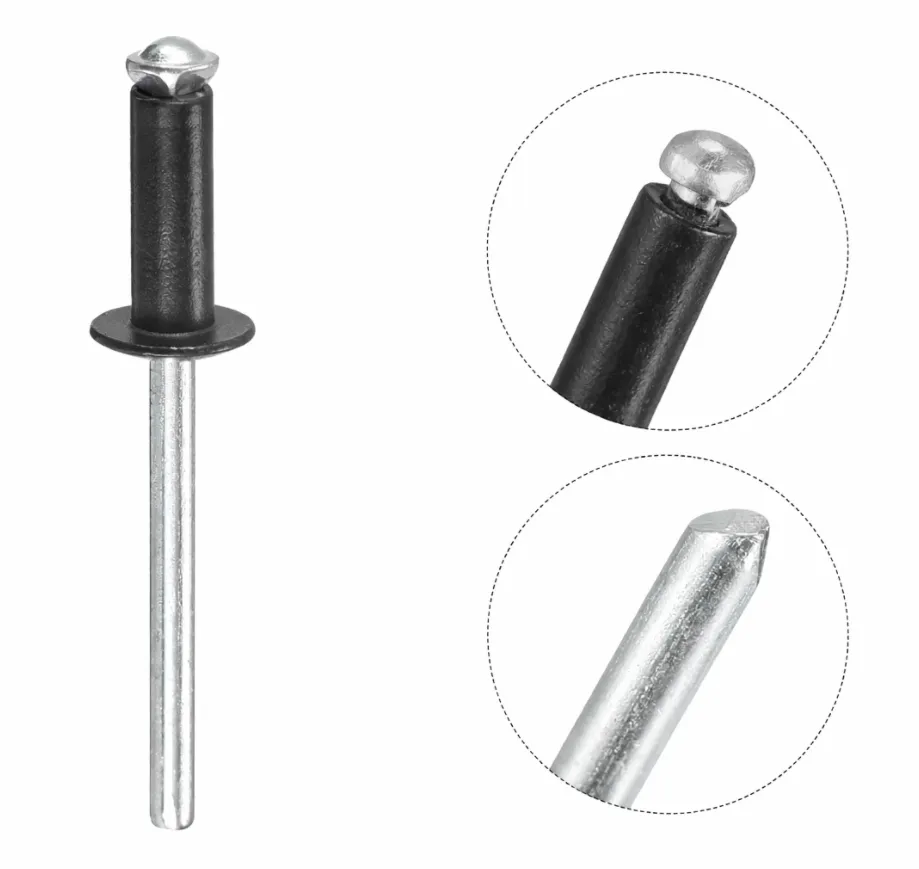
An open-end rivet is a type of pop rivet with an open end. It can be installed from one side of the workpiece; the rivet body is deformed by pulling the mandrel, forming a rivet joint on the reverse side, thereby permanently joining two or more layers of material together.
The open-end rivet is the most common and widely used type of pop rivet/blind rivet. Its key features include ease of installation, low cost, and suitability for most general fastening applications.
Features of Open-End Pop Rivets
- End configurations suitable for standard fixed connections: Open-end configurations are more suitable for general-purpose connections, while closed-end configurations are more suitable for sealed connections.
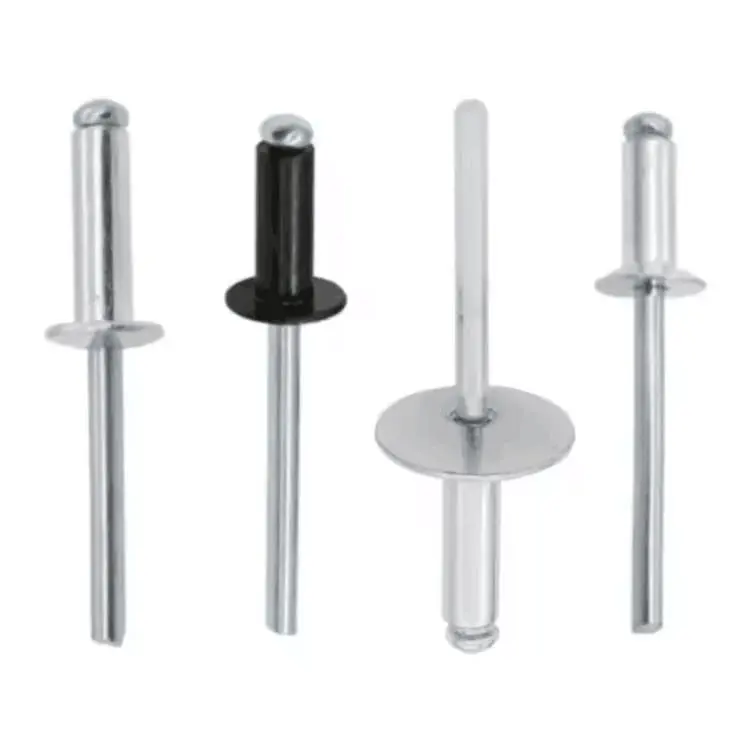
- A wide variety of head types are available to suit different surface requirements:
⑴Dome Head: The most common type, suitable for general fastening applications.
⑵CSK Head: Requires a countersunk hole; provides a flatter surface finish after installation.
⑶Large Flange: Features a larger head diameter, which increases the contact area with the workpiece and reduces localized stress, making it more suitable for thin sheets, soft materials, or situations where the hole is slightly oversized.
- Greater advantages in terms of cost and production efficiency: Open-end rivets are formed by cold heading wire, resulting in high production efficiency.
What Is the Difference Between Closed End and Open End Rivets?
The tail end of an open-end rivet has an open structure. After riveting, the rivet body expands and deforms on the blind side to generate clamping force, but the interior of the rivet body is not completely sealed. The tail end of a closed-end rivet has a closed structure, with the head of the rivet shank enclosed within the rivet shell.
This structural difference determines many of their subsequent performance differences:
Comparison Points | Open End Rivet | Closed End Rivet |
Primary Function | Standard fastening | Fastening + Sealing |
Weaker | Better | |
Water and Dust Resistance | Not a primary advantage | One of the primary advantages |
Cost | More economical | Higher cost |
Applications | Doors, windows, ventilation ducts, interior decoration, ladders, general household appliances, etc. | Electrical cabinets, shipping containers, buses, appliance housings, panel connections requiring sealing, etc. |
Key Selection Criteria | Material, diameter, length, grip range, head type | Material, sealing requirements, grip range, corrosion resistance requirements, operating environment |
1.Primary Function
The primary function of an open-end rivet is “fastening”;The primary function of a closed-end rivet is “fastening and protection.”
Both types can secure materials, but when a project involves water, moisture, dust, corrosive environments, or the protection of electronic components, a closed-end rivet is typically a better long-term solution.
2.Sealing Performance
Closed-end rivets offer significantly better sealing performance, whereas open-end rivets have weaker sealing capabilities.
This is not due to superior materials, but rather to differences in structural design. Closed-end rivets form a sealed structure at the tail end after installation, reducing the ingress of water, air, dust, or liquids through the rivet’s central hole into the joint area; in contrast, open-end rivets, due to the open structure at the tail end, typically leave a potential pathway for penetration even after installation.
3.Water and Dust Resistance
Closed end rivets generally provide better resistance against water and dust because their enclosed body design reduces the chance of moisture, dirt, and contaminants entering through the rivet center.
Open end rivets are used in general fastening applications, but for outdoor equipment, roofing systems, HVAC ducts, trailers, and electrical enclosures where environmental protection is important, closed end rivets are often the preferred choice.
4.Cost
Sealed rivets generally offer superior water and dust resistance, as their sealed design reduces the likelihood of moisture, dust and contaminants penetrating the centre of the rivet. Open rivets are typically used for general fastening applications;
however, in environments where environmental protection is a priority—such as outdoor equipment, roofing systems, HVAC ductwork, trailers and electrical enclosures—sealed rivets are often the preferred solution.
5.Applications
Open end rivets are widely used in general fastening applications such as home appliances, doors, windows, ventilation ducts, furniture, and sheet metal assembly because of their cost-effectiveness and versatility.
Closed end rivets are more commonly used in applications requiring better protection against moisture, dust, or contamination, including HVAC systems, roofing, outdoor equipment, trailers, electrical enclosures, and solar installations.
6.Key Selection Criteria
When choosing between closed end and open end rivets, factors such as operating environment, sealing requirements, material compatibility, strength requirements, grip range, and cost should all be considered. The right choice depends on the application rather than simply selecting the rivet with more features.
How to Choose the Right Rivet for Your Project
Selecting the appropriate type of rivet depends on the operating environment, structural requirements, and total lifecycle cost. Making a choice without careful consideration often leads to assembly failures or increased maintenance costs down the line. Therefore, engineers should make an informed selection during the design phase based on factors such as environmental conditions, protection requirements, and material properties.
1. Determine whether your project requires sealing: Are the riveted areas exposed to rain, moisture, or dust?
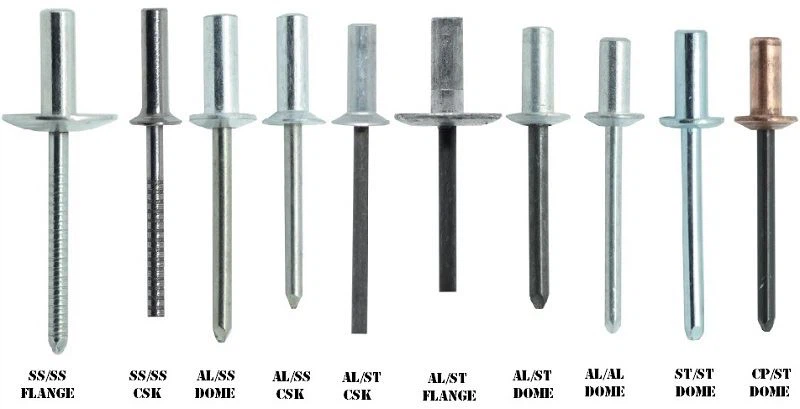
2. Confirm the material combination:
Material Combinations | Features |
Aluminum / Steel | Balances cost and strength; a common, versatile option |
Aluminum / Aluminum | Lightweight; suitable for light-duty applications or situations with moderate corrosion resistance requirements |
Aluminum / Stainless Steel | The nail core offers better corrosion resistance |
Steel / Steel | Offers advantages in strength and cost, but surface treatment requires attention |
Stainless Steel / Stainless Steel | Excellent corrosion resistance; higher cost |
3. Verify the riveting range: Before selecting a rivet, measure the total thickness of the material to be riveted, then confirm that the rivet’s grip range is compatible.
4. Verify hole diameter, mounting surface, and head type: The same rivet performs differently on flat surfaces, curved surfaces, thin sheets, and soft materials, so selection must be tailored to the specific application.
5. Verify strength requirements: Do not use standard rivets in heavy-duty structural applications.
6. Verify surface treatment and corrosion environment:If the project is located outdoors, in humid conditions, in a salt spray environment, in a cleaning environment, or where there is a risk of corrosion, surface treatment and material corrosion resistance must be considered.
When Should You Use Closed End Rivets?
When your project requires more than just simple fastening, you should use blind rivets. If the application requires better protection against water, dust, gas, or liquid leakage, blind rivets are more suitable than standard open-end rivets.
Because the body of a blind rivet is sealed and the rivet head is completely enclosed within the body, blind rivets are suitable for applications such as electrical cabinets, shipping containers, buses, home appliances, outdoor enclosures, and other scenarios that demand high levels of sealing and reliability.

When Are Open End Rivets the Better Choice?
When your project requires standard fastening rather than sealing, open-end rivets are the better choice. They are widely used in doors and windows, ventilation ducts, gutters, ladders, interior decoration, outdoor equipment, and various household appliances.
Compared to blind rivets, open-end rivets are easier to source, offer a wider range of standard sizes and material combinations, and provide greater cost advantages in high-volume assembly. They are suitable for applications where waterproofing, dustproofing, or leak prevention are not critical requirements.

Common mistakes when choosing between open and closed end blind rivets
Mistake 1: Focusing Only on Price and Ignoring Application Risks
Mistake 2: Assuming Closed-End Rivets Are “Better in Every Way”
Mistake 3: Assuming that closed-end rivets are inherently waterproof to a certain degree.
Mistake 4: Focusing only on rivet diameter and rivet length while ignoring the grip range
Mistake 5: Ignoring Hole Diameter and Mounting
Mistake 6: Ignoring Materials and Surface Treatments
Mistake 7: Using Standard Open-End Rivets in High-Vibration or Load-Bearing Applications
Mistake 8: Neglecting Installation Tools and Riveting Quality
FAQs
Are closed end blind rivets stronger than open end rivets Closed end rivets
The key advantages of closed-end rivets are their sealing properties and the encapsulated mandrel head design; the key advantages of open-end rivets are their versatility, cost-effectiveness, and wide range of sizes.
As for which type offers higher strength, it depends on the specific material, diameter, rivet body structure, mandrel material, grip range, and test data.
Are open end rivets good enough if I do not need sealing
Yes, if your project does not require sealing functions such as waterproofing, dustproofing, or leak prevention, open-end rivets are sufficient for standard fastening applications.
However, “no sealing required” does not mean you can simply choose any open-end rivet. You must still verify the material, diameter, length, grip range, hole diameter, head type, surface finish, and strength requirements.
Choosing the best pop rivet type for automotive and marine projects
When selecting pop rivets for automotive and marine applications, the choice should be based on requirements for sealing, corrosion resistance, vibration resistance, and strength.
Open-end rivets are suitable for general non-sealed connections, such as interior panels, lightweight brackets, and standard sheet metal fastening. Closed-end rivets are better suited for applications requiring protection against water, dust, air leaks, or liquid leaks.
If an automotive project involves severe vibration, high shear resistance, or structural safety, standard open-end or closed-end rivets may not be sufficient; in such cases, structural blind rivets or lockbolts should be considered.
Are closed end rivets worth the extra cost over open end
If a project requires waterproofing, dustproofing, airtightness, or liquid tightness, or if the riveted joint is intended to protect an internal space, then closed-end rivets are worth the extra cost compared to open-end rivets.
However, for ordinary fastening applications with no sealing requirements, open-end rivets are often more economical and practical.
Open end vs closed end rivets for HVAC and ductwork installations
For standard HVAC duct fastening, open-end rivets are a practical and cost-effective choice, suitable for connecting ventilation ducts and standard sheet metal.
However, if duct joints are exposed to moisture, rain, condensation, dust, or the risk of leaks, closed-end rivets are more appropriate. This is because their sealed head provides better sealing and protection than standard open-end rivets.
For high-vibration HVAC equipment or large ventilation systems, it is also necessary to verify tensile strength, shear strength, material, surface treatment, grip range, and installation conditions.
Mandrel retention: closed end rivets vs open end rivets
Generally speaking, closed-end rivets are more conducive to mandrel head encapsulation than standard open-end rivets, because the mandrel head of a closed-end rivet is enclosed within the closed rivet body. This helps reduce mandrel head loosening, rattling, internal contamination, or electrical issues.
However, mandrel retention is not determined solely by whether the rivet is open-end or closed-end; it also depends on the mandrel design, break point location, body material, grip range, hole diameter, and installation quality.
Appearance and finish: choosing between open and closed end rivets
If your primary concern is the appearance of the finished surface, you should first select the appropriate head style and surface finish.
Open-end rivets offer a wider range of standard options in terms of head style, material, color, and surface finish, making them suitable for general exposed fastening applications.
Closed-end rivets are better suited for applications where the cleanliness of the back side, a sealed structure, internal cleanliness, or the encapsulation of the rivet shank are more critical. The final appearance also depends on the hole diameter, the rivet gun nozzle, tensile strength, the workpiece surface, coating quality, and installation conditions.
Can open end rivets be used where closed end rivets are recommended
This is strongly discouraged. Open-end rivets can hold materials together, but they lack the sealed body structure found in closed-end rivets.
If closed-end rivets are recommended because the joint requires waterproofing, dustproofing, airtightness, liquid tightness, or better shank coverage, then open-end rivets cannot be used as a direct substitute.
Open-end rivets should only be considered when it is confirmed that the application does not require sealing, the operating environment is suitable, and the material, grip range, hole diameter, and strength requirements are all met.
How to decide between open end, closed end, and multi‑grip pop rivets
If you are making a standard fixed connection that does not require sealing and the workpiece thickness is consistent, you can choose open-end pop rivets.
If your joint requires protection against water, dust, air leaks, or liquid leaks, you should choose closed-end pop rivets. If a single rivet size needs to accommodate multiple sheet thicknesses, or if hole positioning is inconsistent, you can choose multi-grip pop rivets.
If the application involves severe vibration, high shear forces, or structural loads, standard open-end, closed-end, or multi-grip rivets may not be sufficient; you should consider structural blind rivets or lockbolts.
Open end vs closed end rivets in electronics and enclosure sealing
If electronic assemblies only require standard fastening, open-end rivets are sufficient.
However, for electrical cabinets, control boxes, outdoor electronic equipment, battery enclosures, home appliance housings, and equipment enclosures that require sealing, closed-end rivets are more suitable because the sealed rivet head reduces the risk of water, dust, air, or liquids entering the interior through the rivet location.
Closed-end rivets also help enclose the rivet head within the rivet body, reducing the risk of small metal parts becoming loose or falling inside the enclosure.
Work with a IATF 16949 Certified Blind Rivet Manufacturer
Get High Quality Rivets Instead of Huck and Avdel Rivets

Rivmate Rivet
Rivmate is one of China’s top three manufacturers of pop rivets. The company is IATF 16949 certified and offers high-strength structural pop rivets that serve as alternatives to Huck and Avdel products.
Rivmate Rivet
Rivmate is one of China’s top three manufacturers of pop rivets. The company is IATF 16949 certified and offers high-strength structural pop rivets that serve as alternatives to Huck and Avdel products.