What Are Open End Blind Rivets?
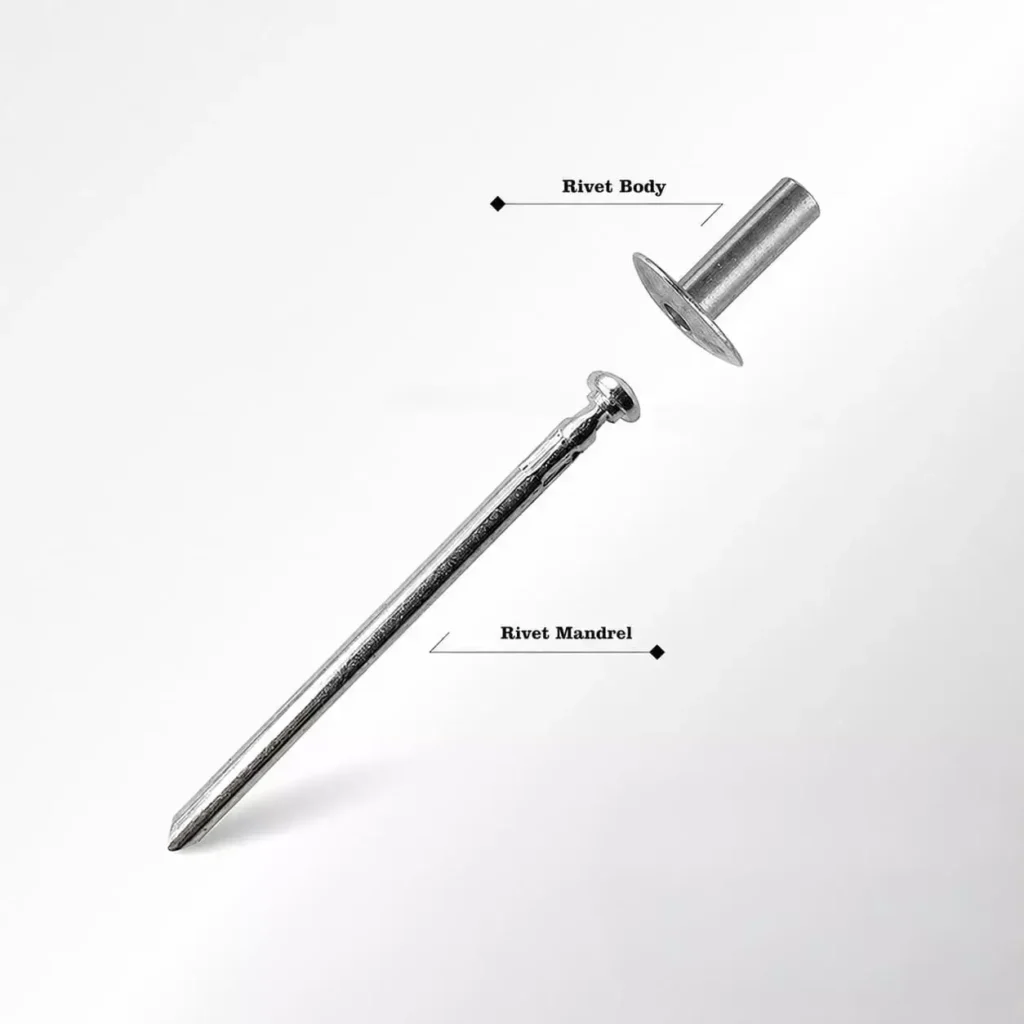
Open-end blind rivets are mechanical fasteners that can only be installed from one side of the workpiece (blind installation) and are used to permanently join two or more pieces of material. They consist of a rivet body and a mandrel.
The tail end of the open-end blind rivet has an open structure. After installation, the mandrel is not completely sealed inside; the tail end remains open.
Open-end blind rivets are among the most common and widely used types within the blind rivet family. They are extensively used in applications such as doors and windows, interior decoration, ventilation ducts, drainage channels, home appliances, and outdoor equipment.
How Do Open End Blind Rivets Work?
Open-end blind rivets work by using a rivet gun to pull the mandrel, causing the tail end of the rivet body to undergo plastic deformation. This creates an expanded locking structure on the back of the workpiece, thereby clamping and securing the material. Once the preset tensile force is reached, the mandrel automatically breaks at the predetermined breaking point, forming a permanent joint.
The installation process consists of four steps:
Insert the rivet into the hole → The rivet gun begins pulling the mandrel → The tail end of the rivet body expands → The mandrel automatically breaks
Tip: The mandrel is not merely an installation tool. During installation, the mandrel provides the pulling force that drives the deformation of the rivet body. After installation is complete, a portion of the mandrel remains inside the rivet body. This increases the overall joint strength and improves shear strength.
Key Types and Materials of Open End Blind Rivets
The material of open-end pop rivets determines their strength, corrosion resistance, cost, and applications.
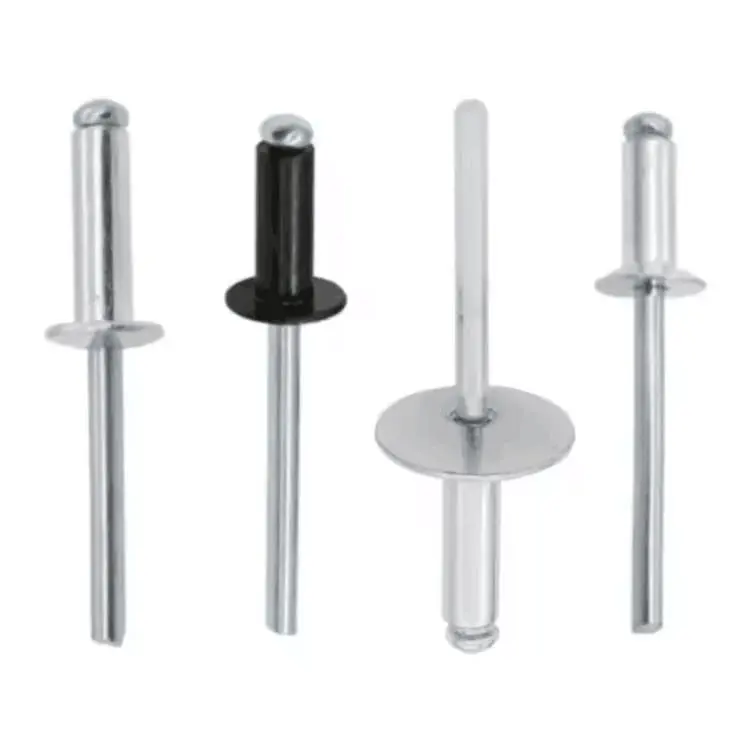
The head type determines: the surface finish of the contact area and the level of protection provided to the workpiece.
Classified by Material
①Aluminum / Steel (AS Series)
Advantages:
✓ Lower cost
✓ Lightweight
✓ Easy to install
✓ Most widely used
Disadvantages:
✗ Moderate strength
✗ Prone to corrosion in humid environments

②Aluminum / Aluminum (AA Series)
Advantages:
✓ Very lightweight
✓ Good corrosion resistance
✓ Resistant to electrochemical corrosion
Disadvantages:
✗ Low strength

③Aluminum / Stainless Steel (AB Series)
Advantages:
✓ More corrosion-resistant than aluminum-iron alloys
✓ Higher strength
✓ Suitable for outdoor environments
Disadvantages:
✗ Higher cost

④Steel / Steel (SS Series)
Advantages:
✓ High strength
✓ High shear strength
Disadvantages:
✗ Prone to rust
✗ Relatively heavy

⑤Stainless Steel / Stainless Steel (BB Series)
Advantages:
✓ High strength
✓ High corrosion resistance
✓ Long service life
Disadvantages:
✗ Highest cost
✗ Requires significant installation torque

Classified by head shape
Advantages and Limitations
Part 1:Advantages
① One-Side Installation
Traditional solid rivet installation:two-sided operation
Open-Ended Blind Rivet Installation:only one-sided installation
② Fast installation speed
③ Lower cost
④ Wide range of material options
⑤ Suitable for thin sheets
Part 2:Limitations
① Limited sealing capability: The tail end of open-end pop rivets is open, which may allow air, water, and dust to enter the channel. For applications requiring high sealing performance, closed-end pop rivets are recommended.
② Moderate vibration resistance
③ Not suitable for structures subjected to extremely high loads
④ Sensitive to grip range

Common Applications Across Industries
One of the main reasons Open-End Blind Rivets have become one of the most common types of blind rivets is that they are suitable for nearly all thin-sheet metal fastening applications.
Common industries include:
1.HVAC (Heating, Ventilation, and Air Conditioning)
2.Construction and doors/windows
3.Home appliances
4.Automotive and transportation equipment
5.Photovoltaics
6.Electrical equipment
7.Metal furniture and general industrial manufacturing

How to Choose the Right Open End Blind Rivet&Common Mistakes to Avoid
When selecting the right open-end blind rivet, don’t focus on price or size first. Instead, follow this logic:
Workpiece material → Total material thickness (Grip Range) → Strength requirements → Operating environment → Head type → Hole diameter and dimensions
Step 1: First, examine the connecting materials:
Workpiece Material | Common Recommendations |
Carbon Steel Sheet | AS / SS |
Aluminum Sheet | AA / AB |
Stainless Steel Sheet | BB |
Plastic | AA or Large Flange |
Soft Materials | Large Flange |
Step 2: Determine the total material thickness (Grip Range)
Step 3: Determine the strength requirements (tensile strength/shear strength)
Step 4: Consider the operating environment
Step 5: Select the head style
Step 6: Determine the hole diameter and dimensions
Common Mistakes to Avoid

Mistake 1: Focusing only on diameter and length
Mistake 2: Ignoring the grip range
Mistake 3: Assuming “stronger is better”
Mistake 4: Ignoring corrosion issues
Mistake 5: Assuming all blind rivets are the same
Mistake 6: Incorrect hole diameter
Mistake 7: Using the wrong installation tool
Mistake 8: Failing to inspect the riveting results after installation
Open End vs Sealed vs Structural Rivets
The main difference between Open-End Blind Rivets, Sealed Blind Rivets, and Structural Blind Rivets lies not in their appearance, but in their design objectives:
- Open-End Blind Rivet → Emphasizes versatility and cost-effectiveness
- Sealed Blind Rivet → Emphasizes sealing, water resistance, and dust resistance
- Structural Blind Rivet → Emphasizes high strength and vibration resistance
Compare across multiple dimensions using the table below
Comparison Items | Open End Blind Rivet | Sealed Blind Rivet | Structural Blind Rivet |
Basic Structure | Open tail end; rivet shank remains exposed | Closed tail end; rivet shank is sealed inside | Includes a mechanical locking mechanism |
Operating Principle | Rivet body deformation to clamp the workpiece | Rivet body deformation + sealed tail end | Rivet body deformation + mechanical locking |
Sealing Capability | Low | High | Mediu006D |
Water Resistance | Fair | Excellent | General |
Dust Resistance | General | Excellent | Moderate |
Vibration Resistance | Moderate | Moderate | High |
Moderate | Moderate | High | |
Moderate | Moderate | High | |
Moderate | Moderate | High | |
Installation Tool Requirements | Standard rivet gun | Standard rivet gun | Specialized tools typically required |
Automation Compatibility | High | High | Moderate |
Typical Applications | HVAC, home appliances, doors and windows, general sheet metal | Roofing, electrical enclosures, liquid containers, outdoor equipment | Trucks, trailers, construction machinery, railway equipment |
Step by step installation guide for open end blind rivets
Step 1: Verify that the rivet specifications are correct.
Step 2: Measure the total thickness of the workpiece.
Step 3: Drill or punch holes.
Step 4: Clean the holes.
Step 5: Insert the rivet.
Step 6: Select the appropriate nozzle and rivet gun, then begin riveting.
Step 7: Remove the broken mandrel after it breaks.
Step 9: Inspect the riveting result.
How to Check the Riveting Results After Installation
1) Check that the front brim fits properly
2) Check that the back bulge is intact
3) Check that the workpiece is securely clamped
4) Check that the rivet shank break point is normal
5) Check the rivet head for cracks, zinc blistering, or abnormal deformation
FAQs
Best practices for drilling and hole preparation for blind rivets
Best practices for drilling and hole preparation for blind rivets include selecting the correct hole diameter, aligning holes between workpieces, removing burrs, cleaning chips and oil from the hole area, and ensuring the sheets are tightly fitted before riveting.
A hole that is too large can reduce clamping force or cause mandrel pull-through, while a hole that is too small may prevent proper installation or damage the rivet body.
Strength and performance of open end blind rivets in different materials
The strength and performance of blind rivets vary significantly depending on the material combination.
Aluminum rivets are lightweight and corrosion-resistant; steel rivets offer higher strength; and stainless steel rivets combine high strength with excellent corrosion resistance.
The selection of the appropriate material should be based on application requirements, environmental conditions, and load demands, rather than simply choosing the option with the highest strength.
When to use open end blind rivets instead of screws or solid rivets
Open-end blind rivets are preferred over screws or solid rivets when single-sided installation, rapid assembly, thin-sheet joining and high production efficiency are required. They are widely used in HVAC systems, sheet metal fabrication, domestic appliances and industrial assembly.
Screws are more suitable for detachable joints, whilst solid rivets are generally the preferred choice for heavy-duty structural applications requiring higher fatigue resistance.
Rivet body and mandrel material combinations for corrosion resistance
The corrosion resistance of open-end blind rivets depends not only on the material of the rivet body but also on the combination of materials used for the mandrel.
Common combinations include aluminum/steel, aluminum/stainless steel, steel/steel, and stainless steel/stainless steel.
Stainless steel combinations typically offer better corrosion resistance, while mixed materials may pose a risk of electrochemical corrosion in humid or outdoor environments.
When selecting appropriate materials, one should consider the workpiece material, environmental exposure, and service life requirements.
Can open end blind rivets provide any sealing against air or water
Because open-end blind rivets have an open tail, small channels typically remain inside after installation; therefore, they are generally not used in applications requiring a seal.
For applications requiring waterproofing, leak prevention, or airtightness, we recommend using sealed blind rivets or employing additional sealing methods such as gaskets and sealants.
Troubleshooting common open end blind rivet installation problems
The most common issues encountered during the installation of open-ended pop rivets include: breakage of the rivet mandrel, the mandrel piercing through the rivet body, loosening of the rivet, and abnormal bulging on the reverse side.
You should check the hole diameter, inspect the tools, verify the fit of the workpiece, and finally check the materials.
Safety tips and tool selection for installing open end blind rivets
When installing open-end blind rivets, select the appropriate tool based on the rivet diameter, mandrel material and production batch size.
Manual riveting tools are suitable for small-batch operations, whilst pneumatic or hydraulic-pneumatic tools are better suited to larger rivets and mass production.
You must follow standard operating procedures during installation. This includes wearing safety goggles, using the correct rivet head, keeping the tool vertical, securing the workpiece, and regularly clearing broken mandrels from the tool.
Buying guide: how to choose quality open end blind rivets
When selecting open-end blind rivets, it is important to look beyond just the diameter and price.
When assessing quality, you should take into account the material composition, clamping range, manufacturing consistency, surface finish, corrosion resistance and the supplier’s testing capabilities.
A high-quality rivet should provide consistent installation performance, reliable strength and long-lasting durability in its intended application.
Are open end blind rivets suitable for general‑purpose applications
Open-end blind rivets are among the most common and typical general-purpose fasteners within the blind rivet category.
They are frequently used in sheet metal fabrication, HVAC systems, domestic appliances, electrical enclosures and general industrial assembly.
In applications involving high vibration, stringent sealing requirements or heavy structural loads, specialised rivets are required.
Open end blind rivets in electronics enclosures and light assemblies
Open-end blind rivets are suitable for electronic enclosures and lightweight assemblies, and are particularly well-suited to applications requiring rapid single-sided installation, thin-sheet fastening and permanent joints.
They are commonly used in metal enclosures, brackets, frames, LED mounts and lightweight fittings.
For waterproof enclosures, outdoor lighting or removable service panels, sealed rivets, screws, washers or sealants are more appropriate.
Work with a IATF 16949 Certified Blind Rivet Manufacturer
Get High Quality Rivets Instead of Huck and Avdel Rivets

Rivmate Rivet
Rivmate is China’s manufacturers of pop rivets. The company is IATF 16949 certified and offers high-strength structural pop rivets that serve as alternatives to Huck and Avdel products.
Rivmate Rivet
Rivmate is China’s manufacturers of pop rivets. The company is IATF 16949 certified and offers high-strength structural pop rivets that serve as alternatives to Huck and Avdel products.

Hey There, I'm Allen!
I am the boss of Rivmate. For over two decades, we have specialized in the manufacture of blind rivets, providing our customers with reliable riveting solutions. Need riveting services? Feel free to contact us.