What Are Closed End Rivets
Closed-end rivets are a type of blind rivet with a completely sealed tail. The main difference between them and standard open-end rivets is that, once installed, the mandrel is enclosed within the closed rivet body. Since no through-hole is formed, they provide superior sealing, waterproofing, and moisture resistance.
Structural Components of a Closed-End Rivet
The structural components of a closed-end rivet primarily include:
1. Rivet Body
2. Mandrel
3. Rivet Head
4. Closed End
5. Break Point
6. Expansion Area
1. Rivet Body
This is the largest part of the closed-end rivet. Its primary function is to undergo plastic deformation and withstand shear forces.
Common materials for rivet bodies include aluminum, carbon steel, and stainless steel.
2.Mandrel
The primary function of the mandrel is to pull on the rivet body, causing it to deform and generate a clamping force, and to break once the set force is reached.
The mandrel is the core driving component of a blind rivet.
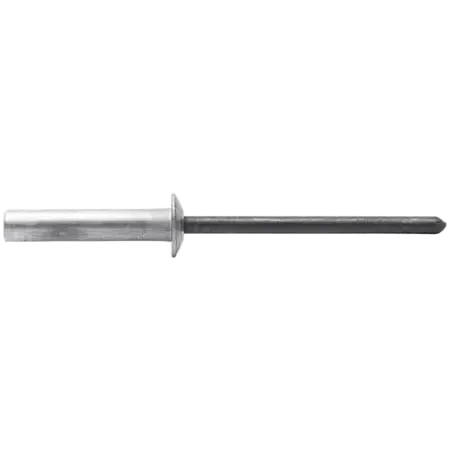
3.Rivet Head
The purpose of a hat brim is not merely to “look good.” Its true function is to distribute pressure. The larger the brim, the greater the surface area that bears the load.
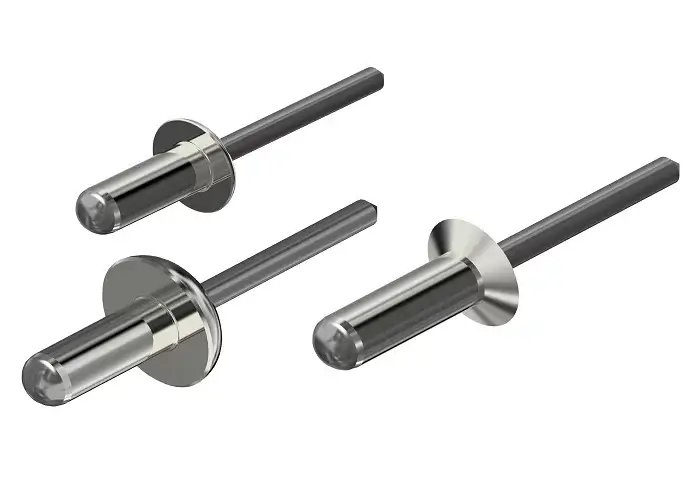
Common hat styles include:
1.Dome Head:The most common and standard blind rivet head type. Highly versatile.
2.Large Flange:The brim is noticeably wider. This increases the contact area with the workpiece, reduces pressure, and protects the workpiece.
3.CSK Head:The surface must not be raised; this hat style emphasizes a “smooth appearance”
4.Closed End
Closed-end design. This reduces water ingress, minimizes salt residue, and improves sealing performance. This is crucial in marine environments.
5.Break Point
There is a special tapered section on the mandrel. When the tensile force reaches the set value, the rivet will break at this point. This is the break point.
The break point determines the location, diameter, and length of the break. It directly affects the rivet’s grip range and shear strength.
6.Expansion Area
This is the position where the Closed-End Rivet actually achieves a “locked” state after installation. During installation, the tail flanges out, bulges, and then presses against the material. This structure determines the clamping force, tensile strength, and anti-loosening performance.
Why Aluminum Boats Require Sealed Rivets Instead of Standard Rivets
Aluminum boats typically require sealed rivets (such as closed-end rivets) rather than standard rivets. The primary reason is not that they provide a “stronger hold,” but rather that they offer superior long-term water resistance, corrosion resistance, and durability.
The drawbacks of standard rivets
Standard open-end blind rivets have an open-ended design. After installation, the mandrel may break, leaving a through-hole at the end and creating a void inside. This design is suitable for doors, windows, home appliances, and HVAC systems.
However, the marine environment is entirely different. The operating conditions for aluminum boats are more demanding than those for ordinary equipment. Aluminum boats are constantly exposed to:
- Seawater salinity ⟹ Accelerated corrosion
- Constant moisture ⟹ Prone to water accumulation
- Wave impact ⟹ Repeated vibration
- Engine vibration ⟹Connection fatigue
- Day-night temperature fluctuations ⟹ Material expansion and contraction
When multiple factors combine, even a very small gap can gradually widen. For this reason, many hull joints prioritize watertight integrity rather than just the strength of the rivets.
The real danger is hidden corrosion
In the case of aluminum boats, an even more serious issue is galvanic corrosion. When an aluminum hull, a steel rivet mandrel, and seawater (the electrolyte) are present simultaneously, an electrochemical reaction may occur. The aluminum plate corrodes first, causing the surface to bulge and the holes to gradually enlarge, which reduces the rivet’s strength.
Therefore, in addition to using closed-end rivets, the marine industry also considers the material of the rivet head, the material of the rivet shank, sealing performance, and surface treatment.
Key Benefits of Closed End Rivets in Marine Applications
For aluminum boats, rivets are not merely “fasteners”; they are an integral part of the hull’s waterproofing and corrosion protection system. While standard fasteners may last for many years in indoor settings, problems are greatly magnified in a marine environment. Closed-end rivets, however, offer numerous advantages in marine environments.
Best Sealing Performance
With standard open-end blind rivets, the mandrel breaks off after installation. This creates a hollow channel and tiny gaps inside the rivet. In typical indoor environments, this issue may not be noticeable for several years. However, in marine environments, seawater constantly soaks, washes, penetrates, evaporates, and crystallizes. Over time, salt gradually accumulates inside the riveted area.
The tail end of a closed-end rivet is sealed, reducing the pathways for liquids to enter the rivet. This significantly improves water resistance, moisture resistance, and resistance to salt spray penetration.

Improved Corrosion Resistance
One of the most serious problems in the marine industry is corrosion, particularly hidden corrosion. This is because seawater contains a high concentration of salt.
Saltwater is essentially a strong electrolyte, which significantly accelerates the rate of metal corrosion. When seawater enters rivet joints, it can easily lead to galvanic corrosion.
Better Vibration Resistance
A boat is not a static structure. While in operation, an aluminum boat is constantly subjected to engine vibrations, wave impacts, hull twisting, and high-frequency fatigue loads.
These forces repeatedly act on the rivet holes and the locking positions of the rivet shanks. If the internal structure of the rivet is unstable, loosening and shank detachment may occur over time.
Because many closed-end blind rivets have a sealed tail, their mandrel retention is more stable than that of standard open-end rivets. They are therefore better suited for marine environments.
Better for Thin Aluminum Panels
Many aluminum boats use 1–4 mm marine-grade extruded aluminum sheets. If subjected to uneven localized stress, these materials are prone to deformation, tearing, and hole enlargement.
Closed-end blind rivets create a more stable bulge at the tail end and provide more uniform clamping force.
Lower Long-Term Maintenance
Many parts of a ship are difficult to disassemble, which makes maintenance inconvenient. Furthermore, the difficulty of performing repairs at sea leads to significant losses for the vessel. Therefore, ship components must be installed correctly the first time to ensure long-term stability.
One of the key benefits of closed-end rivets is that they help reduce the need for repairs due to water ingress. And decrease the frequency of replacements caused by corrosion, thereby reducing the overall frequency of hull maintenance.
Cleaner Finished Appearance
Standard open-end rivets have a hole at the tail end after breaking, exposing the broken core.
In contrast, closed-end rivets remain more intact, resulting in a cleaner appearance and making them less prone to dirt accumulation. They are particularly suitable for yachts and high-end cabins.

Better for Enclosed Wet Areas
Many areas in marine equipment are semi-enclosed, with high humidity and poor ventilation. Storage compartments, battery compartments, and piping areas are particularly vulnerable to prolonged moisture buildup.
The sealed structure of closed-end rivets helps prevent condensation from entering and moisture from accumulating, thereby reducing internal corrosion. As a result, they are commonly used in marine electrical systems.
Best Materials for Aluminum Boat Rivets (Avoid Costly Corrosion Mistakes)
The selection of materials for marine rivets is more complex than in ordinary industrial applications. The marine environment—characterized by salt spray, humidity, and thermal cycling—amplifies the potential difference between metals. Therefore, the selection of marine fasteners is critical.
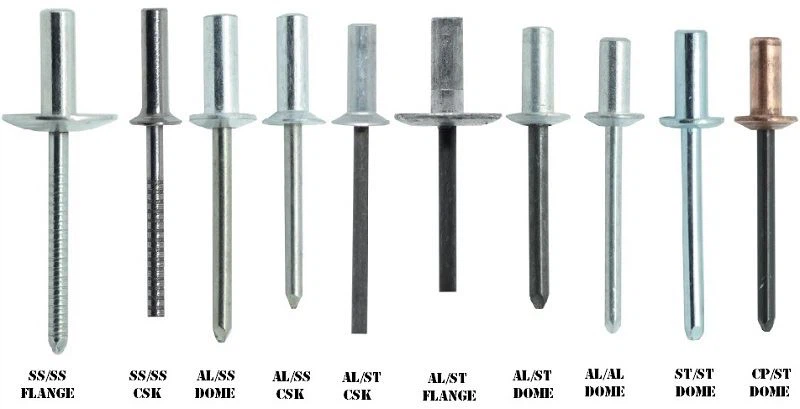
All-aluminum blind rivet
Advantages of All-Aluminum Rivets:
(1) More resistant to marine corrosion
(2) Lightweight
(3) Reduce the risk of corrosion of aluminum sheets
Disadvantages of all-aluminum rivets:
(1)relatively low strength
Aluminum-Stainless Steel Rivets
Advantages of Aluminum-Stainless Steel Rivets:
(1) Combines corrosion resistance, strength, and installation stability
(2)The stainless steel nail core enhances tensile strength and vibration resistance
Disadvantages of Aluminum-Stainless Steel Rivets
(1)There is a significant potential difference between aluminum and stainless steel. In seawater, aluminum may act as the anode (the side being corroded).
All-stainless-steel rivets(Stainless / Stainless)
Advantages of All-Stainless Steel Rivets
(1) High strength
(2) The rivets themselves are corrosion-resistant
(3) Suitable for high-strength marine equipment
Disadvantages of all-stainless-steel rivets
(1) The potential difference between stainless steel and aluminum is greater.
In a long-term seawater environment, the aluminum sheet will corrode first.
How to Choose the Right Closed End Rivet for Your Boat
Step 1: First, determine the hull material:One of the biggest problems with marine riveting isn’t that the rivets themselves fail, but rather that the hull corrodes.
Step 2: Determine the environment (freshwater vs. saltwater):Many materials can be used for long periods in freshwater environments. In seawater environments, seawater acts as a strong electrolyte.
Step 3: Selecting the Correct Grip Range:If the grip range is mismatched, issues such as prolonged hull vibration, moisture, and cyclic loading will be rapidly exacerbated.
Step 4: Select the rivet strength based on the applied load:The hull is divided into light-load areas and high-vibration areas. The stress conditions differ, so the selection of rivet strength also varies.
Step 5: Choose the Right Head Style:Determine whether this area requires a smooth, aesthetically pleasing finish or whether the clamping force needs to be distributed.
Typical Applications of Closed End Rivets in Boat Manufacturing
Hull Bottom
The hull bottom is one of the most demanding areas of an aluminum boat:
Operating Conditions | Impact |
Continuous immersion in seawater | High corrosion |
High-speed wave impact | High impact |
Hull vibration | Fatigue cycles |
Transportation by trailer | Additional vibration |
Collision with shoals | Localized impact |
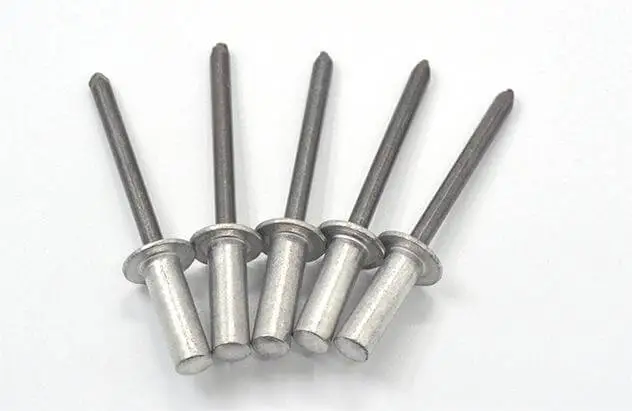
Hull plates are better suited for large-cap closed-end pop rivets.
Recommended:
5056 Aluminum Closed-End Rivet
5154 Aluminum Closed-End Rivet
Aluminum/Stainless Steel Closed-End Rivet (for certain high-vibration areas)
Hull Side Panels
The greatest risk for ship side plates is crevice corrosion. The advantage of blind rivets is that they provide a cold connection.
Deck Panels
The deck is an area subject to “constant foot traffic and prolonged water exposure.” Daily foot traffic creates cyclic loading. This prolonged exposure to small stresses actually makes the deck more prone to edge cracking and plate fatigue.
Closed-end rivets can reduce water seepage and minimize rattling noises in the deck.
Transom
This is the engine compartment. It is also one of the areas with the most vibration.
Types with stainless steel mandrels: These offer better vibration resistance and keep the mandrel more stable. For this reason, many stern fittings use aluminum/stainless steel closed-end rivets instead of standard open-end rivets.
Cabin Panels
This is a semi-enclosed, high-humidity area. Condensation easily forms inside the ship’s hold, leading to moisture buildup and inadequate ventilation.
Closed-end rivets help reduce moisture ingress, minimize moisture accumulation, and prevent corrosion in electrical areas.
Hatches
This is the most typical “waterproof rivet” area. Seawater may enter the storage compartment, battery compartment, and buoyancy compartment.
Closed-end rivets can reduce water seepage through the rivet’s central channel and salt buildup inside the joint.
Railings & Hardware
These areas are subject to frequent stress and prolonged outdoor exposure.
Closed-end rivets offer greater vibration resistance and stability, and the mandrel is less likely to come loose.
Are Closed End Rivets Better Than Welding for Aluminum Boats?
Closed-end rivets are not always superior to welding. However, in aluminum boats, they are often more practical for applications involving thin sheets, waterproofing, corrosion protection, and repairs.
Welding is suitable for areas requiring continuous strength, such as the keel, main frame, and heavy-duty structures. However, welding generates high temperatures, which can cause thin aluminum sheets to deform, alter the strength of the heat-affected zone, and make future repairs difficult.

Closed-end rivets are a cold-forming fastening method. They do not alter the material state of the aluminum sheet and can be installed from a single side. Their sealed structure also prevents moisture and salt spray from entering the joint through the rivet. Therefore, they are better suited for hull panels, hatches, deck fittings, marine electronics, and repair and reinforcement areas.
FAQs
How to Ensure Long-Term Corrosion Resistance in Marine Riveting
To ensure the long-term corrosion resistance of marine riveted joints, you should prioritise the use of closed-end rivets compatible with aluminium hulls, such as 5056 aluminium rivets, and minimise direct contact between dissimilar metals.
Furthermore, the use of the correct clamping range, marine sealant and standard installation procedures can effectively reduce the risk of joint failure caused by seawater ingress, galvanic corrosion and long-term vibration.
Drilling out old rivets and replacing with closed end rivets
When repairing aluminium boats, old rivets usually need to be drilled out first using a drill bit matching the rivet’s diameter, followed by the removal of corrosion and metal debris from the hole.
When replacing rivets, it is recommended to use closed-end rivets to improve sealing and long-term corrosion resistance.
If the original hole is worn or enlarged, check whether the hole diameter needs to be increased by one size and use marine sealant to reduce the risk of water ingress and galvanic corrosion.
Where should sealant be applied when installing closed end rivets?
Marine sealant is applied:
1.inside the rivet hole
2.under the rivet head,
3.around aluminum panel joints
What grip range should I choose for boat rivets?
The grip range must match the total thickness of the joined materials. Incorrect grip range may lead to poor sealing, loose joints, or unstable rivet expansion under vibration.
Are large flange rivets better for aluminum boats?
Large flange rivets distribute pressure over a larger area, helping protect thin aluminum panels from deformation, cracking, and fatigue in high-vibration marine environments.
Why are closed end rivets preferred for marine repairs?
They allow fast cold installation without heat distortion. This makes them practical for repairing aluminum hull panels, hatches, and marine accessories in difficult environments.
How long do marine rivets last in saltwater?
Properly installed marine-grade closed end rivets can last many years. Lifespan depends on material compatibility, sealing quality, vibration exposure, and maintenance conditions.
What causes rivets to loosen on boats?
Continuous vibration, incorrect grip range, oversized holes, and corrosion can all cause rivets to loosen over time in marine environments.
Work with a IATF 16949 Certified Blind Rivet Manufacturer
Get High Quality Rivets Instead of Huck and Avdel Rivets

Rivmate Rivet
Rivmate is one of China’s top three manufacturers of pop rivets. The company is IATF 16949 certified and offers high-strength structural pop rivets that serve as alternatives to Huck and Avdel products.
Rivmate Rivet
Rivmate is one of China’s top three manufacturers of pop rivets. The company is IATF 16949 certified and offers high-strength structural pop rivets that serve as alternatives to Huck and Avdel products.