flat head rivet nuts
Rivmate offers both standard and custom flat-head rivet nuts. Flat-head rivet nuts provide a larger bearing surface. They are suitable for joining thin metal sheets and aluminum sheets.
- The head provides greater surface support
- No countersinking required
- Available in all sizes and specifications


Why Choose Our flat head rivet nuts
- Suitable for forming stable internal threads in thin sheets
- Single-sided installation, suitable for enclosed structures and enclosure assembly
- Can replace welded nuts, reducing the risk of thermal deformation
- Available in a variety of sizes to suit different application environments
- Flat-head design provides stable surface support
- Helps improve assembly efficiency and reduce the risk of rework
Rivmate —— Your Professional Customized flat head rivet nuts Manufacturer
As a professional customized flat-head rivet nuts manufacturer, Rivmate offers standard flat-head rivet nuts as well as customization services. Our customization options include material, dimensions, external structure, and base design. We can also tailor surface treatments and packaging methods to meet your specific needs.
If you have not yet finalized the riveting solution for your project. Please provide detailed information such as your application environment, purchase quantity, sheet metal thickness, and material. Our team of professional engineers will provide one-on-one customized riveting solution services.
Classified by Material
Rivmate offers flat-head rivet nuts made of carbon steel, stainless steel, and aluminum. Depending on the application, the strength, corrosion resistance, weight, and cost requirements for flat-head rivet nuts vary, as do the material selections.

Carbon Steel Flat Head Rivet Nuts
It is suitable for applications requiring mechanical strength, cost-effective bulk purchasing, and reliable industrial assembly. Carbon steel is the more cost-effective option.
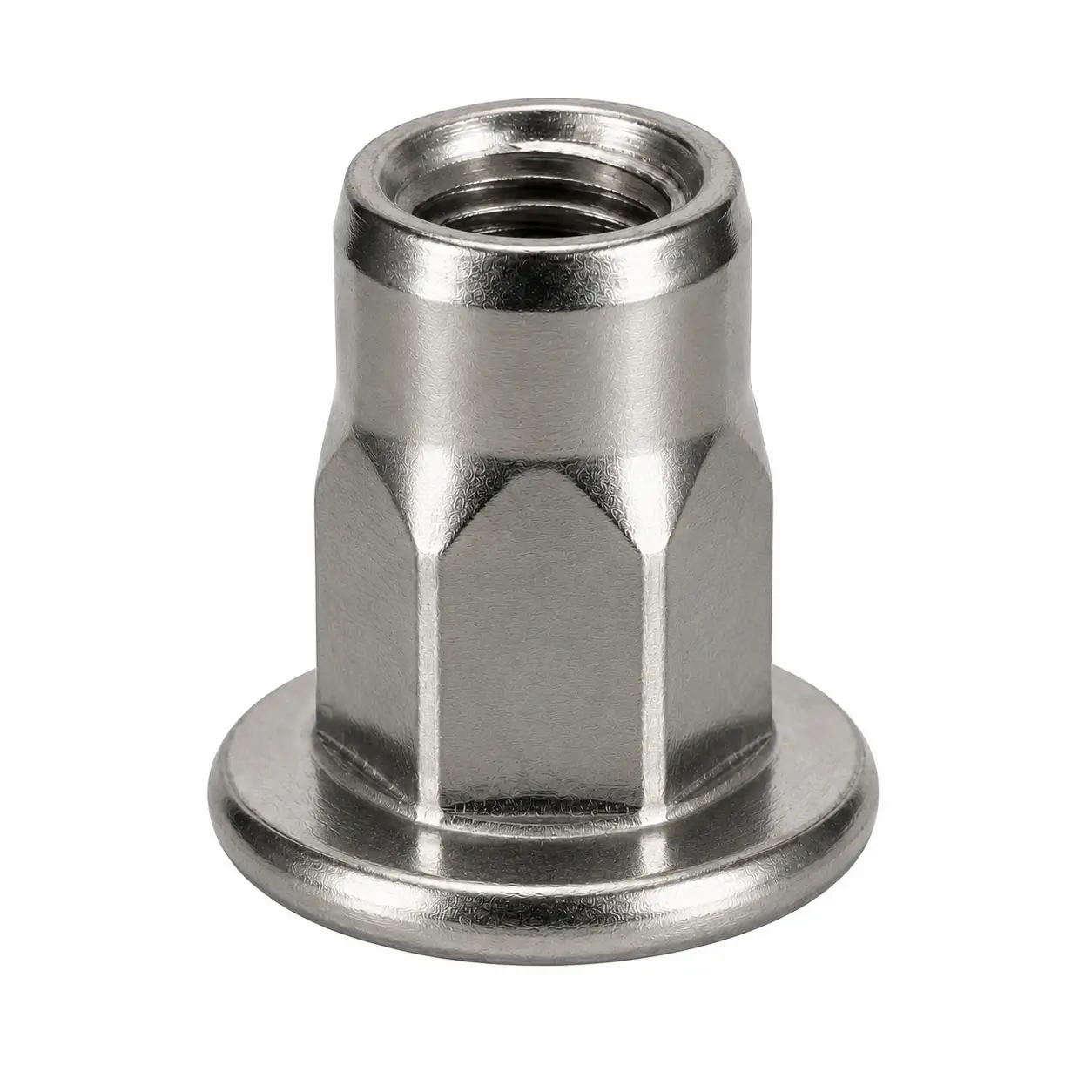
Stainless Steel Flat Head Rivet Nuts
It is suitable for projects with high requirements for corrosion resistance, service life, and outdoor environments. They are widely used in industrial assembly applications where rust prevention is critical.
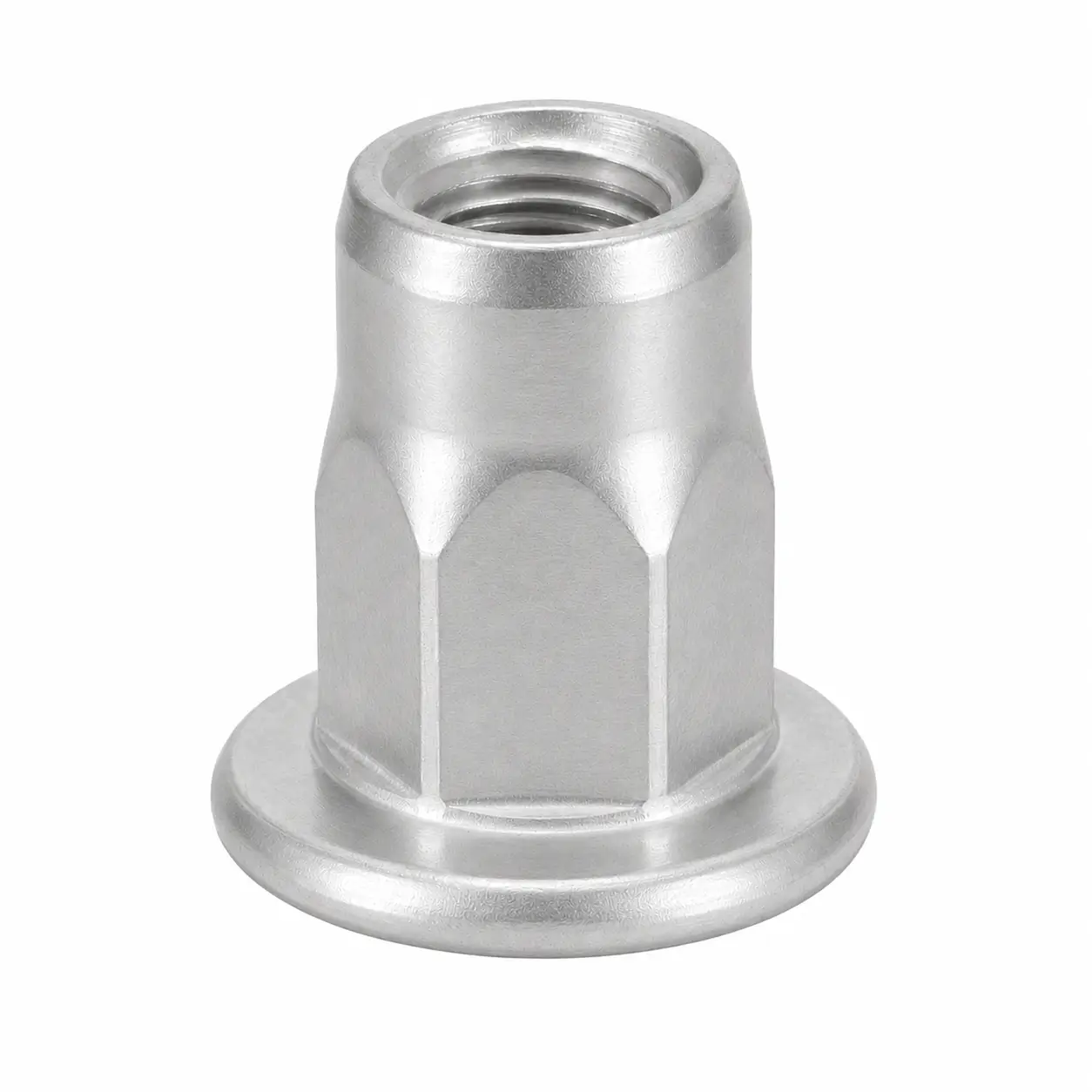
Aluminum Flat Head Rivet Nuts
It is lightweight and easy to install. It is suitable for lightweight assemblies and aluminum sheet connections. It is commonly used for aluminum alloy panels and lightweight equipment housings.
Classified by size
Rivmate’s flat-head rivet nuts are available in a wide range of standard metric thread sizes, including M3, M4, M5, M6, M8, M10, and M12. The various specifications are suitable for a variety of sheet metal thicknesses and fastening strength requirements.

M3 Flat Head Rivet Nuts
The grip range for this size is 0.5–3.0 mm. It is suitable for precision assembly applications with limited space, small connection points, and low load requirements.

M8 Flat Head Rivet Nuts
The grip range for this size is 1–5.5 mm. It is suitable for industrial applications such as equipment housings and structural support components that require higher load-bearing capacity and higher torque.

M4 Flat Head Rivet Nuts
The grip range for this size is 0.5–4.0mm. It is suitable for lightweight connections and provides a stable internal thread while maintaining a low-profile appearance.

M10 Flat Head Rivet Nuts
The grip range for this size is 1–6 mm. It is suitable for large-scale equipment, heavy-duty sheet metal structures, and other applications requiring larger bolt connections and higher-strength assemblies.

M5 Flat Head Rivet Nuts
The grip range for this size is 0.5–5.0 mm. It has a wide range of applications and is suitable for most medium-strength industrial sheet metal assembly needs.

M12 Flat Head Rivet Nuts
The grip range for this size is 2.0–8.0mm. It is suitable for high-strength fastening applications; the appropriate model should be selected based on the actual board thickness, hole diameter, and installation conditions.

M6 Flat Head Rivet Nuts
The grip range for this size is 0.5–5.5 mm. It provides stronger threaded connections and is suitable for applications requiring higher assembly strength.
Classified by Bottom Structure
Rivmate offers two types of rivet nuts: open-end flat-head rivet nuts and closed-end flat-head rivet nuts. When making your selection, you should consider whether you need the closed-end type.

Open End Flat Head Rivet Nuts
It features a through-hole threaded design. Once installed, the bolt passes through the rivet nut, making it suitable for most standard sheet metal fastening applications.
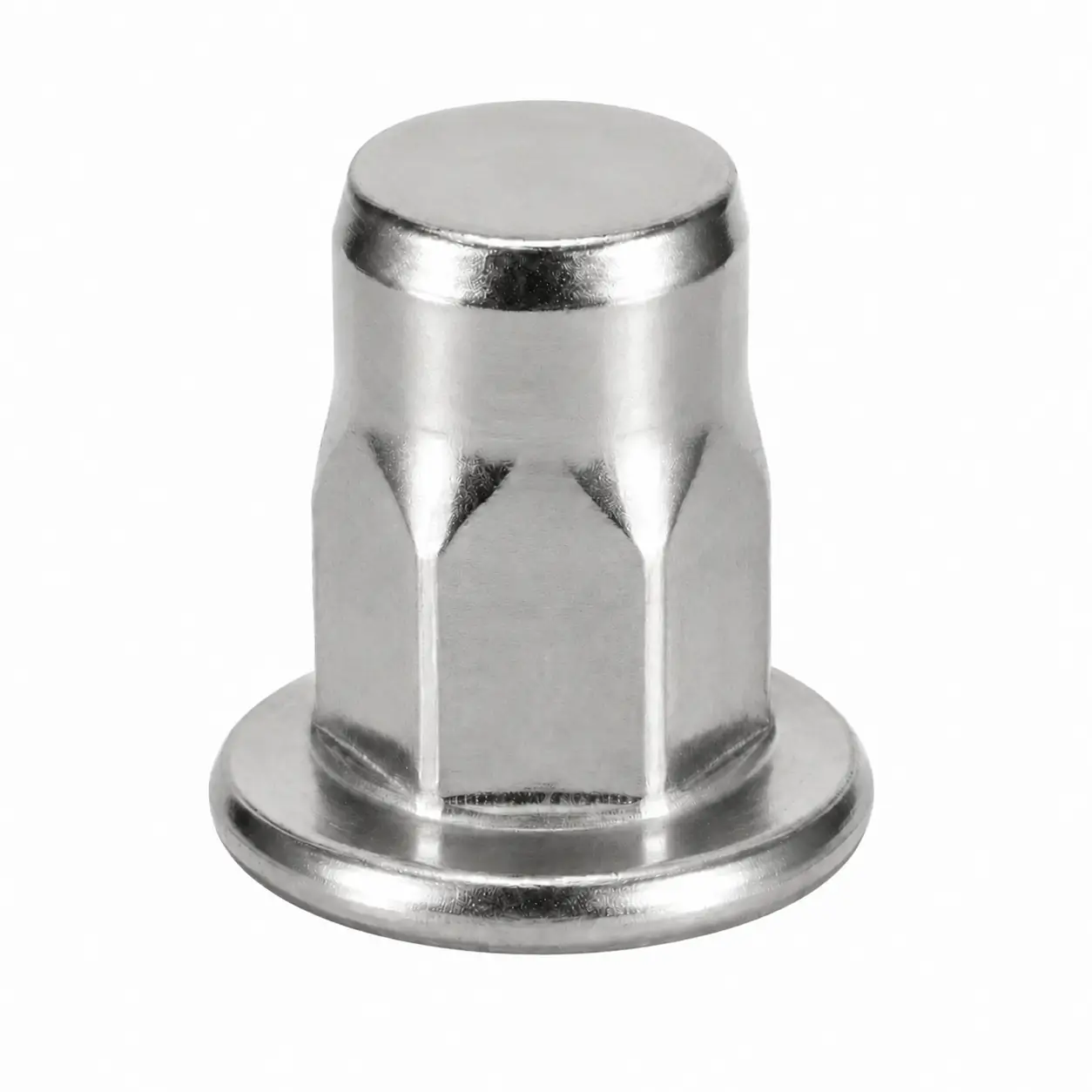
Closed End Flat Head Rivet Nuts
It features a bottom-sealed design. After installation, the bottom of the rivet nut is sealed, helping to prevent dust, moisture, liquids, or from entering the interior through the threaded hole.
Classified by External Surface Structure
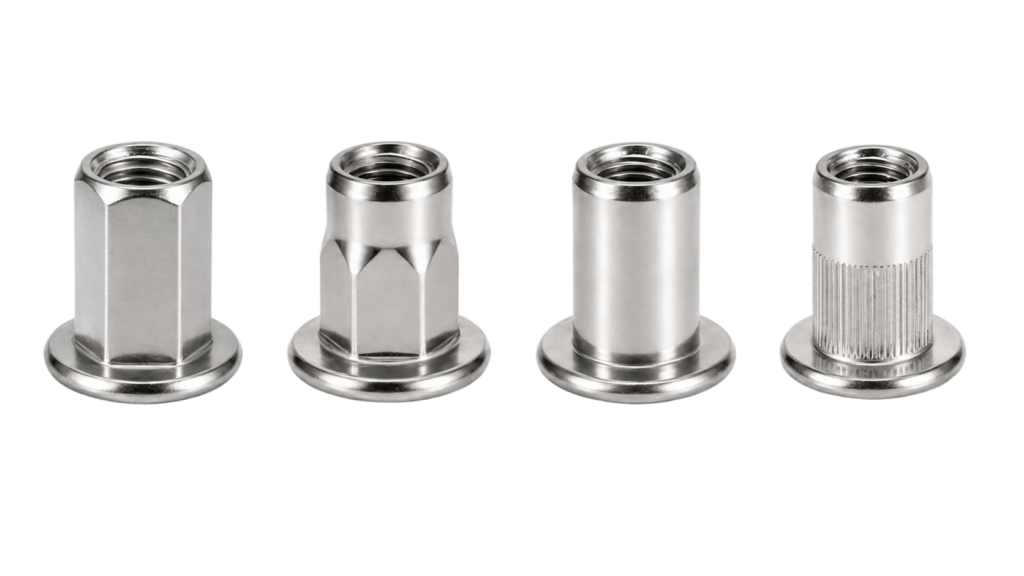
Rivmate flat-head rivet nuts can be classified based on their external surface profiles, which primarily include full hex, half hex, cylindrical, and knurled cylindrical designs. Different external surface profiles directly affect anti-rotation performance, assembly stability, and application costs.

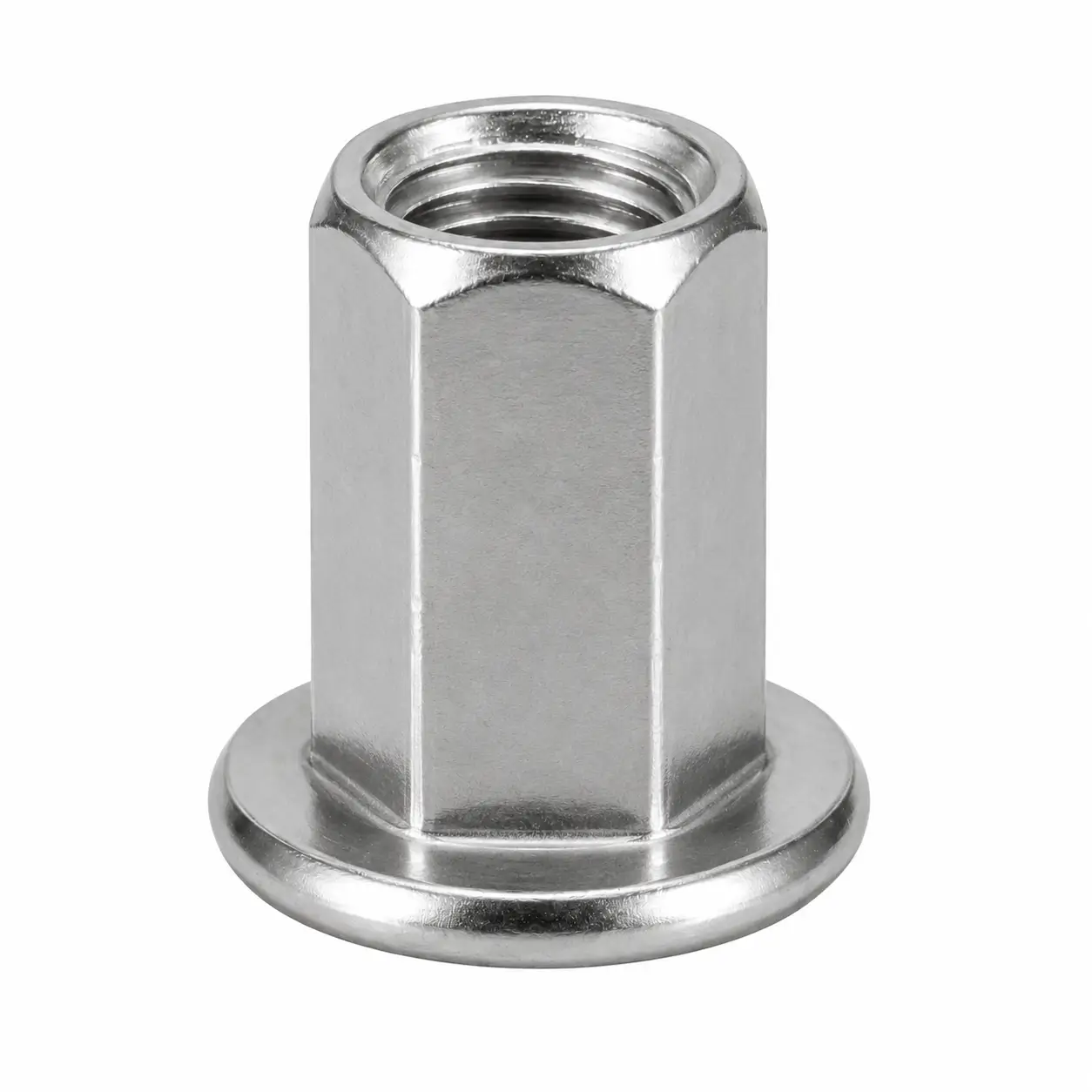
Full Hex Flat Head Rivet Nuts
It features a full hexagonal shank design. Installation requires alignment with hexagonal mounting holes, providing highest resistance to rotation. It is suitable for assembly locations requiring high anti-rotation performance.

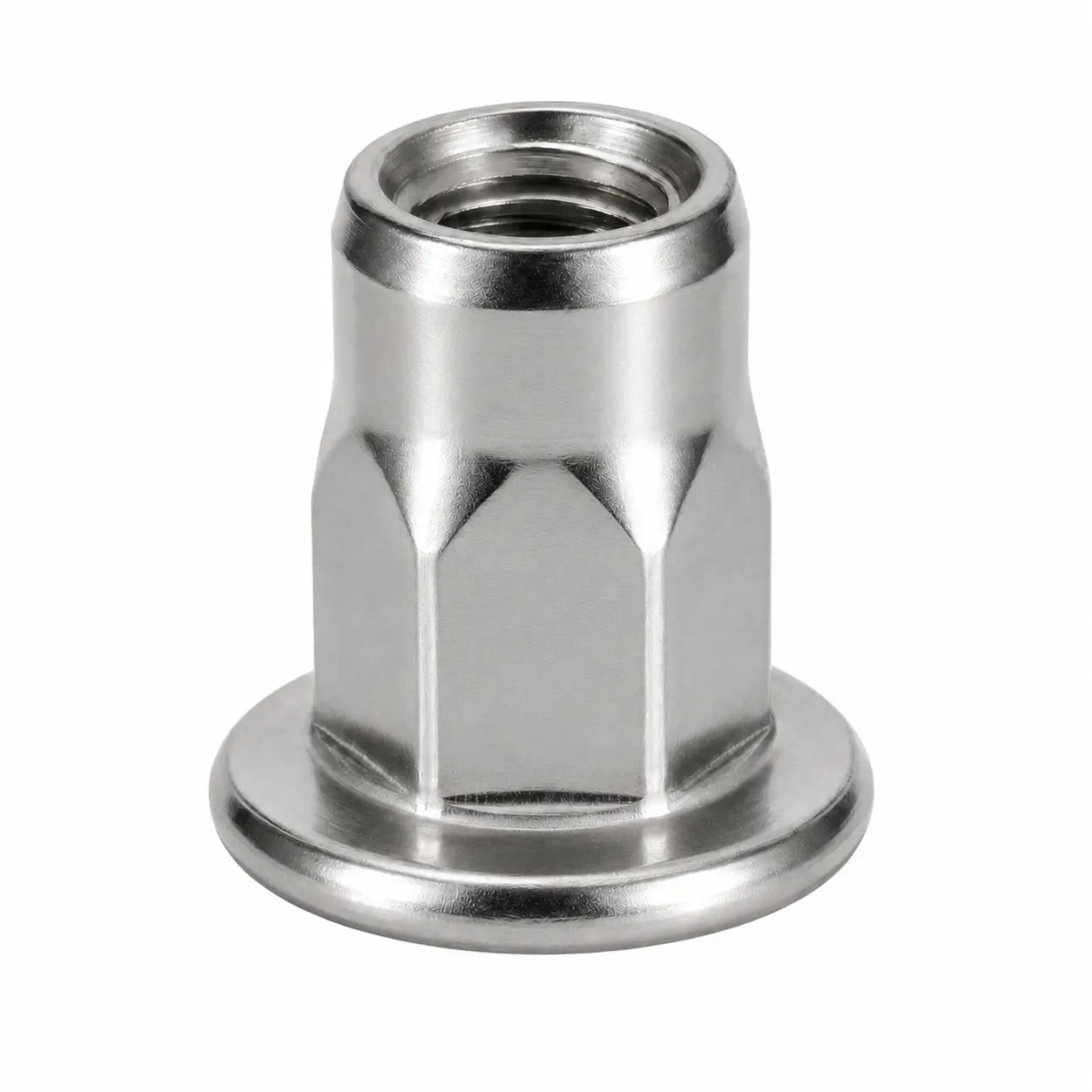
Half Hex Flat Head Rivet Nuts
It features a partial hexagonal shank design. It offers anti-rotation performance and installation flexibility. Compared to standard round-shank rivet nuts, the semi-hexagonal design provides better resistance to rotation.
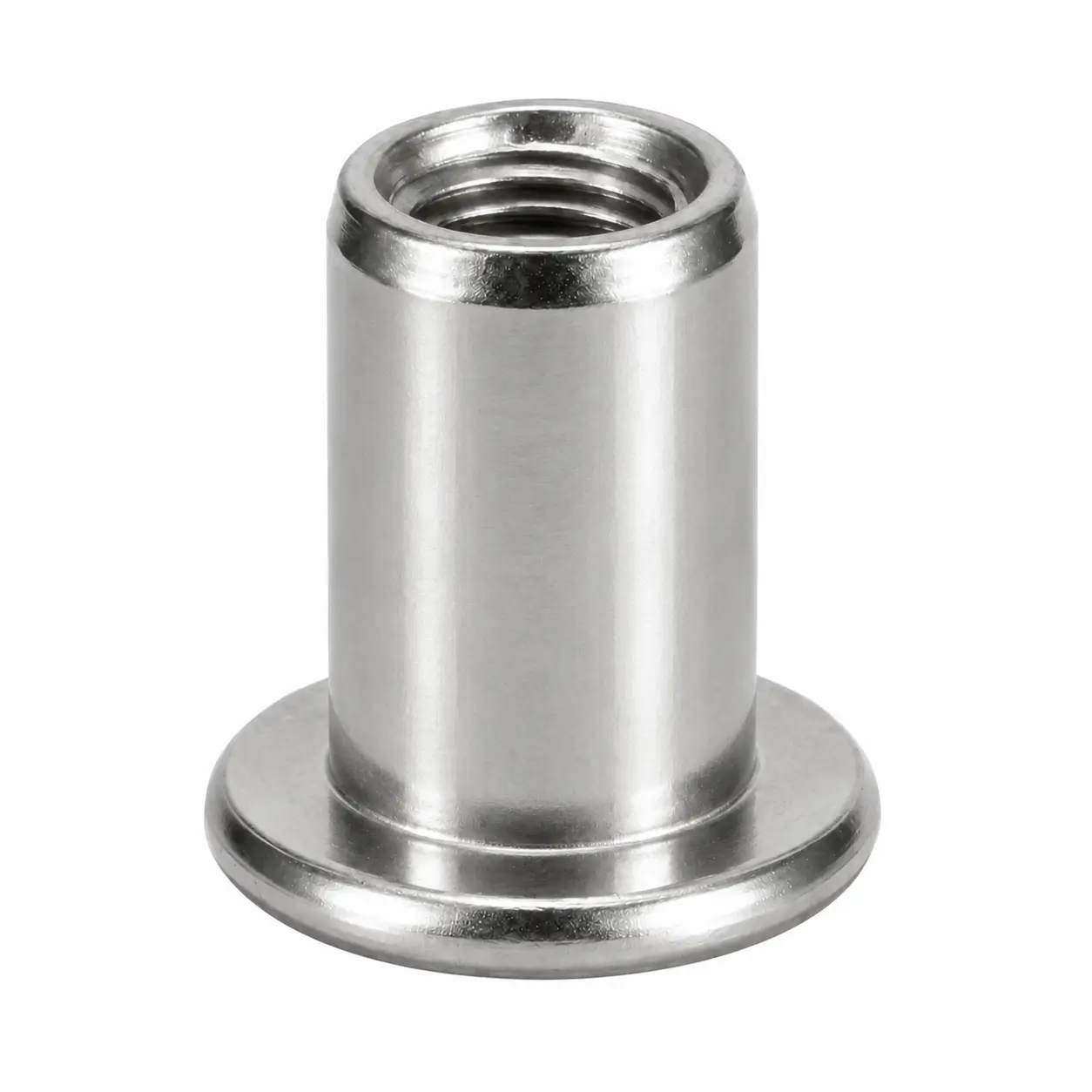
Round Body Flat Head Rivet Nuts
It features a cylindrical external structure. It can be installed in standard round holes, offering high installation compatibility. It is cost-effective and suitable for general sheet metal fastening applications.
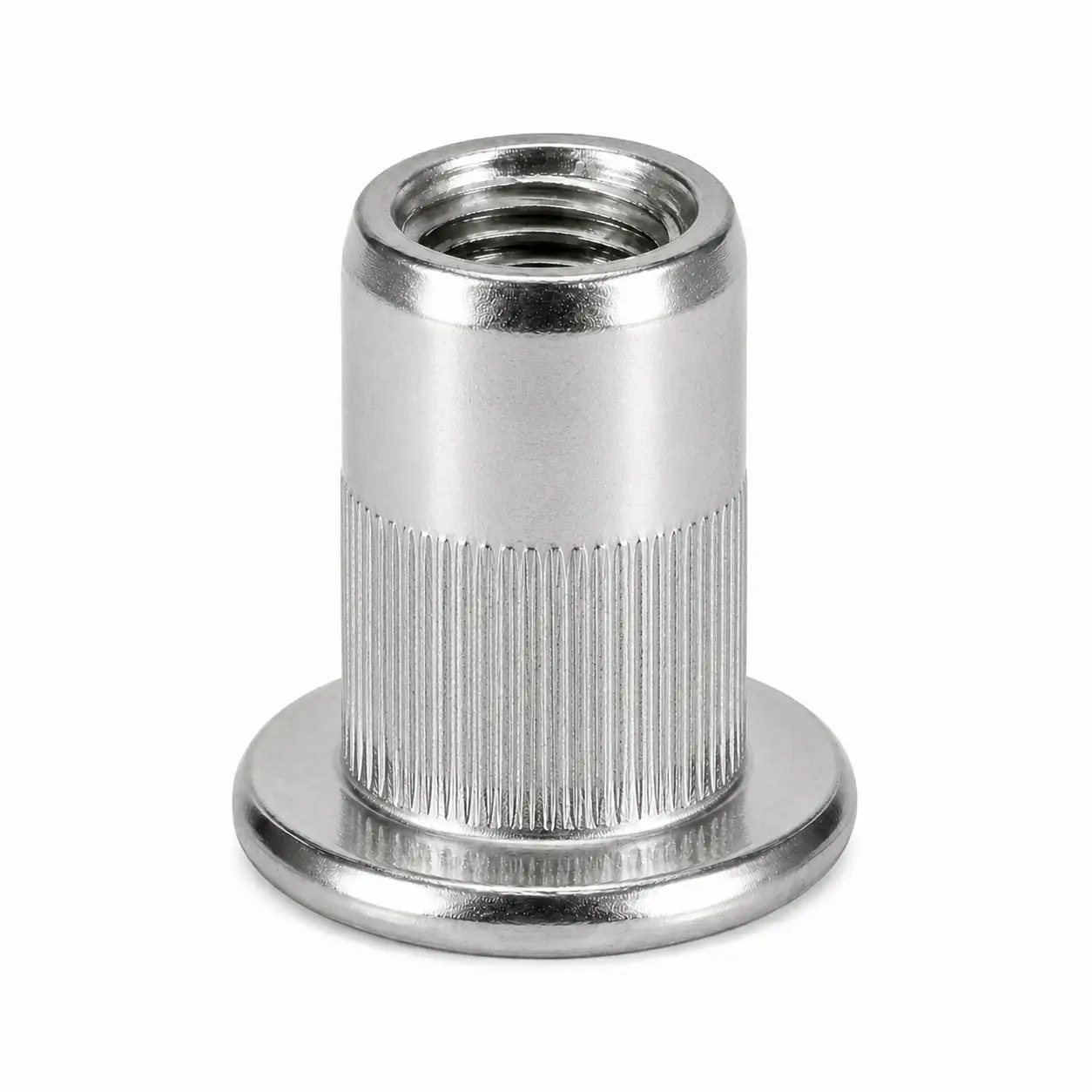
Knurled Body Flat Head Rivet Nuts
Its outer surface features a knurled or serrated pattern. This enhances the grip between the rivet nut and the hole wall, thereby reducing the risk of rotation and improving assembly stability.
| Product Type | Material | Body Structure | End Type | Thread Size Range | Grip Range | Recommended Hole Size |
|---|---|---|---|---|---|---|
| Flat Head Round Body Rivet Nut | Carbon Steel | Round Body | Open End / Closed End | M3–M16 | 0.50–6.50 mm | 5.00–21.00 mm |
| Flat Head Knurled Body Rivet Nut | Carbon Steel | Knurled Body | Open End / Closed End | M3–M12 | 0.50–6.50 mm | 5.00–16.00 mm |
| Flat Head Full Hex Body Rivet Nut | Carbon Steel | Full Hex Body | Open End / Closed End | M3–M12 | 0.50–8.00 mm | 5.00–16.00 mm |
| Flat Head Half Hex Body Rivet Nut | Carbon Steel | Half Hex Body | Open End / Closed End | M3–M12 | 0.50–7.00 mm | 5.00–16.00 mm |
| Flat Head Round Body Rivet Nut | 304 / 316 Stainless Steel | Round Body | Open End / Closed End | M4–M10 | 0.50–4.00 mm | 6.00–13.00 mm |
| Flat Head Knurled Body Rivet Nut | 304 / 316 Stainless Steel | Knurled Body | Open End / Closed End | M3–M12 | 0.50–6.00 mm | 5.00–16.00 mm |
| Flat Head Half Hex Body Rivet Nut | 304 / 316 Stainless Steel | Half Hex Body | Open End / Closed End | M3–M12 | 0.50–8.00 mm | 5.00–16.00 mm |
| Flat Head Full Hex Body Rivet Nut | 304 / 316 Stainless Steel | Full Hex Body | Open End / Closed End | M3–M12 | 0.50–5.00 mm | 5.00–16.00 mm |
| Flat Head Round Body Rivet Nut | Aluminum | Round Body | Open End | M4–M10 | 0.50–4.00 mm | 6.00–13.00 mm |
| Flat Head Knurled Body Rivet Nut | Aluminum | Knurled Body | Open End | M4–M10 | 0.50–4.00 mm | 6.00–13.00 mm |
| Flat Head Knurled Body Rivet Nut, US Type | Carbon Steel / Stainless Steel | Knurled Body | Open End | M4–M12 / 6-32 UNC–1/2-13 UNC | 0.50–8.90 mm / 0.020–0.350 inch | 6.75–17.45 mm / 0.2656–0.6875 inch |
| Flat Head Half Hex Body Rivet Nut, US Type | Carbon Steel / Stainless Steel | Half Hex Body | Open End | M4–M10 / 6-32 UNC–3/8-16 UNC | 0.50–7.90 mm / 0.020–0.312 inch | 6.35–12.70 mm / 0.250–0.500 inch |
| Flat Head Half Hex Body Rivet Nut, UK Type | Carbon Steel | Half Hex Body | Open End | M4–M10 / 5/16-18 UNC / 3/8-16 UNC | 0.50–4.00 mm | 6.40–12.80 mm |
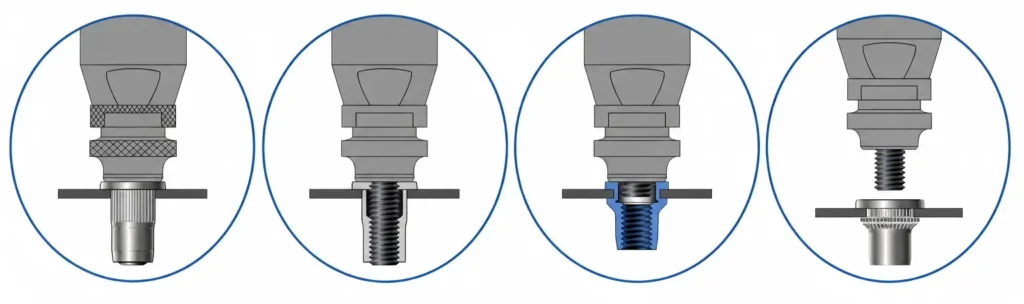
Steps of Rivet Nut Installation
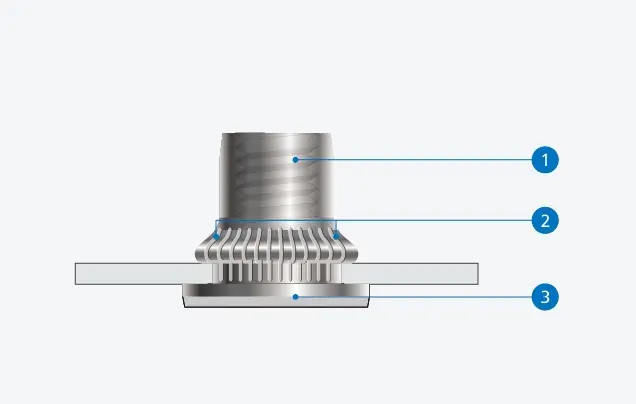
- Insert the rivet nut into the pre-drilled hole, ensuring that the head of the rivet nut is flush with the surface of the workpiece.
- Screw the pull rod of the rivet nut gun into the internal threads of the rivet nut, and hold the tool vertically.
- Activate the rivet nut gun and pull the rod to expand and deform the tail end of the rivet nut, clamping it securely to the workpiece.
- Once riveting is complete, retract the rod in the opposite direction. Check that the rivet nut is secure and confirm that the head is flush with the surface.

Flat Head Rivet Nuts Quality Inspection
Rivmate is equipped with a dedicated flat-head rivet nut testing laboratory. This facility is used to verify the thread accuracy, dimensional stability, sheet metal thickness compatibility, anti-rotation capability, pull-out resistance, and batch consistency of blind rivet nuts.
- Complete Set of Rivet Nut Testing Equipment
- Consistent Batch Quality
- 99.9% pass rate
Using universal testing machines, salt spray test equipment, dimensional inspection tools, and riveting simulation equipment, we can test key performance metrics during sample validation, mass production, and prior to shipment. This helps customers reduce the risk of failure and rework costs during mass assembly, ensuring a more consistent supply of flat-head rivet nuts.
Pop Rivet Cold Heading Machines
Rivet Assembly machines
Our Rivet Warehouse

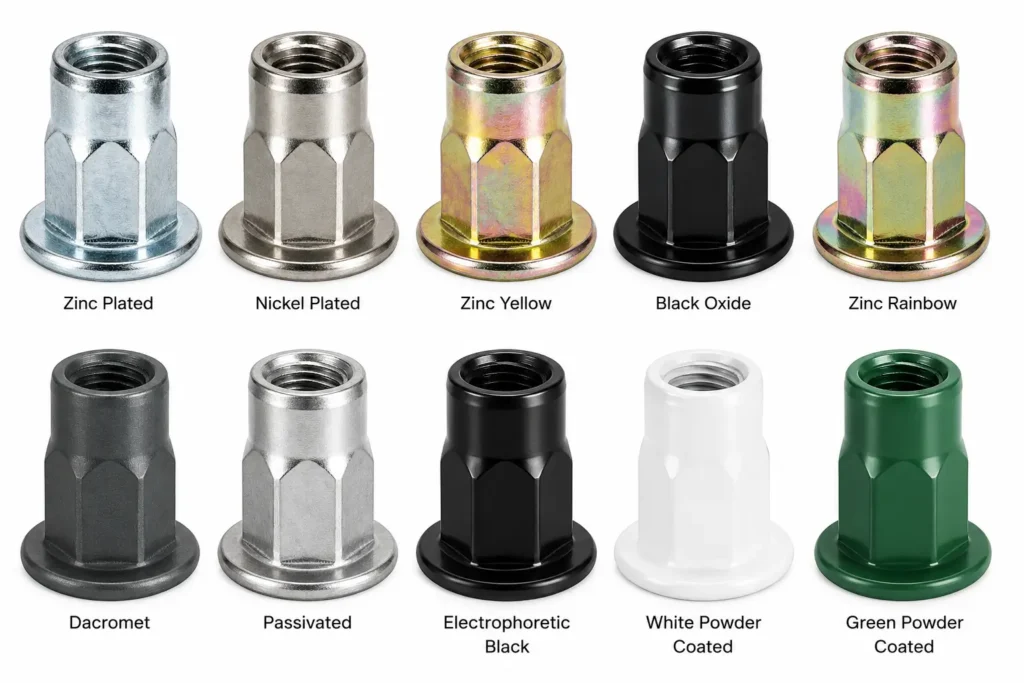
Flat Head Rivet Nuts Surface Finish Options
Different application environments have different surface treatment requirements. Surface treatment directly affects a product’s corrosion resistance, visual consistency, and service life. Rivmate can customize surface treatments based on the customer’s specific application environment requirements.
- Provides basic corrosion protection
- Maintains a consistent appearance
- Extends the product's service life
Rivmate’s customizable surface treatments for rivet nuts include zinc plating, nickel plating, passivation, blackening, zinc-nickel plating, and custom colors. If your project has specific requirements regarding color, corrosion resistance, appearance, or testing, please send samples, drawings, and details of the operating environment to Rivmate. We will evaluate the most suitable surface treatment solution based on your actual needs.
Applications of flat head rivet nuts
Flat-head rivet nuts sit flush against the workpiece surface, providing a larger load-bearing area. They are suitable for sheet metal assemblies that require better support at fastening points, easier installation, and more secure clamping performance.

Thin Sheet Metal Panels Without Countersinking
Due to the limited thickness of thin sheet metal panels, countersinking can easily cause the sheet to deform. Flat-head rivet nuts provide a larger bearing surface and are therefore better suited for joining thin sheets.

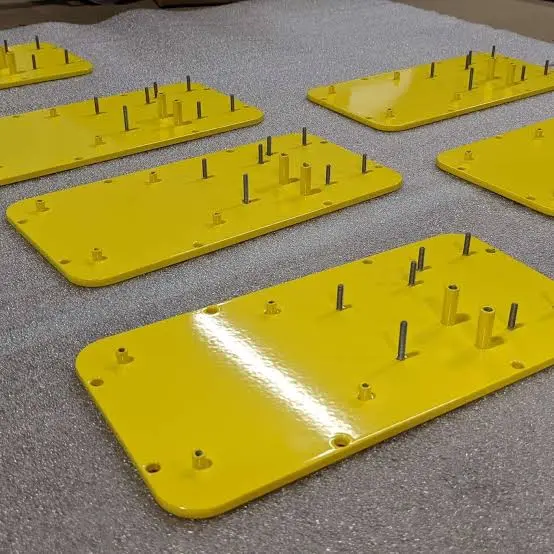
Painted or Powder-Coated Sheet Metal Assemblies
Sheet metal parts that have already been powder-coated, painted, or otherwise surface-treated. Flat-head rivet nuts can be installed in pre-drilled holes without damaging the coating. They also reduce the need for rework after painting.

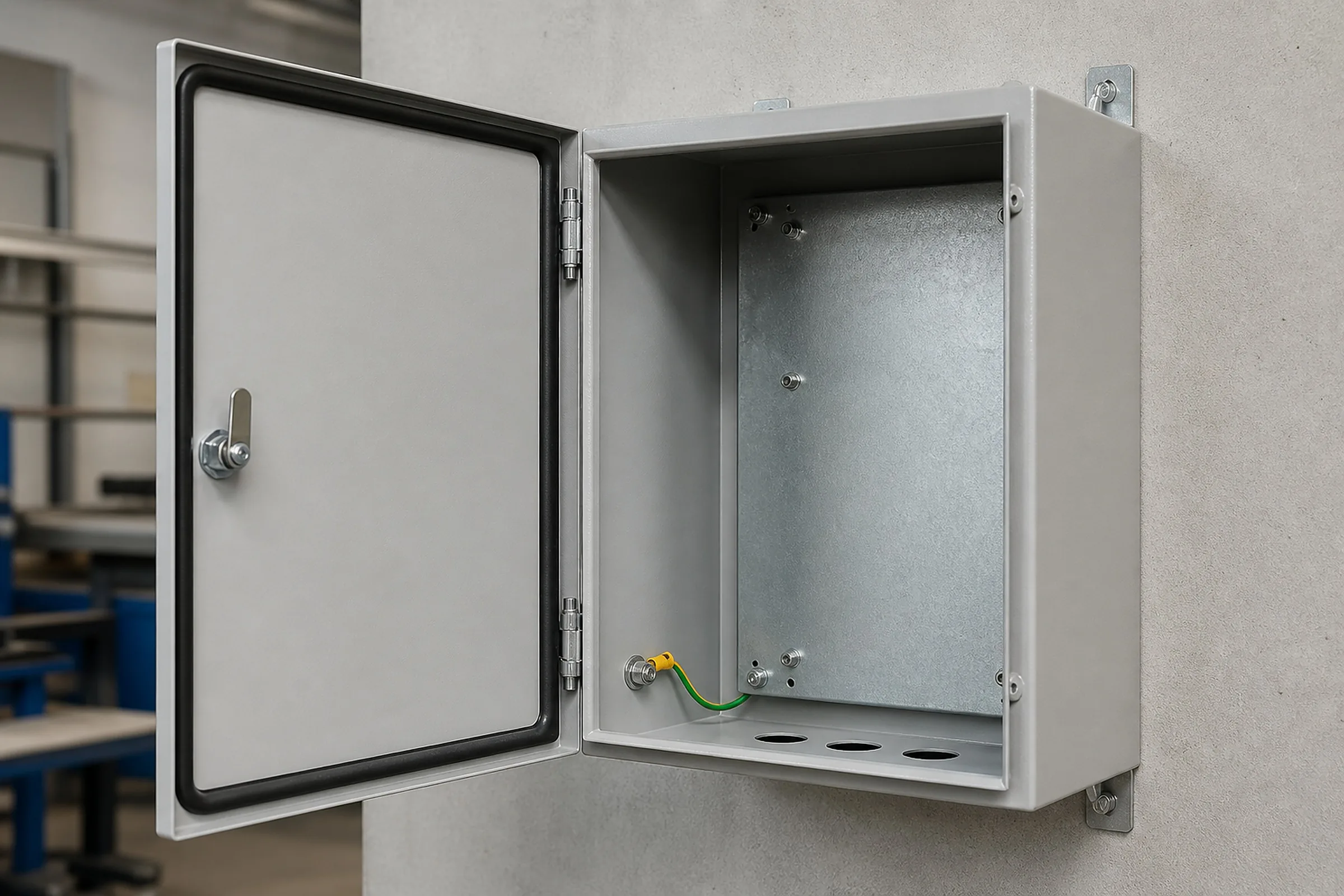
Access Panels and Maintenance Covers Requiring Repeated Screw Removal
Inspection covers and maintenance panels need to be removed frequently for maintenance. Flat-head rivet nuts allow screws to be repeatedly tightened and removed, and can be paired with knurled or hexagonal designs to enhance anti-rotation performance.
Get An Instant Quote Now
How to choose flat head rivet nuts for aluminum panels
First, you need to confirm the total thickness of the aluminum sheet, the mounting hole diameter, the thread size, and the torque requirements. This will help prevent unstable riveting.
Next, select the material. Since aluminum sheets are generally lightweight, choose aluminum flat-head rivet nuts. If rotational resistance is a concern, you can opt for a hexagonal design.
Finally, determine whether corrosion protection is needed and select the appropriate surface treatment.
Difference between flat head and low profile rivet nuts.
Flat-head rivet nuts have a larger head contact area. They provide greater support at the edge of the hole. They are better suited for thin sheet metal and aluminum sheets.
Low-profile rivet nuts have a lower, smaller head. They place higher demands on the installation hole diameter, sheet thickness, and sheet strength. They are suitable for locations with limited space or where appearance is a key consideration.
What is the maximum grip range for flat head rivet nuts?
The maximum grip range for flat head rivet nuts is 8.9mm
What are the advantages of using flat head rivet nuts?
Advantage 1. Larger surface contact area for more stable connections
Advantage 2. No countersinking required, making installation simpler
Advantage 3. Better suited for thin sheets and lightweight materials
Advantage 4. Reduces thermal deformation and surface damage caused by welding
Advantage 5. Suitable for industrial assemblies where a perfectly flush surface is not required
Advantage 6. Supports internal threaded connections that allow for repeated assembly and disassembly
Request a bulk quote for flat head rivet nuts.
If you need a bulk quote for flat-head rivet nuts, please provide Rivmate with the following information:
- Thread size
- Material
- Total plate thickness
- Mounting hole diameter
- External configuration
- Bottom configuration
- Surface finish
- Quantity to be purchased
- Packaging requirements
flat head rivet nuts
Let’s take a closer look at the various performance characteristics of flat-head rivet nuts through this video.
Rivmate Knurled Body Rivet Nut: Torque to turn test
Rivmate Knurled Body Rivet Nut: Shear test
Rivmate Knurled Body Rivet Nut: Riveting test
Resource Center
Access helpful materials to support your project planning and product selection. Download documents for reference and on-site use.
Rivet nut Catalog
Browse our full blind rivet catalog including product types, specifications, and application examples.I am Trailer Box Description Text. You can change me anytime from settings.
flat head rivet nut Drawing
Download the technical drawings for the rivets, which include dimensions, internal structure, and basic product information