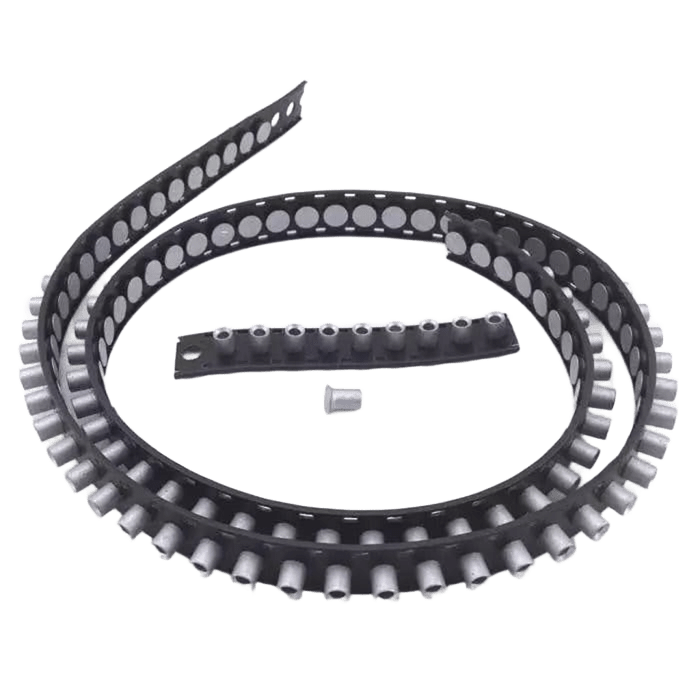
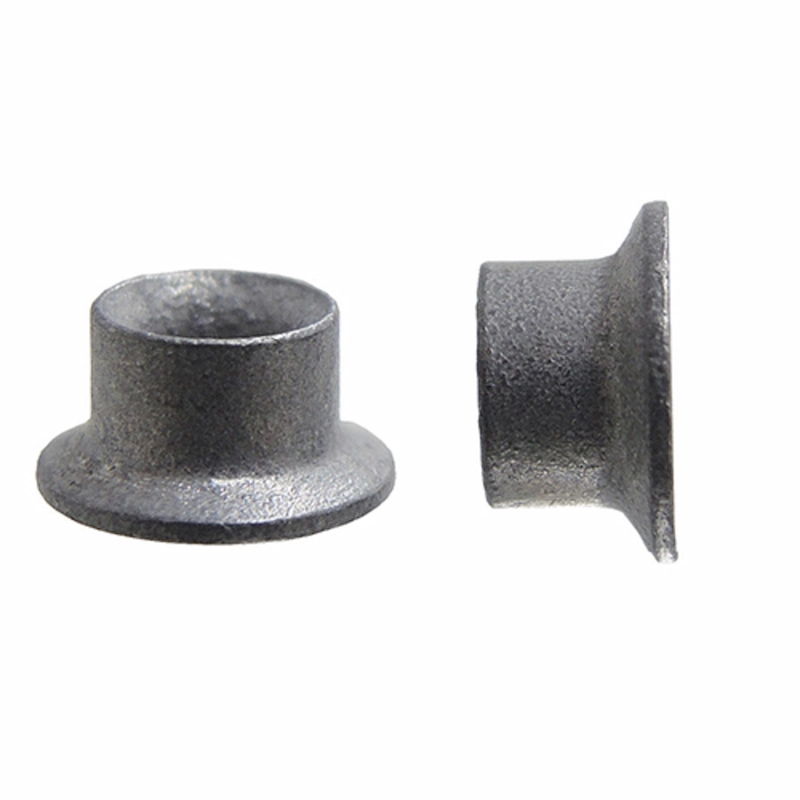
Self Piercing Rivets Manufacturer
Rivmate provides custom manufacturing support for self-piercing rivets for projects involving automotive bodies, automotive components, new energy battery packs, and lightweight structures. SPR rivets are suitable for automated riveting applications, helping you streamline processes and improve assembly efficiency.
- Riveting eliminates the need for welding, reducing distortion and minimizing surface damage
- Factory production controls ensure dimensional consistency
- Support for riveting tests and sample verification
- A variety of corrosion-resistant surface treatment options available
- OEM packaging
Why Choose Our Self Piercing Rivets
- Multilayer and multi-type materials connecting.
- Up to 1200Mpa high strength steel plate.
- No pre-drilling is required, improving the performance of anti-corrosion.
- Glue can be applied between material plate, with little influence.
- High connection strength and fatigue resistance.
- Rapid completion of process and low energy consumption.
- High accuracy of repeated connection.
- Visual inspection of quality.
- Meet the demand of full automation.
- Free of smoke, steam and spark, low noise.
Rivmate —— Your Professional Customized Self Piercing Rivets Manufacturer
Rivmate manufactures high-quality self-piercing rivets and operates as a manufacturer that integrates R&D with large-scale production. Leveraging precision cold heading and heat treatment processes, the company has obtained IATF 16949 automotive quality certification.
The self-piercing rivet factory is equipped with 48 sets of advanced multi-station equipment and 32 sets of high-speed mandrel machines. Monthly production of self-piercing rivets exceeds 100 million pieces. Whether you need products of specific dimensions or specific quality, we can help you create the perfect self-piercing rivet solution. If you are looking for high-quality self-piercing rivets, please contact us immediately for a quote!
Rivamte Self Piercing Rivets Types
A Type Self Piercing Rivets
Type A is available only in a 3.3 mm diameter, with lengths ranging from 3.25 to 4.25 mm. Hardness grades are H1 and H2, and it is compatible with A and N head types.
C Type Self Piercing Rivets
Type C is available in two diameters: 3.3 mm and 5.3 mm, with lengths of 3.5–4.0 and 4.0–6.5, respectively. The hardness range covers H1–H6. They are available with A and P head types.
J Type Self Piercing Rivets
Type J is limited to a diameter of 3.3 mm, with lengths ranging from 5.0 to 6.0 mm. The hardness range is H1–H6, and they are available with A and P head types.
K Type Self Piercing Rivets
Type K is limited to a diameter of 5.3 mm, with lengths ranging from 7.0 to 12.0 mm, and a hardness range of H1–H6. They are available with A, P, and F head types.
P Type Self Piercing Rivets
Type P is available in both 3.3 mm and 5.3 mm diameters, with a wide range of lengths and hardness grades covering H1–H6. Compatible with C and P head types.
HG / PG Type Self Piercing Rivets
Types HG and PG are limited to a 5.5 mm diameter, with lengths ranging from 5.0–8.0 mm; hardness grades are primarily H4 and H6.
R Type Self Piercing Rivets
Type R is available only in a 3.3 mm diameter, with lengths ranging from 5.0 to 8.0 mm. Hardness ranges from H2 to H6. It can be paired with C, F, and P head types.
T Type Self Piercing Rivets
Type T is available only in a 5.3 mm diameter, with lengths ranging from 7.0 to 14.0 mm. Hardness ranges from H2, H4, and H6.It can only be paired with the A head type.
Choose Self Piercing Rivets by Material
Carbon steel self-piercing rivets provide reliable connections for dissimilar aluminum-steel materials and lightweight structures.They are widely used in automotive bodies, EV battery packs, and industrial sheet metal assemblies.
Steel Self Piercing Rivets
Rivmate’s Carbon Steel Self-Piercing Rivets are primarily manufactured from 37MnB5 / 36MnB4 boron steel. This material belongs to the carbon steel family. After heat treatment, it provides the hardness and strength required for SPR (Self-Piercing Riveting). It offers good penetration capability and forming stability.
Choose Self Piercing Rivets by size
Rivmate offers 3.3mm and 5.3mm self-piercing rivets (SPR) suitable for various sheet metal thickness combinations. We can help you select the right rivet specifications for applications such as thin-sheet metal joining, automotive fastening, and electric vehicle battery enclosure assembly.
If you’re unsure which size is best suited for your assembly, please contact us.
3.3mm Self Piercing Rivets
The 3.3mm size takes up less space and is better suited for narrow-bevel, small connection points, and thin sheet metal assemblies. 3.3mm is widely used in lightweight structures, small automotive components, industrial sheet metal assemblies, and precision sheet metal parts.
5.3mm Self Piercing Rivets
The 5.3mm SPR is used for a wider range of sheet thickness combinations and applications requiring higher joint strength. Compared to the 3.3mm version, it is better suited for automotive bodies, EV battery packs, dissimilar aluminum-steel materials, and industrial sheet metal structural components.
Choose Self Piercing Rivets by head shape
Different head styles allow self-piercing rivets to accommodate various sheet metal thicknesses, aesthetic requirements, load distributions, and automated riveting systems. You can send us your requirements, and Rivmate will help you select the appropriate head style.
A Head Self Piercing Rivets
A Head is the most common head type, with a smaller head diameter. After installation, the head protrudes less. A Head Self Piercing Rivet is used in automotive bodies and industrial sheet metal.
P Head Self Piercing Rivets
P Head is a large-head design that provides support over a larger area. It helps reduce localized indentations and A Head well-suited for aluminum alloy sheets and softer materials.
M Head Self Piercing Rivets
The M Head is primarily found in the HG series of SPRs and offers high connection stability. It is typically used in certain high-strength SPR series and for special structural connections.
N Head Self Piercing Rivets
The N Head is used in some European SPR systems to minimize surface protrusion in the connection area. After installation, it provides a flatter appearance and reduces head protrusion.
F Head Self Piercing Rivets
The F Head is designed to be closer to a countersunk head, providing a smoother surface finish after installation and reducing head interference. It is suitable for components requiring flush mounting.
C Head Self Piercing Rivets
The C Head has a relatively small head size, saving installation space. It is suitable for narrow-bevel designs and is used in lightweight and compact structural components.
L Head Self Piercing Rivets
The L Head is primarily used in certain specialized automated assembly and custom projects. It supports unique sheet metal combinations and is used to meet specific assembly requirements.
| No. | Product Type | Material | Surface | Part Number | Size | D (mm) |
L (mm) |
Applicable Products (unit: mm) |
Quantity |
|---|---|---|---|---|---|---|---|---|---|
| 01 | Self-Piercing Rivets | Carbon Steel | Zinc Plated | SSPRA53040 | 5.3 × 4 | 5.3 | 4 | 0.8 + 1 (Steel or aluminum) | 5000 pcs / disk |
| 02 | Self-Piercing Rivets | Carbon Steel | Zinc Plated | SSPRA53050 | 5.3 × 5 | 5.3 | 5 | 0.8 + 1 / 1 + 1.5 (Steel or aluminum) | 5000 pcs / disk |
| 03 | Self-Piercing Rivets | Carbon Steel | Zinc Plated | SSPRA53055 | 5.3 × 5.5 | 5.3 | 5.5 | 1 + 1 / 1 + 1.5 / 1.5 + 1.5 (Steel or aluminum) | 5000 pcs / disk |
| 04 | Self-Piercing Rivets | Carbon Steel | Zinc Plated | SSPRA53060 | 5.3 × 6.0 | 5.3 | 6 | 1.5 + 1.5 / 1.5 + 2 (Steel or aluminum) | 5000 pcs / disk |
| 05 | Self-Piercing Rivets | Carbon Steel | Zinc Plated | SSPRA53065 | 5.3 × 6.5 | 5.3 | 6.5 | 1.5 + 2 / 1.5 + 2.5 / 2 + 2 (Steel or aluminum) | 5000 pcs / disk |
| 06 | Self-Piercing Rivets | Carbon Steel | Zinc Plated | SSPRA53070 | 5.3 × 7.0 | 5.3 | 7 | 2 + 2.5 / 1.5 + 2.5 / 2 + 2 (Steel or aluminum) | 5000 pcs / disk |
| 07 | Self-Piercing Rivets | Carbon Steel | Zinc Plated | SSPRA53075 | 5.3 × 7.5 | 5.3 | 7.5 | 1.5 + 2.5 / 2.5 + 2.5 / 2 + 2 (Steel or aluminum) | 5000 pcs / disk |
| 08 | Self-Piercing Rivets | Carbon Steel | Zinc Plated | SSPRA53080 | 5.3 × 8.0 | 5.3 | 8 | 2.5 + 2.5 / 2.5 + 3 (Steel or aluminum) | 5000 pcs / disk |
| 09 | Self-Piercing Rivets | Carbon Steel | Zinc Plated | SSPRA53090 | 5.3 × 9.0 | 5.3 | 9 | 3 + 3 / 3 + 3.5 (Steel or aluminum) | 5000 pcs / disk |
| 10 | Self-Piercing Rivets | Carbon Steel | Zinc Plated | SSPRA53100 | 5.3 × 10.0 | 5.3 | 10 | 3 + 4 / 3 + 4.5 (Steel or aluminum) | 5000 pcs / disk |
| 11 | Self-Piercing Rivets | Carbon Steel | Zinc Plated | SSPRA53120 | 5.3 × 12.0 | 5.3 | 12 | 5 + 5 / 4.5 + 4.5 (Steel or aluminum) | 4000 pcs / disk |
| 12 | Self-Piercing Rivets | Carbon Steel | Zinc Plated | SSPRA33035 | 3.3 × 3.5 | 3.3 | 3.5 | 1 + 1 (Steel or aluminum) | 10000 pcs / disk |
| 13 | Self-Piercing Rivets | Carbon Steel | Zinc Plated | SSPRA33040 | 3.3 × 4.0 | 3.3 | 4 | 1 + 1 (Steel or aluminum) | 10000 pcs / disk |
| 14 | Self-Piercing Rivets | Carbon Steel | Zinc Plated | SSPRA33050 | 3.3 × 5.0 | 3.3 | 5 | 1 + 1 / 1 + 1.5 / 1.5 + 1.5 (Steel or aluminum) | 10000 pcs / disk |
| 15 | Self-Piercing Rivets | Carbon Steel | Zinc Plated | SSPRA33060 | 3.3 × 6.0 | 3.3 | 6 | 1.5 + 1.5 / 1.5 + 2 (Steel or aluminum) | 10000 pcs / disk |
Steps of Blind Rivet Installation
- Insert the rivet into the pre-drilled hole, ensuring that the rivet head sits flush against the workpiece.
- Place the rivet gun’s nozzle over the rivet mandrel and hold the tool vertically.
- Activate the rivet gun and pull the rivet mandrel to expand the rivet body and secure the workpiece.
- Once the rivet mandrel breaks off, the riveting is complete. Check that the rivet is secure and flush.
Self Piercing Rivet Manufacturing You Can Trust
RIVMATE’s factory specializes in the large-scale production of automotive-grade self-piercing rivets. Using a 37MnB5 / 36MnB4 boron steel material system and heat treatment processes, the company ensures consistent hardness and penetration performance across various sheet metal combinations.
- Automotive-grade manufacturing standards
- Supports reliable joining of dissimilar aluminum and steel materials
- Consistent penetration performance ensures high assembly success rates
During production, every batch undergoes strict dimensional and hardness controls to ensure consistent performance during automated riveting. The product design is optimized for joining dissimilar aluminum and steel materials and for multi-layer thin-sheet applications, effectively reducing the risk of cracking and insufficient clamping.
Pop Rivet Cold Heading Machines
Rivet Assembly machines
Our Rivet Warehouse
Stable Bulk Supply for Self Piercing Rivets
Rivmate provides a stable, high-volume supply of self-piercing rivets to customers worldwide. Our client base includes automotive parts manufacturers, new energy battery pack manufacturers, sheet metal processing companies, and fastener distributors.
- Mainstream specifications in stock year-round
- Comprehensive batch traceability system
- Stable and consistent production capacity
With a mature, large-scale production system, Rivmate can consistently and stably supply mainstream specifications such as 3.3mm and 5.3mm SPRs. These products are designed to meet the continuous material requirements of automated production lines. Rivmate also provides standardized export packaging and a comprehensive batch traceability system to help you manage inventory and your global logistics supply chain more efficiently.
Applications of Self Piercing Rivets
Self-Piercing Rivets are suitable for high-strength fastening applications involving dissimilar materials such as aluminum and steel, as well as multi-layer thin sheets. By eliminating the need for pre-drilling and utilizing a cold-formed, mechanically interlocking fastening method, SPRs can significantly improve automated assembly efficiency. If you are unsure whether Self-Piercing Rivets are suitable for your product, please contact rivmate.
Automotive Body Structures
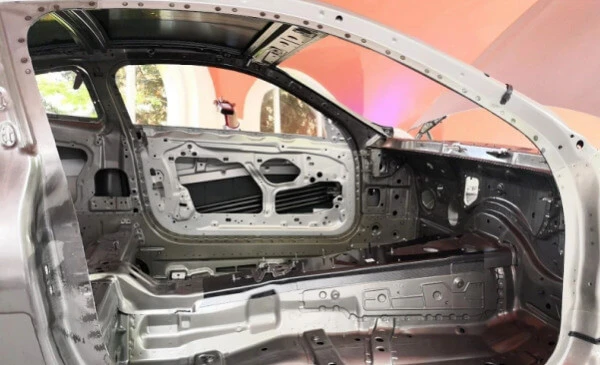
Self-piercing rivets eliminate the need for pre-drilling and reduce thermal distortion caused by welding. Self-piercing rivets are used in door inner panels, body reinforcements, side panel structures, roof frames, A/B/C-pillar reinforcements, trunk lids, and engine compartment brackets, among other applications.
EV Battery Enclosures
Self-piercing rivets effectively minimize the heat-affected zone, maintaining the dimensional stability of the battery pack structure. Self-piercing rivets can be used in locations such as battery pack top covers, battery tray frames, side panels, module mounting brackets, cooling system brackets, and battery protective covers.
Aluminum &Steel Joining
Self-piercing rivets provide stable connections through mechanical locking, eliminating the need for welding. They are commonly used in aluminum-steel body joint nodes, aluminum alloy frames with steel brackets, lightweight equipment frames, transportation equipment structural components, and industrial metal enclosure joints.
Industrial Sheet Metal Assemblies
Self-piercing rivets improve production efficiency and reduce labor costs. They are used in electrical control cabinets, power distribution box enclosures, industrial cabinets, equipment guards, metal door panels, brackets, and side panel connections.
HVAC Equipment
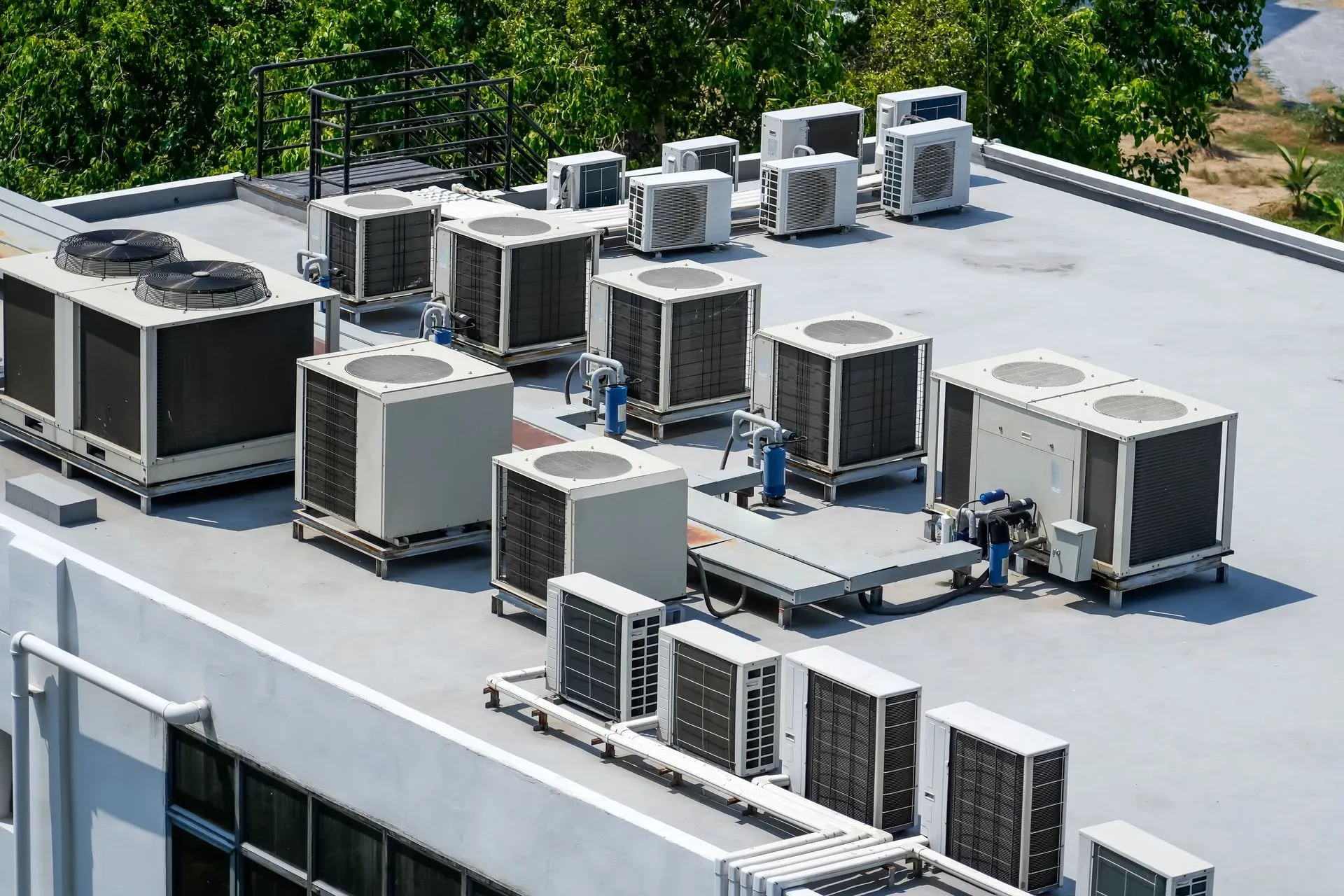
Self-piercing rivets are less likely to cause sheet metal deformation, making them ideal for automated production. They can be used in AHU outer panels, air conditioning unit frames, fan housings, ventilation equipment enclosures, access doors, and metal support components.
Solar Energy Equipment
Self-piercing rivets are suitable for aluminum alloy fastening, with the 63D0 grade providing a stable mechanical connection. Self-piercing rivets can be used in photovoltaic mounting structures, tracking bracket auxiliary components, inverter enclosures, electrical control boxes, and photovoltaic equipment frames.
Get An Instant Quote Now
1.Does Self Piercing Rivets damage coating or surface treatment?
Self-piercing rivets are a cold-forming fastening method that does not create a heat-affected zone, as is the case with welding. Therefore, they do not compromise the overall properties of the material. The cold-forming process may cause slight indentations or coating deformation only in the local contact area, which is a normal occurrence in mechanical forming processes. You can minimize surface effects by selecting the appropriate rivet specifications, optimizing die design, and controlling the pressing parameters.
2.Do Self-Piercing Rivets Require Pre-Drilling?
No pre-drilling is required.One of the key advantages of Self-Piercing Rivets (SPR) is their ability to create a connection without the need for drilling. During installation, the rivet penetrates the upper material directly through a punching action and induces plastic deformation in the lower material, thereby creating a mechanically interlocked connection.
3.What sheet thickness can Self Piercing Rivets join?ough?
Self-piercing rivets are generally used for single-layer sheet metal with a thickness of approximately 0.5 mm – 6.0 mm, and for multiple layers with a total thickness of approximately 1.5 mm – 8.0 mm. The specific range depends on the material combination, rivet specifications, and die design, and is an important engineering parameter for joining thin-sheet structures in the automotive and new energy industries.
4.Can Self Piercing Rivets be used in aluminum to steel joining?
Yes. Self-Piercing Rivets (SPRs) are ideal for joining aluminum and steel sheets, and this is one of the most common applications for SPRs.
SPRs are frequently used for aluminum-to-steel joining in projects such as lightweight automotive structures, new energy vehicle battery packs, and the connection of aluminum alloy housings to steel brackets. The actual results of aluminum-to-steel joining depend on the sheet thickness, material sequence, rivet specifications, hardness grade, and die design.
5.Can Self Piercing Rivets replace welding in automotive structures?
Self-Piercing Rivets can partially replace welding, but they cannot completely replace all welding processes. Welding involves melting material at high temperatures to fuse two metals into a single structure. SPR, however, is a cold-forming mechanical fastening technology.
In actual automotive manufacturing, SPR is better suited for joining dissimilar materials such as aluminum and steel, thin-gauge sheet metal structures, and automated production lines, while welding is more suitable for certain high-rigidity or monolithic structural components.
Resource Center
Access helpful materials to support your project planning and product selection. Download documents for reference and on-site use.
Rivet Catalog
Browse our full blind rivet catalog including product types, specifications, and application examples.I am Trailer Box Description Text. You can change me anytime from settings.
Self Piercing Rivet Drawing
Download the technical drawings for the rivets, which include dimensions, internal structure, and basic product information
What Are Self-Piercing Rivets?
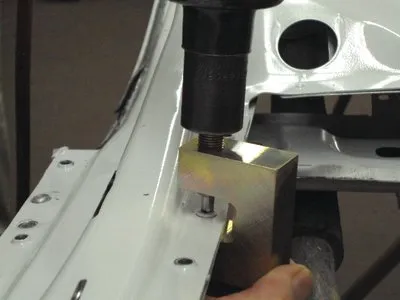
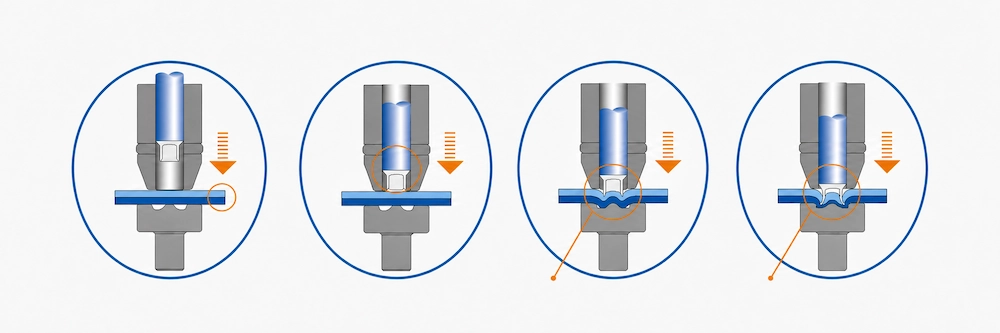
Self-piercing rivets are high-strength mechanical fasteners used to join thin sheet metal. Their key advantage is that they do not require pre-drilling during installation and can create a stable connection between two or more layers of metal sheets.
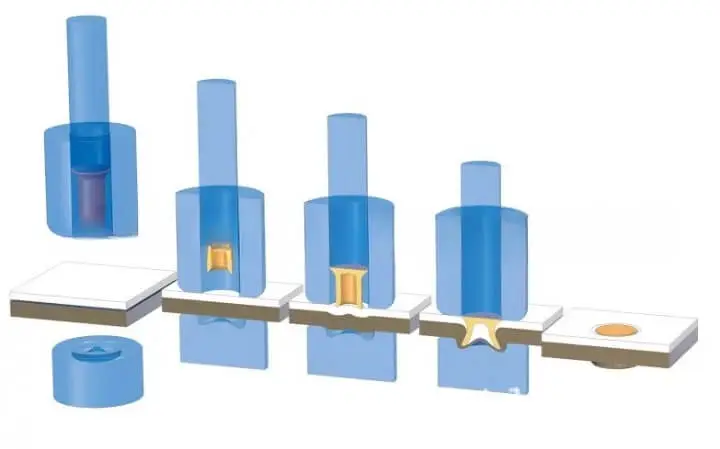
During the riveting process, self-piercing rivets—operated by specialized hydraulic or servo riveting equipment—first penetrate the upper layer of material, then undergo plastic deformation and expansion within the lower layer, ultimately forming a stable “mechanical interlocking structure” to achieve a high-strength connection.
How Do Self-Piercing Rivets Work?
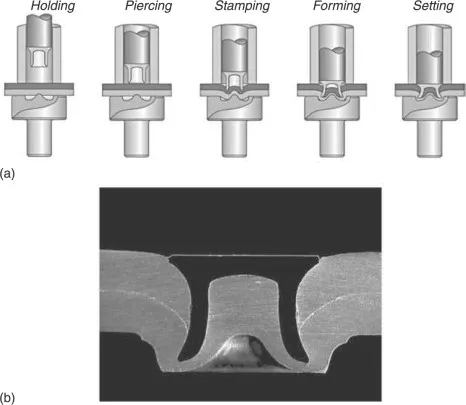
Self-piercing rivets work by applying pressure through a punch, causing the rivet to first shear through the upper sheet metal. The rivet then induces plastic flow in the lower sheet metal and, constrained by the lower die, forms a mechanical interlocking structure, thereby achieving a permanent, high-strength joint without the need for pre-drilling or welding.
Key Advantages of Self-Piercing Rivets
- No Pre-drilling Required
They penetrate the top material directly to complete the connection. Compared to traditional riveting or screw fastening, this reduces processing steps and improves assembly efficiency.
- No Heat-Affected Zone from Welding
SPRs use a cold-fastening process that does not generate high temperatures, thereby preventing material deformation and coating damage.
- Suitable for Automated Production Lines
Compatible with modern industrial automated assembly systems, suitable for large-scale mass production and smart manufacturing.
- Suitable for Joining Dissimilar Materials
Self-Piercing Rivets are one of the few mechanical fastening solutions capable of reliably joining aluminum alloys and high-strength steel.
- Suitable for Lightweight Structures
Self-Piercing Rivets can join two or even multiple layers of thin metal sheets, making them particularly suitable for complex lightweight designs.
Self-Piercing Riveting VS. Traditional Riveting
| Comparison Factor | Self-Piercing Riveting (SPR) | Traditional Riveting |
|---|---|---|
| Joining Principle | No pre-drilling required. The rivet pierces the upper sheet and forms a mechanical interlock in the lower sheet. | Requires pre-drilled holes and mechanical deformation to secure the rivet. |
| Process Flow | Clamping → Piercing → Material flow → Die forming → Locking (single-step joining) | Drilling → Deburring → Rivet insertion → Riveting/deformation → Fixing (multi-step process) |
| Pre-drilling Required | ❌ Not required | ✅ Required |
| Material Compatibility | Aluminum/Aluminum, Aluminum/Steel, Steel/Steel, multi-layer sheet structures | Mainly suitable for similar materials and simple structures |
| Joint Structure | Mechanical interlock formed by material flow and die shaping | Hole-based fastening using rivet deformation |
| Automation Compatibility | Highly suitable for robotic riveting and high-speed production lines | Limited automation, often semi-automatic or manual |
| Production Efficiency | High-speed, single-step joining process | Multiple steps, lower efficiency |
| Structural Performance | High shear strength and excellent vibration resistance | Depends on hole accuracy; may loosen under vibration |
| Cost Efficiency | Reduces drilling and processing steps, lowering total cost | Higher cost due to additional machining and labor |
| Typical Applications | Automotive BIW, EV battery enclosures, aluminum-steel structures, automated sheet metal assembly | Home appliances, basic metal fastening, non-structural assemblies |