The rivet nut standard covers product dimensions, tolerances, mounting hole requirements, clamping range, and mechanical performance testing. If you fail to verify any of these factors, problems such as stripped threads, loosening, or rotation of the rivet nut may occur after installation.
Therefore, you need to understand the three most important aspects of the rivet nut standard: Dimensions, Thread Specifications, and Mechanical Testing. This will help you minimize selection errors.
Table of Contents
Which Standards Apply to a Rivet Nut Specification?
Product standards primarily specify the structure and dimensional specifications of rivet nuts; thread standards specify the dimensions, pitch, and tolerances of internal threads; and mechanical property standards are used to evaluate the load-bearing capacity of materials and fastener assemblies. If you are drafting procurement specifications or engineering drawings, you should not simply cite a standard number; instead, you should clearly identify the specific standard corresponding to each technical requirement.
Chinese Product Standards for Rivet Nuts: GB/T 17880 Series
If the rivet nuts you are purchasing are manufactured in China, you may refer primarily to the GB/T 17880 series of standards. This series of standards is the national standard established for rivet nuts in China.
| Standard Number | Standard Title | Main Applicable Product |
|---|---|---|
| GB/T 17880.1-1999 | Flat Head Rivet Nuts | Flat Head Round Rivet Nuts |
| GB/T 17880.2-1999 | Countersunk Head Rivet Nuts | Countersunk Rivet Nuts |
| GB/T 17880.3-1999 | Small Countersunk Head Rivet Nuts | Small Countersunk Rivet Nuts |
| GB/T 17880.4-1999 | 120° Small Countersunk Head Rivet Nuts | 120° Small Countersunk Rivet Nuts |
| GB/T 17880.5-1999 | Flat Head Hex Rivet Nuts | Flat Head Hex Rivet Nuts |
| GB/T 17880.6-1999 | Technical Specifications for Rivet Nuts | Technical Requirements for Rivet Nuts |
Thread Standards: ISO 261, ISO 262, and ISO 965 series
Thread standards directly affect whether a rivet nut will properly mate with the corresponding bolt. For standard metric threads, procurement must comply with the following standards.
| Standard Number | Main Provisions | Relevance to Rivet Nuts |
|---|---|---|
| ISO 261 | Diameter and pitch series for ISO metric general-purpose screw threads | Defines thread size series |
| ISO 262 | Selected sizes for ISO metric general-purpose screw threads | Identifies commonly used diameter and pitch combinations |
| ISO 724 | Basic dimensions of ISO metric general-purpose screw threads | Defines basic thread geometry dimensions |
| ISO 965-1 | Tolerance principles and basic data for ISO metric general-purpose screw threads | Defines the thread tolerance system |
| ISO 965-2 | Limits of sizes for ISO metric general-purpose screw threads | Defines permissible dimensional limits for internal and external threads |
Mechanical Performance Standards: ISO 898-2 and ISO 3506-2
| Test Item | Test Purpose | Key Aspect Evaluated |
|---|---|---|
| Axial Pull-Out Test | Measures the force required to pull a rivet nut out of the installed panel. | Whether the rivet nut can resist pull-out after installation |
| Torque-Out Test | Measures the resistance of a rivet nut to rotational movement. | Whether the rivet nut rotates under bolt-tightening torque |
| Shear Test | Evaluates the ability of the joint to withstand transverse loads. | Whether the connection can withstand applied shear forces |
| Thread Stripping Test | Evaluates the load-bearing capacity of the internal threads. | Whether the internal threads strip or become damaged under load |
Separating Product Dimensions from Thread and Material Standards
Product Dimension Standards: Determining Whether a Rivet Nut Can Be Installed Correctly
Rivet nut product dimension standards include head diameter, head height, shank diameter, overall length, and related dimensional tolerances. When selecting a rivet nut, these dimension standards will help you choose the right one for your application. Additionally, you must verify that the grip range and the size of the mounting hole meet the connection requirements.
Thread Standards: Determine Whether Bolts Will Fit Correctly
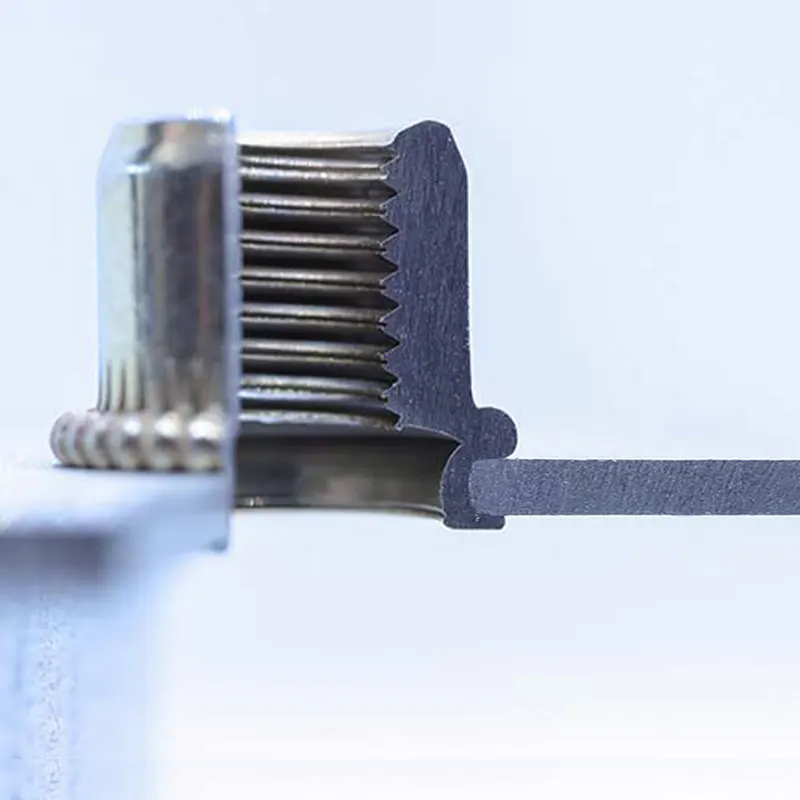
Thread standards specify thread diameter, pitch, and tolerances. Metric threads refer to the ISO 261, ISO 724, and ISO 965 series of standards. These standards help you determine whether internal and external threads will fit together correctly.
Material Standards: Determine Whether the Material Meets Application Requirements

Material standards specify the material grade, chemical composition, and applicable performance requirements for rivet nuts. The most common materials for rivet nuts are carbon steel, stainless steel, and aluminum. You should select the appropriate material based on the connection load, installation deformation capacity, corrosive environment, and compatibility with the sheet metal being joined.
Reading Metric and Inch Thread Designations
When purchasing rivet nuts, you will see various size designations such as M4, M6, M8, 1/4-20 UNC, and 3/8-16 UNC. This is because these represent two different sizing systems: metric threads and imperial threads. If you cannot correctly identify the markings, you may select the wrong thread size, which will prevent the bolt from screwing in properly.
1.Metric Thread Markings: M, Pitch, and Tolerance Class
Metric threads use millimeters as the basic unit of measurement and are denoted by the letter M. Their specifications primarily include the nominal diameter, pitch, and tolerance class.
Example 1: M6 × 1 – 6H:
| Symbol | Meaning | Explanation |
|---|---|---|
| M | Metric Thread | Indicates the ISO metric general-purpose thread system. |
| 6 | Nominal Diameter | The nominal thread diameter is 6 mm. |
| 1 | Thread Pitch | The axial distance between adjacent thread crests is 1 mm. |
| 6H | Tolerance Class | Indicates the dimensional tolerance class for the internal thread. |
- The nominal diameter represents the basic dimension of the thread specification. For example, M6 indicates a nominal diameter of 6 mm. This value is unrelated to the outer diameter of the rivet nut shank or the diameter of the mounting hole.
- Thread pitch refers to the axial distance between the corresponding positions of two adjacent thread flanks. In metric threads, the pitch is expressed in millimeters. For example, the pitch of M6 × 1 is 1 mm.
- The tolerance class specifies the range of permissible deviations for thread dimensions. Taking 6H as an example, the number 6 represents the tolerance class, and the letter H represents the tolerance position.
2.Imperial Thread Designations: Diameter, Threads Per Inch, and Thread Grade
Imperial Thread Designations: Diameter, Threads Per Inch, and Thread Grade
Imperial threads use inches as the unit of diameter. Unlike metric threads, which directly specify the pitch, imperial threads typically use threads per inch (TPI) to indicate thread density.
Example 1: 1/4-20 UNC-2B:
| Symbol | Meaning | Explanation |
|---|---|---|
| 1/4 | Nominal Diameter | The nominal thread diameter is 1/4 inch. |
| 20 | Threads Per Inch (TPI) | There are 20 thread crests per inch of thread length. |
| UNC | Thread Series | Indicates the Unified National Coarse thread series. |
| 2B | Tolerance Class | Indicates a Class 2B internal thread fit. |
- The nominal diameter represents the basic diameter of the thread. For example, 1/4 indicates a nominal diameter of 0.25 inches, which is equivalent to 6.35 mm.
- The number in white, indicating the number of threads per inch, refers to the number of thread pitches along the thread’s axial length per inch. The larger the number, the smaller the distance between adjacent thread pitches. For example, 20 TPI indicates 20 thread pitches per inch, with a corresponding pitch of approximately 1.27 mm.
- The primary purpose of thread series is to distinguish between different pitch series.
UNC: Unified coarse-pitch threads, commonly used for general mechanical connections.
UNF : Unified fine-pitch threads, with a smaller pitch than the coarse-pitch series of the same diameter.
UNEF : Unified extra-fine-pitch threads, suitable for specific connection designs requiring a finer pitch.
The letter “B” in the tolerance class denotes an internal thread, and the number “2” indicates the fit class. Imperial Unified Threads are typically classified into Classes 1, 2, and 3.
The series, classes, tolerances, and marking methods for Imperial Unified Threads are specified by the ASME B1.1 standard. Refer to the ASME B1.1-2024 edition.
Specifying Hole Size, Grip Range, and Head Dimensions
Mounting Hole Dimensions: Hole Diameter, Shape, and Tolerance Requirements
Before machining the mounting holes, you must confirm the shank configuration of the rivet nut. Then, machine the shape and diameter of the mounting holes accordingly. Use round holes for rivet nuts with round shanks and hexagonal holes for rivet nuts with hexagonal shanks.
Next, ensure that the hole diameter tolerance falls within the acceptable range for deviations from the nominal size during actual machining.
Mounting Hole Dimensions: Hole Diameter, Shape, and Tolerance Requirements
The grip range refers to the total thickness range of the material within which the rivet nut can be properly installed and form an effective clamped joint. This range is defined by a minimum and maximum value. The actual thickness of a single sheet of material is relatively easy to measure. For rivet nuts connecting two or more layers of material, you must measure the total thickness at the actual connection point. You should also account for the thickness tolerances of each layer of material. If the connection includes shims or sealing materials, include the actual compressed assembly thickness when determining the grip range.
Head Dimensions: Head Diameter, Head Height, and Installation Clearance
Head diameter refers to the outer diameter of a round head. Head height refers to the distance the head extends above the workpiece surface. Head height determines whether the rivet nut will protrude from the workpiece surface after installation and whether it will interfere with other components later on. The correct approach is to comprehensively evaluate the head dimension requirements, carefully checking the contact between the rivet nut and the sheet metal surface, the space occupied after installation, and the structural design of the connection area.
| Head Type | Key Features | Selection Considerations |
|---|---|---|
| Flat Head | Provides a relatively large flat bearing surface, suitable for general sheet metal fastening. | Check whether the head diameter and height interfere with adjacent components. |
| Countersunk Head | Reduces head protrusion after installation, allowing the head to sit nearly flush with the workpiece surface. | Requires a matching countersunk hole. Verify the sheet thickness and countersink dimensions. |
| Reduced Countersunk Head | Has a smaller head diameter and requires less installation space. | Check whether the smaller bearing area provides sufficient support for the application. |
| Thin Head | Features a low head height, making it suitable for assemblies with limited installation space. | Verify the head support area and the local load-bearing capacity of the parent material. |
Defining Material, Coating, and Corrosion Requirements
The material, surface treatment, and corrosion resistance of rivet nuts are three distinct technical parameters. The choice of material determines the product’s basic mechanical properties. Surface treatment is primarily used to protect the rivet nut. Corrosion resistance requirements must be determined based on the application environment.
Material Selection for Rivet Nuts: Defining Material Types and Grades
Common materials include stainless steel, carbon steel, and aluminum alloys. These materials directly determine the strength, ductility, resistance to deformation, and corrosion resistance of the rivet nut itself. During the installation of a rivet nut, the plates are secured through plastic deformation of the shank. Therefore, when selecting materials, you must not only consider the load-bearing capacity of the threads but also prioritize the material’s ductility.
| Material Type | Key Characteristics | Common Applications | Key Selection Considerations |
|---|---|---|---|
| Carbon Steel | Offers good strength and manufacturing characteristics at a relatively economical cost. | Industrial equipment, automotive sheet metal, enclosures, and machinery assemblies. | Usually requires surface treatment to improve corrosion resistance. |
| Stainless Steel | Provides good corrosion resistance and is suitable for various humid environments. | Outdoor equipment, food processing equipment, and some marine applications. | Select the appropriate stainless steel grade based on the specific corrosive environment. |
| Aluminum Alloy | Lightweight, with a natural oxide film, making it suitable for lightweight structures. | Automotive components, aluminum equipment, and electronic products. | Evaluate material strength, thread load capacity, and installation deformation performance. |
Surface Treatment of Rivet Nuts: Specifying Coating Types and Technical Requirements
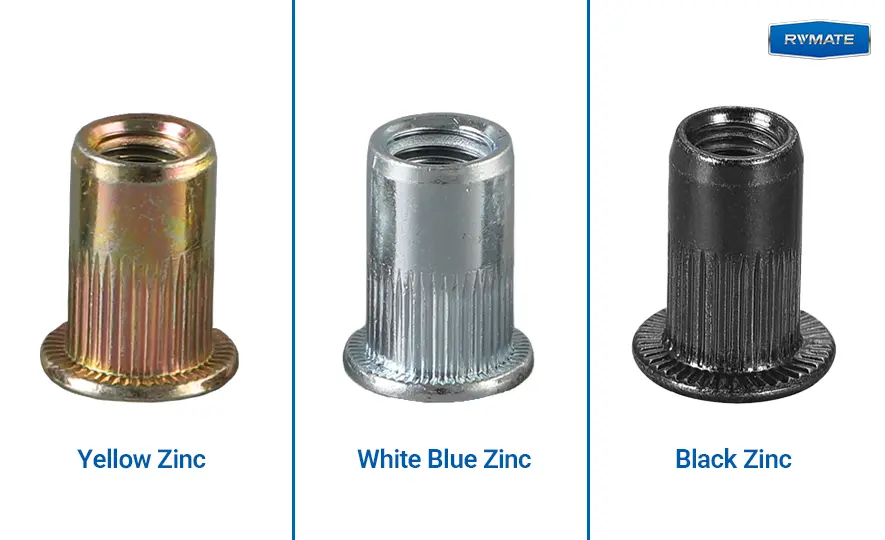
Common surface treatment methods include electrogalvanizing, zinc-nickel alloy plating, zinc flake coating, and anodizing. Surface treatment forms a protective layer on the material’s surface, effectively improving corrosion resistance, appearance, and other functional properties. Surface treatment is particularly important for carbon steel rivet nuts, as it reduces the steel’s direct exposure to moisture, oxygen, and corrosive media.
| Surface Treatment | Key Characteristics | Common Applications |
|---|---|---|
| Zinc Plating | Uses an electrochemical process to deposit a zinc coating, providing basic corrosion protection. | General industrial equipment and indoor sheet metal assemblies. |
| Zinc-Nickel Alloy Coating | Provides enhanced corrosion protection through a zinc-nickel alloy coating. | Steel fasteners requiring higher corrosion resistance. |
| Zinc-Iron Alloy Coating | Provides surface protection through a zinc-iron alloy coating. | Specific industrial and automotive fastener applications. |
| Zinc Flake Coating | Uses a non-electrolytically applied zinc flake coating system. | Steel fasteners requiring corrosion protection and specific hydrogen embrittlement risk control. |
| Anodizing | Forms a protective oxide layer on the aluminum alloy surface. | Aluminum alloy components and selected aluminum fasteners. |
How to Select Materials and Corrosion Protection for Different Environments?
| Operating Environment | Main Corrosion Risks | Material and Protection Considerations |
|---|---|---|
| Dry Indoor Environments | Relatively low corrosion risk. | Carbon steel with appropriate surface protection may be suitable. |
| General Outdoor Environments | Rain, humidity, and temperature fluctuations. | Evaluate coating integrity and weather resistance requirements. |
| Coastal and Marine Environments | Salt exposure, chloride ions, and prolonged moisture. | Carefully evaluate stainless steel grades, alloy coatings, and galvanic corrosion risks. |
| Automotive Undercarriage and Road Environments | Moisture, road salt, and dirt. | Consider prolonged moisture exposure, salt accumulation, and coating damage. |
| Chemical Processing and Cleaning Environments | Acids, alkalis, cleaning agents, and other chemical media. | Select materials based on the specific chemicals, concentrations, and operating temperatures. |
Comparing Torque-Out, Pull-Out, and Thread Strength Tests
| Test Item | Load Type / Unit | Main Evaluation | Test Method and Typical Failure Modes |
|---|---|---|---|
| Torque-Out Test |
Torsional Load N·m | Evaluates the resistance of the internal threads to torsional failure during bolt tightening. | The rivet nut flange is supported by a non-rotating fixture while torque is applied through a test bolt. Typical failures include thread stripping or bolt fracture. |
| Pull-Out Test |
Axial Tensile Load N or kN | Evaluates the ability of the installed rivet nut joint to withstand axial pulling forces. | An installed rivet nut is subjected to axial tension until joint failure. Typical failures include thread pull-out, base material deformation, or the insert pulling through the panel. |
| Thread Strength Test |
Axial Tensile Load N or kN | Evaluates the internal thread’s ability to withstand specified axial loads without stripping or permanent damage. | A test mandrel or bolt is engaged with the internal threads and subjected to axial loading. Testing may evaluate proof load or ultimate thread-stripping strength. |
Checking Interchangeability Against Manufacturer Drawings
The purpose of checking the interchangeability of rivet nuts is to determine whether rivet nuts produced by different manufacturers can be used as direct replacements. This must be done without altering the original mounting holes, connection structure, assembly method, or usage requirements.
In actual procurement, most people encounter this issue: the M6 rivet nuts provided by the original supplier do not fit the connection points of another supplier’s M6 rivet nuts. Although the thread specifications of the two products are identical, problems such as failure to rivet properly or loosening after connection occur after installation. Upon inspection, it is found that while the thread specifications are the same, there are differences in external dimensions, installation requirements, and mechanical properties. The primary reason is that different manufacturers may use different head structures, shank shapes, grip ranges, and mounting hole requirements.
When your project requires switching to an alternative supplier or changing to a different brand, you must use the original manufacturer’s drawings as a reference. Compare key dimensions, tolerances, materials, and performance requirements before making a purchase. Relying solely on thread designations such as M5, M6, or M8 can lead to assembly failures later on.
Writing a Complete Purchase and Inspection Specification
| Specification Section | Required Information | Main Purpose |
|---|---|---|
| 1. Product Identification | Product model, drawing number, revision, and structural type. | Ensure the correct product is specified and purchased. |
| 2. Dimensional Requirements | Overall dimensions, critical tolerances, and mounting hole size. | Ensure installation and assembly compatibility. |
| 3. Thread Requirements | Thread specification, pitch, and tolerance class. | Ensure proper bolt-to-thread compatibility. |
| 4. Grip Range | Minimum and maximum material thickness. | Ensure proper installation across the specified material thickness range. |
| 5. Material Requirements | Material type, grade, and mechanical properties. | Ensure the material meets design requirements. |
| 6. Surface Treatment | Coating type, thickness, and corrosion protection requirements. | Ensure the surface protection meets application requirements. |
| 7. Mechanical Performance | Pull-out, shear, torque, and thread strength requirements. | Ensure the required joint performance. |
| 8. Installation Requirements | Parent material, hole diameter, installation tools, and installation parameters. | Ensure consistent installation quality. |
| 9. Inspection Requirements | Inspection items, methods, frequency, and sampling criteria. | Ensure consistent quality acceptance. |
| 10. Quality Documentation | Material certificates, inspection reports, and test reports. | Ensure complete quality documentation. |
| 11. Lot Traceability | Production lot numbers, material batch numbers, and product labels. | Enable effective quality traceability. |
| 12. Packaging and Delivery | Packaging methods, labeling, and delivery requirements. | Protect product quality during transportation and storage. |
| 13. Change Management | Approval requirements for changes to materials, processes, manufacturing facilities, and drawings. | Prevent unauthorized product changes. |
FAQs
Is a rivet nut the same as a standard hex nut?
No. Rivet nuts have a different structure than standard hex nuts. A standard hex nut is a hexagonal nut. The installation method and applications of standard hex nuts differ from those of rivet nuts.
Does an M6 rivet nut require a 6 mm mounting hole?
No. “M6” refers to the nominal diameter of the internal thread of the rivet nut, which is 6 mm. It does not mean that the diameter of the product’s shank or the mounting hole is also 6 mm. The mounting hole must be larger than 6 mm because, in addition to its internal thread, the rivet nut also has an external shank. The size of the mounting hole must be machined within the range specified by the manufacturer.
Are metric and UNC rivet nuts interchangeable?
No. Metric threads and UNC threads are two different threading systems. They cannot be used interchangeably.
Does RoHS compliance establish mechanical strength?
Compliance with RoHS requirements does not guarantee that a rivet nut has sufficient mechanical strength. RoHS and mechanical performance testing are two distinct quality evaluation systems. RoHS compliance certifies that a product meets the restrictions on specific hazardous substances within the applicable scope; it does not indicate mechanical strength.
Does ISO 9001 certification certify an individual rivet nut?
ISO 9001 certification does not mean that individual rivet nuts have passed product certification. ISO 9001 certification means that the manufacturer’s quality management system complies with the requirements of the ISO 9001 standard.
Can a supplier part number identify a standard by itself?
No. The supplier’s part number is intended to identify the rivet nut product. It does not serve as proof of compliance with any specific standard. The performance and compliance of the rivet nut must be demonstrated through official technical drawings and test reports.
Can closed-end and open-end parts share a thread designation?
Sure.
Should a drawing specify the revision of a referenced standard?
Engineering drawings should specify the version of the standards referenced. This clarification provides a clearer presentation of product dimensions, tolerances, thread specifications, materials, and inspection methods, thereby reducing misunderstandings among different suppliers.
Work with a IATF 16949 Certified Blind Rivet Manufacturer
Get High Quality Rivets Instead of Huck and Avdel Rivets
Rivmate Rivet
Rivmate is blind rivets manufacturers in china. The company is IATF 16949 certified and offers high-strength structural blind rivets that serve as alternatives to Huck and Avdel products.
Explore Rivmate Cases

2.Imperial Thread Designations: Diameter, Threads Per Inch, and Thread Grade
Rivmate Rivet
Rivmate is blind rivets manufacturers in china. The company is IATF 16949 certified and offers high-strength structural blind rivets that serve as alternatives to Huck and Avdel products.

Hey There, I'm Allen!
I am the boss of Rivmate. For over two decades, we have specialized in the manufacture of blind rivets, providing our customers with reliable riveting solutions. Need riveting services? Feel free to contact us.