


Home » 归档于 6 7 月 2024
Types of Rivet Heads and Uses: A Practical Guide to Blind Rivet Head Selection
When selecting blind rivets, do you only consider diameter, length, material, and grip range? Rivet head style is equally important.
The rivet head remains visible on the workpiece after installation. Its size and shape affect the contact area with the sheet material. They also influence load distribution, surface flatness, and final appearance.
This article explains the main aspects of rivet heads. It covers definitions, classifications, selection criteria, and applications. The goal is to help you choose the most suitable blind rivet head style for your installation needs.
What Is a Rivet Head?
The rivet head is the structural component of a rivet designed to seat against and support the surface of the workpiece. Once riveting is complete, it remains on one side of the workpiece, working in conjunction with the deformed rivet body on the opposite side to secure the materials together.
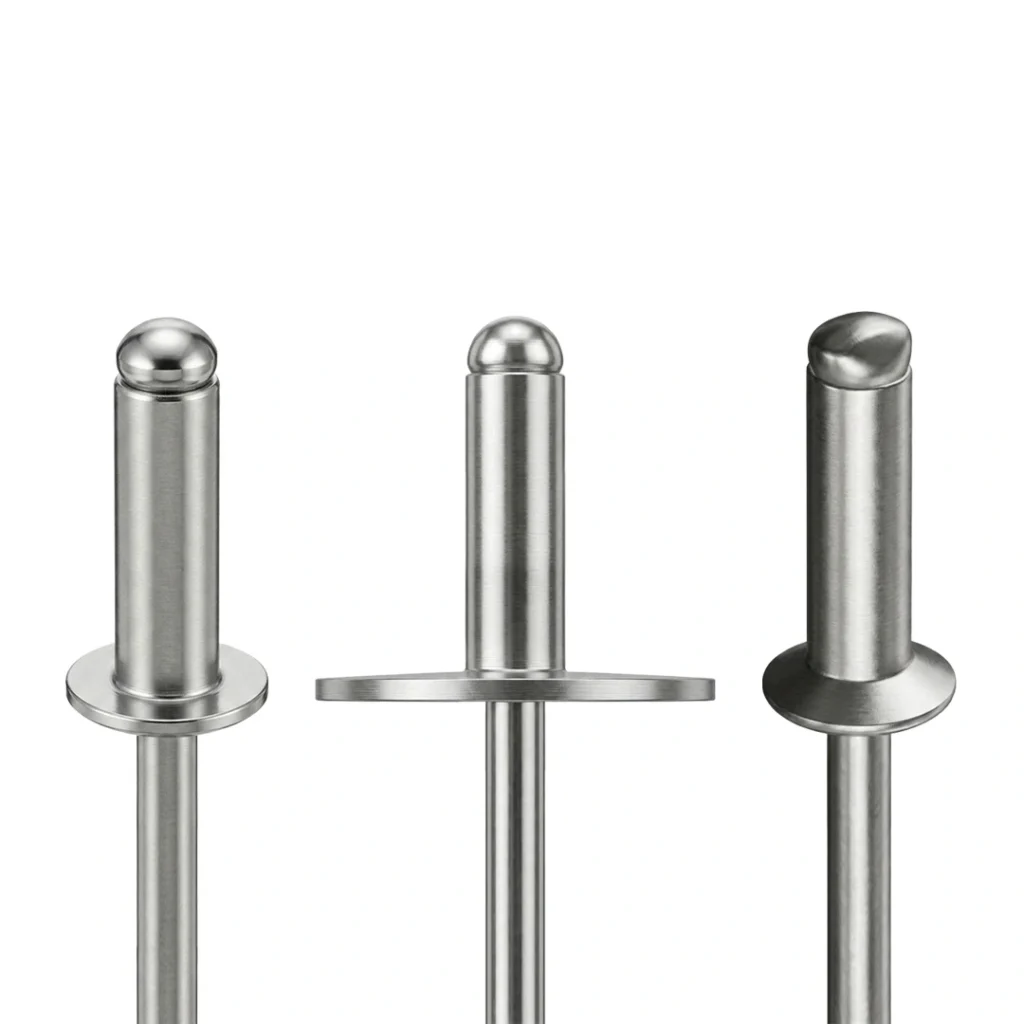
Rivet heads fall into three categories: dome head, large flange head, and countersunk head. They differ in head diameter, height, and profile, and are suited to different application environments.
Main 3 Types of Rivet Heads and Their Uses
Rivet Head Types and Uses Table
| Rivet Head Type | Main Uses | Suitable Materials or Applications |
|---|---|---|
| Dome Head / Standard Head | General sheet metal fastening, equipment housings, ventilation ducts, electrical cabinets, home appliances, and industrial assembly. | Steel sheets, aluminum sheets, and standard materials with sufficient strength around the installation hole. |
| Large Flange Head | Distributes installation pressure over a wider area, reduces deformation around the hole, and provides greater surface coverage. | Thin sheet metal, plastic, fiberglass, composite panels, insulation panels, soft materials, and oversized installation holes. |
| Countersunk Head | Creates a flush or nearly flush surface to reduce protrusion, improve appearance, and prevent interference with adjacent parts. | Exterior panels, equipment housings, vehicle components, sliding assemblies, and areas where another panel must cover the rivet. |
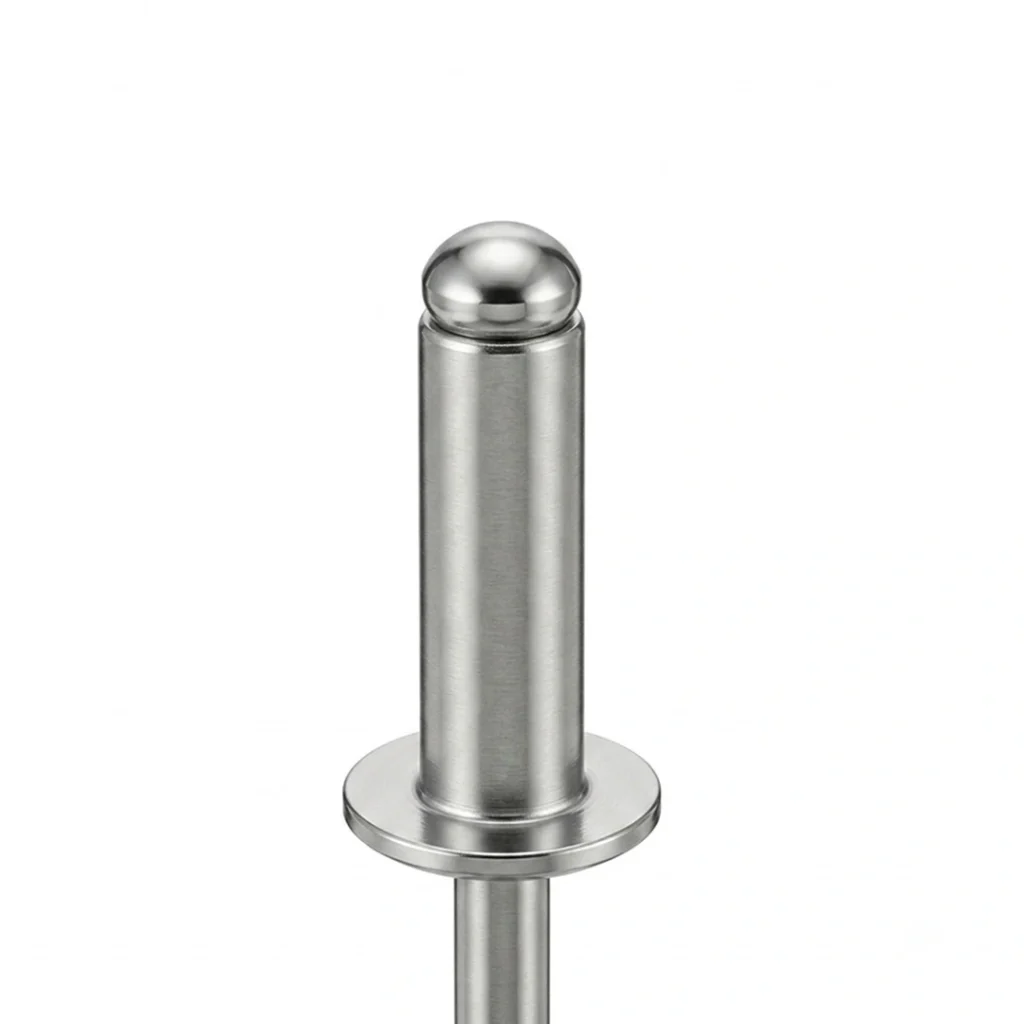
Dome Head Rivets: Features and Uses
What are Dome Head Rivets?
It is the most common and versatile type of head. The head features a low, rounded profile, with moderate diameter and height. Once installed, the rivet head protrudes slightly above the surface of the workpiece.
Key Features of Dome Head Rivets
- Moderate head size
It can cover the mounting hole and provide necessary support around the opening without occupying excessive surface space.
- Sits slightly above the workpiece surface after installation
After installation, the dome head retains a certain amount of protrusion.
- High versatility
Dome head rivets strike a good balance between appearance, cost, and bearing area. For connections without special requirements, the dome head is the preferred head style.
Common Uses of Dome Head Rivets
Dome head rivets are best suited for applications involving standard sheet material strength and installation hole dimensions, where a slightly protruding rivet head is acceptable. Their primary advantage lies not in maximizing bearing area or achieving a flush finish, but rather in striking a balance—within standard fastening scenarios—among load-bearing capacity, space requirements, manufacturing complexity, and cost.
- HVAC duct seams and accessory fastening
- Electrical cabinet internal brackets and connections on non-visible surfaces
- Side panels, back panels, and access panels for equipment enclosures
- Connections between metal brackets and thin-walled profiles
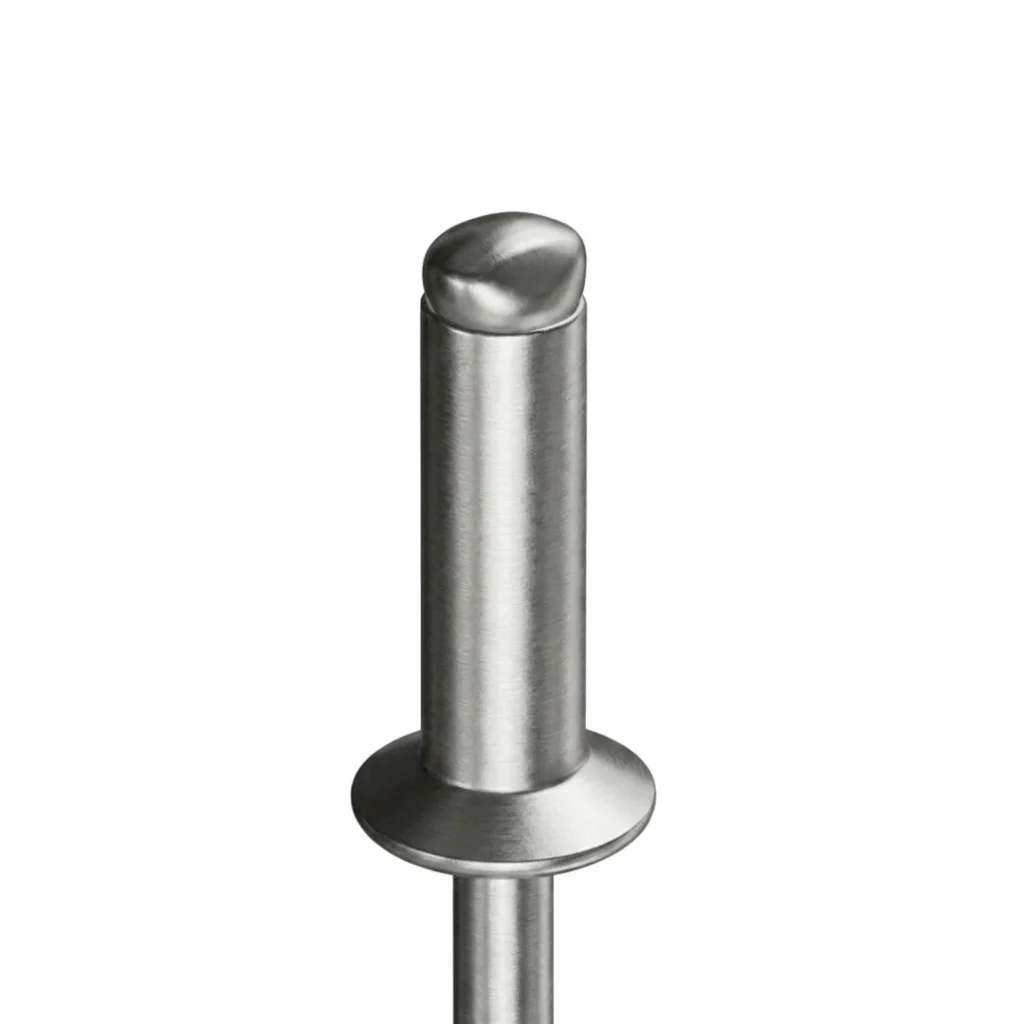
Countersunk Head Rivets: Features and Uses
What are Countersunk Head Rivets
Countersunk-head rivets have a conical base. Before installation, a countersunk hole must be drilled to match the size and angle of the rivet head. After installation, the rivet head sits flush with or nearly flush with the surface of the workpiece.
Key Features of Countersunk Head Rivets
- Results in a flatter surface after installation
After installation, the head of a countersunk rivet sits flush within a pre-machined countersunk hole, leaving no noticeable protrusion at the connection point on the workpiece surface.
- Requires machining of a matching countersunk hole
Dome head and large flange head rivets can usually be installed directly into standard round holes. However, countersunk rivets require a matching countersunk hole; the angle and dimensions of the countersunk hole must correspond to the rivet head.
- Head bearing area is affected by the countersunk hole design
A countersunk hole is required to make the rivet head sit flush with the sheet. However, very thin sheets may lose strength around the hole. Therefore, countersunk blind rivets are better suited for thicker materials with sufficient structural integrity.
- Reduces interference with adjacent components
Using countersunk rivets allows the mounting surface to remain relatively flush, preventing friction or interference with other components.
- Improves the overall appearance of the visible surface
High aesthetic standards are often required for equipment panels and internal product assemblies. Countersunk rivets minimize visual protrusion, resulting in a cleaner, more streamlined appearance for the workpiece.
Common Uses of Countersunk Head Rivets
Countersunk blind rivets are used when the rivet head must sit flush with the workpiece surface. Their main purpose is not to increase the bearing area. Instead, they reduce head protrusion. This helps prevent interference with component coverage, sliding fits, surface mating, and the overall appearance.
- Sheet metal connections beneath cover panels
- Areas near slide rails and moving parts
- Equipment exterior panels requiring a low profile
- Non-critical body panels for vehicles and transport equipment
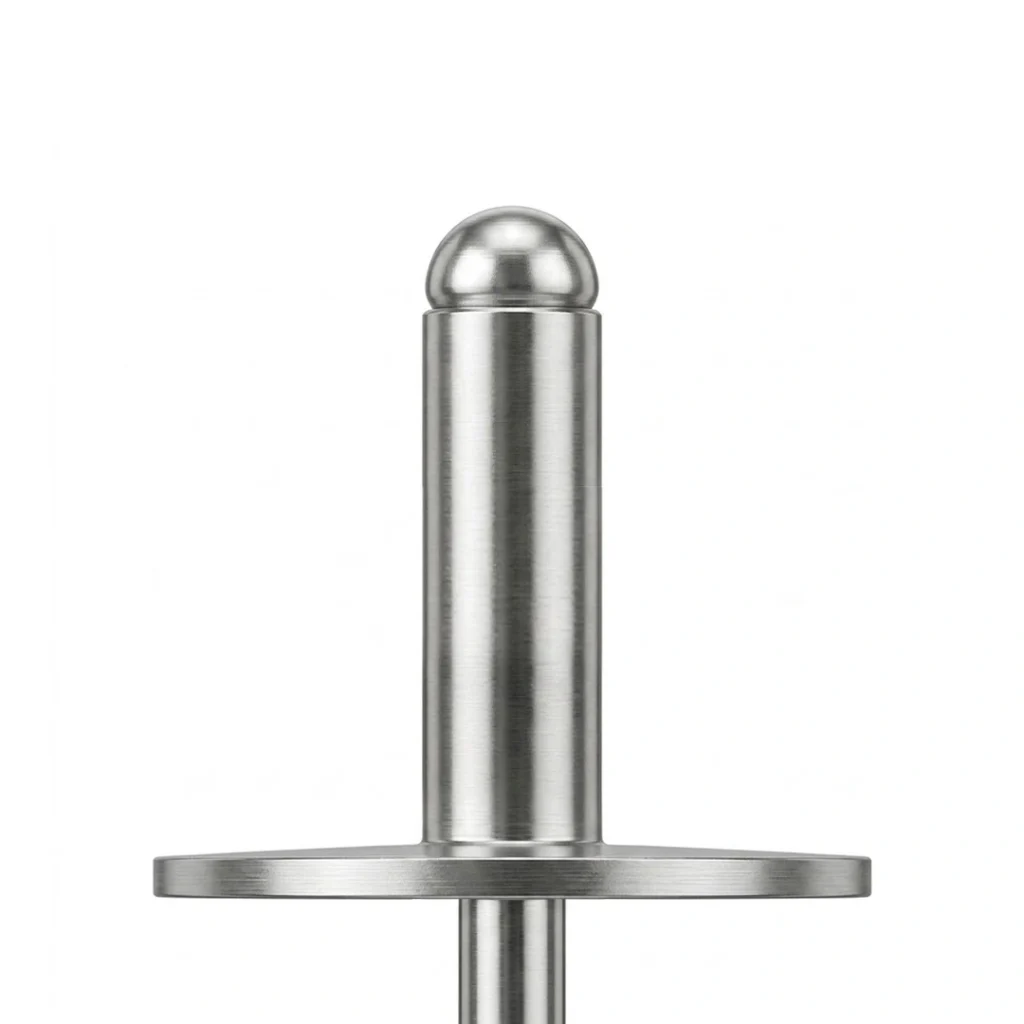
Large Flange Head Rivets: Features and Uses
What are Large Flange Head Rivets
The large flange head features a larger diameter, enabling it to cover a greater surface area of the workpiece and distribute the load, thereby reducing localized pressure around the hole opening.
Key Features of Flange Head Rivets:
- Larger head contact area
The diameter of the large flange head is larger than that of the dome or countersunk head, allowing it to cover a larger surface area of the material.
- Better suited for materials with lower edge strength
When joining sheets that are thin, soft, or lack sufficient rigidity, they are prone to deformation or even puncture due to the pulling force. A large flange head helps reduce the pressure exerted per unit area.
- Can cover a larger area around the hole opening
Repeated repairs can cause wear to the hole or deformation of the hole opening. As long as the hole diameter remains within the acceptable range, a large flange head provides better coverage of the hole edges.
- Occupies more surface space after installation
Although a large flange head provides better support, it also covers a larger area of the workpiece surface.
Common Uses of Large Flange Head Rivets:
Large-flange blind rivets are primarily used for connections requiring an increased bearing surface area on the front side. They are an excellent choice when the bearing surface of a standard dome head is insufficient, yet the flush finish of a countersunk head is not required.
- Joining of thin metal sheets
- Joining of plastic panels to metal frames
- Fiberglass and composite panels
- Fixing of facing layers for insulation boards and sandwich panels
- Repair connections for holes with slight wear
Blind Rivet Head Types vs Solid Rivet Head Types
| Comparison Item | Blind Rivet Head Types | Solid Rivet Head Types |
|---|---|---|
| Basic Structure | Rivet body, preformed head, and mandrel | One-piece solid rivet shank with a preformed head |
| Installation Access | Normally requires access to only one side of the workpiece | Normally requires access to both sides of the workpiece |
| Second Supporting Structure | The blind-side end of the rivet body deforms as the mandrel is pulled | The rivet tail is hammered or pressed to form a shop head |
| Common Preformed Head Types | Dome head, large flange head, and countersunk head | Universal head, dome head, brazier head, flat head, countersunk head, and other standardized designs |
| Key Head Selection Factors | Front-side bearing area, head protrusion, installation clearance, and protection of the joined material | Preformed head profile, shop-head forming space, structural load, and applicable industry standards |
| Installation Tools | Manual, pneumatic, electric, or hydraulic blind-rivet tools | Rivet guns, bucking bars, rivet presses, or specialized riveting equipment |
| Typical Advantage | One-sided installation, making it suitable for enclosed structures and locations where the rear side is inaccessible | The shop head can be formed under controlled conditions, making it suitable for engineered, high-demand joints |
| Main Limitation | Joint performance is influenced by the mandrel, rivet-body design, and blind-side formation | Sufficient rear-side tool clearance and operating space are required |
.rivet-table-scroll {
width: 100%;
overflow-x: auto;
border: 1px solid #dce3ec;
border-radius: 8px;
}
.rivet-comparison-table {
width: 100%;
min-width: 820px;
border-collapse: collapse;
background-color: #ffffff;
}
.rivet-comparison-table th {
padding: 15px 18px;
background-color: #1049a4;
color: #ffffff;
text-align: left;
vertical-align: middle;
font-size: 16px;
font-weight: 700;
line-height: 1.4;
}
.rivet-comparison-table td {
padding: 16px 18px;
border-bottom: 1px solid #e4e8ee;
text-align: left;
vertical-align: top;
font-size: 15px;
line-height: 1.65;
}
.rivet-comparison-table tbody tr:nth-child(even) {
background-color: #f7f9fc;
}
.rivet-comparison-table tbody tr:hover {
background-color: #eef5ff;
}
.rivet-comparison-table tbody tr:last-child td {
border-bottom: none;
}
.rivet-comparison-table th:first-child,
.rivet-comparison-table td:first-child {
width: 24%;
}
.rivet-comparison-table th:nth-child(2),
.rivet-comparison-table td:nth-child(2),
.rivet-comparison-table th:nth-child(3),
.rivet-comparison-table td:nth-child(3) {
width: 38%;
}
.rivet-comparison-table td:first-child strong {
color: #1049a4;
}
@media (max-width: 768px) {
.rivet-comparison-table th,
.rivet-comparison-table td {
padding: 13px 14px;
font-size: 14px;
}
}
How to Choose the Right Rivet Head Type
- First, determine whether the surface must be flush.
If the rivet is permitted to protrude slightly above the workpiece surface after installation, a standard dome head or large flange head may be selected. If another panel is to cover the rivet head, a countersunk rivet should be considered.
- Assessing the board’s susceptibility to deformation
The thickness and hardness of the board can influence the choice of head style. A standard dome head is suitable for boards with adequate edge strength, whereas a large flange head is suitable for thinner, softer boards.
Rivet Head Type Selection by Material Thickness
| Material Thickness Condition | Recommended Head Type | Reason for Selection | Important Considerations |
|---|---|---|---|
| Extremely thin sheet or material with easily deformed hole edges | Large Flange Head | The larger bearing area distributes installation pressure and reduces the risk of surface indentation or the rivet head being pulled into the hole. | Check the blind-side formation to ensure the expanded rivet body does not crush or damage the thin material. |
| General thin sheet with adequate material strength | Dome Head or Large Flange Head | A dome head is suitable for standard fastening. A large flange head can be used when additional support around the hole is required. | Carry out sample riveting to check whether visible deformation occurs around the installation hole. |
| Medium-thickness metal sheet | Dome Head | The material normally provides sufficient support for a standard dome head without requiring excessive surface space. | A countersunk head may be considered when a flush surface is required and the material is thick enough for countersinking. |
| Thicker material | Dome Head or Countersunk Head | Thicker material generally provides better load-bearing capacity around the hole. A countersunk hole can be added when a flush surface is required. | Head type selection does not replace the need to calculate the correct rivet diameter and required joint strength. |
| Multi-layer joint with a large variation in layer thickness | Select according to the material on the rivet head side | A thin front sheet may require a larger head bearing area, while a thicker front sheet can normally support a standard dome head. | The total joint thickness must remain within the specified grip range of the selected blind rivet. |
| Thin plastic, fiberglass, or composite material | Large Flange Head or a rivet designed for soft materials | Soft materials are more sensitive to concentrated pressure and may require a larger load-bearing area on both the front and blind sides. | A large flange head alone may not be sufficient. Peel-type rivets, tri-fold rivets, or backing washers may also need to be evaluated. |
- Check the actual condition of the mounting holes.
If the mounting hole dimensions are correct and the hole edges are intact, a standard dome head is suitable. If there is slight wear around the hole opening, or if a larger front-facing coverage area is required, a large flange head can be selected.
- Check the installation space around the head.
Choose a countersunk head when surface space is limited; choose a dome head rivet when there is ample installation space.
Common Mistakes When Choosing Rivet Head Types
×Error 1: Believing that a larger rivet head results in higher joint strength.
Rivet strength depends on various factors, such as the material, dimensions, and body structure of the rivet; a larger head does not necessarily mean greater strength.
×Error 2: Selecting Large Flange Head rivets for all thin sheets.
Some thin-sheet materials possess high strength and do not deform (dimple) during test riveting; in such cases, Dome Head rivets can be selected.
×Error 3: Considering only the total thickness of the multi-layer material, without regard for the material on the side contacting the rivet head
Total thickness primarily determines the grip range; however, one must also consider the hardness and hole-edge strength of the top sheet that comes into contact with the rivet head.
×Error 4: Using a large-flange head to compensate for installation holes that significantly exceed tolerance limits
When the hole diameter exceeds the permissible range, a rivet with a larger diameter should be used instead of simply switching to a large-flange head.
×Error 5: Failure to verify the countersink angle, diameter, and depth
When selecting a countersink, the angle, maximum diameter, and depth of the counterbore must be confirmed against the product drawings; do not machine the counterbore blindly.
×Error 6: Treating the head style as the deciding factor for sealing performance
The sealing effectiveness of a rivet depends on key factors such as whether the rivet body is of the open-end or closed-end type, and whether sealant or a sealing washer is used. The rivet head style does not determine sealing performance.
Custom Rivet Head Options for Industrial Buyers
To better accommodate existing hole locations, panel structures, assembly space, or product aesthetics, you might consider customizing the rivet head style.
You can customize the following head specifications:
1. Head diameter
2. Head height and profile
3. Countersink angle and dimensions
4. Special large flange dimensions
5. Head material and surface finish
6. Head color
7. Head marking
Why Choose Rivmate for Blind Rivet Head Selection and Supply?
Rivmate operates a manufacturing facility spanning approximately 40,000 square meters, with a comprehensive production chain that enables the supply of a full range of head styles. Additionally, we can recommend and customize suitable head styles based on the specific requirements of the customer’s workpieces.
We strictly adhere to the IATF 16949:2016 standard. Every rivet undergoes 13 inspection procedures—from raw material to finished product—ensuring a 99.9% product pass rate and helping customers minimize procurement risks.
Conclusion
The head style is not the only factor that defines a blind rivet. However, it determines how the rivet head contacts the workpiece surface. It also affects the bearing area, local deformation, installed height, and final appearance.
The dome head is suitable for most standard metal joining applications. It offers good versatility and cost-effectiveness. The large flange head provides a wider bearing area. It is ideal for thin sheets, soft materials, and workpieces with limited strength around the hole edge.Countersunk heads are primarily used in applications requiring a smooth surface finish, though they necessitate precise machining of the countersunk hole.
Rivet strength is not determined by the head style alone. Therefore, the head style should not be treated as a strength grade. Before volume procurement, several other factors must be evaluated. These include the rivet body diameter, body and mandrel materials, structural type, hole diameter tolerance, grip range, and surface finish.
FAQs
What are the cost differences between different rivet head types?
Dome heads offer better overall cost-effectiveness.
Although large flange heads may have a higher unit cost, they can reduce the need for subsequent rework, thereby lowering the total cost.
Countersunk blind rivets require a tapered countersunk hole, resulting in higher final installation costs.
Which rivet head types are best suited for heavy-duty construction projects?
Standard round heads are better suited for heavy-load connections. They provide a stable bearing surface for the rivet head and do not require pre-machined countersunk holes.
Are there specific rivet head types designed for watertight sealing?
The rivet head shape alone does not determine sealing performance. Sealing effectiveness depends on factors such as whether the rivet body is closed, the presence of a sealing structure beneath the head, the fit of the installation hole, and the quality of the riveting process.
You can opt for a closed-end blind rivet combined with a sealing washer or sealant, along with the correct hole diameter and installation procedure. This combination can significantly enhance sealing performance.
How do you select the right rivet head style for fastening metal sheets?
Dome Head: For standard steel or aluminum sheets;
Large Flange Head: Choose this when working with thin metal sheets prone to deformation or indentation;
Countersunk Head: For applications requiring a flush surface finish.
How do you find manufacturers that offer blind rivets with various head styles?
First, examine the product catalog to see if it truly covers various head styles and to assess the supplier’s product selection capabilities. When sourcing via B2B channels, do not focus solely on head styles; also verify specifications such as material, grip range, hole diameter, and batch-to-batch consistency.
Next, verify their quality management systems and testing capabilities, and determine whether they can provide samples.
Finally, confirm whether they offer customization options and can ensure a long-term supply.
Work with a IATF 16949 Certified Blind Rivet Manufacturer
Get High Quality Rivets Instead of Huck and Avdel Rivets

Rivmate Rivet
Rivmate is one of China’s top three manufacturers of pop rivets. The company is IATF 16949 certified and offers high-strength structural pop rivets that serve as alternatives to Huck and Avdel products.
Explore Rivmate Cases

Rivmate Rivet
Rivmate is one of China’s top three manufacturers of pop rivets. The company is IATF 16949 certified and offers high-strength structural pop rivets that serve as alternatives to Huck and Avdel products.