


What Makes Closed End Rivets Different from Open-End Rivets?
The main difference between closed-end and open-end rivets lies in whether the tail end of the rivet is sealed.
Open-end rivets are hollow, and after riveting, a passage may remain near the point where the rivet shank breaks off. In contrast, the tail end of a closed-end rivet is sealed, which provides better protection against water, air, dust or liquids entering the rivet hole after installation.
Difference 1: Structural Differences: Closed-end rivets have a closed tail.
Open-end rivets are the most common type of rivet. They have an open-end design and are not intended to provide a seal.
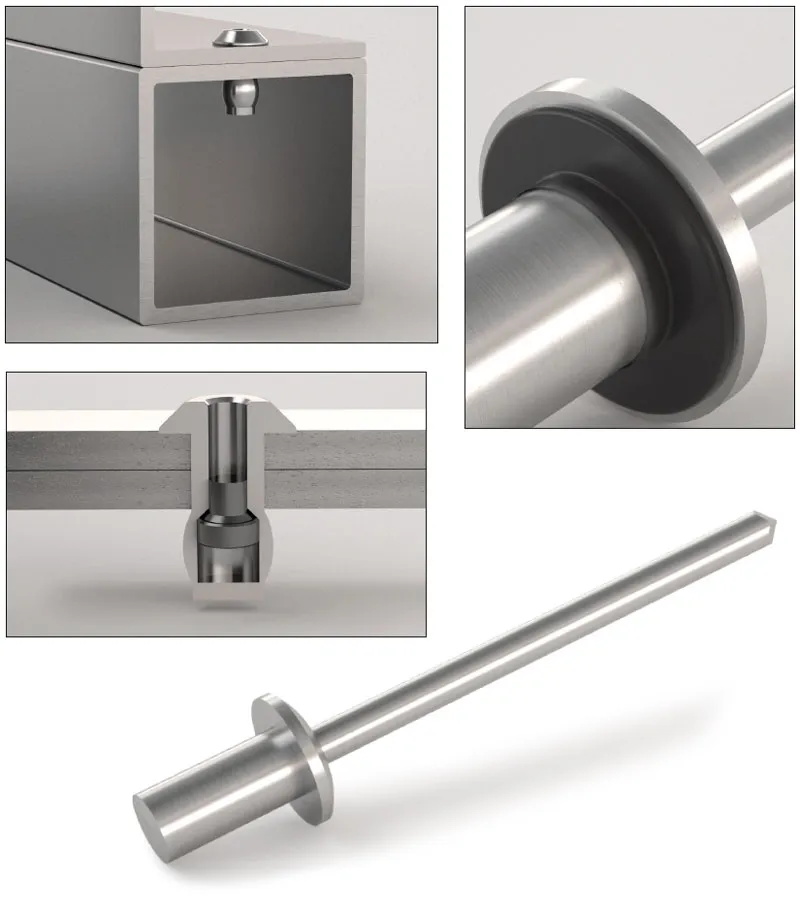
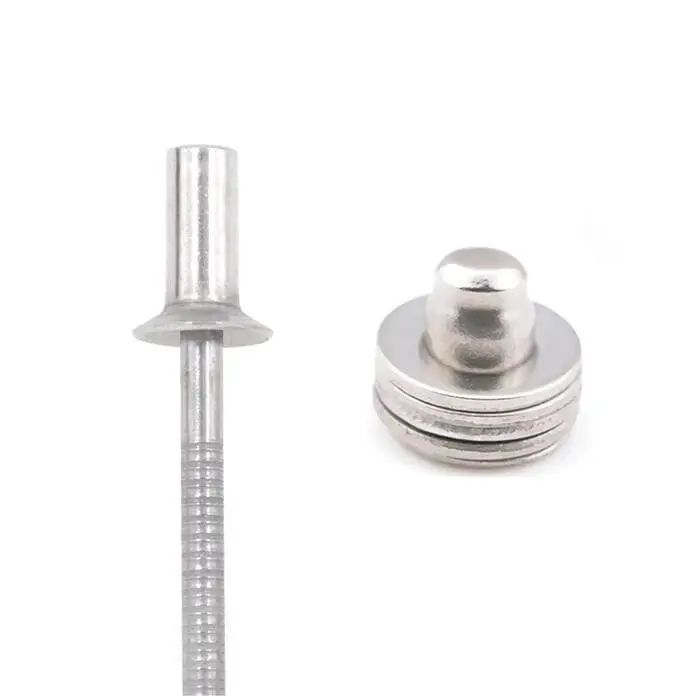
The tail end of a closed-end rivet is sealed. During installation, the mandrel is pulled out, causing the rivet tail to expand and create a clamping force. At the same time, the sealed tail prevents moisture from passing through the rivet and entering the other side of the workpiece.
This is why, when discussing the question “Are Closed-End Rivets Waterproof?”, closed-end rivets are more suitable than open-end rivets for waterproofing, sealing, or dustproofing applications.
Difference 2: Different Sealing Capabilities: Closed-End Rivets Are More Suitable for Waterproof Applications
The advantages of closed-end rivets are:
- The closed end reduces the likelihood of moisture penetrating the interior of the rivet;
- After riveting, the rivet mandrel is more securely enclosed;
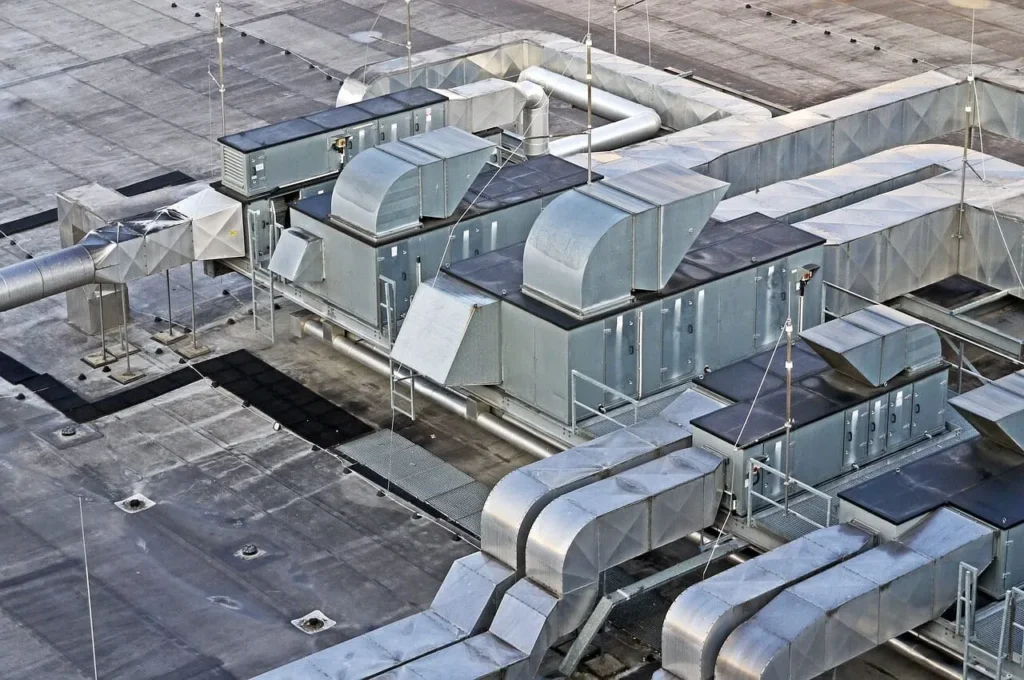
- They are better suited for applications requiring sealing, such as outdoor equipment, enclosures, vehicle components, marine vessels, and HVAC casings.
However, it is important to note that closed-end rivets do not guarantee absolute waterproofing in all circumstances.
Difference 3: Different Applications: Open-End Rivets are primarily for fastening, while Closed-End Rivets are primarily for fastening and sealing.
The primary function of open-end rivets is rapid fastening. They are suitable for general industrial assembly, sheet metal joining, interior trim, lightweight structures, and other applications that do not require a high level of sealing.
Closed-end rivets not only provide structural strength but also emphasize sealing and protection.

How Waterproof Are Closed End Rivets in Real Applications?
In practical applications, closed-end rivets offer significantly better water resistance than open-end rivets.
The closed-end design of closed-end rivets reduces the risk of water, dust, and air penetrating the interior of the rivet.
Why Do Closed-End Rivets Improve Water Resistance?
The closed-end design of closed-end rivets reduces the risk of water, dust, and air penetrating the interior of the rivet.
Once installed, the head of a closed-end rivet forms a relatively sealed structure, minimizing the likelihood of moisture entering the other side through the rivet.
Performance of Closed-End Rivets in Practical Applications
In practical applications, closed-end rivets can be used in the following situations:
Application Environments | Performance of Closed-End Rivets |
Typical indoor humid environments | Generally provide good moisture protection |
Outdoor environments exposed to rain | ore suitable than open-end rivets, but require proper installation |
Environments with liquid splashes | Can reduce the risk of leakage |
Helps improve sealing performance | |
Reduces water and dust ingress | |
Environments with Prolonged Submersion or High Water Pressure | Relying solely on the rivets is not recommended; additional sealing measures are required |
It is important to note that in harsh environments—such as prolonged immersion in water, high-pressure water jets, liquid storage tanks, or underwater hull structures—the waterproofing capabilities of closed-end rivets alone are insufficient. You will need to use sealants, gaskets, coatings, or specialized sealing structures in conjunction with them.
Key Factors That Affect Sealing Performance & Common Mistakes That Make Closed End Rivets Leak
Sealed rivets merely provide a better foundation for waterproofing; whether the system is ultimately waterproof depends on whether the entire riveting system is properly designed.
1.Have you selected the correct type of rivet?
- Whether it is a true sealed rivet;
- Whether it is suitable for the target plate thickness;
- Whether it needs to be used with a seal or washer.
2.Is the hole diameter correct?
If the hole is too large, a small gap may remain between the rivet body and the hole wall. Moisture may not necessarily enter through the interior of the rivet, but could seep in through the gap between the rivet’s outer diameter and the hole wall.
If the hole diameter is too small, the rivet may not insert smoothly, making it easy to scratch the coating or deform the hole edges during installation, which can also compromise the seal.
Therefore, the ideal condition for a waterproof connection is when the hole diameter matches the rivet diameter, allowing the rivet to insert smoothly without any noticeable looseness.
3.Does the clamping range match?
Each type of rivet has a specific total sheet thickness range for which it is suitable.
If the rivet is too short → the rivet shank cannot expand sufficiently → clamping force is insufficient → the rivet head may not fit tightly against the sheet → resulting in gaps.
If the rivet is too long → the shank will not form properly after riveting → abnormal deformation will occur → the sealing effect may not be reliable.
4.Is the installation quality consistent?
Insufficient pulling force from the riveting tool: The rivet is not fully formed, and the clamping force is inadequate.
Excessive pulling force: May cause deformation of the hole or damage to the sheet metal.
Rivet not installed vertically: The rivet head does not sit flush, which can easily leave gaps.
Abnormal breakage of the rivet shank: May affect the internal stability of the rivet.
5.Is the surface of the panel smooth and clean?
If the panel surface has any of the following issues, it may affect the sealing performance:
× Burrs around the hole edges;
× Oil or dust on the surface;
× Uneven coating;
× Panel warping;
× Unevenness around the hole;
× Gaps between the two layers of the panel.
6.Is the material suitable for the intended environment?
Common materials used for blind rivets include:
Application Environments | Common Material Options | Notes |
Standard indoor environments | Lightweight and cost-effective; suitable for general-purpose connections | |
General industrial structures | High strength, but surface corrosion protection is required | |
Outdoor humid environments | Superior corrosion resistance; suitable for environments exposed to rain and moisture | |
Coastal or highly corrosive environments | SS316 stainless steel | Superior corrosion resistance; more suitable for salt spray environments |
7.Are Additional Sealing Measures Required?
If the project has stricter waterproofing requirements, additional sealing measures may be implemented. Common methods include:
- Using sealing washers beneath the rivet heads;
- Applying sealant around the holes;
- Applying a protective surface coating after installation;
- Applying a secondary seal to the joints;
- Avoiding long-term water accumulation through structural design.
When Do You Need Additional Sealing (Washer or Sealant)?
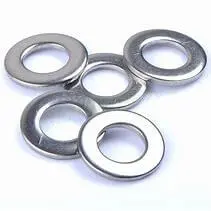
Sealing washers are typically installed beneath the head of a rivet. When the rivet is tightened, the washer is compressed between the rivet head and the sheet metal, helping to fill microscopic gaps.
Recommended applications for sealing washers:
① Metal roofing or roof structures
② Vehicle exterior panels
③ HVAC enclosures or ductwork
④ Coated sheets or color-coated steel sheets
⑤ Thin sheet metal joints
Sealant is typically applied around holes, beneath the rivet head, and at sheet metal seams.
Recommended applications for sealant:
① Enclosures with high waterproofing requirements
② Outdoor electrical cabinets
③ Marine vessels or equipment
④ Vehicle, trailer, and body structures
⑤ Roof mounting structures
⑥ When hole quality is inconsistent
How to make riveted joints watertight with closed end rivets

Step 1: Select a blind rivet
Step 2: Choose the correct material
Step 3: Match the clamping range
Step 4: Control the hole diameter
Step 5: Clean the hole edges and surface
Step 6: Add washers or sealant if necessary
Step 7: Install using the correct tools
Step 8: Perform a water resistance test
Are sealed rivets 100% waterproof in real-world use
As discussed above, there are many factors that affect the waterproofing performance of blind rivets. Therefore, while blind rivets can address the issue of sealing the interior of the rivet, they do not automatically resolve sealing issues on all external contact surfaces.
Blind rivets offer better waterproofing performance than standard open-end rivets, but in real-world applications, they do not automatically provide 100% waterproofing under all circumstances.
Leaks may still occur if there are issues such as excessive hole diameter, poor surface contact, incorrect clamping range, improper installation, corrosion, or gaps between panels. For critical waterproofing applications, we should follow the correct installation procedures to maximize waterproofing effectiveness.
How to Choose the Right Closed End Rivet for Your Project?
When selecting blind rivets, you shouldn’t just look at whether they are “blind” or not; you must also ensure that the material, size, sheet thickness, hole diameter, operating environment, and waterproofing requirements are all compatible.
- Select the appropriate material based on the operating environment (aluminum, carbon steel, stainless steel, SS316 stainless steel)
- Select the correct rivet diameter
- Match the correct clamping range
- Confirm that the installation hole diameter is compatible
- Determine whether washers or sealant are required based on the waterproofing rating
- Select the appropriate head style based on the head design (round head, countersunk head, large flange)
- Consider strength requirements; do not focus solely on waterproofing
- Conduct sample testing; do not rely solely on theoretical judgments
Therefore, closed-end rivets can only achieve their intended sealing performance when the correct type is selected and installed properly.
How to perform a waterproof test after riveting
If you want to test the waterproof rating of the rivets you are currently using, follow these steps:
- Perform a visual inspection first (before testing, you need to confirm that the rivets are properly installed):
- Low-pressure water spray test: Use a hose, spray bottle, or sprinkler system to continuously spray water onto the riveted area.
- Static water test: Allow water to pool on the riveted area for a period of time and observe for any leaks.
- Inspect the back side: Do not check only the front side for water.
- Tissue test: Place a tissue or absorbent paper behind the rivet, then spray water or let water pool on the front side.
- Pressure or vacuum test: Apply a certain amount of pressure to the interior of the product, or create a vacuum, then observe whether the pressure drops.
- Salt spray or immersion test.
Below are some common international waterproofing standards. If you are interested, click here to learn more.
IEC 60529 / EN 60529 — IP Protection Rating Standard
ISO 20653 — IP Protection Ratings for Electrical Equipment in Road Vehicles
ASTM E331 — Water Penetration Test Under Static Pressure Differential
AAMA 501.2 — Field Water Spray Test
FAQ
Do I need sealant with closed end waterproof rivets
In general, closed-end waterproof rivets do not necessarily require additional sealant.
In standard waterproofing, dustproofing, and splash-proofing applications, select the appropriate rivet model based on the specific environment. When installed correctly, the rivet itself provides a certain level of sealing, so sealant is not required in these cases.
However, for applications involving prolonged immersion in water, high-pressure water jets, long-term roof rainwater penetration, high-vibration areas on the exterior of cars or trucks, or scenarios with specific sealing requirements, it is recommended to use sealant or sealing gaskets in conjunction with the rivets.
Are POP closed end rivets waterproof enough for boats
POP closed-end rivets provide a good watertight seal, but they are not suitable for all types of vessels.
For small boats, aluminum boats, interior fittings, locations not subject to prolonged immersion, and light-duty watertight connections, POP closed-end rivets are more suitable than open-end rivets. Their cup-shaped closed-end design prevents liquids or steam from passing through the interior of the rivet.
However, for applications such as the hull bottom, below the waterline, areas subject to prolonged immersion, high vibration, structural loads, or seawater corrosion, relying solely on POP closed-end rivets is not sufficiently reliable. It is recommended to use them in conjunction with marine sealant, giving priority to selecting appropriate materials.
Are stainless steel closed end rivets more waterproof than aluminum
Not necessarily. Stainless steel closed-end rivets are not inherently more “waterproof” than aluminum closed-end rivets simply because they are made of stainless steel.
The water resistance of a rivet primarily depends on the closed-end structure, hole diameter match, grip range, riveting quality, flange fit, and the presence of a gasket or sealant—not solely on the rivet material itself.
In long-term outdoor, humid, seawater, chemically corrosive, or high-vibration environments, stainless steel closed-end rivets offer greater corrosion resistance and higher strength than aluminum rivets, so they may provide better long-term sealing stability.
Do closed end rivets prevent corrosion from trapped moisture
Closed-end rivets can reduce the amount of trapped moisture entering the interior of the rivet, thereby lowering the risk of corrosion to some extent, but they cannot completely prevent corrosion.
The primary benefit of closed-end rivets is that moisture cannot easily enter the joint through the central channel of the rivet, as it can with open-end blind rivets.
However, corrosion may still occur if moisture is already present between the sheet metal, around the hole walls, or at damaged coating areas, or if the rivet material is incompatible with the workpiece material.
Are waterproof rivets necessary if I already use silicone sealant
Waterproof rivets aren’t strictly necessary, but for critical waterproofing areas, it’s recommended not to rely solely on silicone sealant.
For ordinary indoor applications, light-duty waterproofing, or dustproofing where silicone sealant is already in use, standard rivets may be sufficient.
However, for outdoor applications, roofs, marine vessels, HVAC outdoor units, trucks/trailers, solar mounting brackets, or environments subject to prolonged exposure to rain or vibration, we recommend using a combination of waterproof rivets or closed-end rivets with silicone sealant.
How strong are closed end rivets in wet and marine environments
Closed-end rivets maintain good joint strength in humid and marine environments. However, the reliability of this strength depends primarily on the material, surface treatment, hole diameter, grip range, and rivet corrosion control.
The closed-end structure primarily enhances sealing performance.
The strength of closed-end rivets is determined by the combination of materials used for the rivet body and rivet mandrel, as well as whether they will corrode, loosen, or fail in humid, salt spray, or vibration-prone environments.
Are closed end rivets good for waterproof automotive sealing
It is suitable for rivet joints requiring waterproofing, dustproofing, and moisture resistance, such as automotive outer panels, interior sheet metal, light fixture brackets, chassis components, cargo compartment panels, truck/trailer bodies, and HVAC-related parts.
However, for applications involving prolonged exposure to water, high-pressure car washing, salt spray on the chassis, critical sealing areas of the body, and load-bearing structural locations, it is recommended to use a closed-end rivet combined with sealant or a gasket, along with suitable materials and proper installation and testing.
Are waterproof blind rivets safe for pressurized vessels
It is not recommended to use waterproof blind rivets directly in pressurized vessels as pressure-bearing sealing fasteners.
Waterproof blind rivets / closed-end rivets are primarily used for waterproofing, dustproofing, moisture protection, and general sealing. They cannot withstand high internal pressure.
Why do some closed end rivet joints still leak water
Some closed-end rivet joints still leak, not because the “closed-end design is completely ineffective.” but because water seeps in through the rivet head flange, the hole walls, the sheet metal contact surfaces, installation gaps, or areas of material corrosion.
Closed-end rivets primarily seal the internal channel of the rivet body; they cannot seal the entire joint surface.
For critical waterproofing applications, it is recommended to use a sealant or gasket in conjunction with the rivet.
How to choose between standard, sealed, and gasketed waterproof rivets
The higher the waterproofing requirements, the harsher the environment, and the more severe the consequences of water leakage, the more important it is to upgrade from standard rivets to sealed rivets, and then to gasketed waterproof rivets.
For ordinary fastening applications, standard rivets are perfectly sufficient.
If you need to prevent moisture from entering through the rivet body, sealed or closed-end rivets are more suitable.
For outdoor, marine, roofing, truck/trailer, or critical waterproofing applications, based on our experience, we recommend using gasketed waterproof rivets or sealed rivets in combination with sealant.
Work with a IATF 16949 Certified Blind Rivet Manufacturer
Get High Quality Rivets Instead of Huck and Avdel Rivets

Rivmate Rivet
Rivmate is one of China’s top three manufacturers of pop rivets. The company is IATF 16949 certified and offers high-strength structural pop rivets that serve as alternatives to Huck and Avdel products.
Rivmate Rivet
Rivmate is one of China’s top three manufacturers of pop rivets. The company is IATF 16949 certified and offers high-strength structural pop rivets that serve as alternatives to Huck and Avdel products.