


Rivets are installed using a riveting tool to expand and deform the rivet shank, thereby clamping together two or more layers of material and securing the workpiece. The effectiveness of rivet installation is influenced by the rivet diameter, clamping range, material, head type, hole diameter, and workpiece thickness.
What Is blind Rivet?
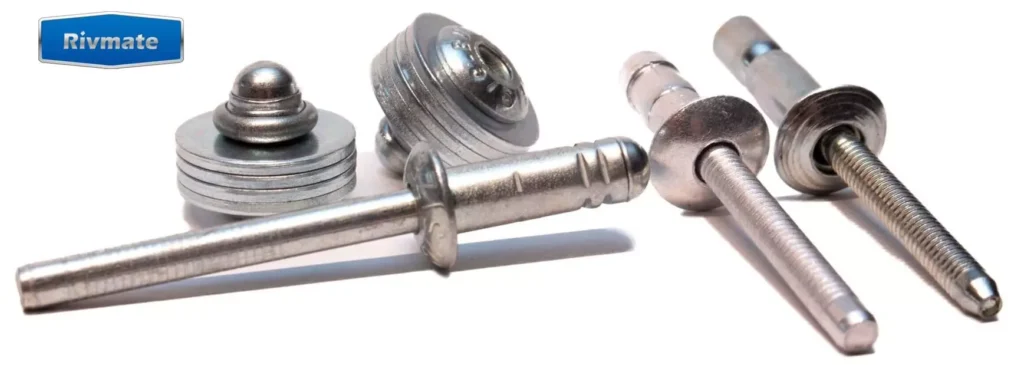
A blind rivet, also known as a pull-through rivet or mandrel rivet, is a permanent mechanical fastener that can be installed by deforming it with a riveting tool from a single side of the workpiece.
The key advantage of a blind rivet is that the installer only needs access to one side of the workpiece. This solves the problem of inaccessible interior areas in certain pipes, enclosures, closed profiles, or equipment housings, allowing the riveting process to be completed from the outside.

The structure of a blind rivet consists primarily of two parts:
- Rivet Body: The part that deforms after riveting, remains in the workpiece, and actually clamps the workpiece in place. It is also the primary connecting component.
- Mandrel: A slender metal rod located at the center of the rivet. It is connected to the rivet body and is used to pull and compress the tail end of the rivet body during installation.
How Do Blind Rivets Work?
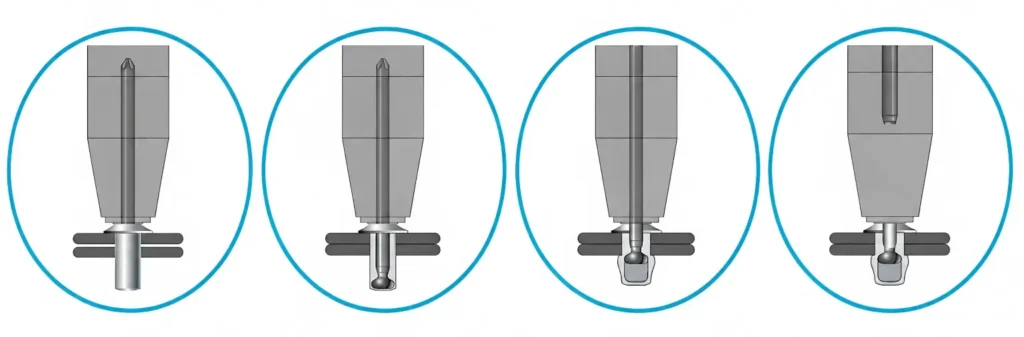
When installing a rivet, first drill a suitable hole in the surface of the workpiece to be secured. The rivet head remains on the front side of the workpiece, while the tail of the rivet body passes through the mounting hole and extends to the back side of the workpiece.
Next, use a riveting tool to pull the rivet mandrel outward; the mandrel head will compress the tail end of the rivet body. Since the rivet head is held against the workpiece surface by the tool’s nozzle, the rivet body cannot detach as a whole but instead gradually expands or bulges on the back side, forming a closed blind end.
As the rivet body continues to expand and deform, the closed head on the blind side and the rivet head on the front side clamp the workpiece in the middle from both sides, causing the multiple layers of material to fit tightly together. When the installation load reaches the standard level, the mandrel breaks at a predetermined breaking point. The riveting tool then extracts the broken mandrel shaft, completing the riveting process.
Step-by-Step Blind Rivet Installation Process
How to Properly Install a Blind Rivet. First, you need to confirm the rivet specifications and grip range, prepare the mounting holes, and inspect the quality of the workpiece joint after riveting is complete.
Measure the total thickness of all the sheets to be joined when stacked, and confirm that this thickness falls within the grip range specified for the blind rivet.
Using a rivet that is too short will prevent a complete closed head from forming on the blind side, while selecting a rivet that is too long may cause unstable forming, protruding mandrels, or inadequate clamping of the workpieces.
Based on the actual application, confirm the following parameters:
- Rivet diameter
- Rivet body length
- Grip range
- Rivet body and mandrel materials
- Rivet head type
- Strength and corrosion resistance requirements
Many customers initially select rivets based solely on total length, but overlook many other factors that can cause riveting failure. The rivet diameter determines the installation hole size and the base material’s load-bearing capacity; the grip range determines whether the rivet body can be formed in the correct position; and the material and head type affect joint strength, surface support, and the operating environment. Therefore, selecting the appropriate rivet requires a comprehensive assessment of whether all parameters are compatible.
Secure the materials to be joined in the correct position, then machine the mounting holes in the workpiece according to the hole diameter range provided by the rivet supplier.
The mounting holes must meet the following requirements:
- Hole positions must be accurately aligned across all layers of material
- The hole diameter must not be too large or too small
- The hole edges must be free of noticeable burrs, cracks, or severe deformation
- The workpiece surfaces must fit snugly together without significant gaps
Hole diameter has a significant impact on the quality of batch riveting. If the hole is too large, it can reduce wall support and cause the rivet to skew. If the hole is too small, the rivet body may not fit or the rivet surface may be scratched. After drilling, remove burrs and metal debris according to the material and quality requirements.
Insert the blind rivet from the side accessible to the workpiece, ensuring the rivet head lies flat against the workpiece surface. Be sure to verify the following:
- Whether the rivet body can pass smoothly through all layers of material
- Whether the rivet head makes good contact with the workpiece surface
- There are no noticeable gaps between multiple layers of the workpiece
- The rivet is not tilted or being forced into the hole
Select a rivet gun nozzle or tip that matches the rivet’s diameter, and insert the mandrel into the riveting tool.When using a riveting gun, verify the size of the nozzle. If the nozzle is too large, it cannot securely grip the mandrel; if it is too small, the mandrel may not fit or the tool may jam. Riveting tools come in pneumatic, hydraulic-pneumatic, or electric varieties; ensure that the pulling force and stroke of each tool are compatible with the installed rivet.
Position the rivet gun’s nozzle over the rivet head, ensuring the tool’s axis remains perpendicular to the workpiece surface. Once activated, the tool will continuously pull the mandrel until the rivet body is fully formed, the workpiece is securely clamped, and the mandrel breaks at the preset breaking point.
Once the rivet mandrel has completed the riveting process, it will break. Remove the tool from the installed rivet and verify that the broken mandrel has been successfully ejected.
Solid Rivets vs Blind Rivets

| Comparison Item | Solid Rivet | Blind Rivet |
|---|---|---|
| Basic Structure | Consists of a preformed head and a solid rivet shank. | Typically consists of a hollow rivet body and a mandrel. |
| Rear-Side Access Required | Usually requires access to both sides of the workpiece. | Requires access to only one side of the workpiece. |
| Installation Principle | The tail of the rivet shank is deformed by impact or compression. | The mandrel is pulled to deform and form the rear side of the rivet body. |
| Common Installation Tools | Riveting hammer, bucking bar, riveting press, or specialized riveting equipment. | Manual, electric, pneumatic, or hydro-pneumatic blind rivet tools. |
| Installation Space Requirements | Sufficient working space is required on both the front and rear sides of the workpiece. | Tool-access space is required only on the installation side. |
| Installation Speed | Depends on the equipment and riveting process. Manual installation is relatively slow. | The installation process is simple and suitable for fast, high-volume assembly. |
| Operating Difficulty | Requires greater control of workpiece support, riveting pressure, and operator technique. | Relatively easy to operate, with lower operator training requirements. |
| Typical Joint Performance | Provides a complete solid load-bearing cross-section and is suitable for applications with higher shear-strength and fatigue-resistance requirements. | Standard blind rivets are suitable for general fastening, while structural blind rivets can provide higher shear strength, tensile strength, and vibration resistance. |
| Factors Affecting Joint Consistency | Riveting pressure, formed-tail dimensions, workpiece support conditions, and operator technique. | Hole diameter, grip range, tool condition, rivet specifications, and batch consistency. |
| Automation Options | Suitable for fixed workstations and dedicated press-riveting production lines. | Can be installed using automatic feeding and automated blind-riveting systems. |
| Removal Method | Usually removed by drilling out or mechanically destroying the rivet. | Usually removed by drilling out the rivet head. |
| Suitable Production Environment | Fixed production lines where both sides of the workpiece are accessible and the process is stable. | Single-sided assembly, on-site installation, and applications with restricted working space. |
| Common Applications | Aircraft structures, bridges, heavy equipment, and selected vehicle structures. | Sheet-metal enclosures, HVAC ductwork, automotive bodies, electrical cabinets, household appliances, and solar mounting systems. |
Common Types of Blind Rivets and How They Work
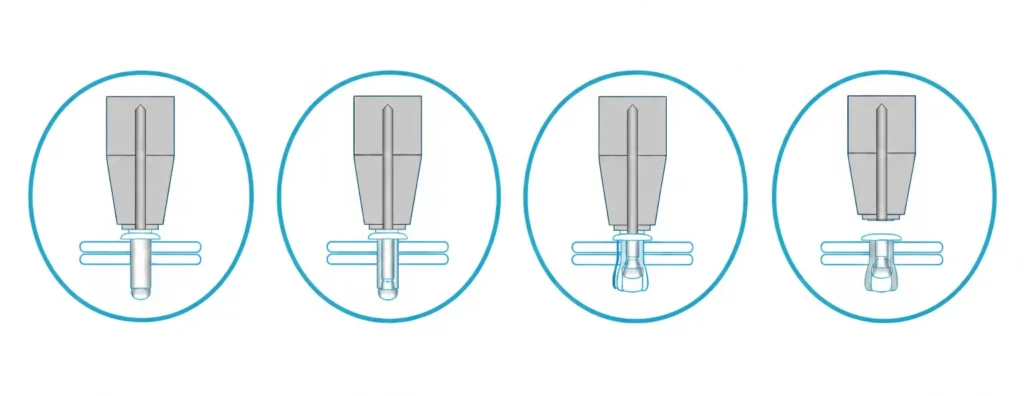
The tail end of an open-end blind rivet is open, featuring a simple design. During riveting, the mandrel head pulls on the tail end of the rivet body, causing the tail end to deform and gradually shorten. Ultimately, the expanded rivet body and the rivet head on the front side work together to clamp the workpiece.
The tail end of a closed-end blind rivet is sealed. During riveting, the mandrel head of the rivet compresses the sealed tail, causing it to expand on the back side of the workpiece and form a closed head. After riveting is complete, the mandrel head remains inside the rivet body.
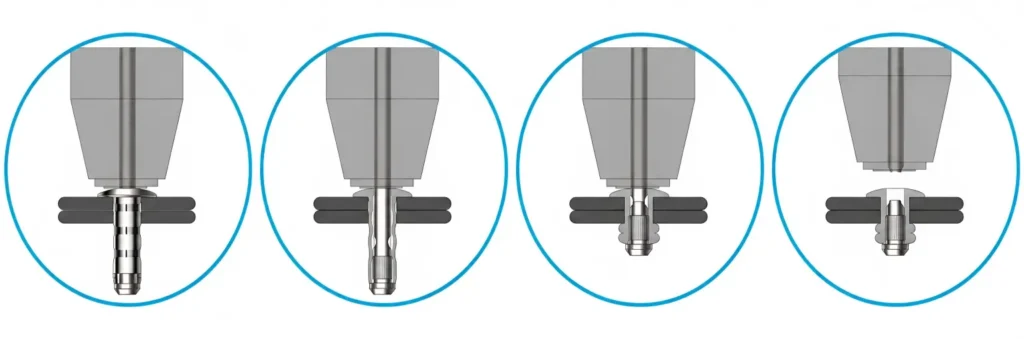
Multi-grip blind rivets cover a wider range of total material thicknesses than standard blind rivets. During installation, the body of a multi-grip blind rivet undergoes controlled deformation and shortening over a longer length, filling the installation hole as completely as possible. A single size of multi-grip blind rivet can join combinations of materials with varying thicknesses.
Unlike standard blind rivets, the peel-type blind rivet does not form a bulge on the blind side after riveting. Instead, under pressure from the mandrel head, the tail end of the rivet body splits longitudinally, ultimately forming multiple petal-like support legs. This helps distribute concentrated stress across the workpiece.
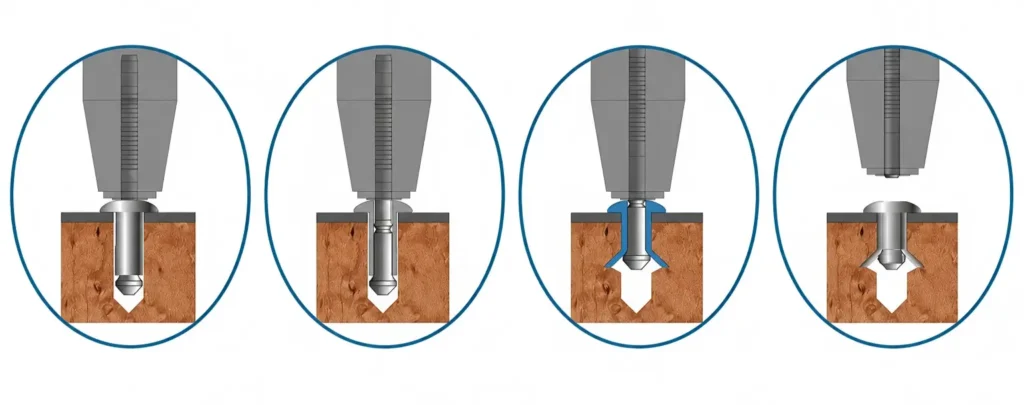
During installation, the tail end of a Tri-Fold Blind Rivet folds outward to form three wide support arms. Compared to Peel-Type Blind Rivets, the support structure is typically more uniform, allowing the clamping load to be distributed over a larger area.
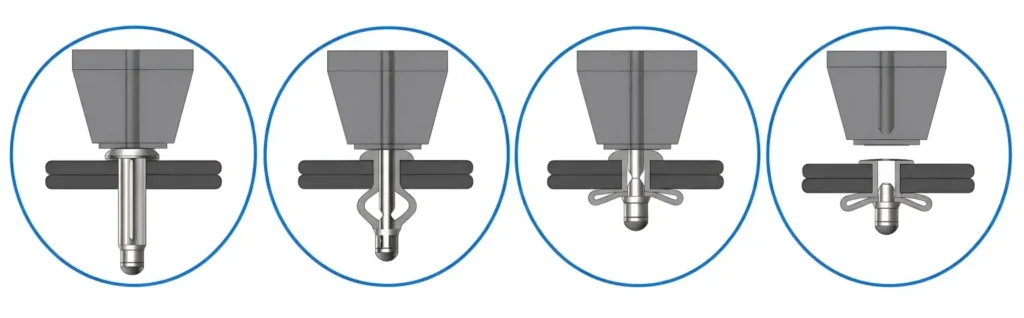
Structural Blind Rivets
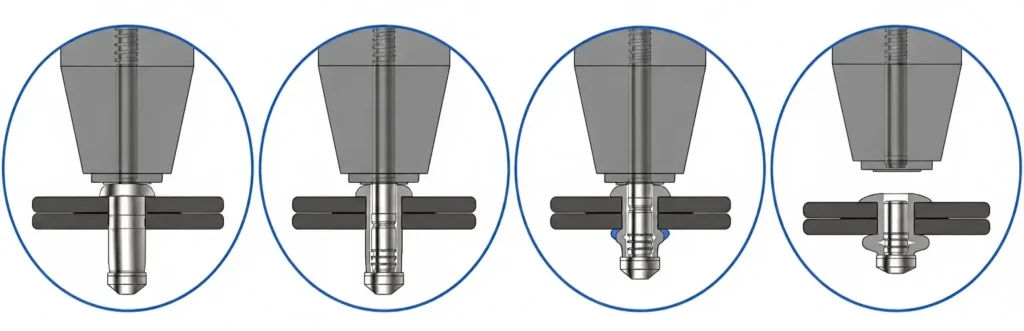
Structural blind rivets provide higher joint strength than standard blind rivets. Not only do they form a strong blind-side closed head, but they also lock the residual mandrel inside the rivet body through a specialized mechanical structure. Different structural blind rivets employ distinct riveting mechanisms, including internal locking, external locking, mechanical locking, or specific blind-side forming methods, each offering different performance characteristics.
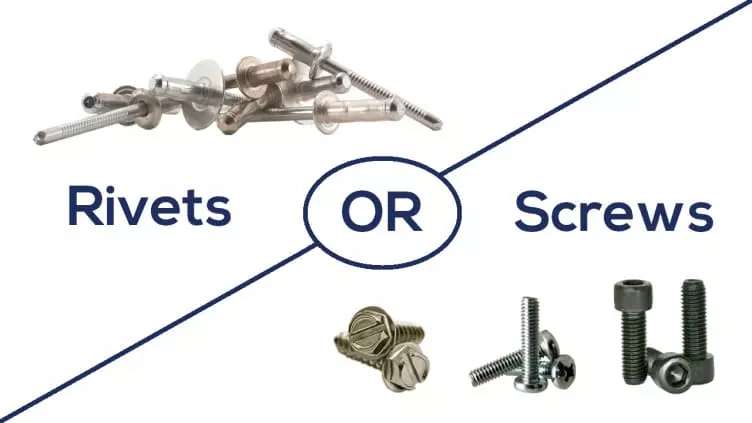
Rivets and screws both serve to join two or more parts; the difference lies in how they are secured:
- Rivets form a connection through the permanent deformation of the rivet body.
- Screws secure parts through the engagement of threads and the preload generated by tightening.
When choosing which fastener provides a better connection, the key is to determine whether the joint requires a permanent connection or one that can be repeatedly disassembled.
| Comparison Item | Rivets | Screws |
|---|---|---|
| Fastening Method | The workpieces are secured through permanent deformation of the rivet body. | The workpieces are secured through thread engagement and tightening force. |
| Removability | Usually requires drilling for removal and cannot be reused. | Can be removed and reinstalled when the threads remain in good condition. |
| Single-Sided Installation | Blind rivets can be installed from only one side of the workpiece. | Self-tapping screws can be installed from one side, while standard screws may require a nut or threaded hole. |
| Suitability for Thin Sheet Metal | Does not rely on threads in the base material and is well suited for thin-sheet connections. | Insufficient thread engagement in thin sheet metal may cause thread stripping or pull-out. |
| Installation Efficiency | Fast setting speed makes rivets suitable for continuous and high-volume assembly. | Each screw must be rotated and tightened, and installation time depends on thread length and tightening torque. |
| Vibration Resistance | No threaded joint is present to loosen through rotation, but correct rivet deformation must be ensured. | Screws may loosen under vibration and often require locking features or anti-loosening measures. |
| Maintenance Convenience | Suitable for structures that do not require frequent disassembly after installation. | Suitable for access panels, covers, inspection points, and components requiring regular maintenance. |
| Typical Applications | Sheet-metal enclosures, HVAC ductwork, vehicle bodies, electrical cabinets, and household appliances. | Equipment covers, mechanical assemblies, inspection structures, and removable components. |

| Comparison Item | Riveting | Welding |
|---|---|---|
| Joining Principle | Rivets deform to mechanically clamp and secure the workpieces together. | Heat or pressure creates a metallurgical bond between the materials. |
| Suitability for Thin Sheet Metal | Well suited for thin sheets and helps reduce the risk of burn-through and warping. | Thin-sheet welding may cause burn-through or thermal deformation. |
| Heat Effect | Usually a cold-joining process that does not create a significant heat-affected zone. | May cause residual stress, deformation, and changes in material properties. |
| Dissimilar Material Joining | Can join aluminum to steel, metal to plastic, and metal to composite materials. | Limited by material weldability, making dissimilar-material joining more difficult. |
| Single-Sided Installation | Blind rivets can be installed from only one side of the workpiece. | Requires welding access, a power supply, and a controlled safety area. |
| Installation Efficiency | Fast installation makes riveting suitable for batch assembly and on-site construction. | Requires welding, cleaning, and potentially additional post-weld treatment. |
| Sealing Performance | Standard riveted joints are not inherently waterproof and usually require sealant or a specially designed sealed structure. | A properly formed continuous weld can provide effective airtight and watertight sealing. |
| Maintenance and Replacement | Individual rivets can be drilled out for localized repair or component replacement. | Repairs usually require cutting, grinding, and rewelding. |
How to Choose the Right Blind Rivets?
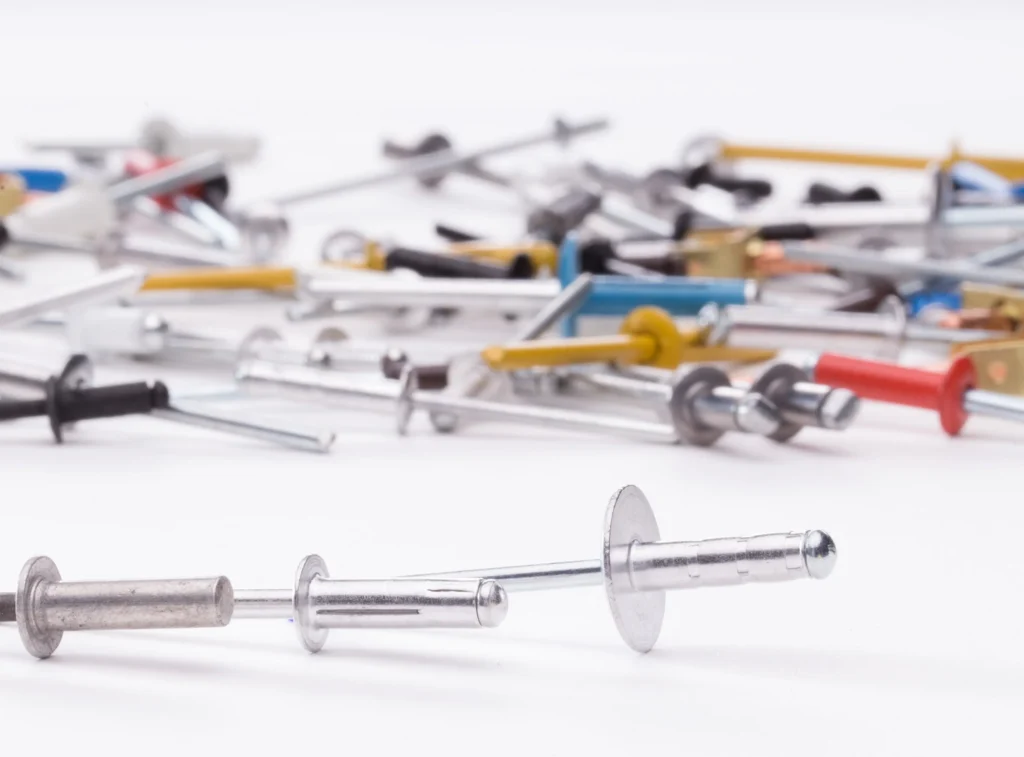
When selecting blind rivets, you must first determine the types of materials to be joined and their total thickness. The total thickness of the sheets being joined must fall within the rivet’s specified clamping range. Otherwise, problems such as loosening, incomplete formation on the blind side, or sheet deformation may occur during the actual riveting process.
Next, select the appropriate rivet diameter. The rivet diameter must match the installation hole size and the required joint strength. Then, ensure the rivet material is compatible with the workpiece material and the operating environment. Aluminum blind rivets are lightweight and easy to install, making them suitable for general-purpose, lightweight applications. Steel blind rivets typically offer higher mechanical strength. Stainless steel blind rivets are better suited for damp, outdoor, or corrosive environments.
Select the head type and rivet style based on your product’s actual application. Standard dome heads are suitable for most general-purpose connections. Large flange heads are suitable for thin sheets or soft materials. Countersunk heads are suitable for workpieces requiring a flush surface.
Why Choose Rivmate as Your Blind Rivet Manufacturer
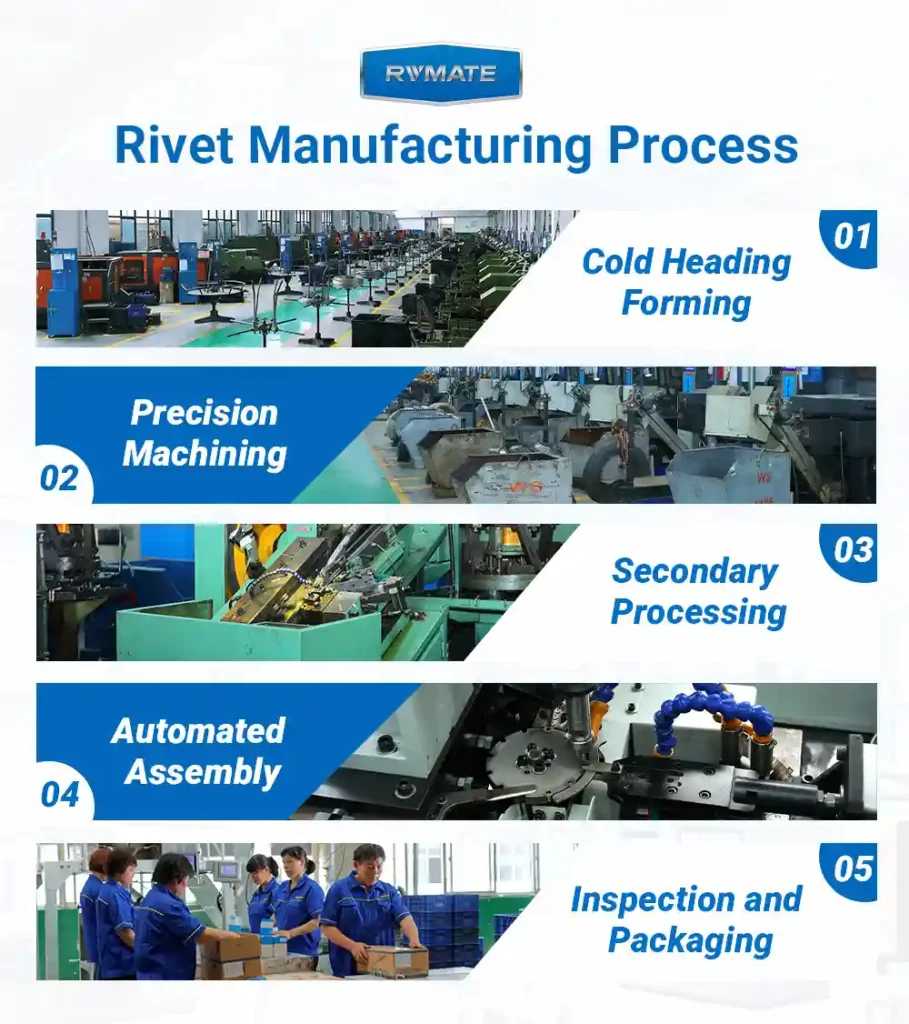
Rivmate has established a 40,000-square-meter production facility equipped with automated production lines featuring state-of-the-art machinery. The facility covers cold heading, mandrel machining, surface treatment, automatic sorting, inspection, and packaging, enabling the company to provide high-quality blind rivets in bulk to distributors, OEMs, and industrial customers.
The factory is equipped with a professional laboratory compliant with IATF standards. It provides test reports on dimensions, tensile strength, shear strength, hardness, vibration, and salt spray resistance. Through strict process control and batch traceability, the product conformance rate reaches 99%.
Rivmate offers both standard and custom blind rivets, including open-end, closed-end, multi-grip,peel-type and structural types. We provide customization options for materials, sizes, head styles, colors, and packaging. For special projects, we also offer product selection and test riveting support.
By choosing Rivmate, you gain a manufacturer that ensures stable production capacity, rigorous testing, and long-term supply reliability.
Conclusion
Rivets firmly join two or more layers of material by deforming themselves. Blind rivets can be installed from a single side of the workpiece, making them particularly suitable for thin sheets, enclosed structures, and mass production.
To achieve reliable riveting results, you cannot rely solely on the rivet diameter or price. You also need to consider the workpiece material, total thickness, clamping range, hole diameter, head type, and operating environment.
Standard blind rivets are suitable for general fastening applications. Structural blind rivets are better suited for high-load and high-vibration environments. Screws are easier to remove. Welding is more suitable for continuous seams. No single fastening method is inherently superior; the key is whether it matches the actual operating conditions.
Proper selection, standardized installation, and consistent product quality are the core factors in ensuring riveting strength and long-term reliability.
FAQs
What types of rivets are best for metal fabrication projects?
The most suitable type depends on the sheet metal thickness, required joint strength, sealing requirements, available installation space, and operating environment. Open-end blind rivets are suitable for standard sheet metal enclosures, electrical cabinets, and equipment panels, offering good value for money. If the product has high waterproofing and dustproofing requirements, closed-end blind rivets are recommended. If there are significant variations in sheet thickness, use multi-grip blind rivets. For high-strength connections in vehicles, machinery, and vibrating environments, structural blind rivets are the best choice.
What are the benefits of using rivets over welding for metal joining?
Minimal heat affect zone
Suitable for dissimilar materials
Supports single-sided installation
High installation efficiency
Simple equipment requirements
Visible joint quality
Easy to perform localized repairs
How do structural rivets contribute to the strength of bridges and buildings?
Structural rivets are high-strength fasteners that enhance the reliability of structural connections by securing materials, resisting shear, distributing loads, reducing loosening, and improving durability.
Which rivet fastening systems are best for aluminum panels?
For aluminum sheet assembly, the rivet material can be selected to match the aluminum rivet body with an aluminum mandrel or an aluminum rivet body with a steel mandrel. The rivet size should be selected based on the total thickness of the aluminum sheet. Match the hole diameter according to the supplier’s specifications. For standard aluminum sheets, aluminum open-type blind rivets are preferred. For thin sheets, select “Large Flange” rivets to increase the load-bearing area. For sheets with significant variations in thickness, choose multi-grip rivets. For applications subject to prolonged vibration and impact, select structural rivets.
How do automated rivet setting machines improve productivity in large-scale manufacturing?
Automatic riveting equipment improves production efficiency for high-volume production by reducing manual material handling and repetitive operations through automatic feeding, positioning, riveting, and spent mandrel collection.
What makes a good quality structural rivet?
High-quality rivets possess consistent shear and tensile strength. They feature dimensional stability, complete rivet formation, reliable mandrel locking, and consistent mechanical properties. They are capable of withstanding long-term loads and vibrations in actual applications.
Are there specific rivet types for automotive repairs?
Yes. In automotive repair, the appropriate rivets are selected based on the connection location, sheet metal thickness, load, and corrosion protection requirements. In safety-critical areas such as the body frame, crash structures, pillars, sills, and areas near the suspension, structural rivets that meet automotive standards must be used. For ordinary body panels, open-end, multi-grip, or large-flange blind rivets may be used. For plastics and composite materials, it is recommended to use peel-type blind rivets or tri-fold blind rivets.
How do structural rivets differ from non-structural rivets?
The difference between structural rivets and non-structural rivets lies in their load-bearing capacity, mandrel retention method, and applications. Structural rivets offer higher strength and are used for high-load, high-vibration, or critical connections. Non-structural rivets have a relatively lower connection strength than structural rivets and are more suitable for ordinary thin sheets and general assembly.
Work with a IATF 16949 Certified Blind Rivet Manufacturer
Get High Quality Rivets Instead of Huck and Avdel Rivets

Rivmate Rivet
Rivmate is one of China’s top three manufacturers of pop rivets. The company is IATF 16949 certified and offers high-strength structural pop rivets that serve as alternatives to Huck and Avdel products.
Explore Rivmate Cases
Rivmate Rivet
Rivmate is one of China’s top three manufacturers of pop rivets. The company is IATF 16949 certified and offers high-strength structural pop rivets that serve as alternatives to Huck and Avdel products.

Hey There, I'm Allen!
I am the founder of Rivmate. For over two decades, we have specialized in the manufacture of blind rivets, providing our customers with reliable riveting solutions. Need riveting services? Feel free to contact us.