


When selecting the right pop rivet, dimensions and diameter are important. The material must also be considered.
The material directly affects the rivet’s strength and performance. This includes tensile strength, shear strength, durability, and corrosion resistance.
This article introduces five common pop rivet materials. It compares their differences, advantages, limitations, and typical applications. It also recommends suitable materials for sheet metal components, automotive parts, HVAC systems, and industrial equipment.
| Pop Rivet Material | Material Combinations | Relative Strength | Corrosion Resistance | Weight | Key Advantages | Main Limitations | Applications |
|---|---|---|---|---|---|---|---|
| Aluminum Pop Rivets |
Aluminum body / aluminum mandrel Aluminum body / steel mandrel Aluminum body / stainless steel mandrel | Low to medium | Good | Lightest | Lightweight, easy to install, and suitable for thin sheets and soft materials | Not suitable for high-load joints. Aluminum and steel combinations require an assessment of galvanic corrosion risk. | Aluminum panels, thin sheet metal, electronic enclosures, household appliances, and light-duty assemblies |
| Steel Pop Rivets | Steel body / steel mandrel | Medium to high | Depends on the surface treatment | Heavy | High mechanical strength, broad industrial applicability, and suitable for general-purpose connections | Carbon steel is susceptible to corrosion and requires zinc plating or another protective surface treatment. | Machinery, steel enclosures, automotive components, and industrial sheet metal |
| Stainless Steel Pop Rivets |
Stainless steel body / stainless steel mandrel Stainless steel body / steel mandrel | Medium to high | Very good | Heavy | Combines mechanical strength, corrosion resistance, and long-term durability | Requires greater installation force. Corrosion resistance varies according to the stainless steel grade. | Outdoor equipment, food-processing equipment, humid environments, and chemical-processing equipment |
| Copper Pop Rivets |
Copper body / steel mandrel Copper body / bronze mandrel | Low to medium | Good | Heavy | Good electrical conductivity, high ductility, and a decorative copper appearance | Lower strength than steel and stainless steel. Not suitable for joints where high structural load is the primary requirement. | Electrical connections, grounding components, copper panels, and decorative products |
| Monel Pop Rivets | Nickel-copper alloy body / steel mandrel | Medium to high | Excellent | Heavy | Suitable for corrosive environments and certain high-temperature conditions, especially marine and chemical applications | A specialty material that must be selected according to the service medium, operating temperature, and product specifications | Marine equipment, offshore engineering, chemical-processing equipment, and specialized industrial environments |
What Is a Pop Rivet?
A pop rivet, also known as a blind rivet, consists of two main parts: a rivet body and a mandrel.
The rivet body is a hollow outer sleeve. It includes a rivet head, a shank, and a deformable section at the pop end.The mandrel is positioned inside the rivet body. It has a pre-determined break point. Once the rivet reaches the required level of deformation, the mandrel breaks at this point.
During installation, the rivet body is inserted into the mounting hole. The nozzle of the riveting tool is then placed over the mandrel.The tool pulls the mandrel backward. This causes the mandrel head to compress the blind end of the rivet body. The rivet body expands and forms a closed head.
The original rivet head and the newly formed closed head clamp the sheets together.When the pulling force reaches the design limit, the mandrel breaks at the pre-determined break point. The installation is then complete.
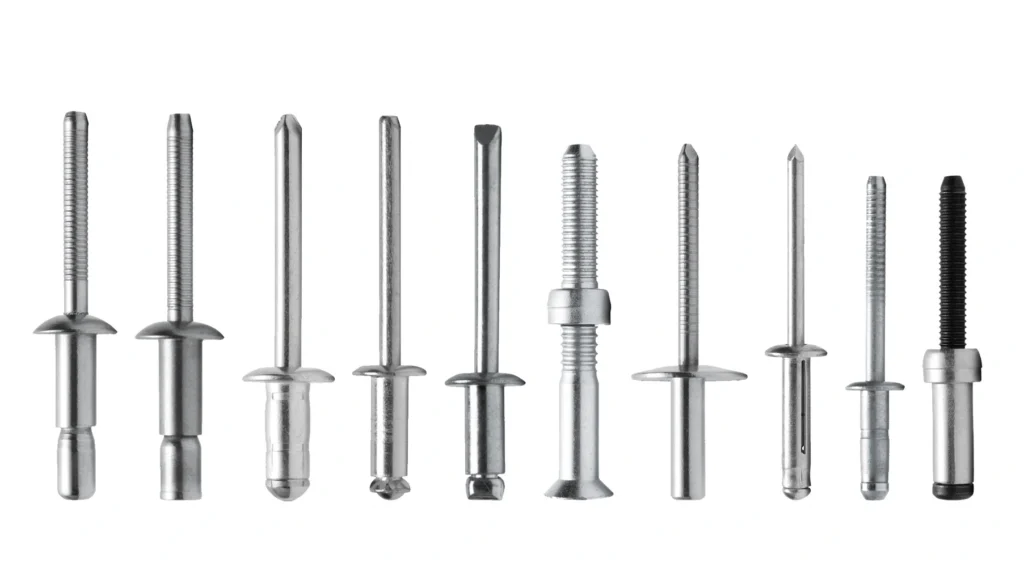
How Are Pop Rivet Materials Classified?
As explained above, a pop rivet consists of two parts: the rivet body and the mandrel.
Pop rivet materials can therefore be classified in two ways. The first method is based on the material of the rivet body. The second method is based on the material combination of the rivet body and the mandrel.
1. Classification by rivet body material
2. Classification based on the material combination of the rivet body and the mandrel.
- Aluminum/Aluminum Pop Rivets
- Aluminum/Steel Pop Rivets
- Aluminum/Stainless Steel Pop Rivets
- Steel/Steel Pop Rivets
- Stainless Steel/Stainless Steel Pop Rivets
- Copper/Steel Pop Rivets
- Copper/Bronze Pop Rivets
- Nickel-Copper Alloy/Steel Pop Rivets
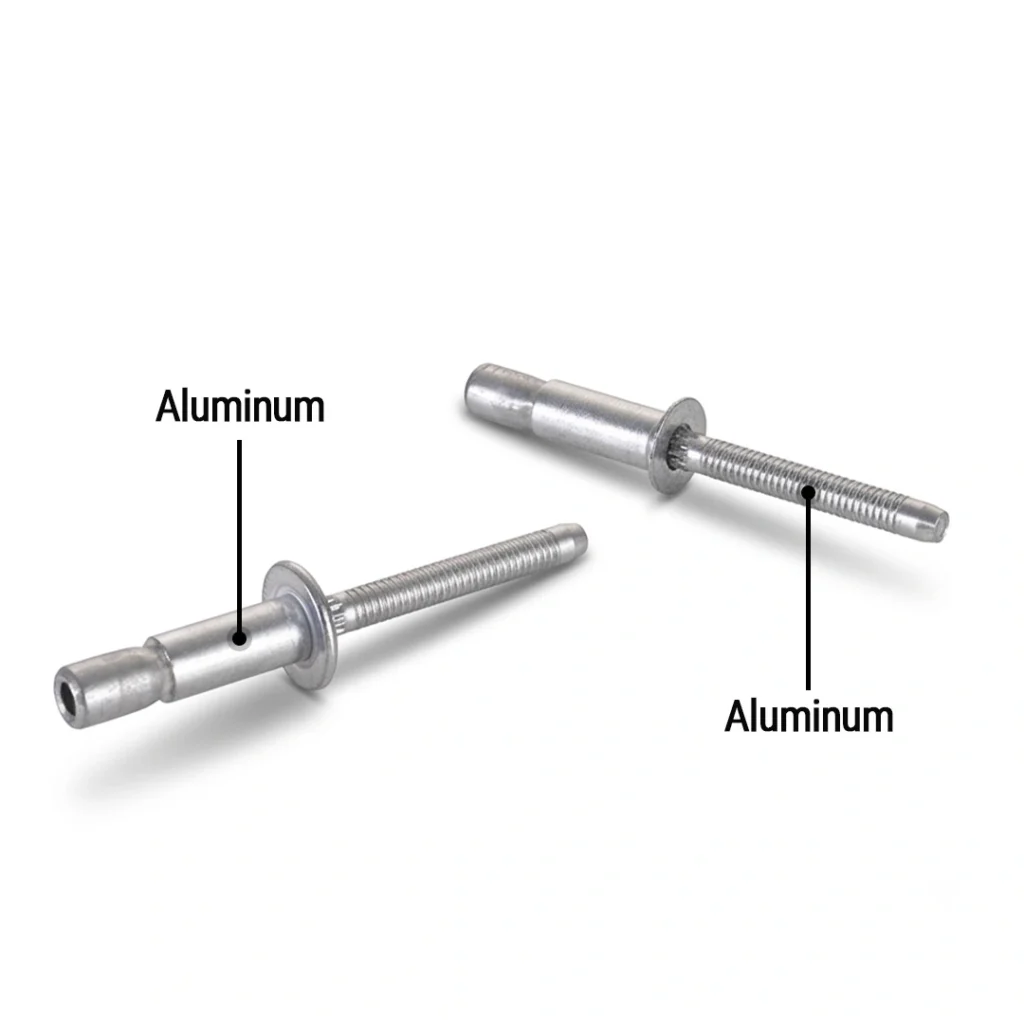
1. Aluminum Pop Rivets
Common Material Combinations for Aluminum pop Rivets
- Aluminum/Aluminum
- Aluminum/Steel
- Aluminum/Stainless Steel
Key advantages of aluminum pop rivets
1. Lightweight
The density of aluminum is approximately 2.70 g/cm³, while that of steel is approximately 7.85 g/cm³. Aluminum is significantly lighter than ordinary steel.
2. Relatively Low Riveting Load
Aluminum pop rivets have a lower installation load. They are easier to rivet than steel or stainless steel rivets.
3. Suitable for softer or thinner materials
Aluminum rivet bodies undergo plastic deformation relatively easily. They can be used with thin aluminum sheets, plastics, and other softer materials.
Limitations of aluminum pop rivets
1. Be aware of galvanic corrosion.
When aluminum comes into direct contact with dissimilar metals in a humid environment, conditions conducive to galvanic corrosion are created, which may accelerate the corrosion process.
2. Lower strength compared to other materials
For standard specifications, aluminum pop rivets have lower strength than those made from other materials. Rivet strength is influenced by various factors, and strength levels vary depending on the specifications.
2. Steel Pop Rivets
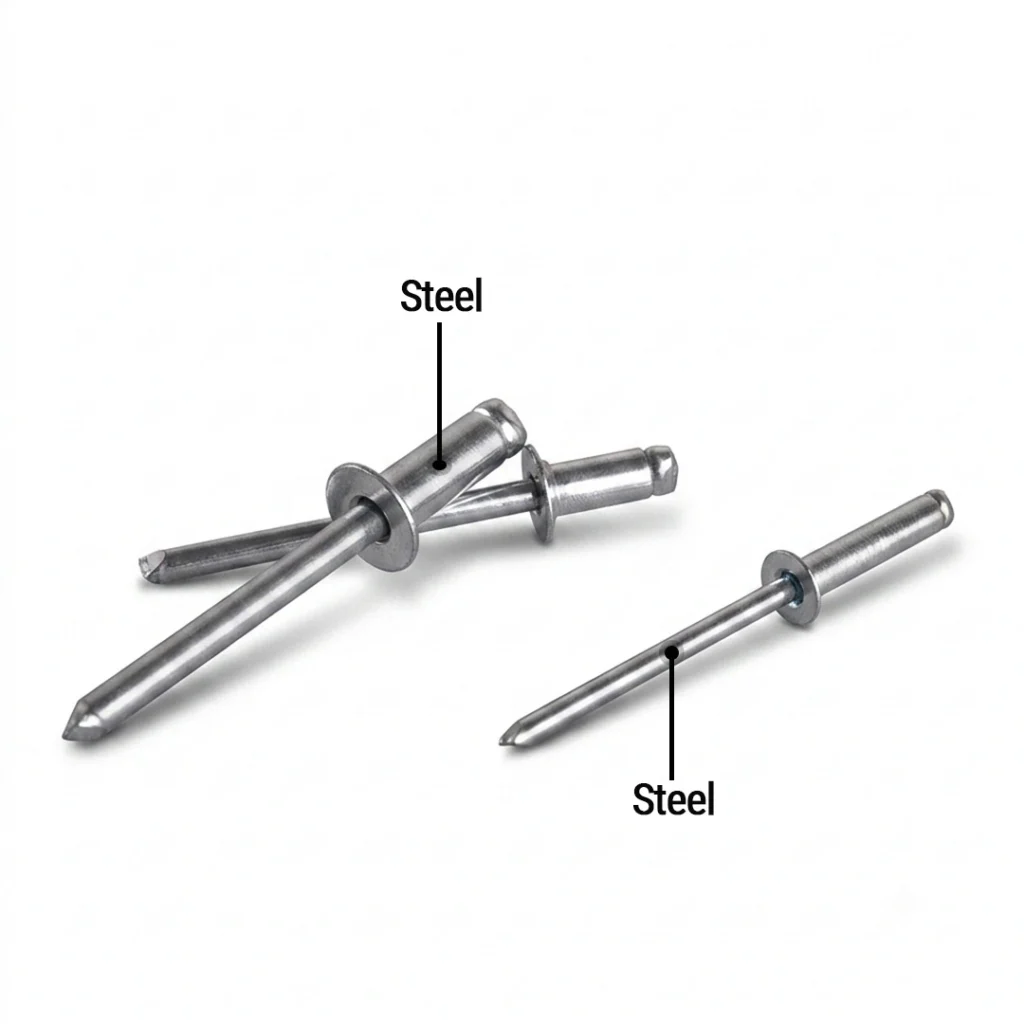
Common Material Combinations for Steel Pop Rivets
- Steel Body / Steel Mandrel
Key advantages of Steel Pop Rivets
1. High mechanical strength
For the same specifications, steel pop rivets offer higher tensile and shear strength than aluminum pop rivets.
2. Good industrial versatility
Steel pop rivets offer a wide range of options regarding dimensions, head styles, and structural designs. They come in various types, including open-end, closed-end, and multi-bulb steel pop rivets.
3. Cost-effectiveness
Compared to other specialty materials, steel pop rivets offer a balance of performance and cost.
Limitations of Steel Pop Rivets
1. Carbon steel is prone to corrosion.
In humid environments, ordinary carbon steel is inherently susceptible to corrosion. Selecting an appropriate surface treatment can prevent this issue.
2. Heavier than aluminum pop rivets
Steel has a higher density than aluminum, making it unsuitable for lightweight assemblies.
3. Stainless Steel Pop Rivets
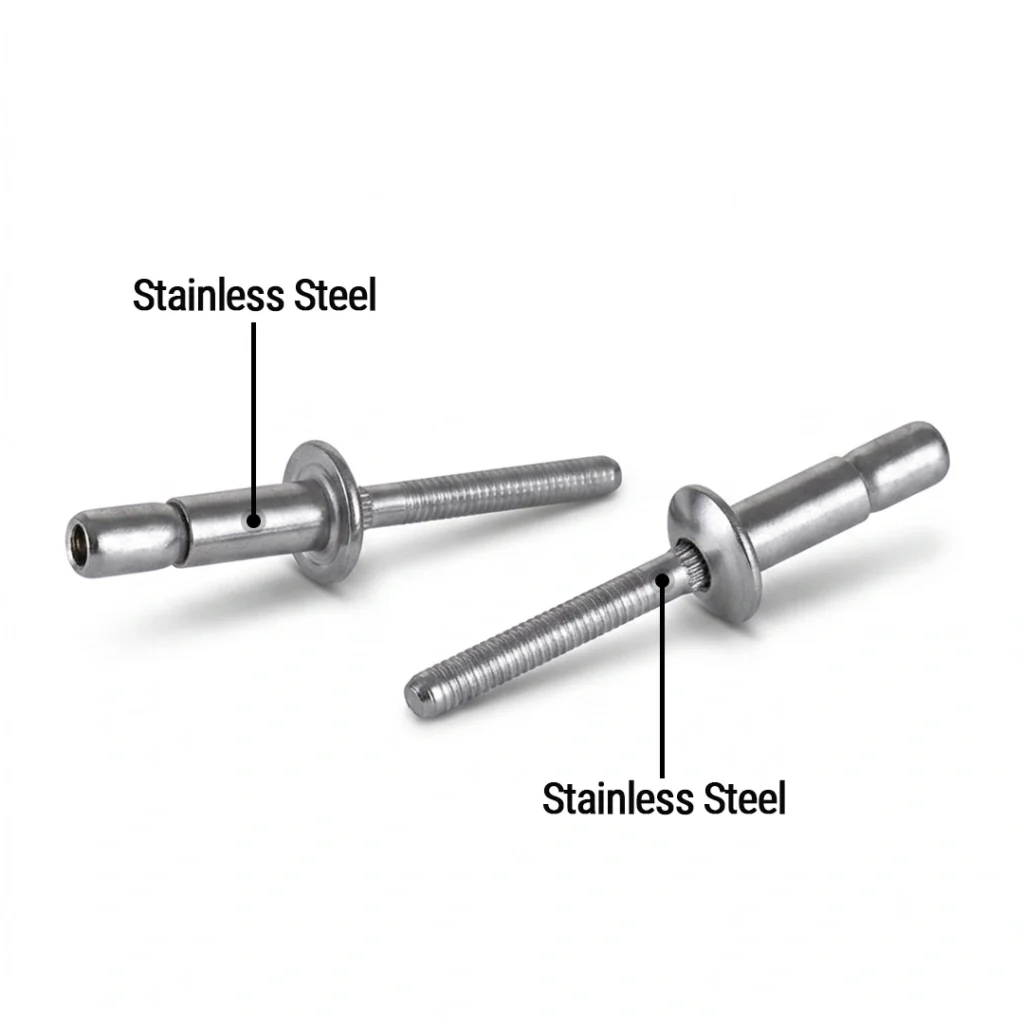
Common Material Combinations for Stainless Steel Pop Rivets
- Stainless Steel Body/Stainless Steel Mandrel
Key advantages of Stainless Steel Pop Rivets
1. Good corrosion resistance
Stainless steel offers basic corrosion resistance and a long service life.
2. Excellent mechanical properties
For the same specifications, stainless steel pop rivets offer superior tensile and shear strength compared to aluminum pop rivets.
3. Good service life and aesthetic stability
Stainless steel pop rivets reduce the issue of red rust caused by coating damage.
Limitations of Stainless Steel Pop Rivets
1. Higher installation force required
Stainless steel pop rivets possess high strength. The installation load is generally higher than that of standard aluminum pop rivets of similar size.
2. Higher cost than standard steel and aluminum rivets
Due to the stringent requirements for cold forming and mandrel manufacturing, the production cost is higher.
3. Localized deformation may occur in soft, thin sheets.
Stainless steel rivets are hard and require high installation pulling force. When used on soft, thin sheets, this can cause deformation around the hole or even pull through the material.
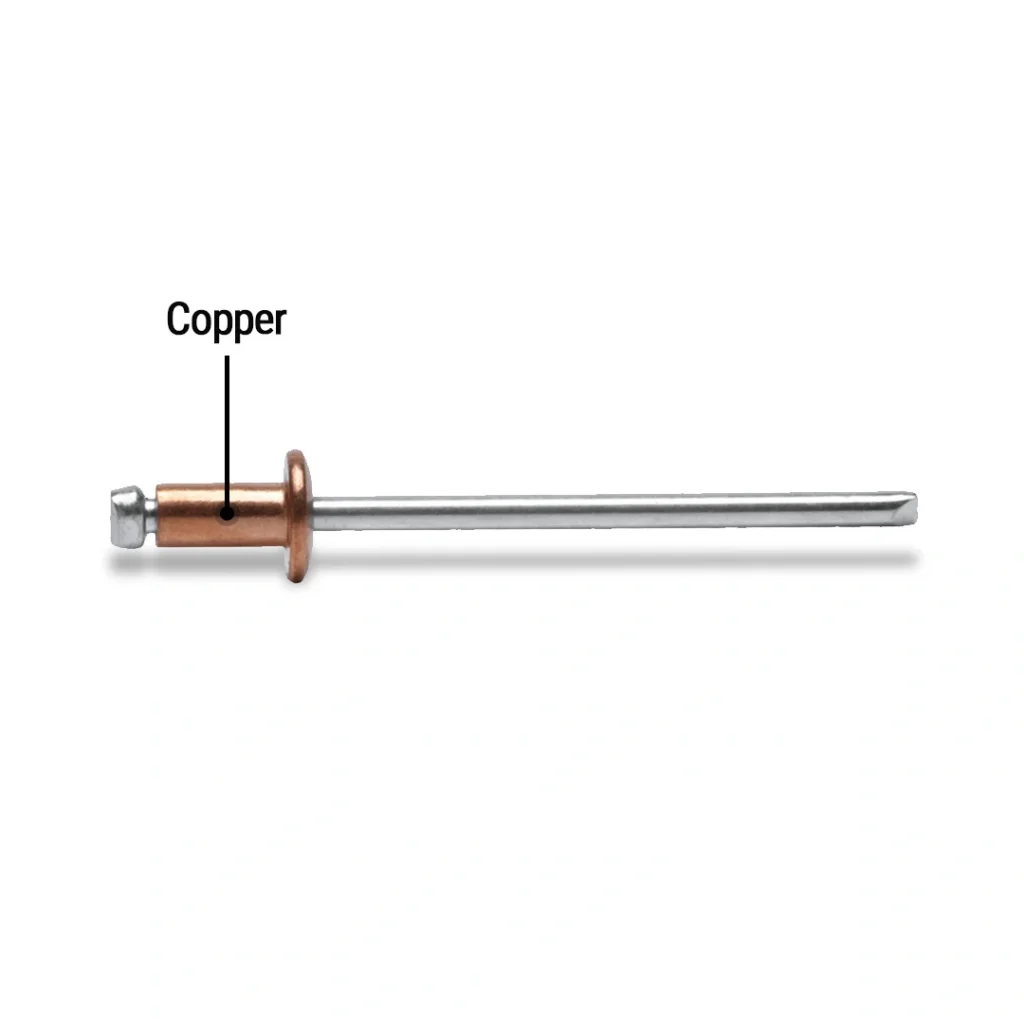
4. Copper Pop Rivets
Common Material Combinations for Copper Pop Rivets
- Copper/Steel
Key advantages of Copper Pop Rivets
1. Excellent electrical conductivity
The copper rivet body offers excellent electrical conductivity, making it suitable for components that require high-performance electrical connections.
2. Suitable for joining copper workpieces
When joining copper parts, it avoids electrochemical differences between dissimilar metals.
3. Possesses a certain degree of corrosion resistance
Copper oxide films or dark-colored protective surface layers exhibit good corrosion resistance.
4. Features a distinctive copper-colored appearance
Exhibits a distinct red-copper or copper-alloy hue, making it suitable for products with decorative requirements.
Limitations of Copper Pop Rivets
1. Material costs are relatively high.
The material cost of copper is generally higher than that of ordinary carbon steel and aluminum.
2. Be aware of galvanic corrosion.
When copper rivets come into direct contact with other metals in humid or saline environments, conditions conducive to galvanic corrosion may arise.
5. Monel Pop Rivets
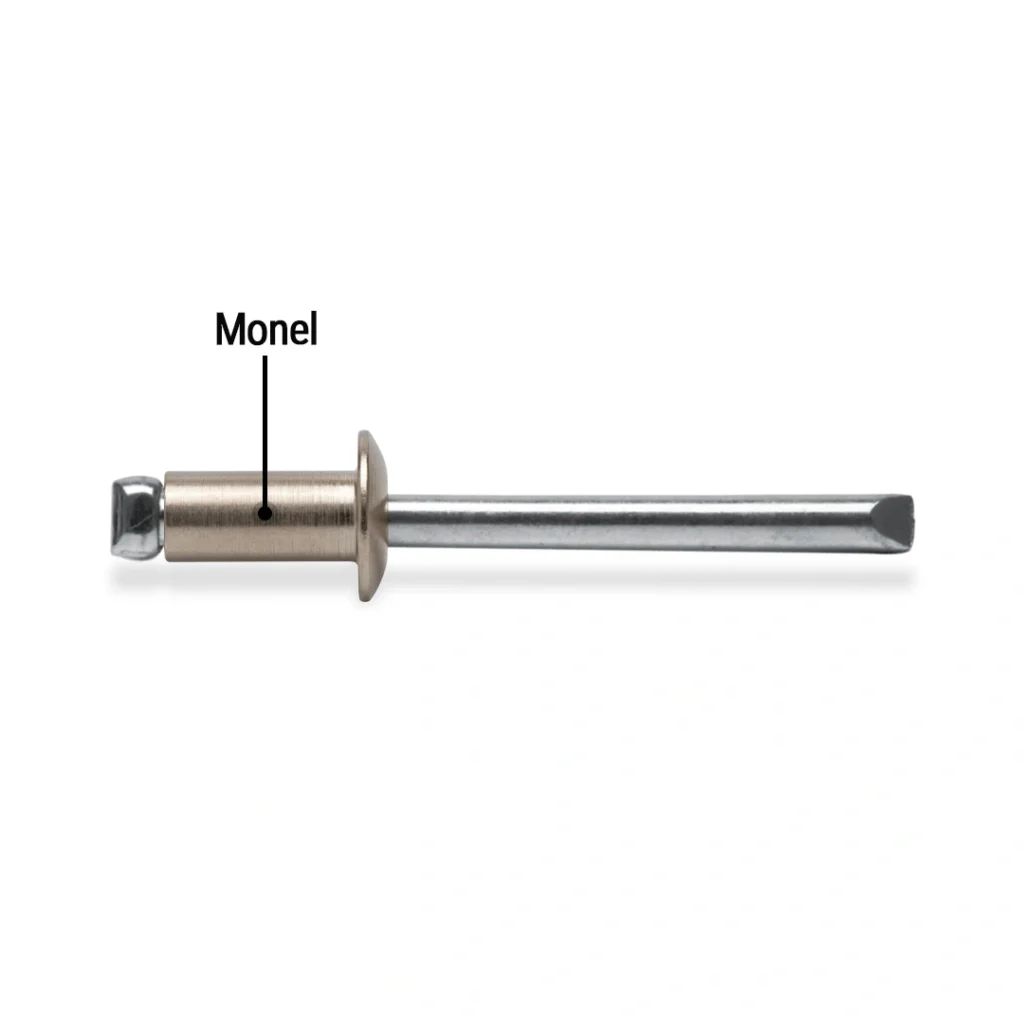
Common Material Combinations for Monel Pop Rivets
- Monel/Steel
- Monel/Stainless Steel
Key advantages of Monel Pop Rivets
1. Excellent corrosion resistance
Monel 400 is resistant to a wide range of reducing corrosive media and is suitable for use in various marine and chemical processing environments.
2. Suitable for marine applications
Monel 400 exhibits a very low corrosion rate in flowing seawater, making it frequently used for marine equipment and marine components.
3. Balancing corrosion resistance and mechanical properties
Monel 400, a corrosion-resistant nickel-copper alloy, possesses good strength and toughness.
Limitations of Monel Pop Rivets
1. Higher price
Compared to standard materials, Monel is a specialized nickel-copper alloy with higher procurement costs.
2. High density
Monel 400 has a density of approximately 8.80 g/cm³, which is higher than that of common materials such as aluminum, steel, and stainless steel.
3. Galvanic corrosion requires attention.
When Monel is connected to more active metals, corrosion may be accelerated in humid environments.
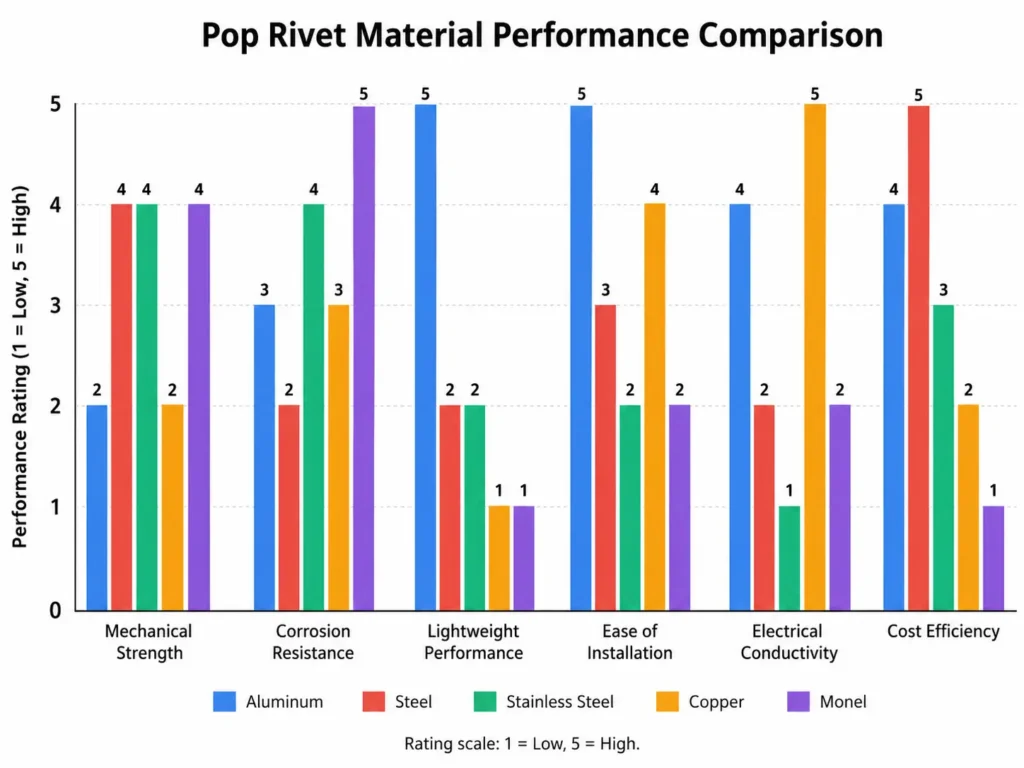
Pop Rivet Material Comparison by Performance
| Performance Factor | Aluminum Pop Rivets | Steel Pop Rivets | Stainless Steel Pop Rivets | Copper Pop Rivets | Monel Pop Rivets |
|---|---|---|---|---|---|
| Mechanical Strength | 2 | 4 | 4 | 2 | 4 |
| Corrosion Resistance | 3 | 2 | 4 | 3 | 5 |
| Lightweight Performance | 5 | 2 | 2 | 1 | 1 |
| Ease of Installation | 5 | 3 | 2 | 4 | 2 |
| Electrical Conductivity | 4 | 2 | 1 | 5 | 2 |
| Cost Efficiency | 4 | 5 | 3 | 2 | 1 |
Rating scale: 1 = Low, 5 = High.
How Pop Rivet Material Affects Joint Performance
The material of a pop rivet affects not only the rivet itself but also directly influences the strength, forming quality, corrosion resistance, installation difficulty, and service life of the entire riveted joint. While material affects joint performance, it is not the sole factor determining it.
1. Material Affects Tensile and Shear Strength
For the same specifications, Monel pop rivets are generally better suited for higher mechanical loads, whereas aluminum and copper pop rivets are preferred for lightweight applications.
2. Material Affects Pop-Side Formation
Due to differences in plasticity and hardness among materials, the characteristics of plastic deformation at the pop end of the rivet body vary.
3. Material affects the pulling force required for installation
The higher the material strength, the greater the pulling force generally required from the installation tool. Insufficient pulling force may result in the failure to snap the mandrel, leading to an unsuccessful riveting operation.
4. Material affects corrosion resistance and joint longevity.
When exposed to the elements for extended periods without surface treatment, steel pop rivets are prone to corrosion.
5. Material compatibility between the rivet and the workpiece affects galvanic corrosion.
Stainless steel, copper, or Monel rivets may be used to join aluminum plates. In humid or salt-spray environments, the more electrochemically active metal will corrode first.
6. Materials affect component weight
Different materials have different densities. The density of aluminum is significantly lower than that of steel; aluminum pop rivets are lighter in weight, making them ideal for lightweight equipment.
Galvanic Corrosion Between Pop Rivets and Workpieces
What is galvanic corrosion?
Galvanic corrosion is a phenomenon in which the more reactive of two dissimilar metals undergoes accelerated corrosion when they are in contact with each other in a moist or conductive environment.
Three conditions must be met to trigger galvanic corrosion: 1. two metals with an electrochemical difference; 2. conductive contact between the two metals; and 3. the presence of an electrolyte at the junction.
Common Pop Rivet and Workpiece Material Combinations
The following ratings indicate general selection trends only. Actual galvanic corrosion risk also depends on humidity, salt exposure, coatings, surface-area ratio, temperature, drainage, and maintenance conditions.
| Rivet and Workpiece Combination | General Risk Level | Key Considerations |
|---|---|---|
| Aluminum Rivet + Aluminum Workpiece | Low | Confirm the compatibility of the aluminum alloys, surface treatments, and service environment. |
| Zinc-Plated Steel Rivet + Aluminum Workpiece | Low to Medium | Zinc plating can improve material compatibility, but coating damage and salt exposure may increase the corrosion risk. |
| Stainless Steel Rivet + Large Aluminum Workpiece | Environment-Dependent | A small stainless steel rivet connected to a large aluminum workpiece creates a relatively favorable area ratio. However, protection is still required in coastal environments, standing water, and exposed hole-edge areas. |
| Copper Rivet + Aluminum Workpiece | High | The aluminum workpiece may corrode more rapidly in humid or salt-containing environments. |
| Monel Rivet + Aluminum Workpiece | High | The electrochemical difference between nickel-copper alloy and aluminum is significant. Electrical isolation and environmental validation are recommended. |
| Steel Rivet + Carbon Steel Workpiece | Low | Zinc plating or another suitable corrosion-protection treatment should still be selected according to the service environment. |
| Stainless Steel Rivet + Carbon Steel Workpiece | Low to Medium | A small stainless steel rivet connected to a large carbon steel workpiece creates a relatively favorable area ratio. Hole edges, salt exposure, and standing-water areas still require protection. |
| Steel Rivet + Stainless Steel Workpiece | High | The small steel rivet may act as the anode and corrode rapidly, especially when connected to a large stainless steel surface. |
| Stainless Steel Rivet + Stainless Steel Workpiece | Low | Confirm that the specific stainless steel grades are suitable for the actual moisture, chloride, temperature, and chemical conditions. |
| Copper Rivet + Copper Workpiece | Low | Check whether the mandrel is steel or bronze and evaluate the complete joint under the intended service environment. |
| Monel Rivet + Monel Workpiece | Low | Confirm the mandrel material and verify that the selected Monel alloy is compatible with the specific corrosive medium. |
How can the risk of galvanic corrosion be reduced?
- Prioritize rivets made of compatible materials
- Isolate dissimilar metals
- Prevent moisture ingress at the joint
- Protect drilled holes and cut edges
- Select the correct mandrel material
- Control the anode-to-cathode surface area ratio
- Conduct practical testing in high-risk environments
How to Choose the Right Pop Rivet Material
Step 1: Check the Workpiece Material
Step 2: Determine the Required Joint Strength
Step 3: Evaluate the Corrosion Environment
Step 4: Check for Galvanic Corrosion
Step 5: Consider Weight Requirements
Step 6: Check Electrical Requirements
Step 7: Match the Rivet to the Workpiece Hardness
Step 8: Confirm the Mandrel Material
Step 9: Confirm the Installation Tool
Step 10: Verify the Grip Range and Hole Size
Best Pop Rivet Materials by Application
Best Material for Light-Duty Sheet Metal:Aluminum Pop Rivets.
The aluminum rivet body offers good ductility, requiring minimal pulling force during the riveting process. It is compatible with manual rivet guns, lightweight electric riveting tools, and automated equipment, making it suitable for high-volume installation.
Best Material for Steel Enclosures and Machinery:Steel Pop Rivets
Steel rivet bodies offer superior mechanical strength. Steel is readily available, striking an optimal balance between performance and procurement costs. They are suitable for applications such as HVAC equipment panels and machinery housings.
Best Material for Outdoor and Humid Environments:Stainless Steel Pop Rivets
Steel rivet bodies offer superior mechanical strength. Steel is readily available, striking an optimal balance between performance and procurement costs. They are suitable for applications such as HVAC equipment panels and machinery housings.Stainless steel pop rivets offer both excellent mechanical properties and corrosion resistance, making them ideal for use in environments subject to regular moisture, such as solar energy equipment and ventilation or exhaust systems.
Best Material for Marine Applications:Monel Pop Rivets
Marine applications involve highly corrosive environments characterized by humidity and salt spray. Monel pop rivets offer excellent corrosion resistance.
Best Material for Electrical Applications:Copper Pop Rivets
The copper rivet body features good electrical conductivity and is suitable for products with specific conductivity requirements.
Best Material for High-Load Assemblies:Steel Pop Rivets/Stainless Steel Pop Rivets
For industrial connections subject to high mechanical loads, we can use blind rivets made of high-performance materials. However, high strength is not solely determined by the material; factors such as the rivet’s structural dimensions must also be taken into account.
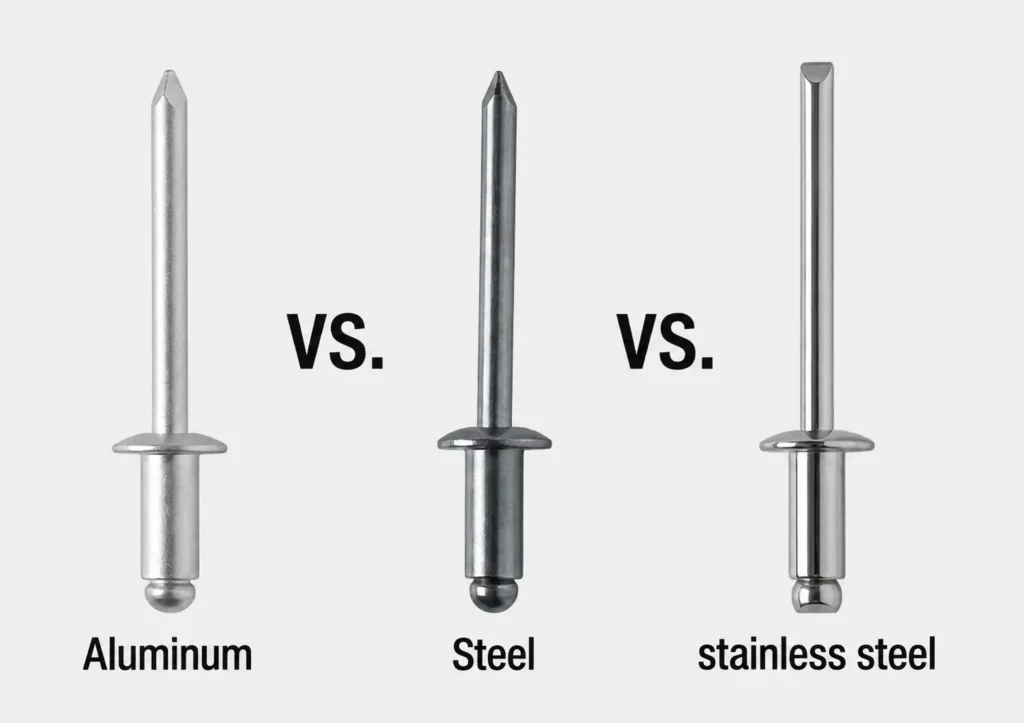
Aluminum vs Steel vs Stainless Steel Pop Rivets
Aluminum vs Steel vs Stainless Steel Pop Rivets Comparison
| Comparison Factor | Aluminum Pop Rivets | Steel Pop Rivets | Stainless Steel Pop Rivets |
|---|---|---|---|
| Common Material Combinations |
Aluminum body / aluminum mandrel Aluminum body / steel mandrel Aluminum body / stainless steel mandrel | Zinc-plated steel body / zinc-plated steel mandrel |
Stainless steel body / stainless steel mandrel Stainless steel body / steel mandrel |
| Relative Strength | Low to medium | Medium to high | Medium to high |
| Weight | Lightest | Heavier | Heavier |
| Corrosion Resistance | Good in normal environments | Depends on the plating or protective coating | Good, but performance depends on the stainless steel grade and service environment |
| Installation Force | Relatively low | Relatively high | Generally the highest |
| Cost Trend | Low to medium | Good cost efficiency | Higher |
| Main Applications | Aluminum panels, electronic enclosures, and lightweight sheet metal | Steel enclosures, machinery, and general industrial sheet metal | Outdoor equipment, stainless steel workpieces, and humid environments |
| Main Limitations | Limited load capacity in some applications and potential galvanic corrosion with dissimilar metals | May rust if the plating or protective coating is damaged | Higher material cost and tool requirements; the correct grade must be selected for chloride-containing environments |
What Should Buyers Check Before Ordering Pop Rivets?
| Check Item | What to Confirm | Why It Matters |
|---|---|---|
| Material Combination | Rivet body material, mandrel material, and specific material grade | Affects mechanical strength, corrosion resistance, installation force, and galvanic corrosion risk |
| Rivet Size | Rivet body diameter, body length, and grip range | Determines whether the rivet can correctly clamp the workpieces |
| Hole Size | Actual hole diameter, dimensional tolerance, and hole quality | An oversized hole may cause looseness, while an undersized hole may prevent proper insertion and formation |
| Joint Strength | Tensile, shear, vibration, and safety requirements | Determines whether a standard or structural blind rivet is required |
| Service Environment | Humidity, salt exposure, temperature, and chemical media | Determines whether the selected material and surface treatment can meet the required service-life target |
| Rivet Structure | Open-end or closed-end design, head style, and special rivet structure | Affects sealing performance, bearing area, appearance, and blind-side formation |
| Installation Tool | Tool pulling force, stroke, nosepiece size, and supported rivet diameter | An unsuitable tool may cause incomplete rivet formation or prevent the mandrel from breaking correctly |
| Quality Documents | Drawings, technical data, test reports, and traceability requirements | Ensures that mass-produced rivets remain consistent with approved samples and purchasing specifications |
How Rivmate Controls Pop Rivet Material Quality
As a professional pop rivets manufacturer and supplier, Rivmate conducts production and inspection in strict accordance with the IATF 16949 quality management system. The process involves 13 rigorous testing procedures spanning from raw materials to the finished product, ensuring a 99.9% pass rate.
Rivmate’s dedicated pop rivet testing laboratory utilizes universal testing machines, salt spray testing equipment, dimensional inspection tools, and riveting simulation equipment to verify key performance indicators during sample validation, mass production, and pre-shipment stages. This helps customers mitigate risks such as incorrect product selection, assembly failures, and batch quality inconsistencies.
Conclusion
Aluminum, steel, stainless steel, copper, and Monel are five common materials for pop rivets. These materials differ in terms of cost, weight, strength, and corrosion resistance.
Aluminum pop rivets are lightweight and easy to install; steel pop rivets offer a good balance between strength and cost; stainless steel pop rivets are ideal for applications requiring high corrosion resistance; copper pop rivets provide electrical conductivity; and Monel pop rivets are suitable for certain marine and chemical environments.
When making your final selection, you must consider not only the material but also the actual application environment. You also need to verify the rivet body, mandrel, size, grip range, strength requirements, and installation tools to minimize installation risks and ensure the stability of the connection.
FAQs About Pop Rivet Materials
Can stainless steel rivets be used with aluminum?
Yes, stainless steel pop rivets can be used to join aluminum sheets, offering high mechanical strength and corrosion resistance.
However, stainless steel acts as a relatively corrosion-resistant cathode, while aluminum serves as a more reactive anode; consequently, galvanic corrosion is prone to occur in environments exposed to rain or salt spray.
What does Aluminum/Steel mean?
“Aluminum/Steel” indicates a blind rivet configuration consisting of an aluminum alloy rivet body and a steel mandrel.
The material specification for pop rivets is presented in the format: rivet body material / mandrel material.
Do steel pop rivets rust?
Steel pop rivets are susceptible to rusting.
For use in humid environments, the surface of the steel pop rivets can be galvanized.
Are copper pop rivets conductive?
Yes, copper blind rivets are electrically conductive.
However, the electrical conductivity of the entire joint also depends on the material of the mandrel, the surface condition of the workpieces, the quality of the contact, and the operating environment.
Does rivet material affect the rivet gun?
Yes. The rivet material affects the pulling force required by the rivet gun and the load placed on the tool. Aluminum blind rivets are easier to install; steel rivets require higher pulling force; and stainless steel rivets place greater demands on the tool’s capabilities.
Work with a IATF 16949 Certified Blind Rivet Manufacturer
Get High Quality Rivets Instead of Huck and Avdel Rivets
Rivmate Rivet
Rivmate is one of China’s top three manufacturers of pop rivets. The company is IATF 16949 certified and offers high-strength structural pop rivets that serve as alternatives to Huck and Avdel products.
Explore Rivmate Cases
Rivmate Rivet
Rivmate is one of China’s top three manufacturers of pop rivets. The company is IATF 16949 certified and offers high-strength structural pop rivets that serve as alternatives to Huck and Avdel products.