When the sheet metal is too thin to cut threads directly, or when access is limited to only one side of the sheet, rivet nuts for sheet metal provide a highly practical means of fastening.
In practical sheet metal fabrication, the type of rivet nut is selected according to the specific application. Common types include cylindrical, knurled, semi-hexagonal and fully hexagonal rivet nuts. These different types vary in terms of anti-rotation capability, mounting hole requirements and suitable materials.
Table of Contents
Why Rivet Nuts Work Well in Sheet Metal
The main reason rivet nuts are suitable for sheet metal joining is that they resolve issues such as the difficulty of directly tapping threads in thin sheets, the inability to work from the reverse side, and the need for repeated disassembly of components at a later stage. Compared to direct welding or the insertion of nuts, rivet nuts offer a more efficient and reliable method of fastening. They are secured within the sheet metal through mechanical deformation and provide an independent internal threaded connection point. Below, I shall explain in detail the five main reasons why rivet nuts are suitable for sheet metal fabrication.
1. Creating a reliable internal thread on thin metal sheets
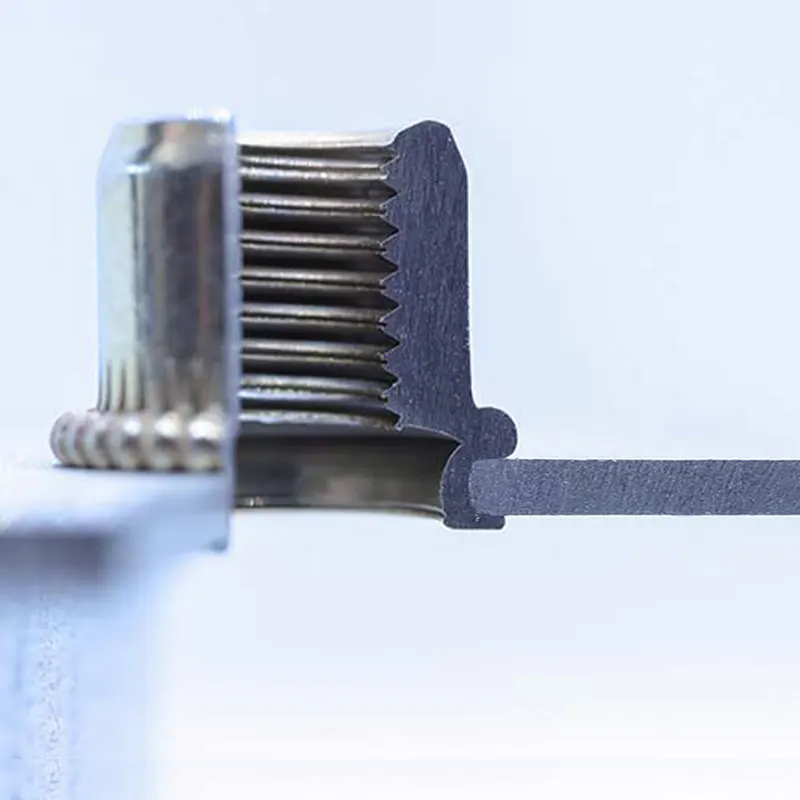
Some thin metal sheets are too thin to allow for the direct tapping of a sufficiently long internal thread. However, as the body of a rivet nut features an internal thread, it can form a thread without being constrained by the thickness of the sheet.
2. Supports single-sided installation without requiring access to the rear of the sheet metal
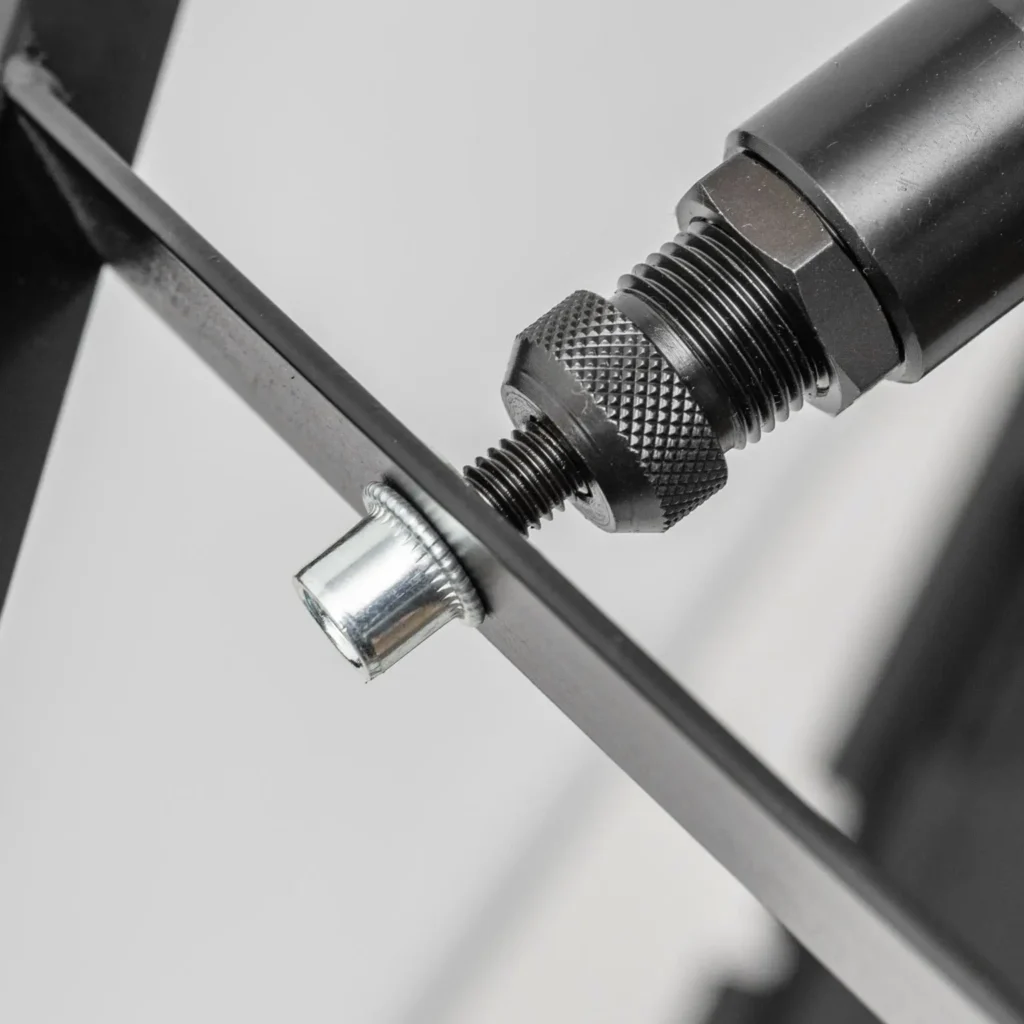
Rivet nuts can be installed from one side into pre-machined mounting holes. The body of the rivet nut deforms on the rear side of the sheet metal, working in conjunction with the head on the front side to clamp the sheet metal securely.
Although the rivet nut only requires installation from one side, the sheet metal requires a certain amount of space on the reverse side. You must ensure there is sufficient space on the reverse side to accommodate the deformed structure of the rivet nut after installation.
3. Providing removable, serviceable threaded connections
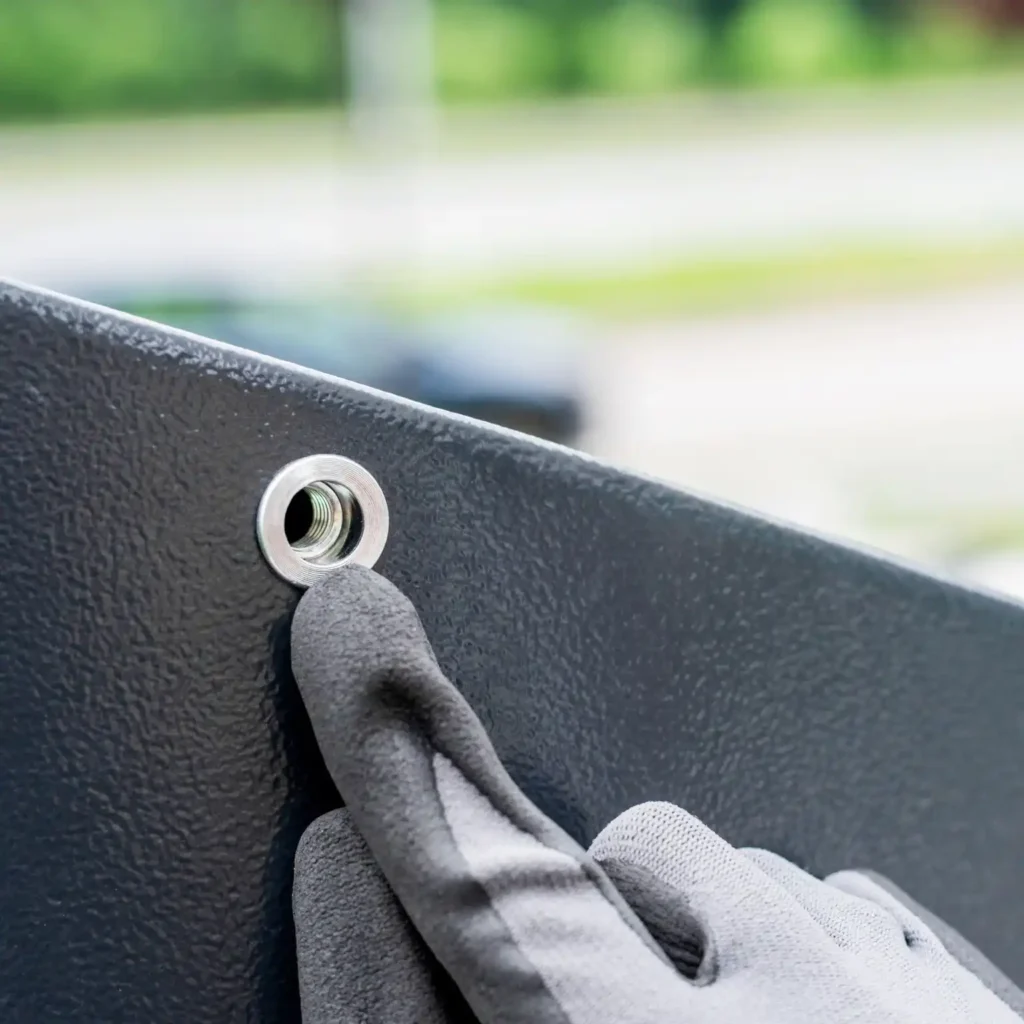
Unlike the permanent connections formed by standard blind rivets, rivet nuts allow you to install, replace or service components by screwing in or removing bolts after riveting. This can be done without damaging the rivet nuts already secured in the sheet metal.
This is particularly suitable for equipment enclosures, access panels or replaceable brackets that need to be opened periodically. The rivet nut connection method effectively improves ease of maintenance and reduces damage to the sheet metal during disassembly.
The fact that the connection is removable does not mean that the parts within the internal thread can be assembled and disassembled an unlimited number of times. You must control the bolt tightening torque and avoid cross-threading, thread damage and the rivet nut rotating within the hole.
4. No welding required, reducing thermal deformation of thin sheets
Rivet nuts operate on the principle of mechanical deformation for fastening. As no welding process is used, there is no heat-affected zone generated during installation. This effectively prevents localised high temperatures from damaging the surface coating of thin metal sheets.
5. Suitable for a wide range of sheet metal materials and structures
Rivet nuts are widely used with various metal materials, including steel sheets, stainless steel sheets and aluminium sheets. They are available in a variety of body structures and flange types to meet different sheet metal joining requirements.
Cylindrical rivet nuts are suitable for many standard round-hole installation scenarios. Knurled rivet nuts enhance mechanical interlock with the hole walls through the textured surface of the body. Hexagonal rivet nuts, when mated with matching hexagonal holes, provide a more secure mechanical anti-rotation effect.
Round, Knurled, Hex, and Slotted Body Types
When selecting rivet nuts for sheet metal applications, the body design is also one of the key factors affecting the reliability of the joint. The available types include Round Body, Knurled Body, Hex Body and Slotted Body. The differences lie in the mounting hole requirements, anti-rotation capability and the manner in which the rivet nut deforms on the reverse side of the sheet metal after installation.
Round Body Rivet Nuts
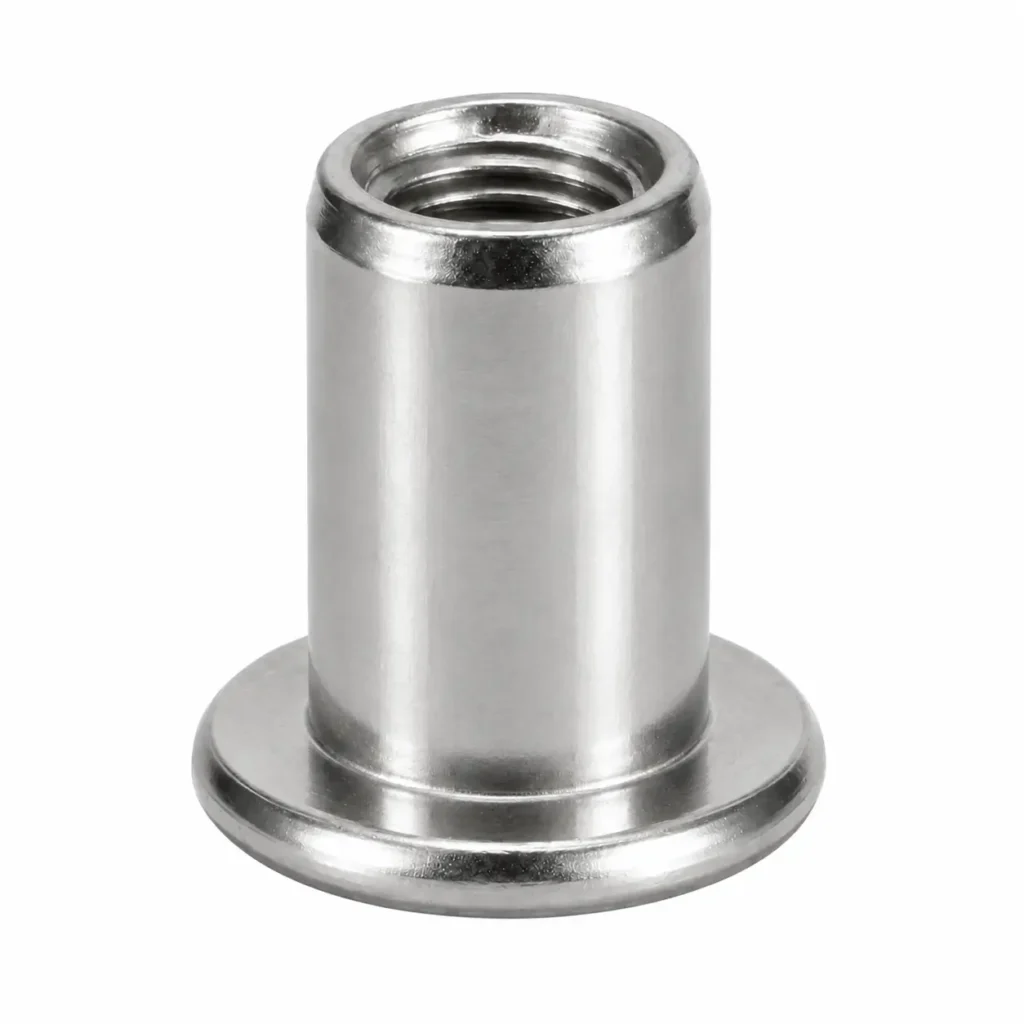
When selecting rivet nuts for sheet metal applications, the body design is also one of the key factors affecting the reliability of the joint. There are Round Body, Knurled Body, Hex Body and Slotted Body types. The differences lie in the mounting hole requirements, anti-rotation capability and the manner of deformation on the reverse side of the sheet metal after installation.
- Key advantages: Cylindrical rivet nuts have relatively simple machining requirements for the mounting hole. There is no need to produce specialised hexagonal holes, making them suitable for standard sheet metal fabrication and mass assembly.
- Applications:Metal cabinets, equipment enclosures, sheet metal brackets, and general-purpose connections where bolt tightening torque requirements are not high.
Knurled Body Rivet Nuts
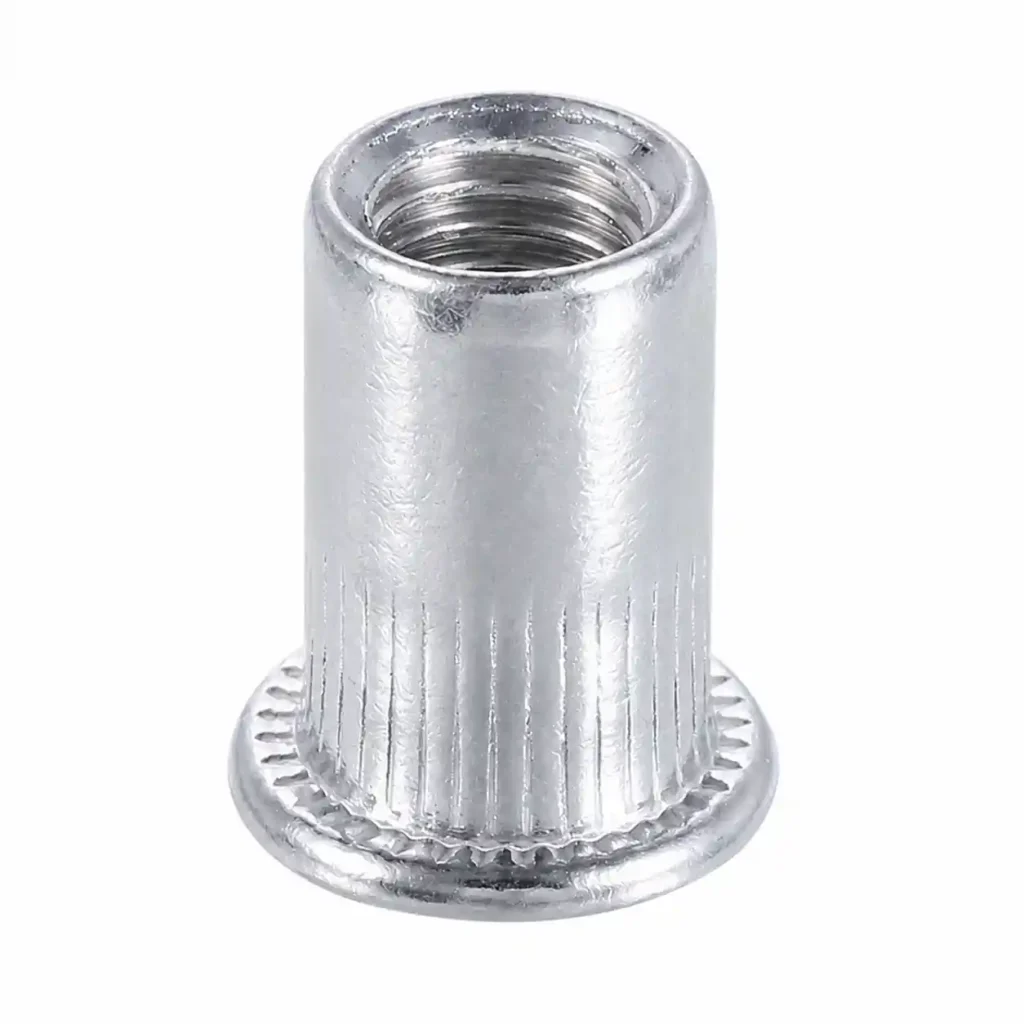
The body is cylindrical in shape, with a knurled pattern added to the outer surface. This serves to create fine raised ridges that enhance mechanical interlocking. Once installed, these ridges form an additional mechanical interlock with the inner wall of the mounting hole, improving the rivet nut’s resistance to rotation.
- Key advantages: Under suitable sheet metal and hole diameter conditions, the knurled structure provides better anti-rotation performance than a smooth cylindrical structure; the mounting hole can still be machined as a round hole.
- Applications: Aluminium alloy sheet metal, relatively soft metal sheets, and equipment housings and sheet metal assemblies that require a certain level of anti-rotation performance but where it is impractical to machine hexagonal holes.
Hex Body Rivet Nuts
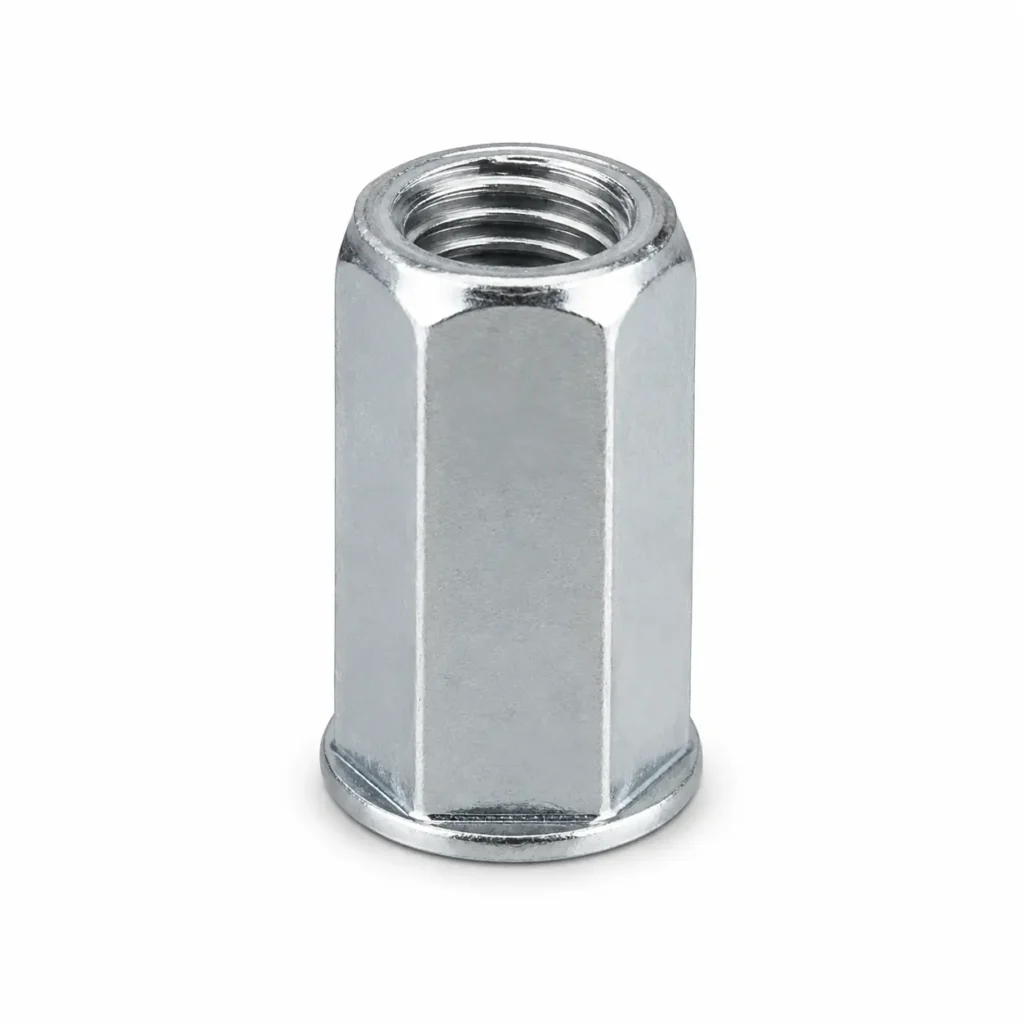
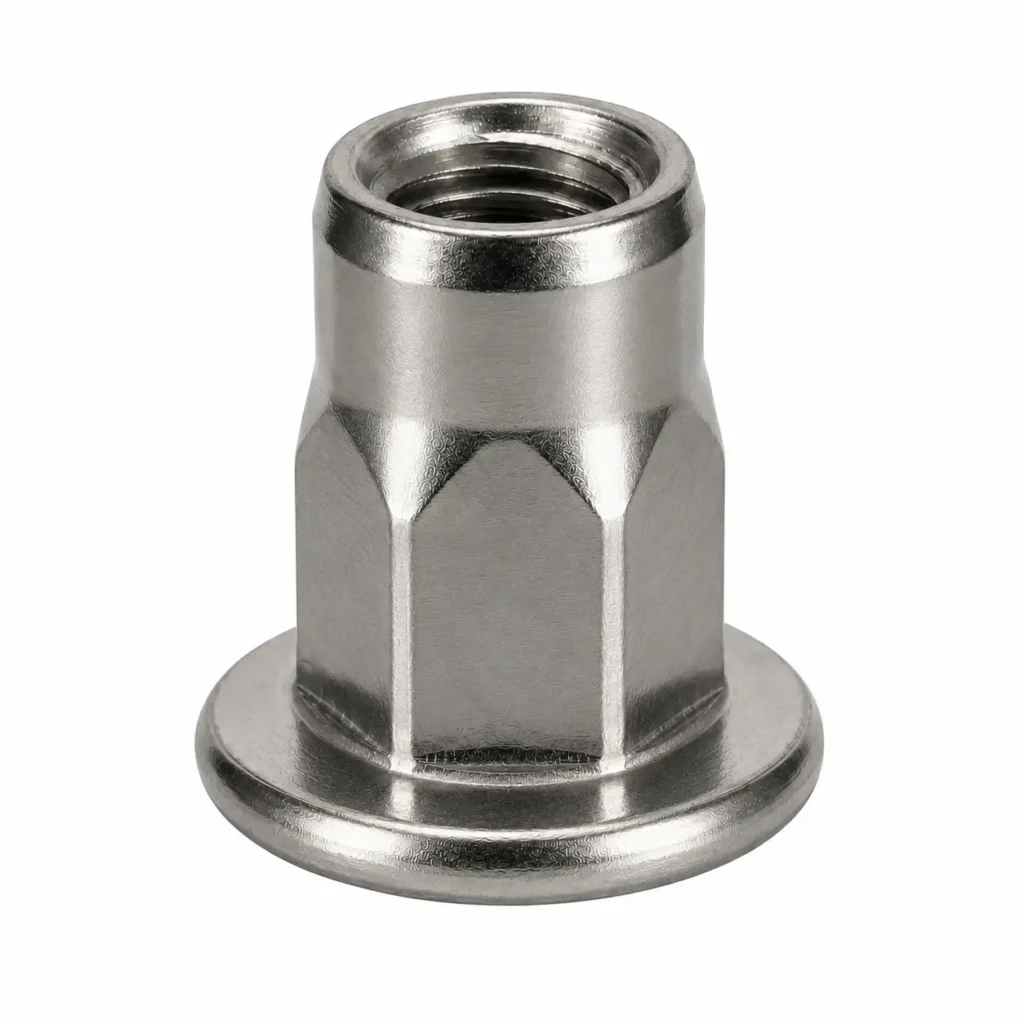
These feature a body with a hexagonal cross-section. They include Full Hex and Half Hex variants. Unlike cylindrical rivet nuts, they must be installed in a dimensionally matched hexagonal hole to achieve a form-fit between the body and the hole walls. Relative rotation is restricted by the geometric shape, rather than relying solely on friction.
- Key advantages: Within a matching hexagonal hole, the hexagonal body typically provides high anti-rotation resistance, making it suitable for sheet metal joints requiring high bolt tightening torque or frequent disassembly and reassembly.
- Applications: Industrial equipment mounting brackets, automotive sheet metal components, electrical control cabinets, and metal structures where high anti-rotation performance is required.
Slotted Body Rivet Nuts
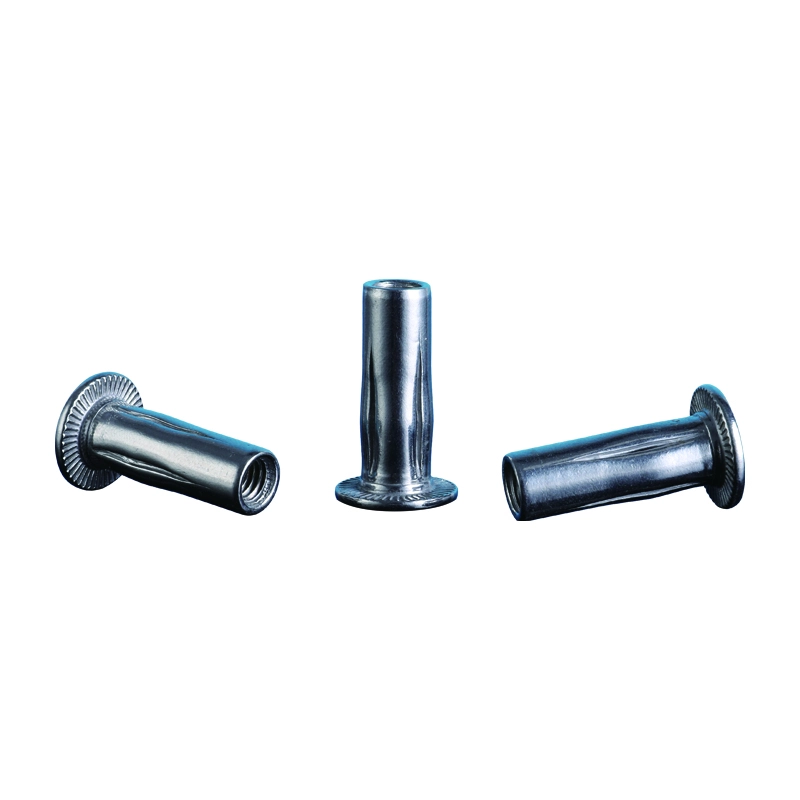
The body of a slotted rivet nut features a longitudinal slotted structure. Upon installation, the slotted areas expand outwards, forming multiple support legs on the reverse side of the sheet metal. For example, a common four-slot design can create four outward-expanding support areas, thereby increasing the load-bearing surface area on the reverse side.
- Key advantages: Compared to conventional designs that clamp sheet metal by relying on a small area of deformation on the reverse side, slotted rivet nuts distribute the load across a larger support area on the reverse side, thereby reducing the risk of excessive localised stress in thin sheets or softer materials.
- Applications: Thinner metal sheets, softer sheet metal materials, and connections requiring a larger support area on the reverse side. Similar designs are also commonly used in fibreglass-reinforced plastic and certain plastic components.
Selecting the Correct Grip Range for Sheet Thickness

When selecting the clamping range for sheet metal rivet nuts, it is essential to ensure that the actual sheet thickness and the riveting tolerances fall entirely within the ‘Grip Range’ specified for the chosen model.
Firstly, you should measure the actual thickness of all the sheet metal to be joined and then check the supplier’s technical specifications. Finally, carry out a trial fit using a sample to confirm that the clamping structure on the reverse side is formed correctly.
Where there are significant variations in sheet thickness, or where multi-layer sheet metal, softer materials or higher joint loads are involved, further consideration must be given to the rivet nut design and installation conditions. The reliability of the joint cannot be determined solely on the basis of the grip range.
Hole Size, Tolerance, and Edge Distance
When selecting rivet nuts for sheet metal applications, the three most important factors in the selection process are the installation hole size, hole tolerance and edge distance. This is because if the installation hole is too large, the hole shape is inaccurate, or the installation position is too close to the edge of the sheet metal, the rivet nut may become loose, rotate or tear through the sheet metal after installation.
Choose the Correct Installation Hole
Hole size refers to the diameter of the hole in the sheet metal used to install the rivet nut. For cylindrical rivet nuts, this refers to the diameter of the round hole to be machined. For hexagonal rivet nuts, it refers to the diagonal dimension and shape of the hexagonal hole to be machined.
Incorrect installation hole size and shape will directly affect the secure fit between the rivet nut and the sheet metal:
- Hole diameter too large: Excessive clearance between the rivet nut and the hole walls. After installation, this reduces anti-rotation capability and increases the risk of the joint becoming loose.
Hole diameter too small: The rivet nut may not be able to be inserted properly; forcing it into the hole during installation may damage the rivet nut itself, the hole walls or the surface coating. - Mismatched hole profile: For example, installing a hexagonal rivet nut in a standard round hole. After installation, the rivet nut will be unable to achieve the designed hexagonal mechanical anti-rotation effect.
Control Hole Diameter Accurately
Hole tolerance can be understood as the permissible deviation of the actual machined hole diameter from the specified dimension. Even if your sheet metal design drawings specify the correct hole diameter, the actual dimensions may vary after machining due to drilling, punching, laser cutting or tool wear.
For mass-production of sheet metal, you must verify that the post-machining hole diameter, shape and periphery fall within the specified tolerances. Assess whether the hole tolerance values comply with the technical specifications.
Maintain Sufficient Edge Distance
Edge distance refers to the distance from the centre of the mounting hole to the nearest free edge of the sheet metal. The distance to the nearest free edge includes the outer contour of the sheet, as well as the edges of any nearby openings, notches or large cut-outs.
The reason for maintaining a sufficient edge distance is that the sheet metal surrounding the hole must withstand clamping forces, the forces generated by bolt tightening, and the actual operational loads. If mounting holes are positioned too close to the edge of the sheet, this increases the risk of localised deformation, edge tearing or the failure of rivet nuts.
Choosing Aluminum, Steel, or Stainless Steel
Material is also a key parameter in selecting rivet nuts for sheet metal applications. Different materials offer varying thread load-bearing capacities, corrosion resistance, installation requirements and overall costs. The correct approach is to make a selection based on the actual connection load, sheet metal material, operating environment and installation equipment.
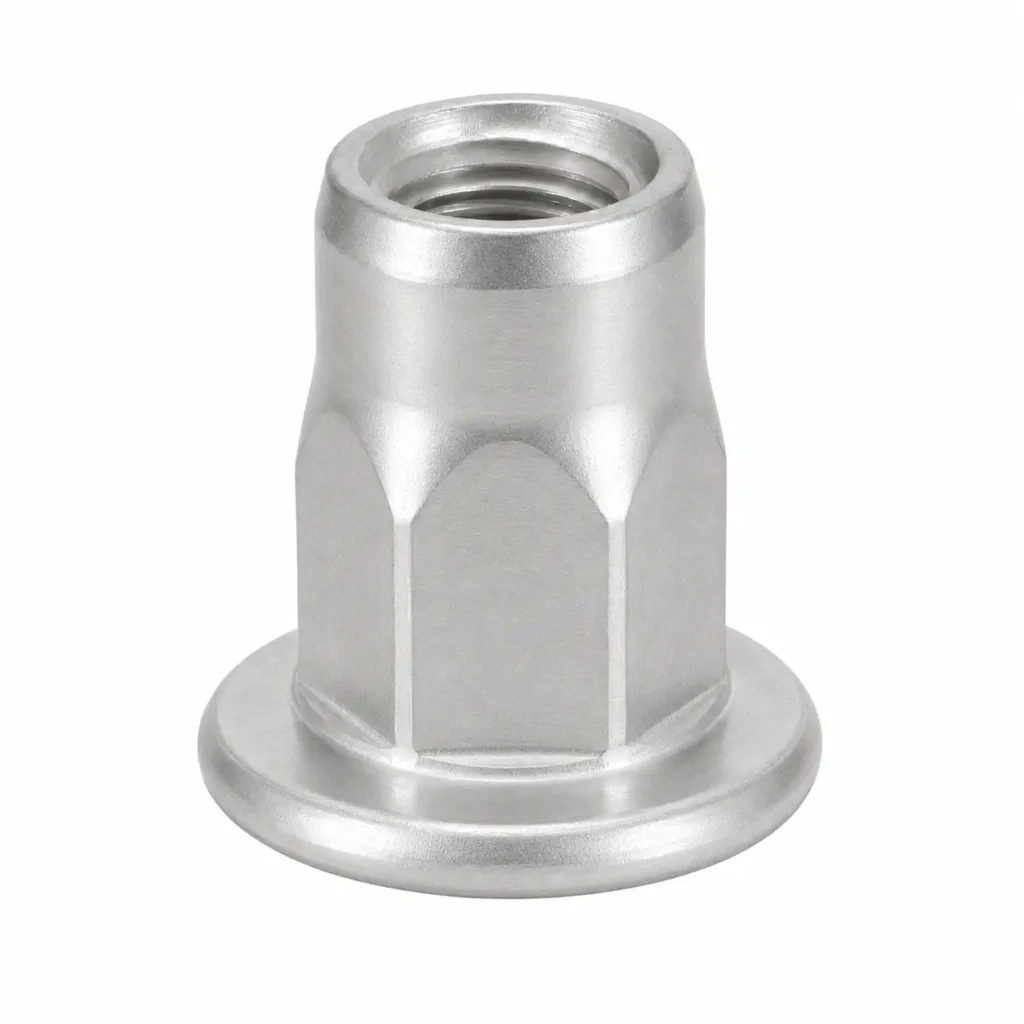
Lightweight, with basic corrosion resistance. The material is more prone to deformation.
Suitable applications:
- Aluminium alloy equipment housings
- Electronic equipment enclosures
- Lightweight automotive sheet metal components
- Aluminium sheet connections with moderate load requirements
②Steel Rivet Nuts
Balance mechanical strength and procurement costs. Extremely economical and practical.
Suitable applications:
- Industrial machinery housings
- Steel sheet metal brackets
- Electrical cabinets
- Automotive sheet metal components
- General indoor industrial equipment
③Stainless Steel Rivet Nuts
High corrosion resistance. Common grades include 304 and 316.
Suitable applications:
- Outdoor equipment
- Stainless steel cabinets
- Food processing equipment
- Certain coastal equipment and sheet metal components with high corrosion resistance requirements.
Flange Styles and Their Effect on Load Distribution
The flange design not only determines the height by which the rivet nut protrudes from the sheet metal surface after installation, but also affects load distribution, local deformation of the sheet metal and the stability of the joint. The contact surface between the flange and the sheet metal is particularly important when selecting rivet nuts for thin or soft sheet metal. Common rivet nut flange designs include standard flat head, Large Flange, Reduced Head and countersunk.
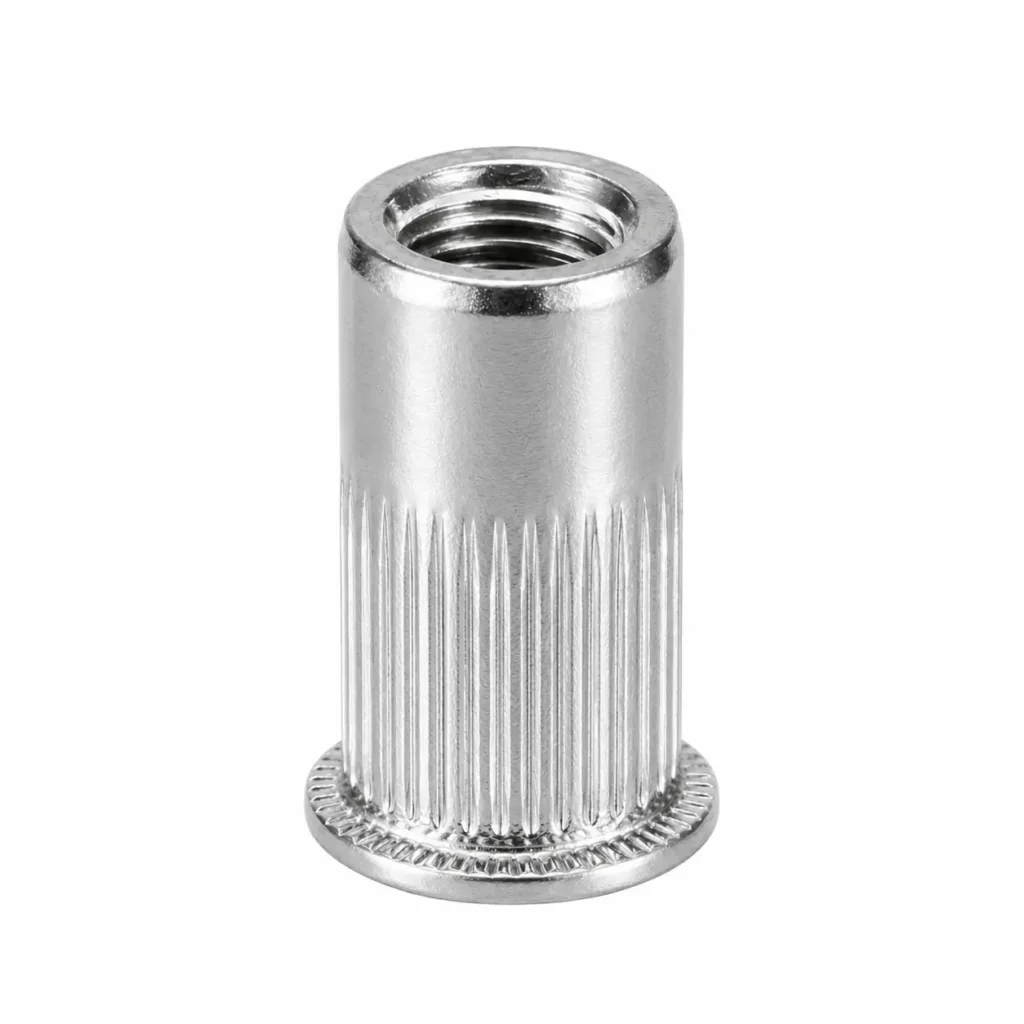
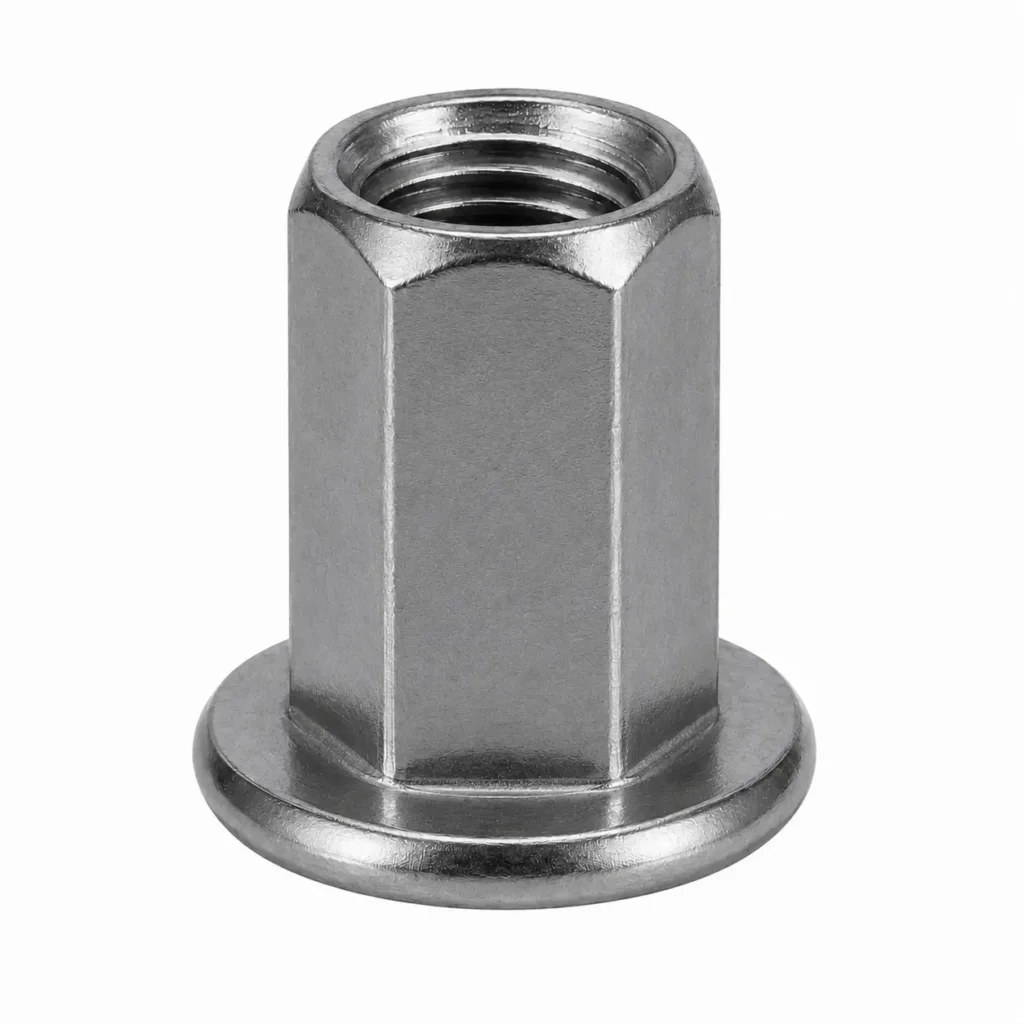
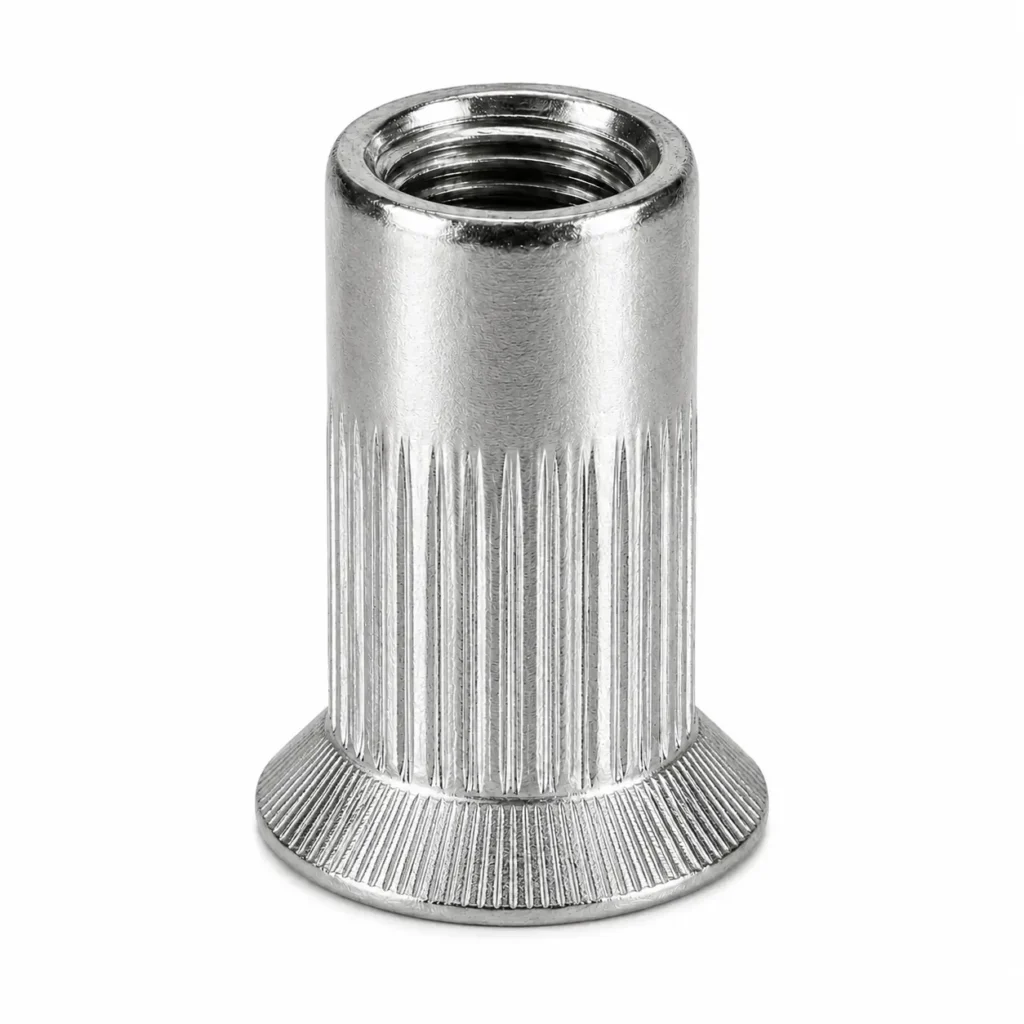
| Flange Type | Load Distribution | Main Advantages | Key Considerations |
|---|---|---|---|
| Standard Flat Head | Provides a conventional bearing area around the installation hole. | Suitable for general sheet metal fastening applications. | The flange protrusion may interfere with adjacent components or prevent flush mating. |
| Large Flange | Provides a larger contact area, helping reduce average local contact pressure. | Offers additional front-side support for thin sheet metal. | Requires sufficient surface area and clearance around the installation hole. |
| Reduced Head | Typically provides a smaller front-side bearing area. | Offers a low-profile installation and generally avoids the need for a conventional countersink. | Evaluate push-out resistance and the risk of local sheet deformation. |
| Countersunk Head | Transfers load through the conical contact surface between the head and the sheet. | Allows a flush installation for applications requiring a smooth surface. | Requires a correctly machined countersink and sufficient remaining sheet thickness. |
Preventing Spin-Out, Pull-Through, and Panel Distortion
When using rivet nuts for sheet metal, common assembly issues include rivet nut rotation, pull-through and localised deformation of the sheet metal. As the causes of these three failure modes differ, it is necessary to select the appropriate rivet nut design, mounting hole dimensions and installation parameters based on the specific problem.
Preventing Spin-Out
| Inspection Item | Common Problem | Preventive Measures |
|---|---|---|
| Installation Hole Size | The hole is oversized or irregular, resulting in poor engagement between the rivet nut and the hole wall. | Control hole diameter, hole shape, and machining tolerances according to the manufacturer’s specifications. |
| Rivet Nut Body Design | A smooth round body may not provide sufficient anti-rotation resistance for the application. | Consider a knurled or hex-body rivet nut. Hex-body designs require a correctly sized hexagonal hole. |
| Grip Range | The sheet thickness falls outside the specified grip range, preventing proper clamping. | Ensure the actual sheet thickness falls within the manufacturer’s specified grip range. |
| Installation Parameters | Under-setting or over-setting results in an improperly installed joint. | Use a compatible installation tool and follow the manufacturer’s recommended setting stroke or force. |
| Bolt Tightening Torque | The applied tightening torque exceeds the rivet nut’s resistance to rotation. | Determine appropriate assembly torque based on the specific product’s torque-out performance data. |
| Post-Installation Inspection | The rivet nut is loose, rotates with the bolt, or has an enlarged installation hole. | Inspect the hole dimensions, installation condition, and rivet nut for damage. Repair the joint or reassess the design when necessary. |
Preventing Pull-Through
| Inspection Item | Common Problem | Preventive Measures |
|---|---|---|
| Sheet Thickness and Strength | Thin or soft sheet metal cannot withstand the applied load. | Evaluate the joint based on sheet material, thickness, and local load-bearing capacity. |
| Flange Size | An insufficient front-side bearing area creates excessive local pressure. | Consider a large-flange design where space permits to improve front-side load distribution. |
| Blind-Side Support | The deformed portion of the installed rivet nut provides insufficient support for the panel. | Evaluate designs with a larger blind-side bearing area and verify their suitability using product specifications. |
| Installation Hole and Edge Distance | An oversized hole or insufficient distance from the panel edge leaves inadequate supporting material. | Control hole dimensions and ensure the edge distance meets the design requirements. |
| Applied Load | The axial tensile load exceeds the capacity of the sheet metal or the complete joint. | Verify pull-out performance under representative conditions. Consider a reinforcement plate or redesign if necessary. |
| Failure Location | Thread damage, insert pull-out, and panel tearing are incorrectly treated as the same failure mode. | Inspect the failed joint to determine whether the threads, rivet nut body, or surrounding sheet metal failed first. |
Preventing Panel Distortion
| Inspection Item | Common Problem | Preventive Measures |
|---|---|---|
| Sheet Thickness and Stiffness | The sheet is too thin or lacks sufficient local stiffness, making it prone to bending during installation. | Select a suitable rivet nut based on the material and panel design. Add local reinforcement when necessary. |
| Grip Range | The actual sheet thickness falls outside the specified grip range. | Select a rivet nut whose grip range covers the actual sheet thickness and its manufacturing tolerances. |
| Setting Force and Stroke | Excessive installation force or stroke causes over-setting and unwanted deformation. | Follow the manufacturer’s recommended installation settings. Do not increase the setting force without investigating the cause. |
| Installation Hole Quality | Burrs, incorrect hole dimensions, or a deformed hole prevent the flange from seating properly. | Machine the hole to the specified dimensions and remove burrs without enlarging or distorting the hole. |
| Flange Seating | An uneven panel surface or incorrect tool alignment creates uneven local loading. | Ensure the installation surface is sufficiently flat and the tool is correctly aligned with the panel. |
| Installation Tool and Fixturing | The tool is unsuitable for the rivet nut, or the panel lacks adequate support during installation. | Use a compatible installation tool and provide suitable fixture support when necessary. |
| Post-Installation Condition | The panel shows bulging, dents, cracks, or dimensional changes after installation. | Inspect the surface and critical dimensions. Perform additional performance testing when required. |
Installation Tools and Setting Control
Types of Rivet Nut Installation Tools
Tools for rivet nuts can be categorised as manual, electric or pneumatic/hydraulic pressure-assisted installation tools. These tools differ in terms of their operating methods, installation capacity and level of process control. You should make your selection based on your project’s production volume, operating environment and quality control requirements.
| Tool Type | Main Advantages | Suitable Applications | Key Considerations |
|---|---|---|---|
| Manual Rivet Nut Tool | Simple design, no external power required, and relatively low initial equipment cost. | Sample production, small-batch manufacturing, and maintenance work. | Installation consistency may depend on operator strength and technique. |
| Battery-Powered Tool | Portable, efficient, and available with electronic parameter control on some models. | Small- to medium-volume production, batch assembly, and mobile workstations. | Verify thread-size compatibility, installation capacity, and available control functions. |
| Pneumatic or Hydro-Pneumatic Tool | Suitable for frequent repetitive installation; some models provide force or stroke control. | Factory batch production and fixed assembly stations. | Check the required power supply, maintenance needs, and specific control method. |
| Automated Setting System | Can integrate automatic feeding, installation parameter monitoring, and process recording. | High-volume production lines requiring consistent installation quality. | Requires equipment integration, parameter validation, and ongoing process management. |
Setting Stroke vs. Setting Force
When controlling the installation of rivet nuts on sheet metal, the two most important factors are the setting stroke and the setting force. The setting stroke determines how far the tool is pulled back, whilst the setting force primarily determines the amount of pulling force applied by the tool. Which factor is used to control the process depends on the rivet nut model, the sheet metal conditions and the requirements of the installation tool.
Corrosion, Vibration, and Service Environment
Corrosion Resistance of Different Materials and Their Suitable Environments
| Rivet Nut Material | Corrosion Resistance | Suitable Environments | Selection Considerations |
|---|---|---|---|
| Aluminum Rivet Nuts | Naturally forms a protective oxide layer, providing a certain level of corrosion resistance. | Aluminum sheet metal, lightweight equipment, and environments with low corrosive exposure. | Consider actual loading conditions, aluminum alloy grade, and galvanic corrosion risks when in contact with dissimilar metals. |
| Coated Carbon Steel Rivet Nuts | Primarily relies on zinc plating, zinc-nickel plating, or other protective coatings for corrosion resistance. | Indoor industrial equipment, standard metal cabinets, and sheet metal assemblies with appropriate corrosion protection. | Verify coating type, integrity, and environmental suitability. Not all coatings are suitable for long-term outdoor exposure. |
| 304 Stainless Steel Rivet Nuts | Provides good corrosion resistance in many typical humid environments. | Humid indoor environments, stainless steel cabinets, and certain outdoor equipment. | Localized corrosion may still occur in environments with high chloride concentrations or prolonged moisture retention. |
| 316 Stainless Steel Rivet Nuts | Generally offers better resistance to chloride-induced pitting corrosion than 304 stainless steel. | Coastal equipment, certain salt-exposed environments, and applications requiring enhanced corrosion protection. | Not completely immune to seawater corrosion. Evaluate salt exposure, temperature, and moisture accumulation. |
Vibration Resistance
For sheet metal structures subject to continuous vibration—such as those found in automotive components, industrial machinery and transport equipment—it is essential to prioritise the long-term stability of the joints.
- Rotation of the rivet nut body. When the holding force between the rivet nut and the mounting hole is insufficient, the rivet nut may rotate along with the bolt during the tightening or removal process. Common causes include an oversized mounting hole, an unsuitable body design, a mismatch in the clamping range, or insufficient installation forming.
In such cases, it is recommended to use knurled or hexagonal rivet nuts. This is because the knurled structure enhances mechanical interlock with the hole walls, whilst the hexagonal body utilises a shape that matches the hexagonal hole to resist rotation. - Loosening of the mating bolt. Whilst the body of the rivet nut is firmly secured within the sheet metal, the bolt in the joint may still gradually loosen due to lateral vibration, relative slippage at the contact surface, or other cyclic loads. Consequently, automatic anti-loosening cannot be achieved simply by selecting a rivet nut design with superior anti-rotation capability.
Select rivet nuts according to the actual operating environment
| Service Environment | Key Risks | Recommended Selection | Key Inspection Points |
|---|---|---|---|
| Dry Indoor Equipment | General wear and occasional loosening. | Consider carbon steel rivet nuts with appropriate surface protection. | Applied loads, installation quality, and bolt tightening requirements. |
| Humid or General Outdoor Environments | Moisture-related corrosion and protective coating damage. | Evaluate steel rivet nuts with suitable protective coatings or stainless steel options. | Material corrosion resistance, drainage, and coating protection. |
| Coastal or Salt-Exposed Environments | Chloride-induced pitting and galvanic corrosion. | Consider 316 stainless steel rivet nuts or other suitable corrosion-resistant solutions. | Material compatibility, corrosive exposure, and prolonged moisture accumulation. |
| High-Vibration Machinery | Bolt loosening, rivet nut rotation, and sheet metal fatigue. | Evaluate rivet nut body designs with sufficient anti-rotation resistance and compatible bolt-locking solutions. | Torque-out resistance, bolt preload, and cyclic loading. |
| Chemical Processing Equipment | Chemical corrosion and protective coating failure. | Select suitable rivet nut materials and surface protection based on the specific chemical exposure. | Chemical type, concentration, temperature, and material compatibility. |
| Temperature-Cycling Environments | Differential thermal expansion and changes in joint clamping conditions. | Select rivet nuts that meet the operating temperature and mechanical load requirements. | Temperature range, material combinations, and joint stability. |
| Outdoor Electrical Enclosures | Corrosion and moisture ingress into electrical equipment. | Evaluate closed-end rivet nuts or specially designed sealing rivet nuts according to application requirements. | Installation hole sealing, assembly waterproof performance, and corrosion resistance. |
How to Specify Rivet Nuts for a Sheet Metal Assembly
In sheet metal assembly, it is important to select the appropriate rivet nut. This requires not only a clear understanding of the sheet material, actual thickness, mounting hole dimensions, the rivet nut’s structure and clamping range, but also consideration of the connection load and installation conditions.
| Specification Item | Parameters to Confirm | Selection Guidelines |
|---|---|---|
| Sheet Material | Carbon steel, stainless steel, aluminum alloy, and specific material grade. | Affects installation deformation, hole-bearing capacity, and material compatibility. |
| Sheet Thickness | Actual thickness, thickness tolerance, and total thickness of stacked sheets. | Ensure the entire expected thickness range falls within the specified grip range. |
| Thread Size | Thread diameter, pitch, and mating bolt specification. | Select according to joint requirements. Thread size alone does not determine joint strength. |
| Body Style | Round, knurled, hex, or slotted body. | Select based on anti-rotation requirements, sheet properties, and installation hole geometry. |
| Flange Style | Standard flat head, large flange, reduced head, or countersunk head. | Balance bearing area, head protrusion, and flush-mounting requirements. |
| Material and Finish | Aluminum, carbon steel, stainless steel, and appropriate surface protection. | Consider mechanical properties, corrosion exposure, and compatibility with the sheet material. |
| Installation Hole | Hole diameter, shape, dimensional tolerance, and edge quality. | Follow the selected product’s specifications to prevent looseness, rotation, or installation difficulties. |
| Hole Position and Edge Distance | Hole location, distance to panel edges, and spacing between adjacent holes. | Maintain sufficient surrounding material to reduce the risk of deformation and edge tearing. |
| Installation Clearance | Flange height, blind-side deformation dimensions, and tool access. | Prevent interference with bends, stiffeners, and adjacent components. |
| Joint Performance | Axial pull-out load, torque-out resistance, shear load, and bolt tightening requirements. | Verify the complete joint under actual loading conditions rather than relying only on insert strength. |
| Installation Process | Tool model, threaded mandrel, setting stroke, or setting force. | Follow manufacturer instructions and confirm installation quality through representative samples. |
| Service Conditions and Product Identification | Temperature, humidity, vibration, corrosion exposure, product number, and technical document revision. | Verify long-term suitability and record the manufacturer’s part number and applicable technical specifications. |
FAQs
How thin can sheet metal be for a rivet nut?
It is not possible to specify the exact minimum sheet thickness for which all rivet nuts are suitable. The minimum sheet thickness on which a rivet nut can be fitted depends on the minimum permissible material thickness within the ‘Grip Range’ of the selected model.
What is the strongest rivet nut body shape?
Full-Hex Body rivet nuts offer the highest resistance to rotation. This is because, once the hexagonal body is fitted into a matching hexagonal hole, it is secured against rotation not only by friction but also by the hole walls, which directly restrict the rivet nut’s rotation.
Can rivet nuts be used in galvanized sheet metal?
Rivet nuts can be fitted into galvanised steel sheets. As rivet nuts are fitted mechanically, they do not generate heat—unlike welding—which could damage the galvanised coating.
How close can a rivet nut be installed to an edge?
It is not possible to specify a fixed minimum clearance for rivet nuts. How close a rivet nut can be positioned to the sheet metal depends on the rivet nut dimensions, the flange diameter, the size of the rear bulge after installation, the base material, the sheet thickness and the actual load.
Do rivet nuts deform thin sheet during installation?
Thin sheets may be subject to deformation. When the local clamping forces generated during the installation of a rivet nut exceed the thin sheet’s capacity to withstand them, dents, warping or deformation around the hole may occur. You will need to select a rivet nut model that is suitable for the installation parameters and loads involved.
What is the difference between a nutsert and a rivnut?
Nutsert and Rivnut refer to the same type of product; both are varieties of blind rivet nuts. They are simply different brand names for blind rivet nuts.
Can a rivet nut be welded to sheet metal?
It is not recommended to weld standard rivet nuts directly onto sheet metal. This is because the rivet nut itself can be clamped in place by deforming it from the reverse side of the sheet metal using a fitting tool. Welding is not required.
How do I repair a spinning rivet nut in sheet metal?
Firstly, you need to identify the cause of the spin-out. Common causes include mounting holes that are too large, insufficient tightening torque on the rivet nuts, a mismatch between the product and the board thickness, and cross-threaded or corroded bolts that are seized. If the rivet nut is significantly loose, it will need to be removed and replaced with a suitable one.
Work with a IATF 16949 Certified Blind Rivet Manufacturer
Get High Quality Rivets Instead of Huck and Avdel Rivets

Rivmate Rivet
Rivmate is blind rivets manufacturers in china. The company is IATF 16949 certified and offers high-strength structural blind rivets that serve as alternatives to Huck and Avdel products.
Explore Rivmate Cases
Rivmate Rivet
Rivmate is blind rivets manufacturers in china. The company is IATF 16949 certified and offers high-strength structural blind rivets that serve as alternatives to Huck and Avdel products.

Hey There, I'm Allen!
I am the boss of Rivmate. For over two decades, we have specialized in the manufacture of blind rivets, providing our customers with reliable riveting solutions. Need riveting services? Feel free to contact us.