When selecting rivet nuts for thick materials, the most important factor is that the rivet nut can deform properly within the thicker sheet metal and form a secure threaded connection. Therefore, for joining thick steel plates, aluminum sheets, or multi-layer materials, you must select a rivet nut with the appropriate grip range.
When selecting rivet nuts for thick sheet metal, a longer rivet nut is not necessarily better. Instead, you need to measure the actual sheet thickness to determine the appropriate product specifications for the rivet nut. Then, select the specific model based on the connection requirements.
Table of Contents
Why Material Thickness Determines Rivet Nut Selection
Material thickness is one of the most important factors when selecting a rivet nut, as it directly affects whether the rivet nut can be installed correctly and secured firmly. During installation, the deformable area of the rivet nut compresses and bulges on the back side of the sheet metal, thereby clamping the sheet metal together with the flange on the front side. Therefore, sheet metal that is too thick or too thin may compromise the connection’s holding performance after installation.
It is crucial to pay attention to the clamping range, as it directly determines the maximum thickness that the rivet nut can properly clamp. If the sheet thickness exceeds the maximum clamping range, the rivet nut will not deform sufficiently, resulting in a loose connection. If the sheet thickness is below the minimum clamping range, excessive deformation may occur, potentially damaging the threads.
How to Measure Total Grip Thickness Correctly
To correctly measure the total clamping thickness, you must first identify all the sheet metal that will actually be clamped. Compare the measured dimensions with the “Grip Range” specified in the rivet nut specifications.
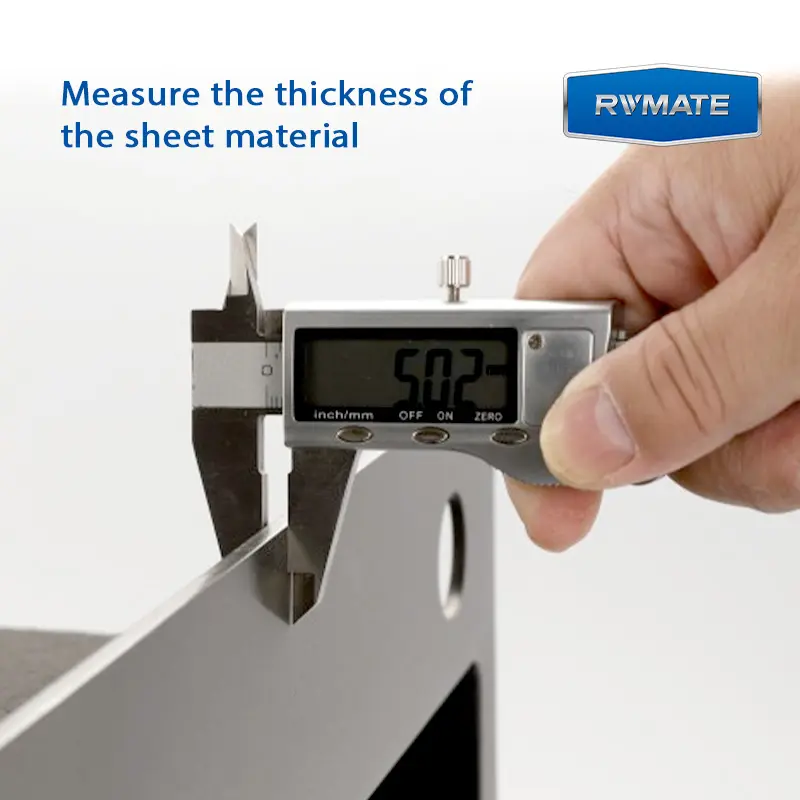
Measuring Tools
- Vernier caliper
- Digital caliper
- Outside micrometer
Correct Measurement Method
- For single-layer sheet metal, you can measure the actual sheet thickness directly near the rivet nut mounting hole. Do not rely solely on the nominal thickness shown on the drawing, as actual sheet metal may have thickness tolerances.
- For two or more layers of sheet metal, you need to measure the total stacked thickness of these sheets in their final, actual assembly configuration. The correct method is to hold the materials to be clamped together in their actual assembly configuration and then measure the total thickness directly with a caliper. This approach helps avoid issues caused by gaps and variations in surface layer thickness that may occur during actual assembly.
- When measuring, ensure that the measuring face of the caliper or micrometer remains essentially parallel to the sheet surface and makes only light contact with the material. Be careful not to apply excessive force, as softer materials, coatings, or interlayers may be compressed, resulting in an underestimated value.
Which Thicknesses Should Be Included?
The total thickness should include the thicknesses that, after installation, are located between the flange of the rivet nut and the deformed area on the back side and will be clamped together by the rivet nut.
For example, if Steel Plate A and Steel Plate B are clamped together by the same rivet nut, then Total Grip Thickness= Steel Plate A + Steel Plate B.
If the rivet nut is first installed in a single Steel Plate A, and then a bracket is mounted using a bolt, then Total Grip Thickness = Steel Plate A.
Understanding Grip Range and Installed Length
- Grip Range: Refers to the range of material thicknesses that the rivet nut can securely grip.
- Installed Length: Refers to the length of the rivet nut between the specified measurement reference points after it has completed the riveting deformation.
What is the difference between Grip Range and Installed Length?
These two length factors address different issues. The Grip Range determines whether a particular rivet nut can properly clamp the sheet metal. Checking the Installed Length, on the other hand, determines whether there is sufficient space behind the equipment, profiles, enclosed cavities, or other structures to complete the installation—ensuring that the installed length does not interfere with internal components or other structures.
Therefore, when selecting a rivet nut for thick sheet metal, you must check the Grip Range specifications to determine if the sheet thickness is compatible. Measure the Installed Length to assess the space occupied after installation and check for structural interference.
Standard, Multi-Grip, Pre-Bulbed, and Plus Nut Options
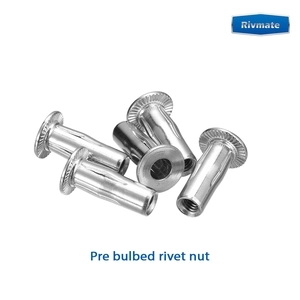
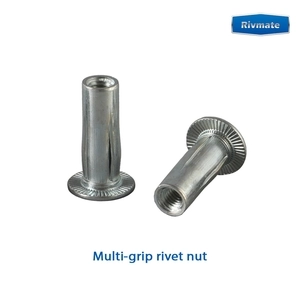
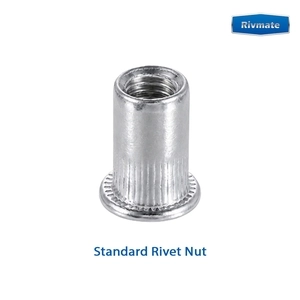
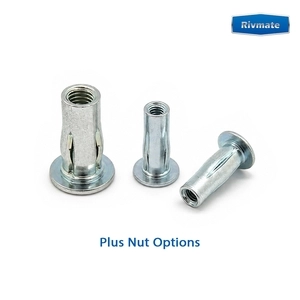
Standard, Multi-Grip, Pre-Bulbed, and Plus Nut options are designed for different applications and address distinct fastening challenges. If the Standard rivet nut covers your required thickness, it should be your first choice. For applications with a wide range of thickness variations, consider the Multi-Grip or Wide-Grip options. For soft materials, large back-support areas, or special assembly conditions, we recommend using Pre-Bulbed or Plus Nut designs.
| Type / Option | Simple Explanation | Main Features | When It Is Suitable | When It Is Not the First Choice | Key Point for Thick Materials |
|---|---|---|---|---|---|
| Standard Rivet Nut | A conventional rivet nut with a defined grip range. | Designed for a specified Grip Range and commonly available in round, knurled, or hex body styles. | Suitable when material thickness is relatively consistent and falls within the specified grip range. | Not suitable if the actual material thickness exceeds the maximum grip range of the selected rivet nut. | Check whether the Grip Range covers the actual material thickness. Do not select only by overall length. |
| Multi-Grip / Wide-Grip Rivet Nut | A rivet nut designed to cover a wider range of material thicknesses. | Can accommodate a broader thickness range than many standard grip options. | Useful when material thickness varies between parts or when fewer rivet nut grip sizes are preferred. | May not provide a clear advantage when the material thickness is stable and a standard rivet nut already matches the application. | Always check the minimum and maximum Grip Range rather than relying only on the “Multi-Grip” name. |
| Pre-Bulbed Rivet Nut | A slotted rivet nut with a partially pre-formed bulge before installation. | The slotted body folds further during installation and creates a larger bearing area on the blind side. | Suitable where a larger blind-side bearing area is useful, especially with softer materials or applications with varying thickness. | Not ideal when blind-side clearance is limited or the assembly cannot accommodate the expanded folded section. | Check the Grip Range, blind-side clearance, and final deformation area. |
| Plus Nut / PLUSNUT®-Type | A slotted, wide-grip rivet nut design that forms multiple folded sections behind the material. | Provides a relatively wide grip range and a larger blind-side bearing area. | Often considered for softer materials, plastics, composites, wider grip ranges, or applications requiring a larger blind-side support area. | Should not automatically be treated as a “thick steel plate rivet nut” or assumed to provide higher strength in every application. | Verify the Grip Range, hole size, base material, and available blind-side space. |
Choosing Body Shape, Flange Style, and Material
Body Shape, Flange Style, and Material—these three factors address different issues. The body shape determines the rivet nut’s resistance to rotation; the flange determines the support area and projection height on the mounting surface; and the material determines the joint’s strength, weight, and corrosion resistance.
Body Shape
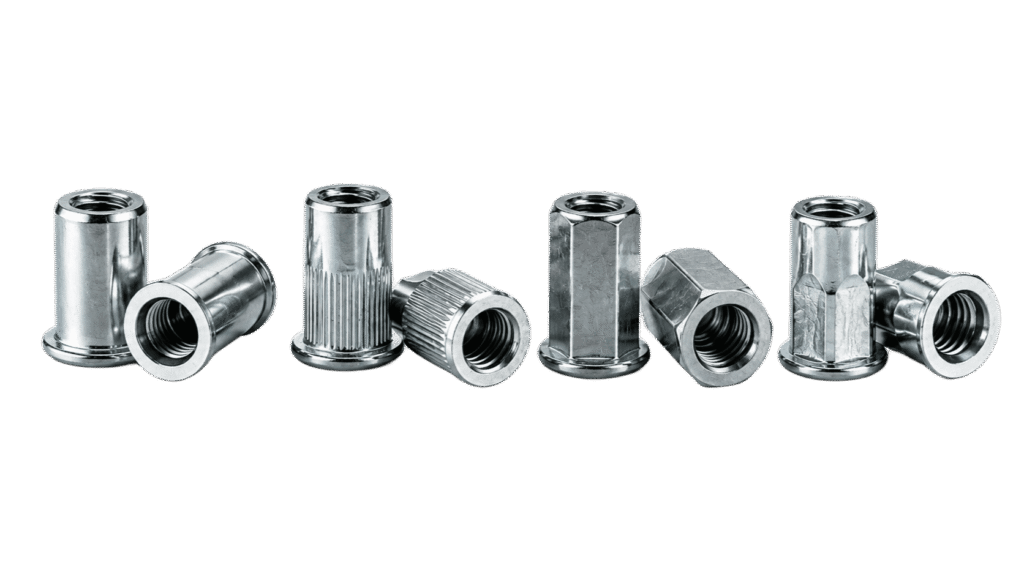
Common rivet nut body types include Round Body, Knurled Body, Half-Hex, and Full-Hex. One of the main differences among them is their varying ability to resist rotation after installation.
| Body Shape | Suitable Applications | Key Considerations | Selection for Thick Materials |
|---|---|---|---|
| Round Body | General fastening applications using a standard round hole. | Anti-rotation performance is generally lower than knurled or hex body designs. | If the Grip Range matches the material thickness, a round body rivet nut can still be suitable for thick materials. |
| Knurled Body | Applications that require a round hole but need better resistance to rotation. | Knurling performance can vary depending on the hardness and type of the base material. | A practical option when you want to keep round-hole machining while improving anti-rotation performance. |
| Half-Hex Body | Connections requiring higher resistance to rivet nut rotation. | Requires the specified matching hole shape and dimensions. | Suitable when tightening torque is higher and there is a greater risk of the rivet nut spinning in the panel. |
| Full-Hex Body | Applications with high anti-rotation requirements. | Requires a properly formed hexagonal installation hole. | Its main advantage is anti-rotation performance; it is not automatically better for thick materials than a round-body design. |
Flange Style
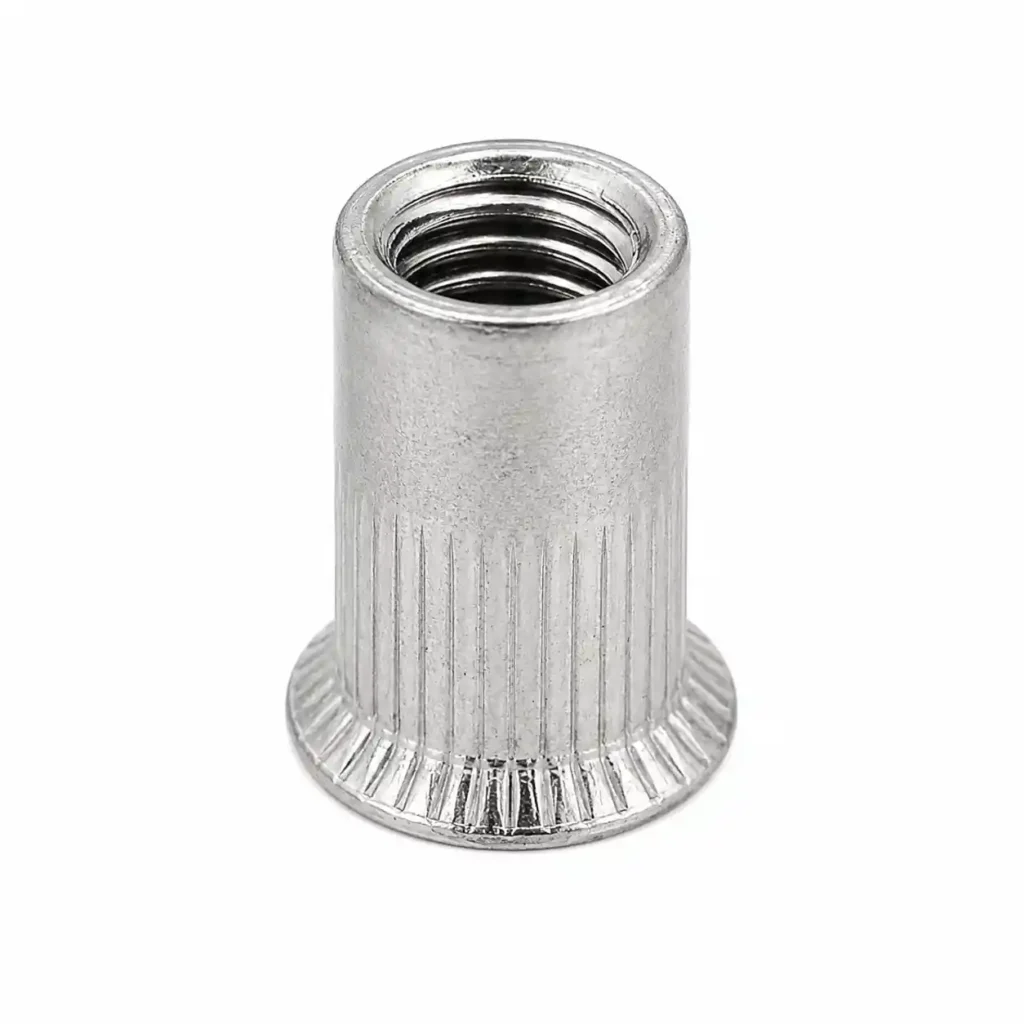
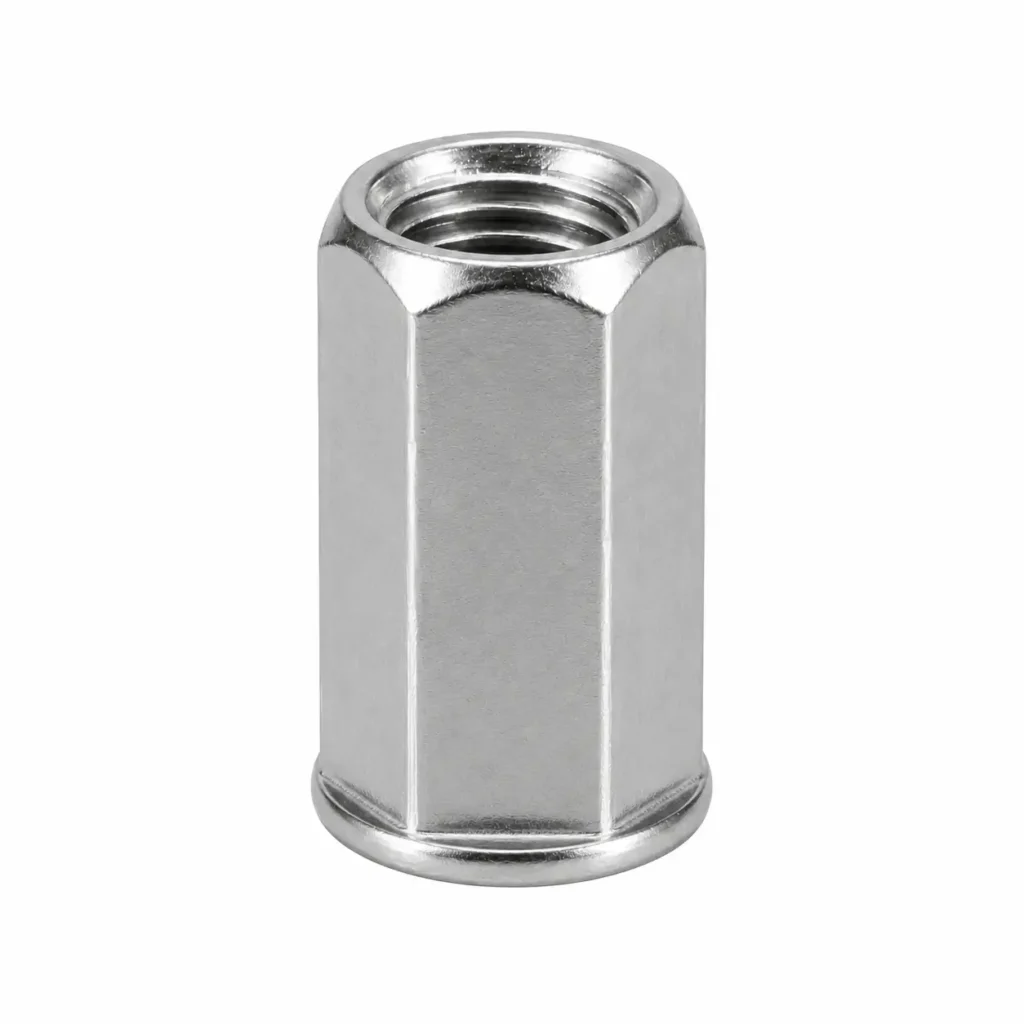

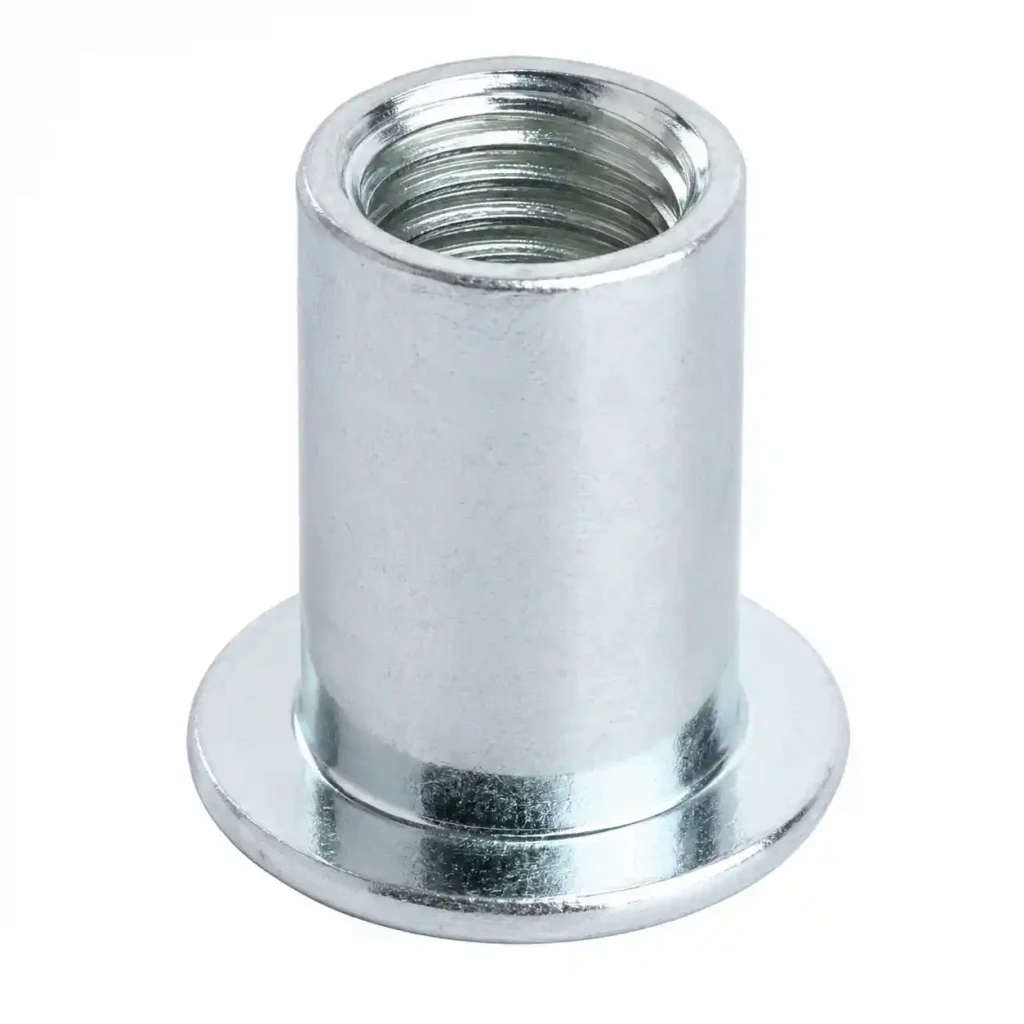
A flange refers to the head that remains on the front face of the plate after a rivet nut has been fitted. Common types include large flanges, reduced/small flanges and countersunk heads.
| Flange Style | Suitable Applications | Key Considerations | Selection for Thick Materials |
|---|---|---|---|
| Large / Flat Flange | General industrial fastening where a larger bearing area on the front surface is preferred. | The flange remains more visible above the material surface. | A common and practical choice for thick materials when a flush surface is not required. |
| Reduced / Small Flange | Applications with limited surface space or where lower flange projection is preferred. | Provides a smaller bearing area than a large flange. | Do not select it only for appearance. Make sure the available bearing area is suitable for the application. |
| Countersunk Head | Applications where the installed surface needs to be nearly flush. | Requires a correctly machined countersunk installation hole. | Follow the product drawing for the required countersink dimensions and hole geometry. |
Material
| Flange Style | Suitable Applications | Key Considerations | Selection for Thick Materials |
|---|---|---|---|
| Large / Flat Flange | General industrial fastening where a larger bearing area on the front surface is preferred. | The flange remains more visible above the material surface. | A common and practical choice for thick materials when a flush surface is not required. |
| Reduced / Small Flange | Applications with limited surface space or where lower flange projection is preferred. | Provides a smaller bearing area than a large flange. | Do not select it only for appearance. Make sure the available bearing area is suitable for the application. |
| Countersunk Head | Applications where the installed surface needs to be nearly flush. | Requires a correctly machined countersunk installation hole. | Follow the product drawing for the required countersink dimensions and hole geometry. |
Hole Size, Edge Distance, and Backside Clearance
Hole Size: The mounting holes must be compatible with the specific rivet nut
Hole Size refers to the diameter or shape of the hole required for installing the rivet nut. Each rivet nut model has corresponding mounting hole requirements. You must determine the hole dimensions in accordance with the specific product technical data before drilling.
Edge Distance: Mounting holes must not be too close to the edge of the plate
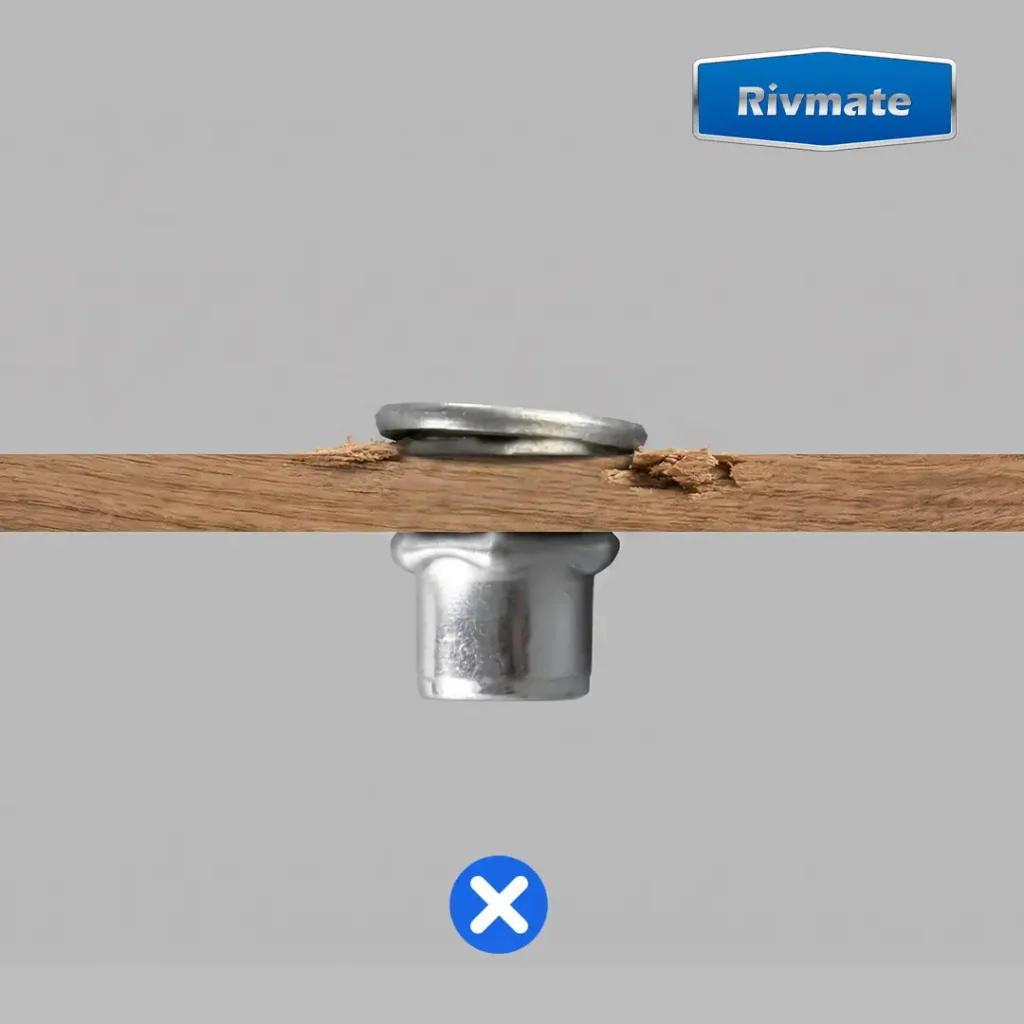
Edge Distance refers to the distance from the centre of the mounting hole to the nearest free edge of the plate. Once the rivet nut is installed, the plate material surrounding the hole must withstand certain clamping, anti-rotation, pull-out and actual connection loads. Therefore, the hole must not be positioned too close to the edge of the plate.
If the hole is too close to the edge of the plate, there will be insufficient material remaining between the hole and the edge. During subsequent use, this makes the plate more susceptible to localised deformation, damage to the hole edges, or a reduction in the load-bearing capacity of the joint.
Backside Clearance: Sufficient space must be provided on the backside to accommodate deformation
Backside clearance refers to the space on the back of the sheet metal reserved for the body of the rivet nut and the deformation zone after installation. Although rivet nuts support single-sided installation, a certain amount of space is also required on the backside of the sheet metal. This is because, after the rivet nut is riveted, a bulge will form on the backside; sufficient space must be available to allow the deformation to occur naturally.
Pull-Out, Spin-Out, Shear, and Thread Strength
| Performance Metric | Simple Meaning | Main Influencing Factors | What to Check for Thick Materials |
|---|---|---|---|
| Pull-Out Strength | Resistance to being pulled out of the base material. | Base material, material thickness, hole size, blind-side deformation, flange design, and installation quality. | Check whether the rivet nut can resist axial loads without being pulled out of the panel. |
| Spin-Out Resistance | Resistance to rotating inside the installation hole. | Body shape, knurling or hex geometry, hole size, base material, and installed condition. | Check whether the rivet nut may rotate when the bolt is tightened, loosened, or repeatedly serviced. |
| Shear Strength | Resistance to loads acting across the fastener. | Rivet nut material, size, body design, and the overall joint configuration. | Check the rivet nut’s ability to withstand lateral or transverse loading in the joint. |
| Thread Strength | Load-carrying capacity of the internal thread. | Thread size, rivet nut material, effective thread engagement, and product design. | Check whether the internal thread can withstand bolt tension and tightening without stripping or thread failure. |
Tool Stroke and Force for Thick-Material Installation
| Parameter | Simple Meaning | If Set Too Low | If Set Too High | Correct Approach |
|---|---|---|---|---|
| Stroke | The axial distance the rivet nut is compressed during installation. | The rivet nut may be under-set, resulting in insufficient deformation and clamping. | Excessive deformation may damage the rivet nut, internal thread, mandrel, or base material. | Set the stroke according to the specific rivet nut design and actual grip thickness. |
| Setting Force | The pulling force applied by the installation tool to form the rivet nut. | The blind-side bulge may not form correctly, resulting in an incomplete set. | Excessive force may over-compress the rivet nut or damage the thread or tool mandrel. | Use the setting force specified by the rivet nut manufacturer for the selected size and design. |
During the installation of a rivet nut, stroke and setting force are two key parameters that control the deformation of the rivet nut. The stroke determines how far the tool pulls the rivet nut, whilst the force determines the amount of force the tool applies to cause the rivet nut to deform.
How to Validate the Joint with Samples and Testing
If you have already selected a rivet nut based on material thickness, grip range, hole diameter and material type, we do not recommend proceeding directly to bulk procurement and production. To ensure a more reliable rivet nut for thick materials, you should carry out a trial fit using a sample that matches the actual workpiece, and then verify the installation status and connection performance.
The performance data provided by suppliers has all been verified under specified material, hole diameter and test conditions. These may differ from your actual base material, plate thickness, hole tolerances, surface treatment and installation tools. It is therefore recommended that you carry out practical testing using actual connections.
- Step 1. Carry out installation using a sample with the actual sheet metal, hole dimensions and installation tools.
- Step 2. Once installation is complete, inspect the flange, any bulging on the reverse side, the sheet metal and the condition of the threads.
- Step 3. Carry out assembly testing using the actual bolts.
- Step 4. Conduct mechanical performance testing under actual loads.
- Step 5. Check the consistency of repeated installations.
Common Selection Failures and Better Alternatives
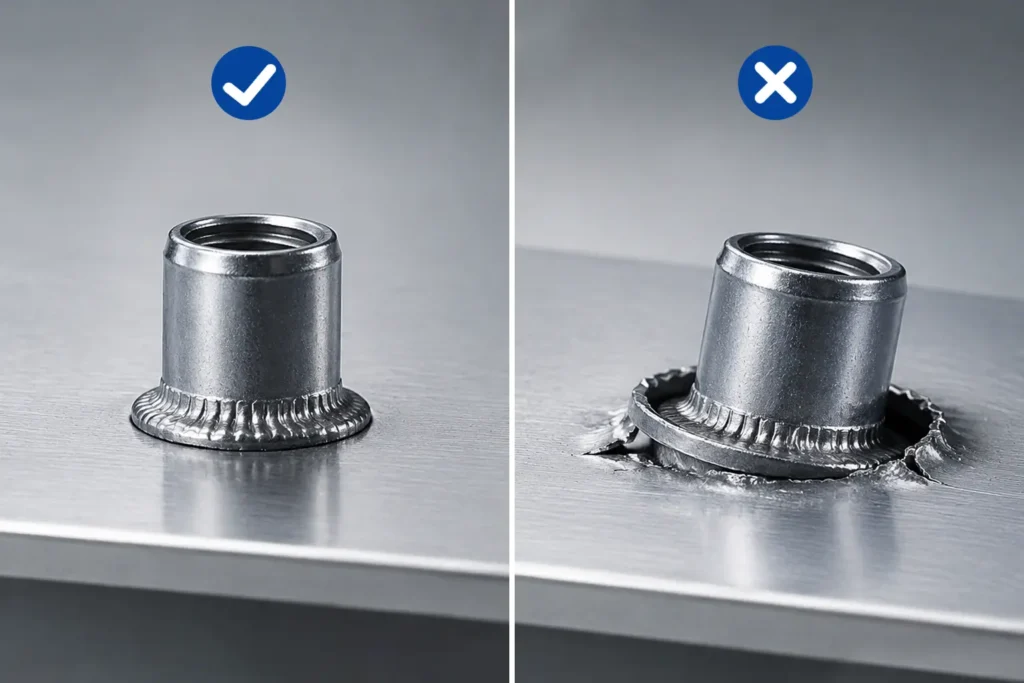
Most quality issues relating to the installation of rivet nuts are not caused by the quality of the product itself. Rather, they are influenced by a variety of other factors, including the grip range, hole size, anti-rotation requirements, clearance on the reverse side and the method of installation.
| Common Selection Failure | Why It Causes Problems | Better Alternative |
|---|---|---|
| Selecting Only by Thread Size | Rivet nuts with the same M6 or M8 thread size can have different grip ranges. | Determine the total grip thickness first, then select the required thread size within a suitable grip range. |
| Using a Rivet Nut Beyond Its Maximum Grip Range | The rivet nut may not form the intended blind-side deformation or clamp the material correctly. | Choose a rivet nut with a grip range that covers the actual material thickness, or consider a suitable wide-grip design. |
| Assuming a Longer Rivet Nut Fits Thicker Material | Overall length and grip range are different dimensions. | Check the manufacturer’s specified minimum and maximum grip range instead of judging by overall length. |
| Making the Installation Hole Larger | An oversized hole can reduce positioning accuracy and may weaken anti-rotation and joint performance. | Machine the hole according to the specified hole size and tolerance for the selected rivet nut. |
| Increasing Setting Force to Fix Spin-Out | Spin-out may be caused by hole size, body geometry, or insufficient anti-rotation features rather than low setting force. | Check the hole size first. If higher anti-rotation performance is required, consider a knurled or hex-body rivet nut. |
| Ignoring Blind-Side Clearance | The rivet nut needs enough space behind the material to form its blind-side bulge and installed projection. | Check the required blind-side projection and bulge diameter before selecting the rivet nut. |
| Using a Narrow Grip Range for Variable Thickness | Different material thicknesses may lead to under-setting or over-setting with the same installation setup. | Consider a wide-grip or multi-grip option that covers the full thickness range, then confirm it with sample installation. |
| Assuming Rivet Nuts Are Always Best for Thick Solid Material | Very thick solid material may already provide enough thickness for another threaded fastening method. | If the design allows, compare direct tapping or other fastening methods before deciding that a rivet nut is necessary. |
FAQs
How thick of material can a rivet nut go through?
The thickness of the sheet metal on which a rivet nut can be installed depends on the product’s grip range. There is no fixed thickness range that applies to all rivet nuts.
What happens if the material exceeds the grip range?
If the material thickness exceeds the clamping range of the rivet nut, the rivet nut may not deform sufficiently on the reverse side of the workpiece. This can result in insufficient clamping, a loose fit, or even rotation or dislodgement when subjected to load.
Can two sheets be included in one grip thickness?
Where the two layers of sheet metal are clamped together during installation using a rivet nut, the total thickness of the two layers may be counted as a single clamping thickness.
Are plus nuts stronger than standard rivet nuts?
In thin sheet metal, plastics and other softer materials, Plus Nuts offer higher pull-out resistance than standard rivet nuts. However, it cannot be stated that the overall joint strength of Plus Nuts is higher than that of standard rivet nuts.
Can rivet nuts be installed in thick solid plate?
Yes, that is possible. The following two conditions must be met. Firstly, the actual thickness of the metal plate must fall within the clamping range specified for the selected Rivet Nut model. Secondly, there must be sufficient space behind the mounting hole to accommodate deformation of the rivet nut body.
Does a longer rivet nut always provide more strength?
Not necessarily. A longer rivet nut body does not necessarily mean that its pull-out resistance, rotational resistance or thread strength are necessarily higher.
How much backside clearance does a rivet nut need?
There is no standard fixed value for the amount of space that needs to be allowed at the rear. The required clearance must be determined based on the body length of the rivet nut, its structural type, the thickness of the sheet metal, and the dimensions resulting from deformation after installation. The clearance provided must ensure that the rivet nut can deform fully at the rear.
When is a tapped hole better than a rivet nut?
If the sheet metal is of sufficient thickness and strength to allow the direct machining of internal threads that meet the connection requirements, then direct tapping (tapped hole) is simpler than using a rivet nut. This method is suitable for use with thicker solid metal sheets, machined parts and metal blocks.
Work with a IATF 16949 Certified Blind Rivet Manufacturer
Get High Quality Rivets Instead of Huck and Avdel Rivets

Rivmate Rivet
Rivmate is blind rivets manufacturers in china. The company is IATF 16949 certified and offers high-strength structural blind rivets that serve as alternatives to Huck and Avdel products.
Explore Rivmate Cases

Rivmate Rivet
Rivmate is blind rivets manufacturers in china. The company is IATF 16949 certified and offers high-strength structural blind rivets that serve as alternatives to Huck and Avdel products.

Hey There, I'm Allen!
I am the boss of Rivmate. For over two decades, we have specialized in the manufacture of blind rivets, providing our customers with reliable riveting solutions. Need riveting services? Feel free to contact us.