Rivet nuts are fasteners that allow internal threads to be machined into sheet metal. Installation can be completed with contact on just one side. Rivet nuts can be classified into various types based on their body shape, head structure, base configuration, thread size, and material.
Different types of rivet nuts vary in terms of anti-rotation capability, load-bearing capacity, sealing performance, and the range of sheet thicknesses they can accommodate. Next, I’ll guide you on how to correctly select the right type of rivet nut.
Table of Contents
What Are the Main Types of Rivet Nuts?
There are many types of rivet nuts. You can start by distinguishing them based on the two most obvious structural features: the head and the body. The head primarily determines how much the rivet nut will protrude from the surface of the sheet metal after installation and how much support area it provides. The body structure mainly affects anti-rotation capability, the shape of the mounting hole, and stability after riveting.
Types of Rivet Nuts by Head Style
1.Flat Head Rivet Nut
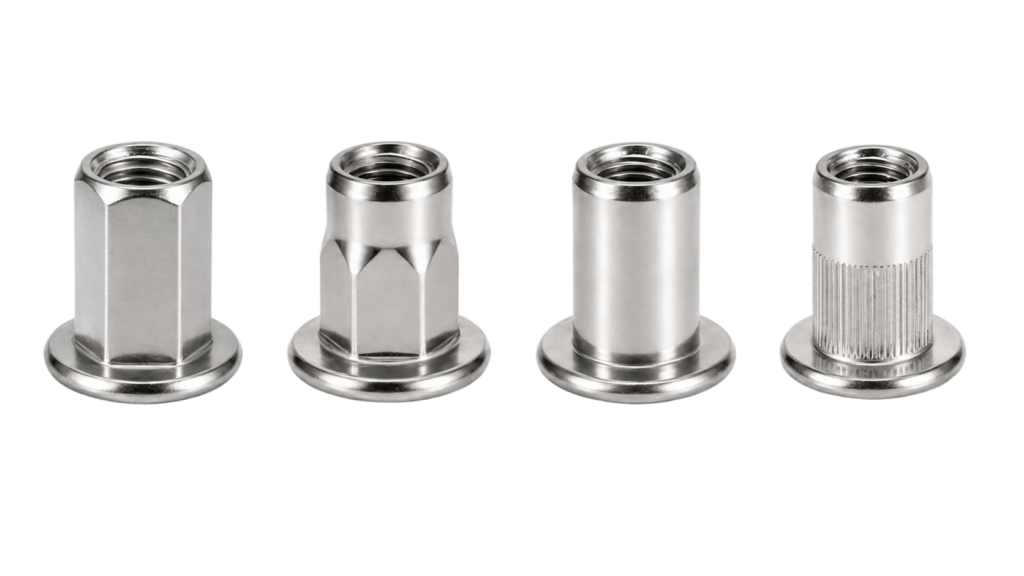
Flat-head rivet nuts are one of the most common types used in industrial assembly. The head features a distinct flange, and once installed, the head protrudes noticeably above the surface of the sheet metal.
The advantage of flat-head rivet nuts is that the head has a relatively large contact area with the sheet metal, providing good support.
Common Applications:
- Automotive components
- Electrical cabinets and control boxes
- Machinery enclosures
- HVAC equipment
- Metal furniture
- General sheet metal structures
2. Reduced Head Rivet Nut
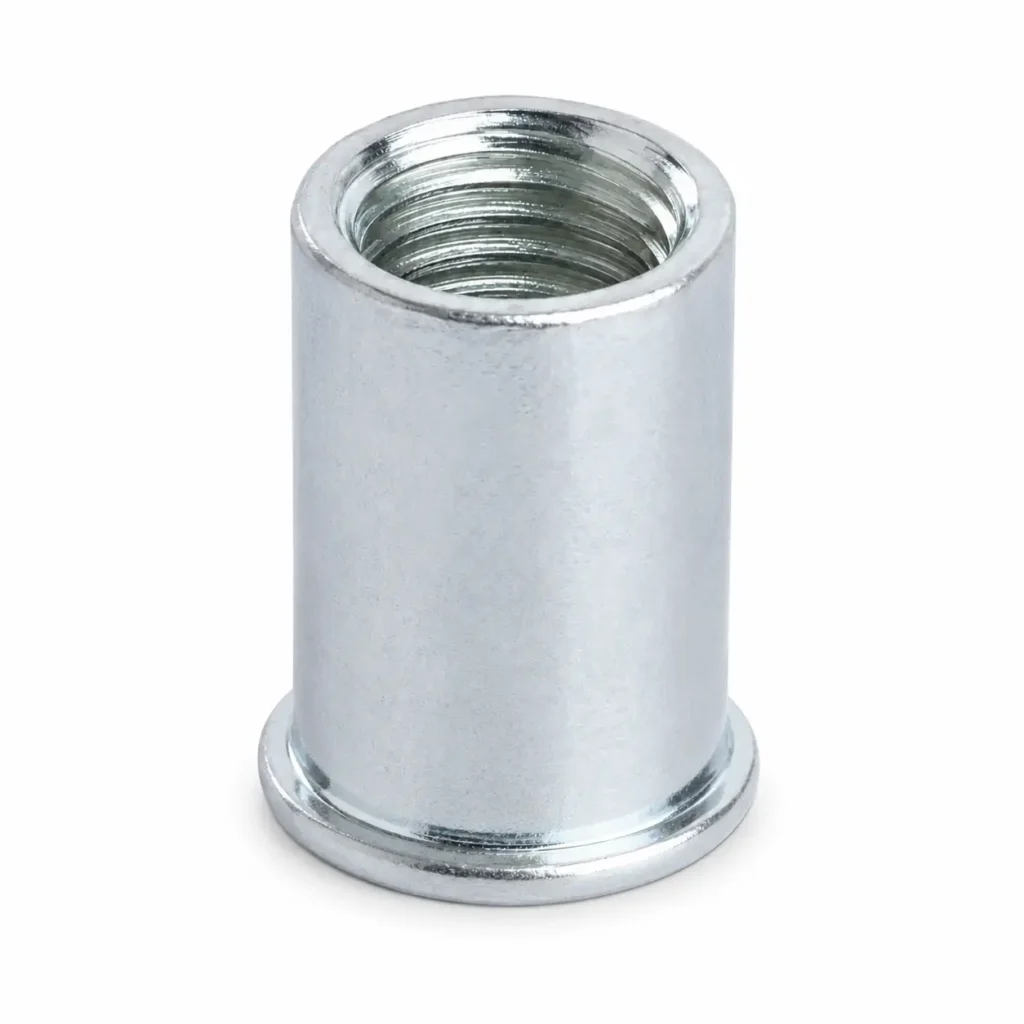
Compared to the Flat Head Rivet Nut, the Reduced Head Rivet Nut has a smaller flange. After installation, it occupies less space on the sheet metal surface.
The advantage of the Reduced Head Rivet Nut is that it does not take up too much space on the workpiece, making it more suitable for locations with limited installation space or where there are height requirements for the workpiece surface.
3. Countersunk Head Rivet Nut
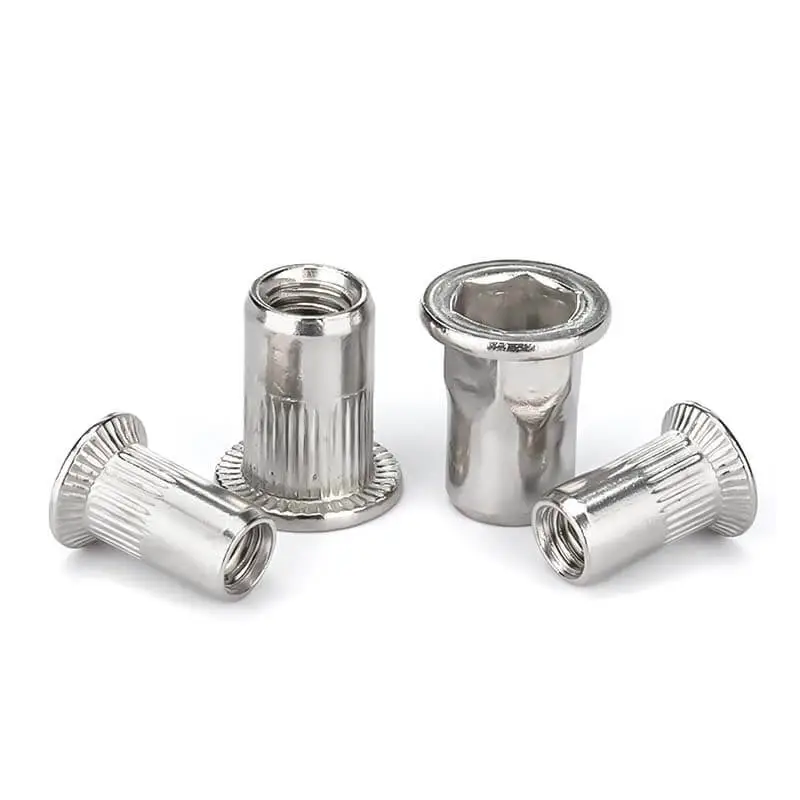
The head of a Countersunk Head Rivet Nut is tapered and requires a pre-machined countersunk hole. Once installed, the head of the rivet nut sits flush with the edge of the sheet metal.
The primary advantage of the Countersunk Head Rivet Nut is that it minimizes head protrusion. It is better suited for applications where additional components will be installed later or where high surface flatness is required.
It is important to note that when using a countersunk head rivet nut, the sheet metal must be machined with a properly sized countersunk hole. You must ensure that the angle and dimensions of the hole exactly match the specific rivet nut specifications. A hole that is too large, too small, or misaligned will result in rivet nut failure.
Types of Rivet Nuts by Body Style
1. Round Body Rivet Nut
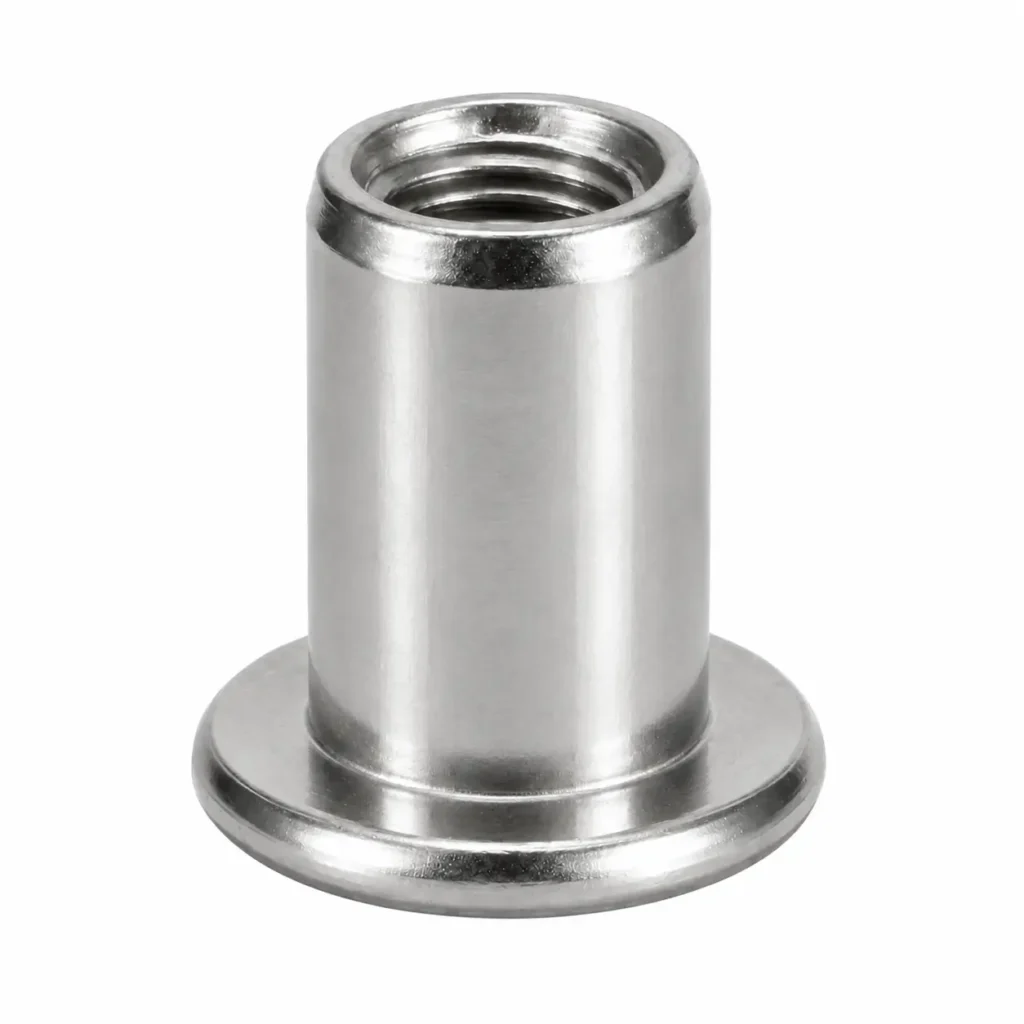
The Round Body Rivet Nut has a relatively simple structure. Its body is cylindrical. A key advantage of the Round Body Rivet Nut is that the mounting hole only requires machining as a standard round hole.
The Round Body Rivet Nut provides anti-rotation capability through the clamping force generated by riveting, as well as the friction and deformation between the rivet nut body and the hole wall.
Suitable Applications:
- General sheet metal connections
- Applications with low anti-rotation requirements
- Connection points requiring moderate assembly torque
2. Knurled Round Body Rivet Nut

The knurled round body rivet nut also features a cylindrical body, but differs in that its outer surface is knurled. The primary function of these grooves is to create a stronger mechanical interlock between the rivet nut and the sheet metal after installation, thereby enhancing slip resistance and anti-rotation capabilities. Round holes can still be used for installation.
Suitable Structures:
- Sheet metal joints requiring better anti-rotation capability
- Equipment subject to some vibration
- Locations where bolt installation torque is relatively high
3. Half Hex Body Rivet Nut
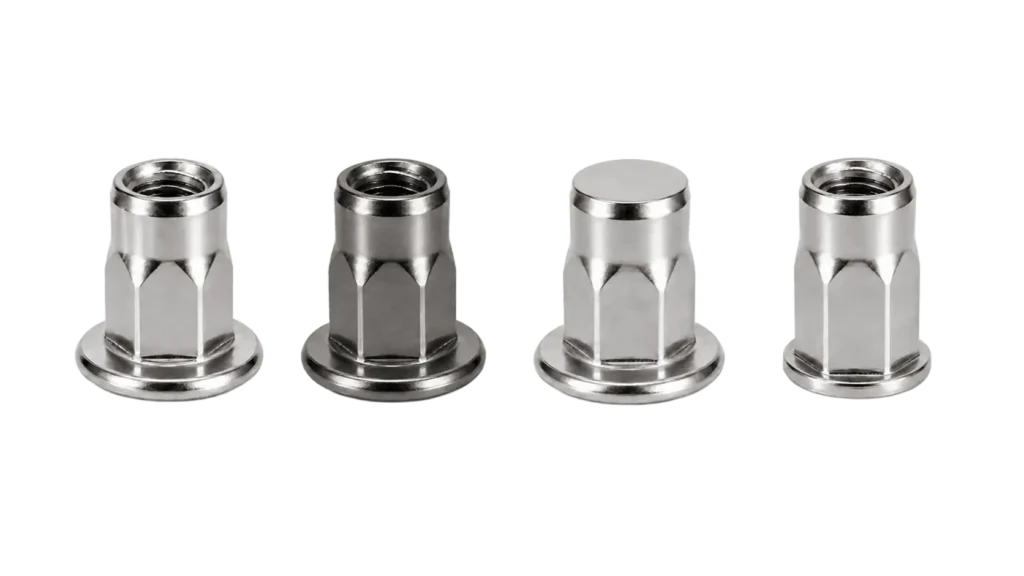
The body of a half-hex rivet nut is not entirely hexagonal; instead, only a portion of it features a hexagonal structure. During installation, it must be mated with a hole of corresponding shape.
Compared to the Round Body Rivet Nut, the Half Hex Body Rivet Nut provides better mechanical anti-rotation performance. This is because the hexagonal portion of the Half Hex Body Rivet Nut is constrained by the hole walls, preventing the rivet nut from rotating.
4. Full Hex Body Rivet Nut
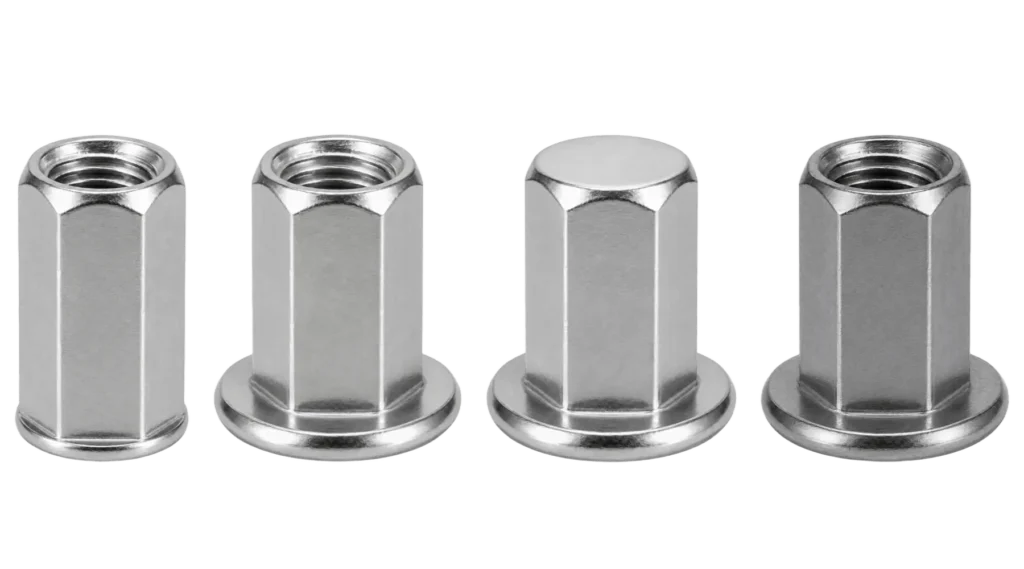
Compared to the Half Hex Body Rivet Nut, the main body of the Full Hex Body Rivet Nut is hexagonal. The installation hole requires more complex machining and must be installed in a matching hexagonal hole. Therefore, the Full Hex Body Rivet Nut offers superior anti-rotation performance.
In addition to relying on friction to prevent rotation, the Half Hex Body Rivet Nut is also constrained by its body structure. When the bolt is tightened, if the rivet nut attempts to rotate, it must overcome the mechanical restriction imposed by the hexagonal hole.
Suitable Applications:
- High installation torque
- Applications requiring frequent bolt removal and reinstallation
- Automotive components
- Industrial machinery
- Vibration-prone environments
- Applications sensitive to rivet nut slippage
Open-End vs Closed-End Rivet Nuts
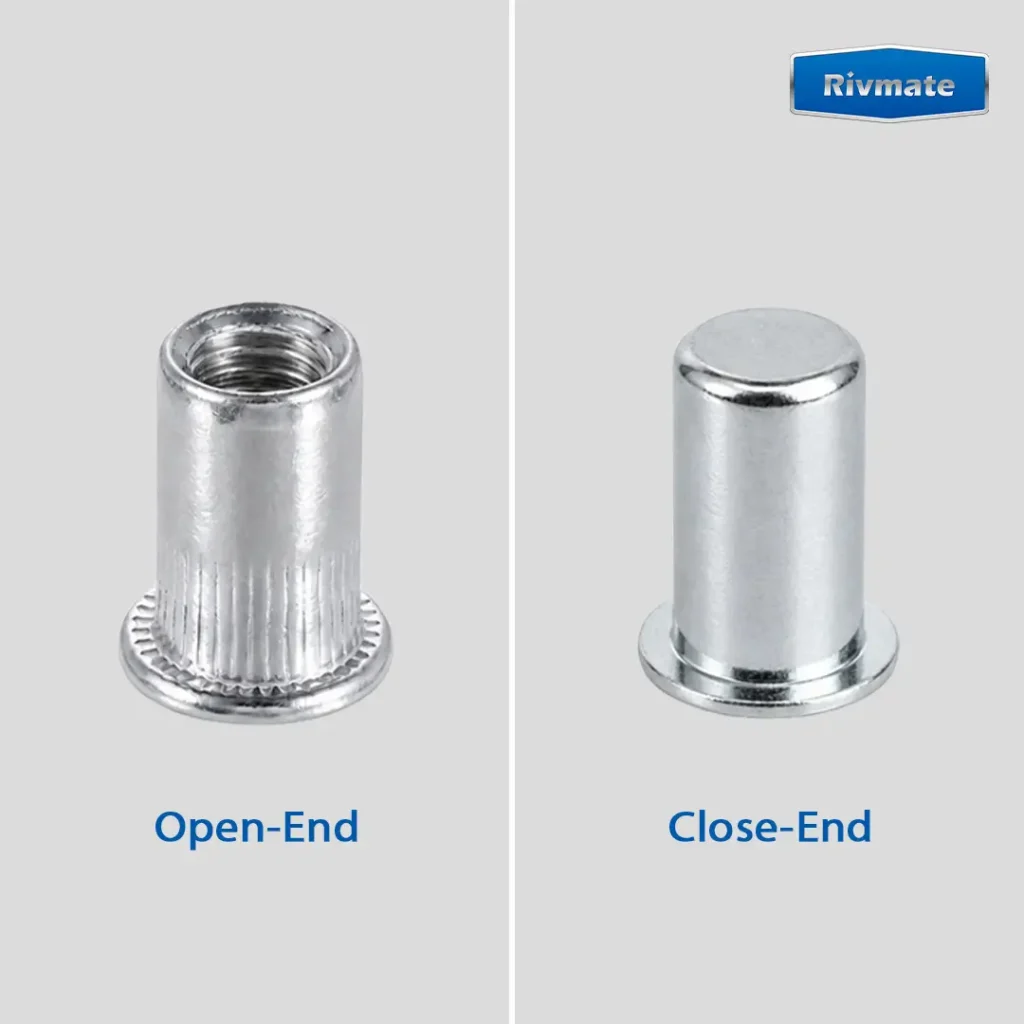
The main difference between open-end rivet nuts and closed-end rivet nuts is whether the bottom of the rivet nut is closed. Open-end rivet nuts have an open bottom, allowing the bolt to pass all the way through the rivet nut. In contrast, closed-end rivet nuts have a sealed bottom, so the bolt can only be screwed in to a certain depth.
| Comparison Item | Open-End Rivet Nut | Closed-End Rivet Nut |
|---|---|---|
| End Structure | Open and through-hole design | Closed at the end |
| Can the Bolt Pass Through the End? | Yes | No |
| Bolt Length Flexibility | Higher | Bolt engagement depth must be controlled |
| General Industrial Applications | Very common | Selected according to special requirements |
| Protection Against Direct Dust or Liquid Entry Through the End | Limited | Better |
| Protection of Internal Space | Standard | Better |
| Key Selection Considerations | Sheet thickness, hole size, Grip Range, and other standard parameters | In addition to standard parameters, confirm the usable internal thread depth and correct bolt length |
What Are Plusnuts, Jack Nuts, Well Nuts and Rivet Studs?
In addition to the common cylindrical, hexagonal, open, and closed rivet nuts, you’ll also find Plusnuts, Jack Nuts, Well Nuts, and Rivet Studs.
What they all have in common is that they can be installed from one side of the workpiece. The differences lie in how the back is formed after installation, whether the resulting thread is internal or external, and what materials they are compatible with.
Plusnut
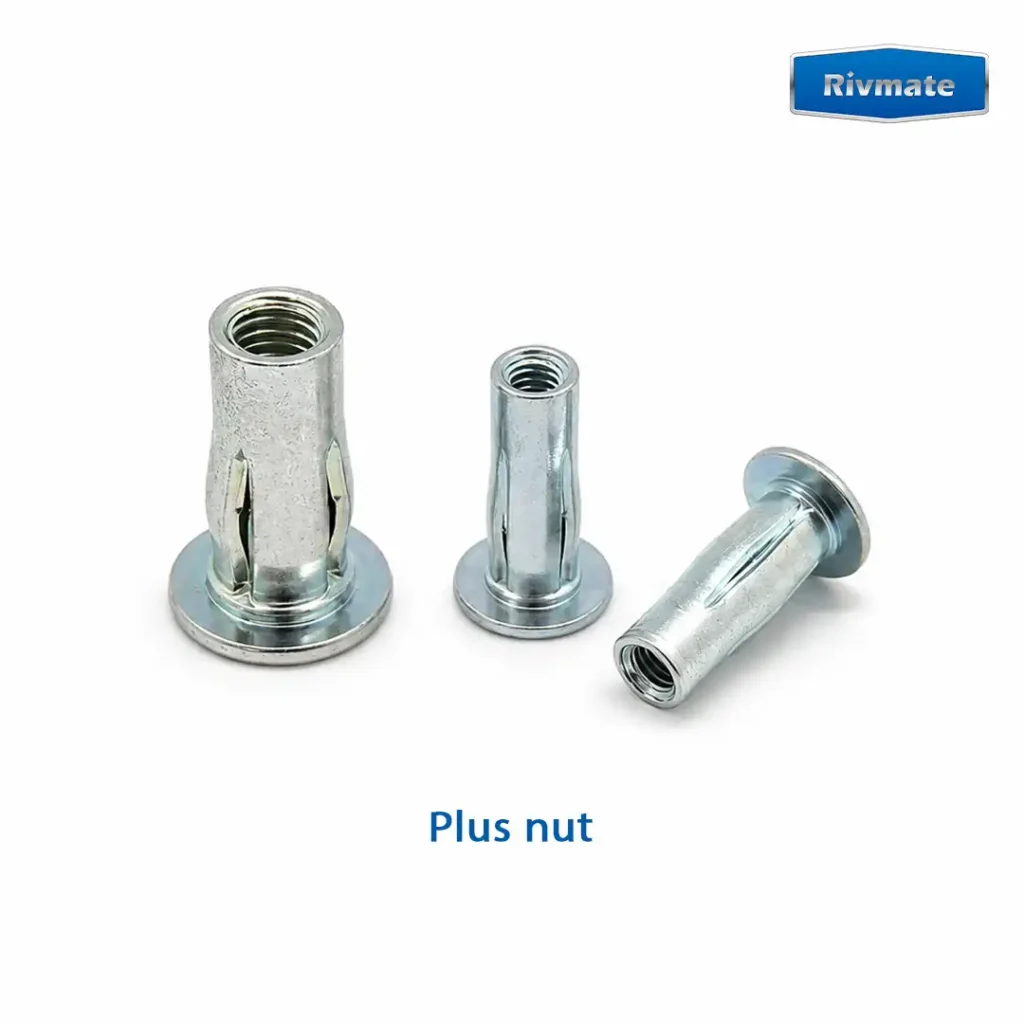
Plusnut is a special type of blind-mount threaded fastener. Its long, slotted body expands over a wide area on the back of the sheet material. It is particularly suitable for thin sheets and certain softer materials.
Jack Nut
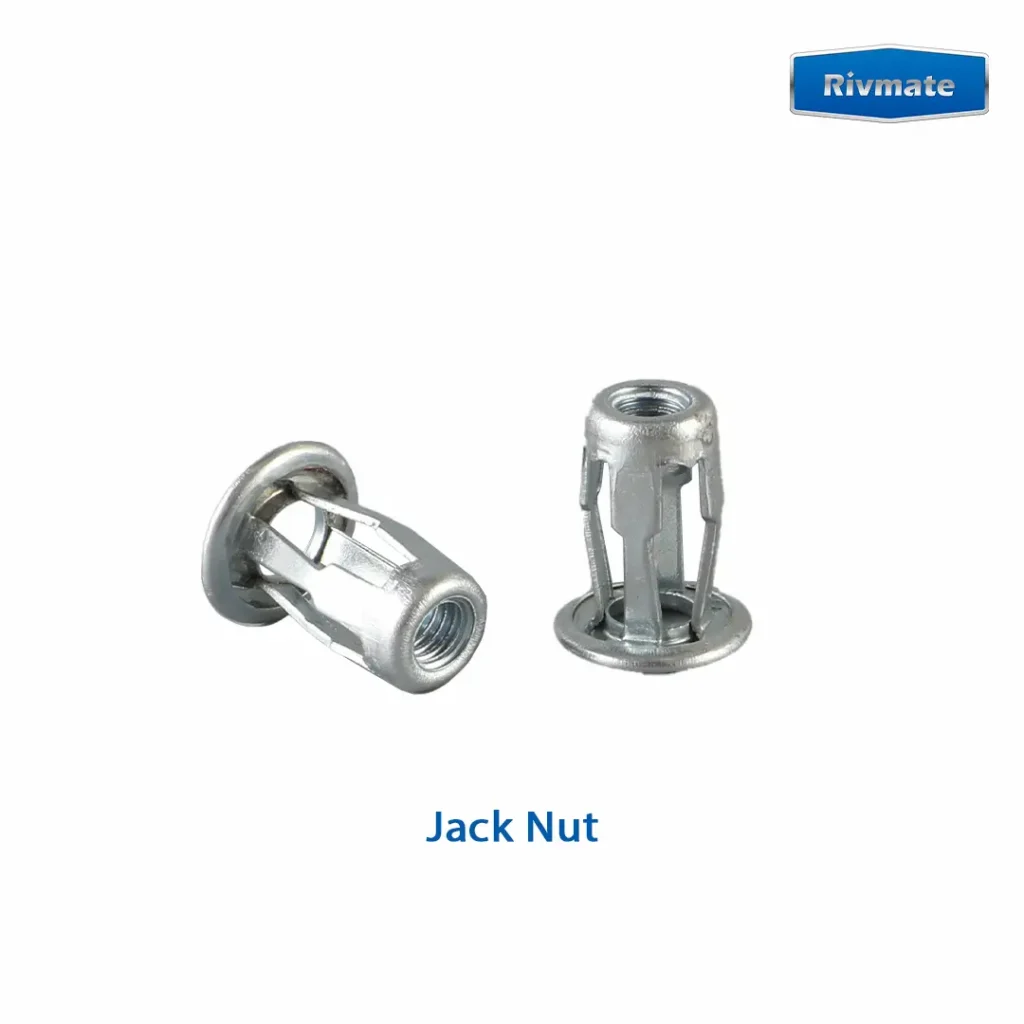
After installation, the Jack Nut’s multiple legs bend and spread outward on the back of the sheet material to clamp it in place, creating a large support area on the back of the sheet.If you’re unsure whether to use a Jack Nut or a standard rivet nut for your project, check out our comparison guide for Jack Nuts and rivet nuts. Learn about the differences between the two in terms of suitable sheet metal, load-bearing capacity, installation methods, and application scenarios to help you make the best choice based on your specific conditions.
Well Nut
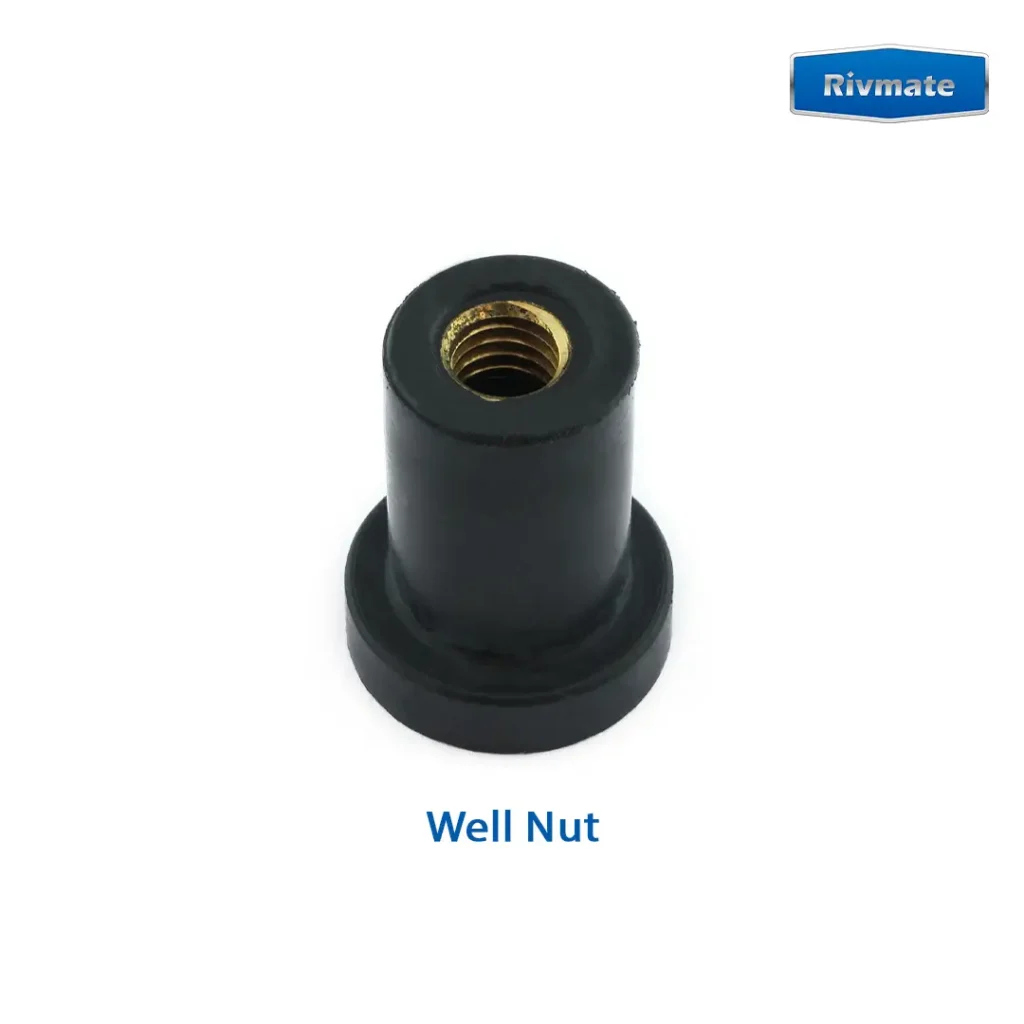
The Well Nut consists of a rubber or elastomer sleeve and an internal metal threaded insert. The rubber body works in conjunction with the internal threaded insert; when tightened, the rubber expands. It is primarily used for vibration damping, isolation, and, to a certain extent, sealing.
Rivet Stud
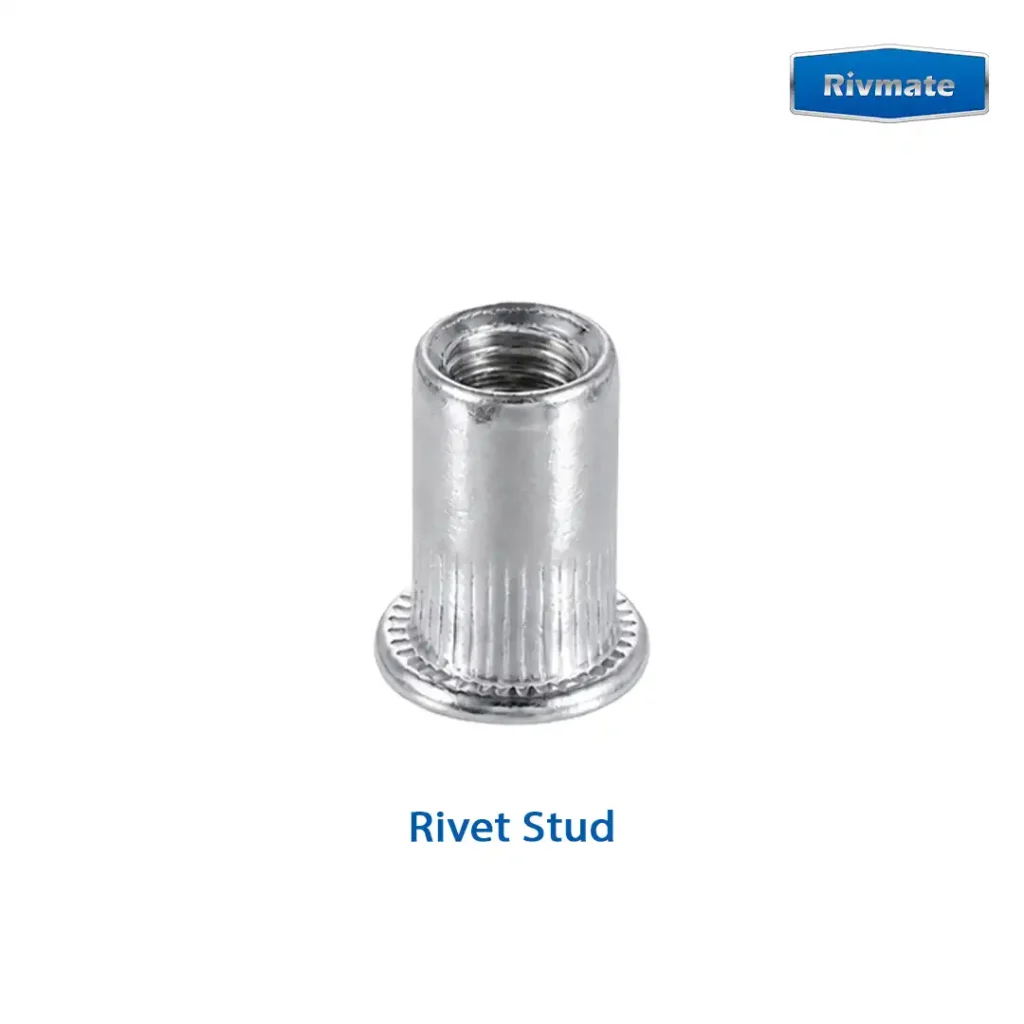
Unlike standard rivet nuts, which provide internal threads, the Rivet Stud provides an external threaded stud after installation. A part is then slipped over this stud and secured with a nut.
Plusnut vs Jack Nut vs Well Nut vs Rivet Stud
| Type | Installed Structure | Main Advantages | Best-Suited Applications |
|---|---|---|---|
| Plusnut | Slotted body expands over a large area behind the material | Large backside bearing area and better load distribution | Thin sheet metal, plastics, and composite materials |
| Jack Nut | Multiple legs expand behind the material | Suitable for thin-wall and relatively soft materials | Plastics, fiberglass, thin sheet metal, and hollow structures |
| Well Nut | Rubber body compresses and expands during installation | Vibration isolation, soft-material protection, and some sealing capability | Plastic housings, fiberglass, outdoor equipment, and vibration-sensitive parts |
| Rivet Stud | Leaves an external threaded stud after installation | One-side installation with a ready-to-use external thread | Brackets, electrical components, and assemblies requiring a threaded stud |
Steel, Stainless Steel or Aluminum Rivet Nuts?
Steel, stainless steel, and aluminum are all common materials used for rivet nuts, and each is suitable for different applications. The choice of rivet nut material depends on the load on the joined materials, the operating environment, the surface treatment, and the risk of corrosion resulting from contact between different metals.
① Steel Rivet Nuts
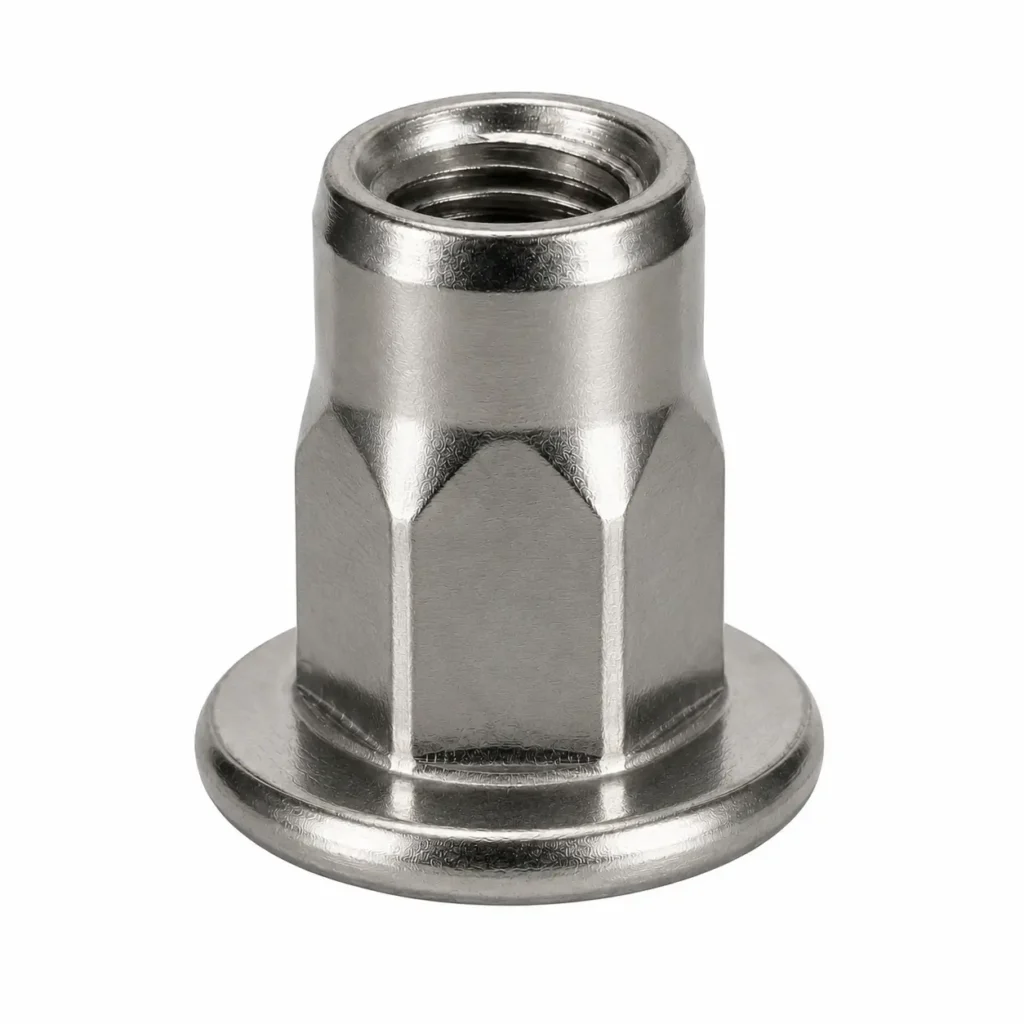
Steel rivet nuts offer high strength and can be paired with various corrosion-resistant surface treatments. They are particularly well-suited for industrial assembly applications.
Common Applications:
- Sheet metal enclosures
- Mechanical equipment
- Automotive components
- Electrical cabinets
Industrial brackets - HVAC equipment
- General steel structural components
Taking RIVMATE’s actual products as an example, many steel rivet nuts are paired with plating or other surface treatments to enhance corrosion resistance. For instance, the SFK1/4-20-42UNC rivet nut features a colored zinc coating for outdoor industrial connections.
② Stainless Steel Rivet Nuts
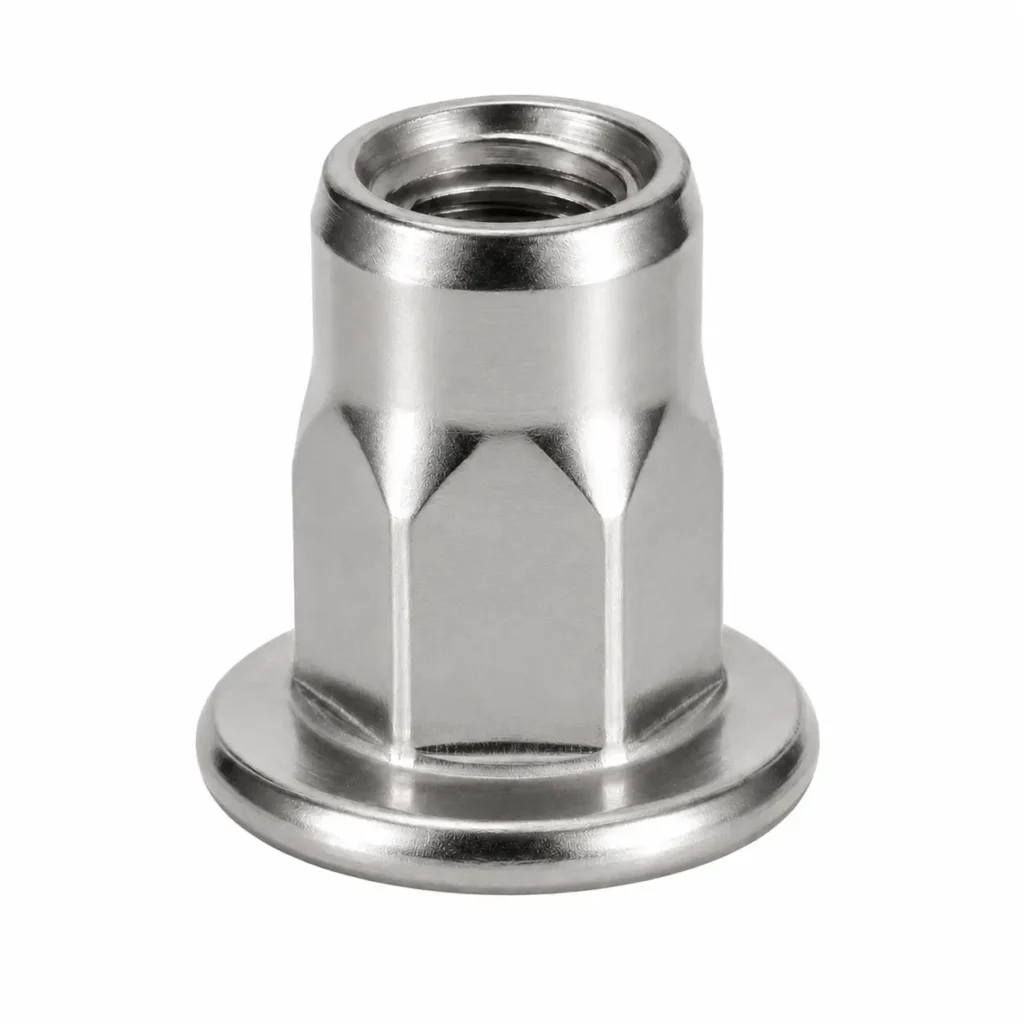
Stainless steel rivet nuts offer outstanding corrosion resistance, helping to extend product lifespan. They are better suited for outdoor, humid, and coastal environments.
Common Applications:
- Outdoor equipment
- Humid environments
- Components in food or sanitary equipment
- Coastal or high-salinity environments
- Chemical processing or equipment at risk of corrosion
- Structures requiring long-term, high-level rust protection
③Aluminum Rivet Nuts
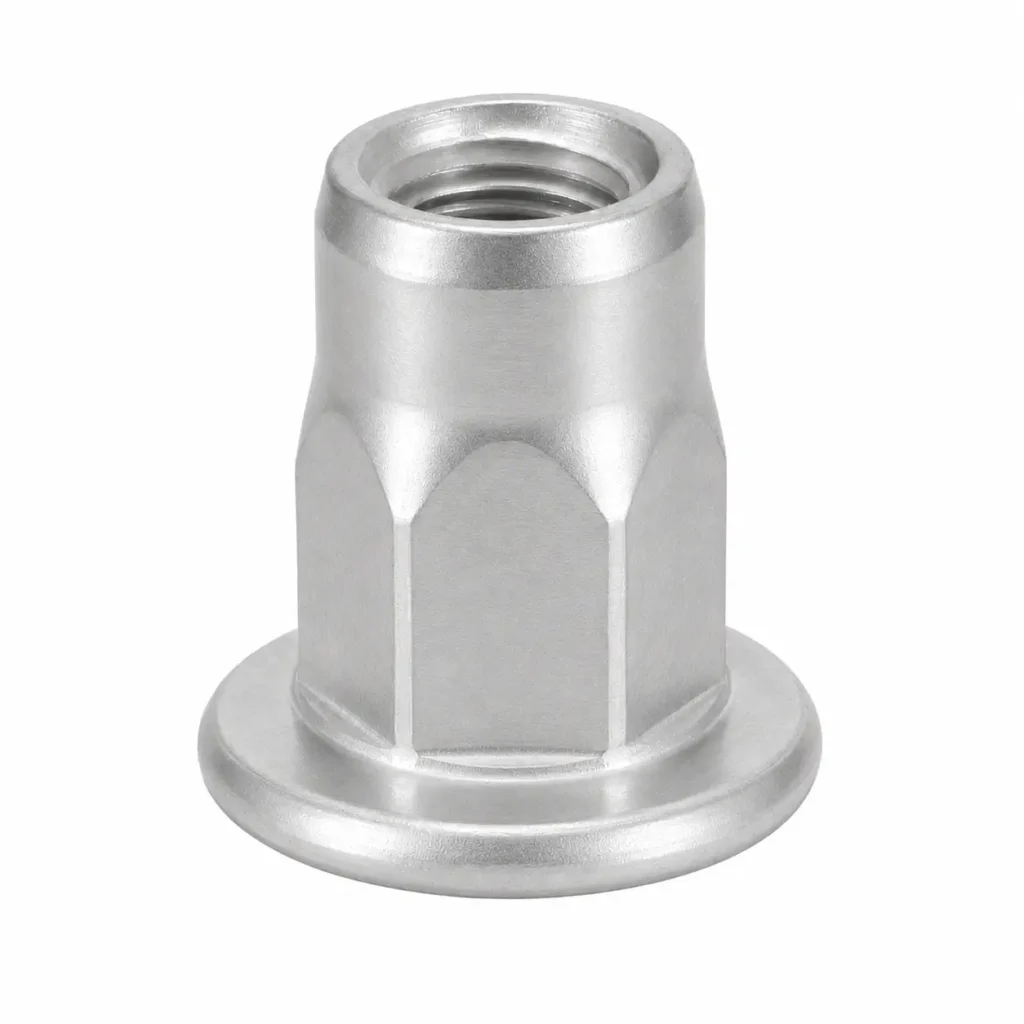
Aluminum rivet nuts offer the advantages of light weight and basic corrosion resistance. However, they are prone to deformation and are not suitable for high-load connections.
Common Applications:
- Aluminum alloy sheets
- Lightweight equipment
- Lightweight automotive structures
- Electronic device enclosures
- Certain transportation equipment
- Components where overall weight is a critical consideration
According to our technical team’s testing: If your connection point is subject to significant mechanical loads, torsional forces, or requires high thread load-bearing capacity, you should not use aluminum rivet nuts directly—even if the base material is aluminum.The material strength around the threaded area of aluminum rivet nuts is insufficient, which can easily lead to thread deformation or nut slippage.
How Do Thread Size and Grip Range Affect Selection?
Thread Size determines “what size bolt you should use.” Grip Range determines “whether a rivet nut of this size can be properly installed on your sheet metal thickness.” Both Thread Size and Grip Range are important factors in determining whether a rivet nut can be properly riveted.
Thread Size determines the bolt specification
Thread Size refers to the specification of the internal threads in the rivet nut. Common metric rivet nuts from Rivmate include M3, M4, M5, M6, M8, M10, and M12. For example, if you choose an M6 bolt, you must use the corresponding M6 rivet nut.
It is important to note that a larger thread size does not necessarily mean a better rivet nut. This is because larger thread sizes require larger bolts. The corresponding rivet nuts are also larger, thus requiring larger mounting holes and more installation space, which can impact the surrounding structural design.
Grip Range determines the bolt specification
Grip Range refers to the range of base material thicknesses that the rivet nut can be properly installed and clamped to.
One of the most common issues customers report during actual assembly is related to the grip range. If your material thickness is less than the specified grip range, the rivet nut may not be able to clamp the material correctly as intended, potentially leading to issues such as insufficient clamping, loosening, or reduced torsional resistance. If your sheet thickness exceeds the maximum grip range, the rivet nut may similarly fail to produce the correct riveting deformation, or even result in abnormal installation stroke or an inability to clamp the material sufficiently.
As a result, we frequently receive inquiries from customers who, although they have selected the correct rivet nuts, have overlooked the thickness tolerances of the sheet metal. Sheet metal with a nominal thickness of 1.0 millimeters may experience changes in actual thickness after undergoing coating or forming processes.
Rivet Nut Selection Matrix by Application
| Common Application | Recommended Rivet Nut | Why It Is Suitable | Key Factors to Confirm |
|---|---|---|---|
| Enclosures, Cabinets and General Sheet Metal | Steel + Flat Head + Knurled Round Body | Round holes are easy to produce, knurling helps improve spin resistance, and the flat head provides a larger bearing area. | Thread Size, Grip Range, Hole Size |
| Automotive Parts and Vibration-Prone Assemblies | Knurled Round, Half Hex or Full Hex | Higher vibration and tightening torque make rivet nut spin resistance more important. | Spin-Out Torque, Pull-Out, Vibration Testing |
| Industrial Machinery and Equipment Brackets | Steel + Knurled Body / Hex Body | These applications typically require good thread load capacity and resistance to rotation. | Load, Bolt Grade, Installation Torque |
| Outdoor Equipment and Humid Environments | Stainless Steel or Steel Rivet Nut with Suitable Corrosion Protection | Corrosion resistance becomes more important for long-term exposure to moisture and outdoor conditions. | Stainless Steel Grade, Coating, Corrosion Requirement, Galvanic Corrosion |
| Aluminum Enclosures and Lightweight Structures | Aluminum Rivet Nut, or Steel / Stainless Steel Based on Load Requirements | Aluminum rivet nuts are lightweight and can suit weight-sensitive designs. | Load, Base Material Combination, Galvanic Corrosion |
| Plastic, Fiberglass and Composite Materials | Plusnut, Jack Nut; Well Nut for Selected Applications | A larger backside support area or flexible structure can help reduce localized stress concentration. | Cracking, Crushing, Pull-Through, Actual Material Testing |
| Very Thin Sheet Metal with Pull-Through Risk | Large Flange Rivet Nut, Plusnut or Other Wide-Support Designs | A larger head or backside bearing area helps distribute load over a wider area. | Sheet Thickness, Pull-Out, Installation Deformation |
| Panels Requiring a Flush Surface | Countersunk Rivet Nut | Helps reduce the height of the rivet nut head above the workpiece surface. | Countersink Dimensions, Sheet Thickness, Head Dimensions |
| Outdoor Electrical Boxes, Closed Cavities or Dust-Sensitive Structures | Closed-End Rivet Nut | The closed end helps reduce direct entry of dust or liquid through the bottom of the rivet nut. | Sealing Design, Bolt Length, Usable Thread Depth |
| Equipment Requiring Frequent Disassembly or Higher Tightening Torque | Half Hex / Full Hex Rivet Nut | Stronger mechanical anti-rotation helps reduce the risk of the rivet nut spinning during repeated assembly and disassembly. | Spin-Out Torque, Thread Strength, Bolt Torque |
How to Choose a Rivet Nut in Seven Steps
- Step 1: Determine the material on which you will install the rivet nut.
- Step 2: Determine the rivet nut’s thread size based on the bolt.
- Step 3: Measure the thickness of all materials to be joined to determine the grip range.
- Step 4: Select the body style based on your anti-rotation requirements for the joint.
- Step 5: Select the head style based on the available installation space and surface finish requirements.
- Step 6: Select the material and base structure based on the load and environmental conditions of the joint.
- Step 7: Verify that the hole size and actual mechanical properties of the selected model meet the project requirements.
Common Rivet Nut Selection Mistakes
The proper installation of rivet nuts depends not only on the quality of the rivet nuts themselves but is also influenced by other factors. These include thread size, grip range, hole size, body style, installation tools, and riveting methods.
Please review the common rivet nut selection errors listed in the table to avoid issues such as loosening, slippage, pulling through, and installation difficulties after installation.
| Common Selection Mistake | Why It Causes Problems | Possible Problems | What You Should Do |
|---|---|---|---|
| Checking Thread Size but Ignoring Grip Range | M6, M8 and other sizes only define the thread specification. They do not tell you what material thickness the rivet nut can grip. | Insufficient clamping, looseness or incorrect deformation. | Confirm the thread size first, then make sure the Grip Range covers the actual material thickness and thickness tolerance. |
| Assuming a Larger Grip Range Is Always Better | Grip Range is the material thickness range the rivet nut is designed to grip correctly. A wider range is not automatically better. | Incorrect setting deformation or insufficient clamping. | Choose a Grip Range that matches your actual material thickness, rather than simply selecting the widest available range. |
| Ignoring Hole Size | Even with the same M6 thread, different Body Styles and product series may require different installation hole sizes. | Difficult insertion, excessive hole clearance or increased Spin-Out risk. | Check the Recommended Hole Size and hole tolerance in the data sheet for the exact rivet nut model. |
| Using a Smooth Round Body When High Spin Resistance Is Required | A smooth round body relies mainly on clamping force and friction to resist rotation. | The Rivet Nut may rotate together with the bolt during tightening. | For round holes, consider a Knurled Round Body. For higher anti-rotation requirements, evaluate Half Hex or Full Hex designs. |
| Assuming Hex Body Is Always Better | Hex Body designs provide better mechanical anti-rotation, but require a matching shaped hole. | More difficult hole preparation and higher manufacturing cost. | Select the body style according to the required Spin-Out Torque. Avoid unnecessary overdesign when high anti-rotation is not required. |
| Choosing Rivet Nut Material Only to Match the Base Material | The base material and rivet nut do not always need to be made from the same metal. | Insufficient strength or an unsuitable material combination. | Consider Base Material, Load, Corrosion, Bolt Material and Environment together. |
| Assuming Stainless Steel Is Always Better Than Steel | Stainless steel offers better corrosion resistance in many environments, but its cost, installation force and tool requirements are different. | Insufficient tool capacity, higher cost or unstable installation. | Select the material according to the corrosion environment and confirm the stainless steel grade and installation tool capability. |
| Using Standard Sheet-Metal Solutions in Plastic or Fiberglass | Soft materials are more sensitive to concentrated compression and localized stress. | Cracking, Crushing, Hole Enlargement or Pull-Through. | Evaluate Large Flange Rivet Nuts, Plusnuts, Jack Nuts or Well Nuts according to the material, and validate them with the actual workpiece. |
| Assuming a Closed-End Rivet Nut Is Waterproof | A Closed-End design only closes the bottom. Leakage paths may still exist around the head and installation hole. | Water or dust may still enter the equipment. | If waterproofing is required, design sealing around the head and hole and perform actual sealing tests. |
| Ignoring Bolt Length with a Closed-End Rivet Nut | A Closed-End Rivet Nut has limited internal depth and the bolt cannot pass through the bottom. | The bolt may bottom out before the component is properly clamped. | Confirm Usable Thread Depth, component thickness, washer thickness and Bolt Engagement Length. |
| Using a Flat Head When a Flush Surface Is Required | A Flat Head remains above the surface after installation. | Interference with mating components or an uneven surface profile. | Consider a Countersunk Rivet Nut and confirm the sheet thickness and countersink dimensions. |
| Selecting a Rivet Nut Only by Industry | Terms such as “automotive” or “machinery” do not define the actual joint requirements. | Different positions within the same industry may require completely different rivet nut designs. | Evaluate Base Material → Thickness → Load → Anti-Rotation → Environment before choosing the rivet nut. |
| Checking the Rivet Nut but Ignoring the Installation Tool | Different materials and sizes require different installation forces, strokes and tooling components. | Failure to install, under-setting or over-setting. | Confirm Tool Capacity, Pull Force, Stroke, Mandrel and Nosepiece compatibility. |
| Assuming More Installation Force Means a Stronger Joint | A Rivet Nut must form the correct designed deformation. It should not simply be installed with the highest possible force. | Thread damage, base material deformation or excessive compression. | Set the installation parameters according to the specific rivet nut and inspect the deformation after installation. |
| Judging High-Load Performance Only by M6, M8 or M10 Size | Thread Size is only one factor affecting the mechanical performance of the joint. | Actual Pull-Out or Spin-Out performance may fail to meet the requirement. | Check the specific model’s Pull-Out, Spin-Out Torque and Thread Strength. |
| Skipping Sample Validation Before Mass Production | Catalog data cannot fully represent your actual material, hole size and assembly conditions. | Looseness, spin-out or pull-through may appear after mass production begins. | Validate the joint using the actual workpiece + actual hole + actual Rivet Nut + actual installation tool. |
Frequently Asked Questions About Rivet Nut Types
Which Rivet Nut Has the Best Spin Resistance?
Full Hex Body Rivet Nuts offer the best resistance to rotation. Next, consider Half Hex Body Rivet Nuts.
When Is a Closed-End Rivet Nut Required?
Use a closed-end rivet nut when the connection does not require bolts to protrude from the bottom of the rivet nut. Consider using a closed-end rivet nut to minimize the entry of external liquids and dust into the structure through the bottom of the rivet nut.
Which Flange Works Best in Thin Sheet?
For thin sheets, especially if the material itself is relatively soft, give priority to Large Flange Rivet Nuts. These increase the contact area between the rivet nut and the sheet, helping to distribute localized concentrated loads. If the product requires a flush surface after installation, we recommend selecting a Countersunk Rivet Nut. If there are space constraints for installation, consider using a Reduced Head rivet nut.
Work with a IATF 16949 Certified Blind Rivet Manufacturer
Get High Quality Rivets Instead of Huck and Avdel Rivets

Rivmate Rivet
Rivmate is blind rivets manufacturers in china. The company is IATF 16949 certified and offers high-strength structural blind rivets that serve as alternatives to Huck and Avdel products.
Explore Rivmate Cases
Rivmate Rivet
Rivmate is blind rivets manufacturers in china. The company is IATF 16949 certified and offers high-strength structural blind rivets that serve as alternatives to Huck and Avdel products.

Hey There, I'm Allen!
I am the boss of Rivmate. For over two decades, we have specialized in the manufacture of blind rivets, providing our customers with reliable riveting solutions. Need riveting services? Feel free to contact us.