Whether a jack nut or a rivet nut is better suited for your project depends on the specific application. Jack Nuts are better suited for thin sheets, plastics, and certain softer materials. Once installed, a Jack Nut forms outward-expanding support legs to distribute pressure across the back of the material. Rivet Nuts are better suited for thin metal sheets and industrial applications requiring higher connection strength.
Below, I’ll provide a detailed comparison of Jack Nuts and Rivet Nuts to help you understand their differences in structure, installation methods, load-bearing capacity, and suitable applications. The goal is to help you select the right fastener for your project.
Table of Contents
Jack Nut vs Rivet Nut: The Key Difference
The key difference between a Jack Nut and a Rivet Nut lies in their operating principles. A Jack Nut distributes pressure on the back side by expanding its support legs. In contrast, a standard Rivet Nut primarily clamps the sheet metal through localized deformation of its body.
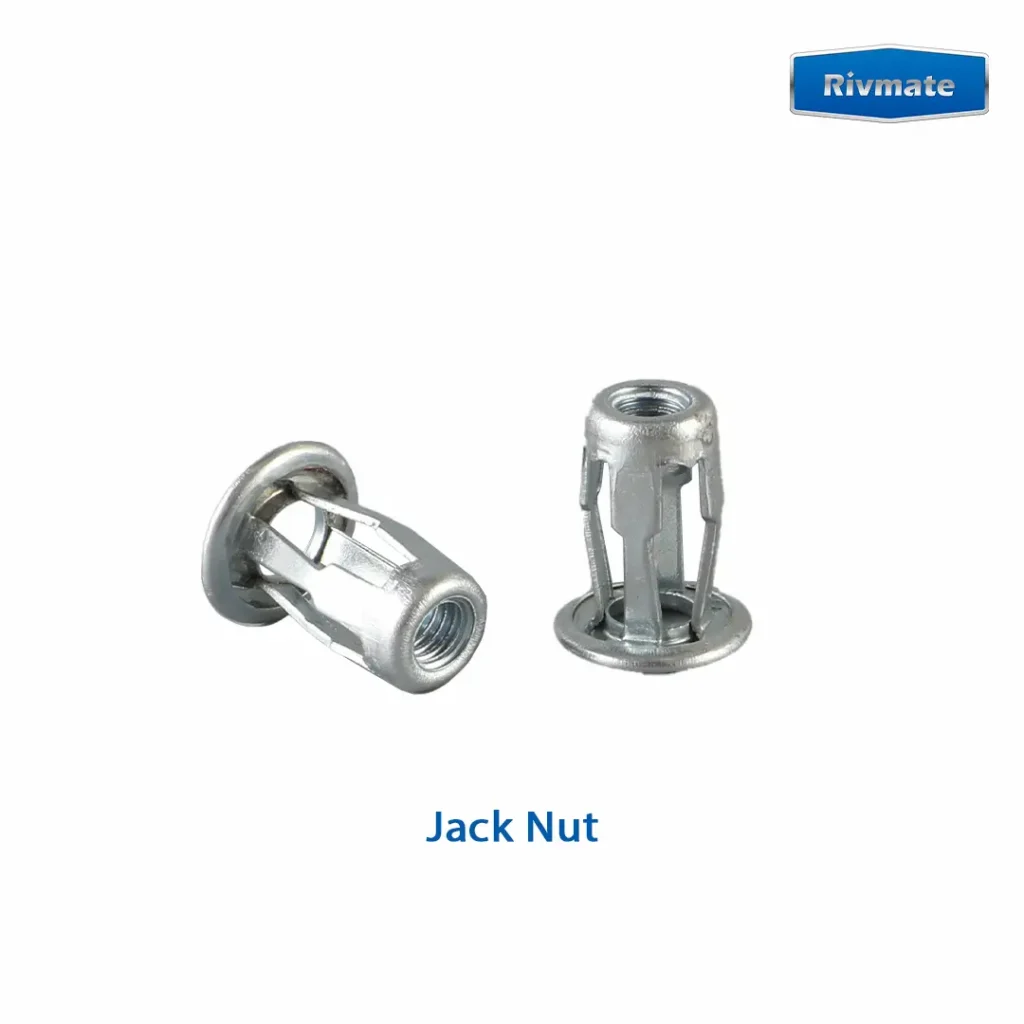
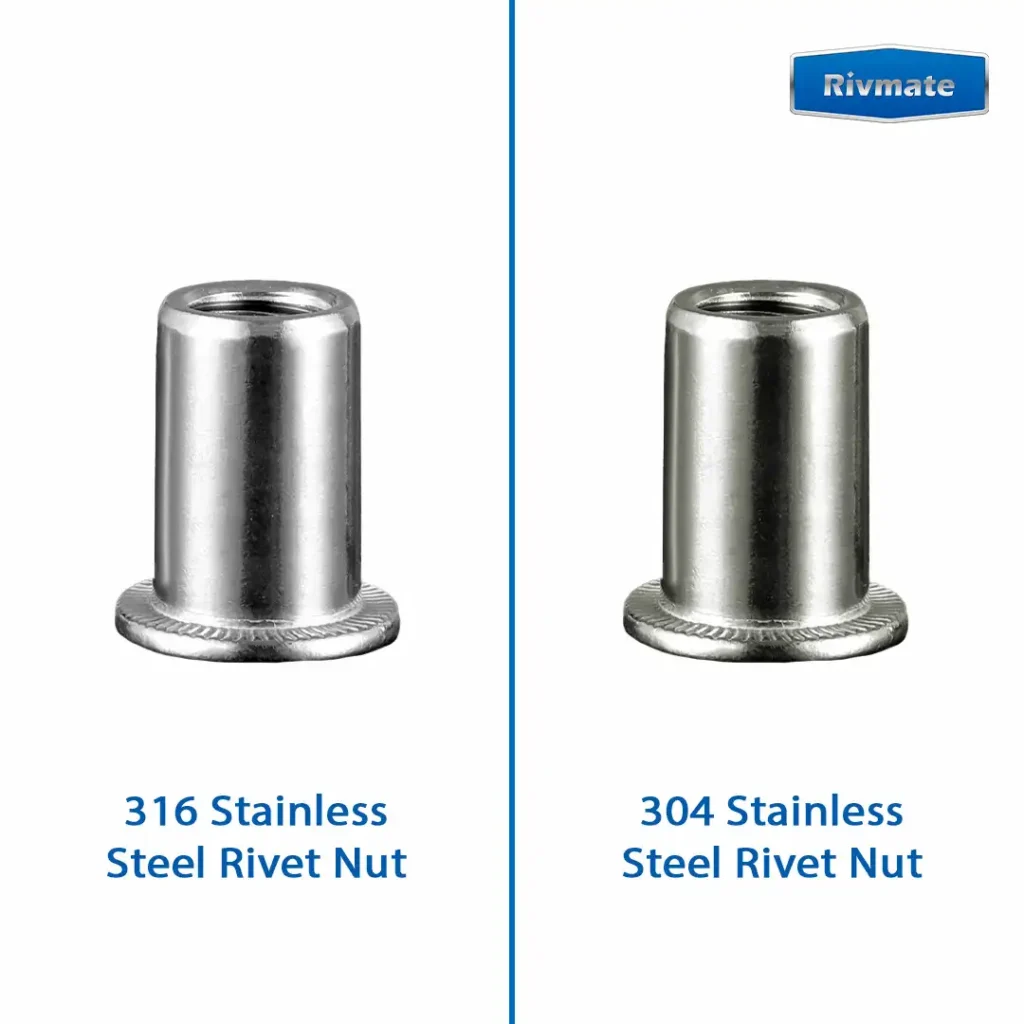
The Jack Nut is characterized by its ability to distribute pressure. The body features four longitudinal slots; during installation, these slots expand outward to form four support legs on the back of the sheet metal. This helps distribute the clamping force over a larger contact area, thereby reducing localized pressure.
A standard rivet nut is characterized by the formation of a compact, stable clamping connection. After the internal threads are drawn in by an installation tool, the nut body undergoes plastic deformation on the back of the sheet metal, forming a raised clamping section. This secures the sheet metal between the nut head and the deformed area.
| Comparison | Jack Nut | Standard Rivet Nut |
|---|---|---|
| Body Structure | Slotted tubular body designed to expand into multiple supporting legs. | Available with round, knurled, or hexagonal bodies. |
| Installed Shape | Expands outward to form supporting legs behind the material. | Compresses locally to form a bulge behind the material. |
| Load Distribution | Distributes clamping pressure across the expanded supporting area. | Clamps the material between the head and the deformed body. |
| Suitable Materials | Plastic panels, thin sheets, and certain composite materials. | Metal sheets, certain rigid plastics, and composite materials. |
| Common Applications | Plastic panels, lightweight furniture, and decorative components. | Automotive components, metal enclosures, and industrial equipment. |
| Key Selection Factors | Material compression resistance and rear-side support area. | Grip range, torque-to-turn resistance, and pull-out strength. |
How Jack Nuts and Rivet Nuts Form Their Grip
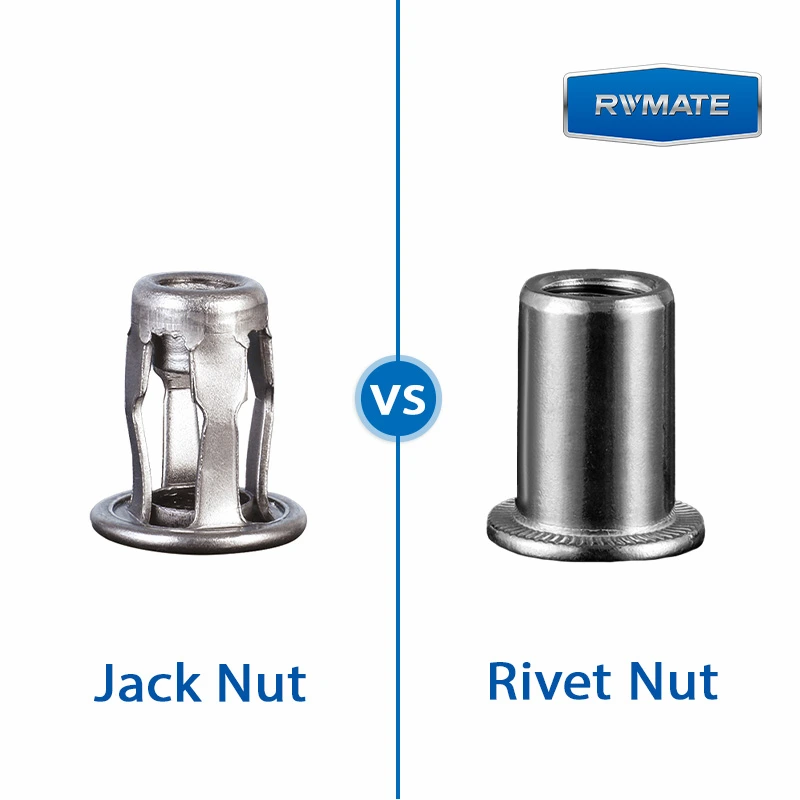
Both Jack Nuts and Rivet Nuts can be installed from one side of the sheet metal. Once installed, they both create a reliable internal threaded connection in the material. The difference lies in how they are secured to the sheet metal.
Jack Nuts create a clamping force through outward-spreading support legs. Standard Rivet Nuts create a clamping force through localized compression and expansion of the body.
Suitable Parent Materials for Each Fastener
Both Jack Nuts and standard rivet nuts are single-sided threaded fasteners. However, they differ in their suitability for base materials. Jack Nuts are better suited for soft, brittle, or easily locally crushed materials. Standard rivet nuts are better suited for thin metal sheets and structures requiring a more stable threaded connection.
For which materials are Jack Nuts more suitable?
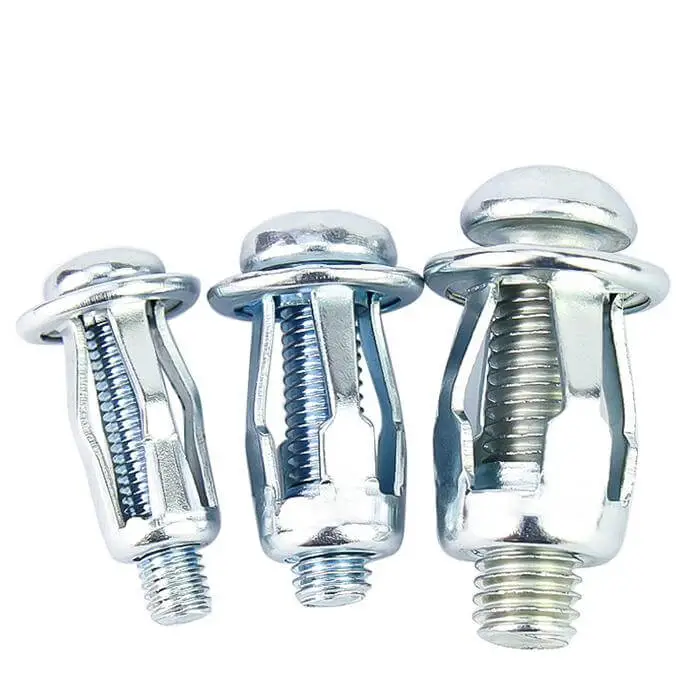
The advantage of the Jack Nut is that, once installed, it expands on the back side of the sheet material to form multiple support legs. This distributes concentrated loads and helps prevent localized indentation, cracking, or material tear-through caused by standard fasteners. Therefore, the Jack Nut is well-suited for plastics, fiberglass, certain composite materials, and other relatively soft, thin-walled materials.
For which materials are standard rivet nuts more suitable?
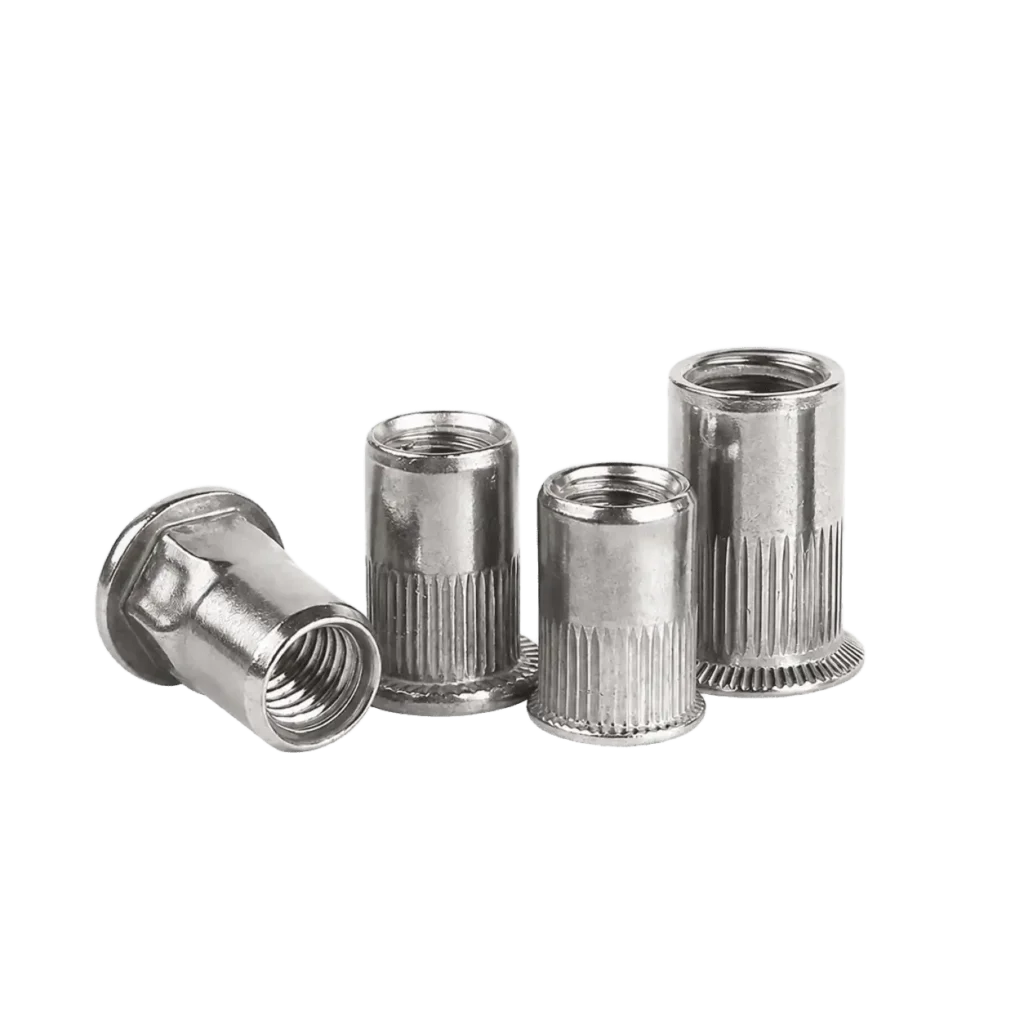
The main advantage of rivet nuts is their ability to create a permanently fixed internal thread in relatively thin materials. They are widely used in automotive sheet metal, enclosures, electrical cabinets, equipment housings, and general metal fabrication. Therefore, they are more suitable for steel sheets, stainless steel sheets, aluminum sheets, and other thin metal sheets.
Load Capacity, Pull-Out Resistance, and Vibration
When comparing Jack Nuts to standard rivet nuts, Jack Nuts place greater emphasis on distributing the load over a larger area of the base material, while standard rivet nuts focus more on creating a compact, stable mechanical clamping action. As a result, their performance can vary significantly depending on the material and the applied load conditions.
Load-bearing Capacity
Load-bearing capacity refers to the amount of working load a fastening point can withstand during actual use. If you are fastening lightweight components with a relatively soft base material, the Jack Nut is worth considering. If you are installing brackets, equipment, or other parts requiring a stable threaded connection on thin metal sheets, a standard rivet nut is typically more suitable.
Pull-Out Resistance
Pull-out resistance refers to a fastener’s ability to resist being pulled out of the base material when an external force pulls outward along the bolt’s axis.
The Jack Nut distributes the tensile force over a larger rear surface area via its expanded support legs. For plastics, fiberglass, or other relatively soft or brittle materials, this reduces the risk of the material being torn through near the mounting hole.
The pull-out resistance of a standard rivet nut depends on its expanded backing structure, the strength of the base material, the plate thickness, and the quality of installation. When installed in steel or hard aluminum plates, and provided the hole diameter, clamping range, and installation stroke are correct, it can form a very stable connection.
Vibration Resistance
Jack Nuts can be used in applications subject to some vibration, but their primary advantage lies in load distribution; they are not designed to provide high rotational resistance.
When installed correctly, standard rivet nuts form a stable mechanical clamping structure within the sheet metal. If higher rotational resistance is required, rivet nuts with knurled, hexagonal, or square body profiles can be selected to help prevent the rivet nut from rotating with the bolt inside the mounting hole.
Grip Range and Hole Requirements
When comparing Jack Nuts and standard Rivet Nuts, the grip range and hole requirements are the two most critical factors affecting installation quality. Even if you select the correct thread size, the rivet nut may become loose, rotate, or deform abnormally after installation if the sheet thickness and mounting hole dimensions are incorrect.
Grip Range
The grip range refers to the range of thicknesses for all connecting materials that the fastener can properly clamp. Whether you choose a Jack Nut or a Rivet Nut, you must select a specification that matches the appropriate sheet thickness range. Only when the sheet thickness falls within this range can the fastener undergo sufficient deformation after installation to provide a stable clamping force.
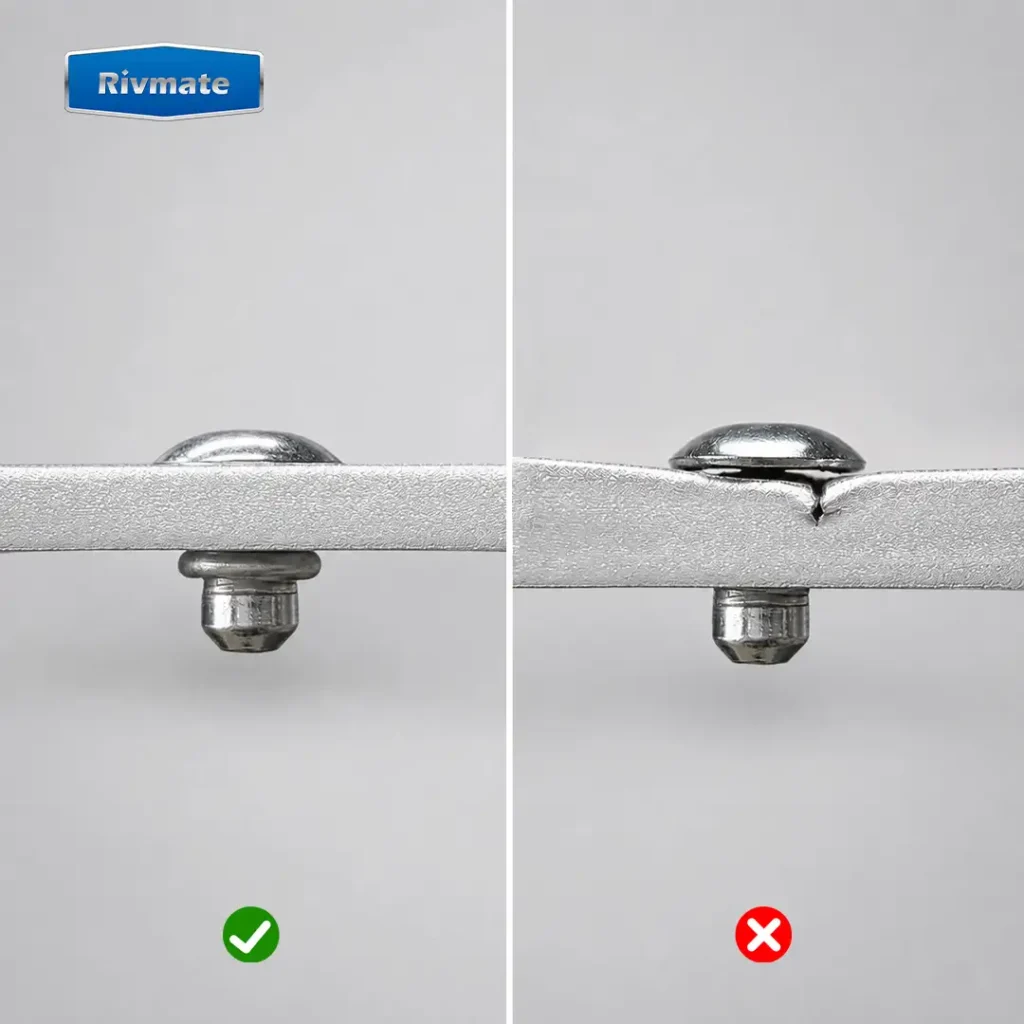
For a Jack Nut, the slotted portion of the body expands outward during installation, forming support legs on the back of the sheet. Therefore, the sheet thickness must match this expansion position. If the selected sheet is too thin, the support legs may fail to provide a stable clamping force. If the sheet metal is too thick, the support legs cannot fully expand into the correct position.
Standard rivet nuts have specific requirements for the grip range. When a rivet nut is installed, it creates a bulge on the back of the sheet metal. If the sheet metal exceeds the product’s specified grip range, the body may not compress sufficiently. If the sheet metal is significantly thinner than the applicable range, excessive deformation or insufficient clamping may occur.
Why are mounting holes so important?
The size of the mounting hole not only determines whether the fastener can be inserted, but also directly affects the stability and resistance to rotation after installation.
If the hole is too small, the Jack Nut or Rivet Nut may not fit properly, and forcing it into place during installation can damage the surface plating, the hole edges, or the fastener itself. If the hole is too large, the gap between the fastener and the hole wall will increase. This not only makes misalignment during installation more likely but may also cause the rivet nut to rotate along with the bolt during subsequent tightening. Therefore, the mounting hole must be determined according to the specific product specifications.
Installation Tools and Process Compared
Because Jack Nuts and Rivet Nuts use different clamping methods, there are differences in the installation tools and procedures.
Jack Nut Installation Process
Jack Nuts are installed using a dedicated Jack Nut installation tool. Depending on the product size and quantity, you can choose between a manual tool, a threaded riveting tool, or a pneumatic tool.
The installation process can be divided into the following three steps:
- Step 1: You need to machine the mounting holes according to the product specifications.
- Step 2: Insert the Jack Nut into the mounting hole so that its head lies flush against the material surface. The main body of the Jack Nut is located on the back of the material, and its internal threads are used to connect to the installation tool.
- Step 3: Use the installation tool to pull on the Jack Nut’s internal threads, causing the main body to compress axially.As the main body shortens, the slotted areas expand outward, forming multiple support legs. Ensure that the support legs expand properly and lie flush against the back of the material, working together with the head on the front to clamp the material securely.
Rivet Nut Installation Process
The installation method for rivet nuts is similar to that of jack nuts, both require a tool to apply axial tension. However, the resulting deformation differs after tension is applied.
Three types of specialized tools are commonly used for rivet nuts:
- Hand Rivet Nut Tool
- Pneumatic Rivet Nut Tool
- Electric or Battery-Powered Rivet Nut Tool
The installation steps for the Rivet Nut are divided into the following three parts:
- Step 1: Machine a mounting hole that matches the rivet nut’s specifications.
- Step 2: Insert the rivet nut into the mounting hole so that the flange or head lies flush against the material surface.
- Step 3: Use the installation tool to pull the rivet nut through the threaded mandrel.
As the axial tensile force increases, the thin-walled area of the rivet nut begins to undergo plastic deformation, forming a bulge on the back side of the material. The sheet metal is then clamped by the rivet nut head and the deformed area on the back side, creating a stable threaded mounting point.
| Comparison | Jack Nut | Rivet Nut |
|---|---|---|
| Installation Tools | Dedicated Jack Nut tools or suitable threaded mandrel tools. | Manual, pneumatic, electric, or battery-powered rivet nut tools. |
| Deformation Method | The slotted body expands outward to form supporting legs behind the material. | The body compresses and forms a bulged clamping area behind the sheet. |
| Installation Focus | Ensure the supporting legs expand completely and contact the backside properly. | Control the deformation amount to achieve proper clamping force. |
| Main Installation Risks | Insufficient backside space may prevent the legs from expanding correctly. | Over-deformation or insufficient deformation may affect connection reliability. |
| Common Applications | Plastic panels, composite materials, and soft thin sheets. | Metal sheets, industrial equipment, automotive components, and general sheet metal assembly. |
Removal, Replacement, and Serviceability
In actual procurement, fasteners must not only ensure reliable installation but also take into account the ease of subsequent removal, replacement, and maintenance. Both Jack Nuts and Rivet Nuts provide removable threaded connections. Rivet Nuts are designed for industrial connections requiring long-term maintenance, while Jack Nuts are better suited for threaded connections that protect soft materials.
Advantages of Rivet Nut Removal and Maintenance
Once installed, a rivet nut provides a stable internal threaded connection. The rivet nut body is securely fastened to the sheet metal. The internal threads accommodate a bolt, allowing for repeated disassembly. This type of fastening is necessary for maintenance, part replacement, or periodic inspections.
Therefore, a rivet nut is essentially a one-sided internal threaded fastener that creates a removable connection even when the back side is inaccessible.
Common Applications:
- Equipment maintenance access panels
- Automotive interior components
- Industrial equipment enclosures
- Mechanical protective covers
Common characteristics of the above applications:
- Disassembly for inspection
- Replacement of internal parts
- Reinstallation of the enclosure
Advantages ofJack Nut Removal and Maintenance
Jack Nut also offers removable threads. The primary advantage of Jack Nut is not frequent assembly and disassembly, but rather providing a stable connection in softer materials.
Once installed, the support legs on the back of the Jack Nut extend and clamp the material. Therefore, under normal circumstances:
- The bolt can be removed
- External parts can be replaced
- The threads can be reused
However, if the base material into which the Jack Nut is installed is relatively soft—such as plastic or composite materials—repeated exposure to significant assembly and disassembly forces may lead to issues such as enlarged mounting holes, material fatigue, or loosening of the Jack Nut.
Consequently, the Jack Nut is better suited for occasional maintenance, light-to-medium loads, and connections involving non-metallic materials. It is not suitable for industrial maintenance scenarios involving frequent and extensive assembly and disassembly.
Cost and Production-Volume Considerations
When selecting Jack Nuts and Rivet Nuts, cost and production volume are also very important factors to consider. They indirectly affect the total cost of the entire production process. The actual cost of a project depends not only on the unit price of individual fasteners but also includes:
- Cost of installation tools
- Installation time
- Labor costs
- Production efficiency
- Future maintenance costs
Therefore, the choice of fastener should be based on your production volume and specific application.At Rivmate, you can purchase high-quality, affordable Jack Nuts and Rivet Nuts. For more specifications and information, please contact us at rivmate.
| Cost Factor | Jack Nut | Rivet Nut |
|---|---|---|
| Part Cost | Depends on specification and material, commonly used for special material fastening applications. | Offers a wider range of products, and bulk purchasing costs are often easier to optimize. |
| Installation Tool Cost | Requires installation tools compatible with the Jack Nut design. | Supports a wider range of tools, including manual, pneumatic, and electric installation tools. |
| Installation Time | Requires proper expansion of the supporting legs to achieve a reliable grip. | Standardized installation processes make it easier to apply in high-volume production. |
| Rework Risk | If the parent material is damaged, replacement may require repairing the base material. | Metal sheet applications are usually easier to standardize and control during production. |
| Long-Term Maintenance Cost | Suitable for applications with occasional disassembly and maintenance. | Better suited for frequent maintenance and repeated assembly/disassembly operations. |
When to Choose a Jack Nut
The decision to use Jack Nut depends on whether the base material, installation conditions, and connection requirements are compatible.
| Application Condition | Why Choose a Jack Nut | Typical Applications |
|---|---|---|
| Soft or fragile parent materials | The expanding legs distribute clamping force over a larger area, reducing stress concentration around the installation hole and lowering the risk of cracking or crushing. | Plastic panels, fiberglass parts, composite structures |
| Materials with low resistance to local pressure | The larger backside support area helps spread the load and prevents direct damage around the installation hole. | Thin-wall plastic housings, lightweight covers |
| When protecting the parent material is more important than maximum strength | The main advantage of a Jack Nut is reducing material damage rather than achieving the highest structural load capacity. | Plastic components, non-metal structures |
| One-side installation is required | No access to the backside is needed, making it suitable for closed or difficult-to-reach installation areas. | Hollow structures, closed enclosures, assembled components |
| A removable thread is needed in non-metal materials | Provides a metal threaded insert and prevents wear caused by repeated screw installation in plastic materials. | Plastic housings, composite components |
| Welding is not suitable | Creates a mechanical fastening point without welding heat, avoiding thermal effects on sensitive materials or finished surfaces. | Plastic parts, coated components |
| Sufficient backside expansion space is available | The supporting legs need enough room to expand and create a stable clamping structure. | Open structures, unobstructed installation areas |
When to Choose a Rivet Nut
Rivet nuts are widely used in thin metal sheets, equipment housings, or structural components to create a stable, repeatedly removable threaded connection. Their greatest advantage is that they can be installed from one side of the sheet to form a permanent internal threaded connection.
| Application Condition | Why Choose a Rivet Nut | Typical Applications |
|---|---|---|
| Metal sheet fastening | When sheet thickness is too thin for reliable threading, a Rivet Nut provides a separate metal threaded connection point for improved fastening reliability. | Steel sheets, stainless steel sheets, aluminum panels, metal enclosures, equipment housings |
| Stable threaded connection is required | The Rivet Nut forms a mechanical grip behind the sheet, creating a fixed threaded point suitable for long-term use. | Industrial equipment, mechanical components, sheet metal structures |
| Repeated assembly and disassembly | Provides durable internal threads and avoids thread damage caused by repeated fastening directly into thin sheet metal. | Maintenance panels, equipment covers, serviceable structures |
| Higher anti-rotation performance is required | Knurled, half-hex, or full-hex Rivet Nut designs improve resistance against rotation during bolt tightening. | Automotive components, machinery assembly, vibration environments |
| Higher tightening torque is required | A properly selected Rivet Nut design provides more stable support for bolt installation and tightening. | Bracket installation, industrial equipment connections |
| One-side installation is required | No access to the backside is needed, allowing threaded connections to be created in closed or hard-to-reach areas. | Hollow structures, tubes, closed enclosures |
| High-volume production assembly | Compatible with pneumatic, electric, and automated installation tools to improve efficiency and installation consistency. | Automotive manufacturing, sheet metal fabrication, industrial production lines |
FAQs
Is a jack nut a type of rivet nut?
Yes. A Jack Nut can be considered a special type of blind rivet nut. It is not the same as a rivet nut, because their structural designs and the way they generate clamping force are different.
Which fastener is better for plastic panels?
For use on plastic panels, we recommend using Jack Nuts whenever possible. This is because, once installed, the Jack Nut’s support legs spread out to distribute the clamping force over a larger area, reducing the risk of the plastic panel cracking, being crushed, or being torn through.
Which fastener holds more weight?
It is impossible to specify. This is because the actual load-bearing capacity of a Jack Nut or Rivet Nut depends on the base material type, plate thickness, fastener specifications, installation quality, and the direction of the applied force. The load-bearing capacity will vary under different conditions.
Can jack nuts and rivet nuts use the same installation tool?
You cannot use the same installation tool for both. Because Jack Nuts and Rivet Nuts differ in their deformation methods, stroke, tensile force requirements, and mandrel structures, a single tool cannot accommodate the differences between the two.
Are jack nuts easier to remove than rivet nuts?
Neither jack nuts nor rivet nuts can be easily removed. Because both are secured within the material once installed, removing them requires destructive procedures that damage the structure itself.
Which option is better for vibration?
In vibrating environments, the choice between a Jack Nut and a Rivet Nut depends on the specific application. Rivet Nuts are better suited for metal-to-metal connections, as their knurled, hexagonal body design enhances anti-rotation performance and improves stability in vibrating environments. Jack Nuts are better suited for vibrating environments where soft materials need to be protected.
Can a jack nut replace a rivet nut in an existing hole?
You cannot directly replace a rivet nut that is already installed in a hole with a jack nut. This is because jack nuts and rivet nuts differ significantly in terms of dimensions, installation methods, clamping range, and load-bearing mechanisms. They cannot be directly substituted in existing holes.
How do jack nuts compare with plus nuts?
Both Jack Nut and Plus Nut can create threaded connections without access to the back side, but they are designed for different applications. Jack Nut is suitable for use with softer base materials—such as plastic, fiberglass, and composites—to distribute clamping force and protect the material. Plus Nut is suitable for high-strength connections in thin-walled metals, plastics, and composites, and is designed to provide greater clamping force and higher load-bearing capacity.
Work with a IATF 16949 Certified Blind Rivet Manufacturer
Get High Quality Rivets Instead of Huck and Avdel Rivets

Rivmate Rivet
Rivmate is blind rivets manufacturers in china. The company is IATF 16949 certified and offers high-strength structural blind rivets that serve as alternatives to Huck and Avdel products.
Explore Rivmate Cases
Rivmate Rivet
Rivmate is blind rivets manufacturers in china. The company is IATF 16949 certified and offers high-strength structural blind rivets that serve as alternatives to Huck and Avdel products.

Hey There, I'm Allen!
I am the boss of Rivmate. For over two decades, we have specialized in the manufacture of blind rivets, providing our customers with reliable riveting solutions. Need riveting services? Feel free to contact us.