To select the correct Jack Nut size, you must not only consider the thread size but also ensure an accurate match with the hole diameter, grip range, and rear clearance.
These factors collectively determine whether the Jack Nut can be installed correctly and secured reliably. You should select the appropriate model step by step, taking into account the actual sheet thickness, on-site installation space, and bolt specifications. This effectively avoids common issues such as dimensional mismatches, installation jams, and loose connections, thereby improving the reliability of the riveted assembly.
Table of Contents
Which dimensions define a jack nut size?
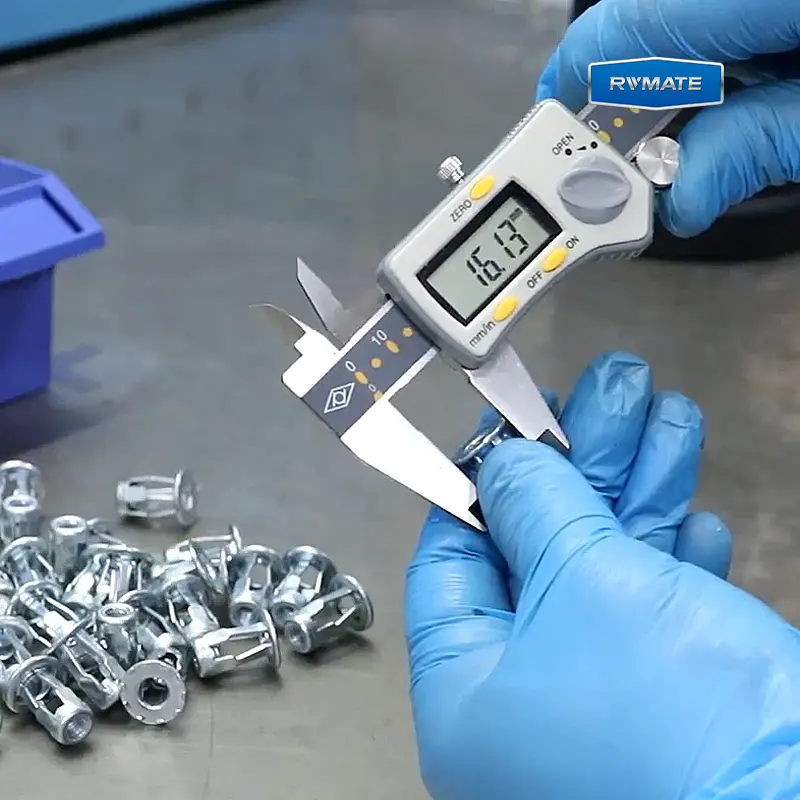
The main factors determining the specifications of a jack nut are thread size, hole size, grip range, and rear clearance. You must consider all these factors to determine the correct part number.
Below are the specifications for Jack Nuts manufactured by Rivmate. As you can see, the differences between the various specifications are minimal. Therefore, when selecting a Jack Nut specification, you must not only confirm that the product fits into the mounting hole, grips the sheet metal, and matches the bolt, but you must also ensure there is sufficient rear clearance after installation to accommodate the expanded portion.
| Part Number | Thread | Installation Hole Diameter | Grip Range |
|---|---|---|---|
| SFJ10-24-47UNC | 10-24 | 9.7–10.16 | 0.79–4.75 |
| SFJ10-24-95UNC | 10-24 | 9.7–10.16 | 4.75–9.53 |
| SFJ1/4-20-47UNC | 1/4-20 | 11.13–11.43 | 0.79–4.75 |
| SFJ1/4-20-95UNC | 1/4-20 | 11.13–11.43 | 4.75–9.53 |
| SFJM4-50 | M4 | 8.55–8.65 | 0.5–5.0 |
| SFJM4-100 | M4 | 8.55–8.65 | 5.0–10.0 |
| SFJM5-50 | M5 | 10.55–10.65 | 0.5–5.0 |
| SFJM5-100 | M5 | 10.55–10.65 | 5.0–10.0 |
| SFJM6-50 | M6 | 12.55–12.65 | 0.5–5.0 |
| SFJM6-100 | M6 | 12.55–12.65 | 5.0–10.0 |
| SFJM8-80 | M8 | 15.55–15.65 | 0.5–8.0 |
| SFJM8-120 | M8 | 15.55–15.65 | 5.0–12.0 |
Thread Size
The nominal size of the Jack Nut’s internal thread determines which bolts it is compatible with. Rivmate offers both metric and imperial sizes. When selecting a Jack Nut size, make sure the bolts of that model match the internal thread.
- Metric: M4, M5, M6, M8
- Imperial: 10-24, 1/4-20
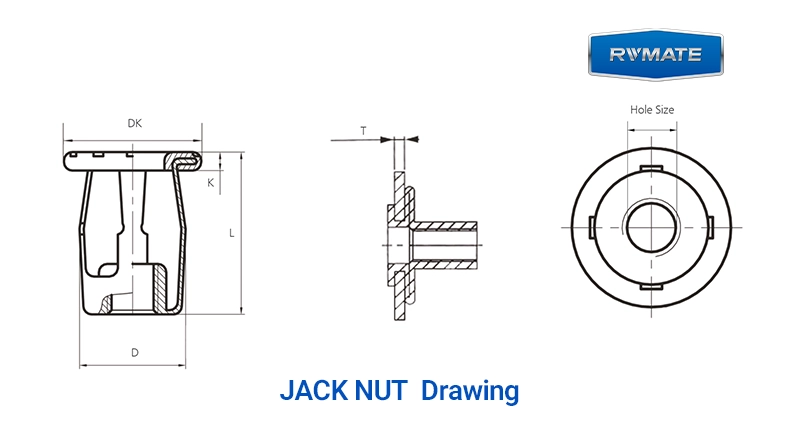
Hole Size
Hole Size refers to the diameter of the hole that needs to be machined in the sheet metal before installing the jack nut. Hole Size and Thread Size are two different dimensions. For example, an M4 jack nut does not mean the mounting hole diameter is 4 mm, because the internal threads and the external body occupy different amounts of space. You should refer to the recommended hole diameter in the supplier’s specification sheet when machining the hole.
Grip Range
The grip range refers to the range of material thicknesses that the Jack Nut can effectively clamp. The Grip Range is also one of the key parameters used to determine a specific product part number.
Rivmate offers two models of M4 Jack Nuts with different grip ranges:
- SFJM4-50: 0.5–5.0
- SFJM4-100: 5.0–10.0
Therefore, for a sheet with a thickness of 3 mm, you should select the SFJM4-50; however, for a sheet with a total thickness of 8 mm, you should consider the SFJM4-100.
Rear Clearance
Rear clearance refers to the available space behind the installation location for the Jack Nut’s expansion mechanism. If the space behind the installation location is too limited, it will prevent the Jack Nut from expanding properly.
How do you identify the mating screw thread?

To determine the matching bolt thread for a Jack Nut, it is most important to identify the appropriate nominal diameter, thread pitch, and thread system.
- Step 1: First, check the bolt’s size marking and select the corresponding Jack Nut.
- Step 2: If the bolt has no size marking, use a caliper to measure its outer diameter. This will give you a preliminary determination of the thread diameter.
- Step 3: Use a thread pitch gauge to confirm the pitch.
- Step 4: Distinguish between metric and imperial threads. Confirm the corresponding pitch notation and the dimensional system for the bolt and thread.
- Step 5: Perform a preliminary screw-in test using a bolt of the confirmed specification and the Jack Nut.
How do panel thickness and hole size narrow the options?
- Narrow Down the Product Part Number Range Based on the Grip Range
Example 1: Take the M4 model Jack Nut manufactured by Rivamte as an example. These two models have different grip ranges and are suitable for materials of different thicknesses. For the same specifications, the Jack Nut can help narrow down the part number range.
| Part Number | Thread Size | Grip Range | Mounting Hole Diameter |
|---|---|---|---|
| SFJM4-50 | M4 | 0.5–5.0 | 8.55–8.65 |
| SFJM4-100 | M4 | 5.0–10.0 | 8.55–8.65 |
- Narrow Down the Product Part Number Range Based on the Mounting Hole Diameter
The mounting hole diameter is different from the thread diameter and the body diameter. Selecting an M4 Jack Nut does not mean you should simply machine a 4 mm mounting hole. You must machine the hole according to the recommended diameter and allowable tolerances specified for the Jack Nut part number.
Will there be enough room behind the panel?
During installation, the Jack Nut’s grooved body deforms and spreads outward toward the back of the panel, forming multiple support legs. Therefore, a larger contact area is required on the back of the panel to secure it in place.
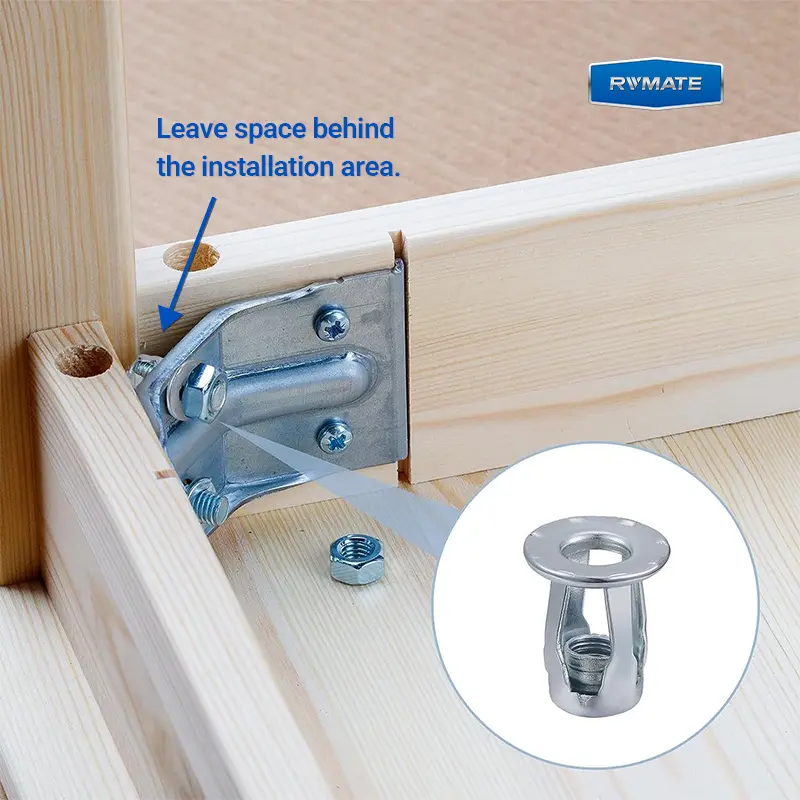
What Space Does a Jack Nut Need After Installation?
First, you need to understand how the structure of the Jack Nut changes before and after installation in order to determine the available space on the back side.
Before installation, the main body of the Jack Nut has a slotted tubular structure. After installation, the Jack Nut forms four outward-spreading support areas. The support legs come into contact with the back of the panel, together forming a support and clamping structure.
How Do You Measure Axial and Radial Clearance?
To determine whether there is sufficient clearance on the back side, you must not only measure the distance in millimeters behind the panel but also check the axial and radial clearances.
| Inspection Direction | Definition | How to Measure |
|---|---|---|
| Axial Clearance | Available axial space behind the panel | Measure the distance from the back of the panel to the nearest rear obstruction. |
| Radial Clearance | Available lateral space around the mounting hole | Check the available area around the mounting hole for the support legs to expand outward. |
How Do You Check the Required Clearance for a Specific Part Number?
The most reliable method is to obtain the supplier’s post-installation dimensional chart for the Jack Nut part number. You can verify this by checking the following parameters. If necessary, validate the fit by installing a sample.
| Parameters to Verify | Specific Verification Requirements |
|---|---|
| Part Number | Confirm the exact Jack Nut part number. |
| Overall Length | Verify the overall length before installation. |
| Body Diameter | Verify the outside diameter of the body before installation. |
| Grip Range | Confirm the material thickness range supported by the product. |
| Expansion Diameter | Verify the maximum expanded diameter of the support legs after installation. |
| Expansion Depth | Verify the axial depth occupied by the expanded structure behind the panel. |
What If There Is Not Enough Space Behind the Panel?
| Actual Condition | Potential Problem | Recommended Action |
|---|---|---|
| Insufficient Rear Depth | The support legs may not expand fully. | Adjust the installation location or reassess the fastener selection. |
| Reinforcement Rib Too Close to the Mounting Hole | The expansion of the support legs may be obstructed. | Relocate the mounting hole. |
| Another Panel Behind the Main Panel | The expanded structure may interfere with the rear panel. | Recheck the clearance between the two panels. |
| Wires or Pipes Behind the Panel | Internal components may be compressed during installation. | Adjust the installation location. |
| Irregular Rear Clearance | Some expansion areas may be obstructed. | Verify the fit through a sample installation. |
What belongs on a replacement part request?
| Information Required | Details to Provide |
|---|---|
| Original Manufacturer | Name of the original manufacturer. |
| Original Part Number | Original product part number. |
| Thread Specification | Complete thread specification and pitch. |
| Panel Material | Material of the panel. |
| Panel Thickness | Actual panel thickness. |
| Mounting Hole | Hole diameter, tolerance, and shape. |
| Grip Range | Required grip range. |
| Product Dimensions | Body diameter, head dimensions, and overall length. |
| Blind-Side Clearance | Available rear space and expansion requirements. |
| Material & Finish | Product material and surface finish. |
| Operating Conditions | Operating environment and load requirements. |
| Installation Tool | Installation tool currently in use. |
| Required Quantity | Estimated order quantity. |
| Reference Files | Product photos, physical samples, or engineering drawings. |
Is the original fastener actually a jack nut?
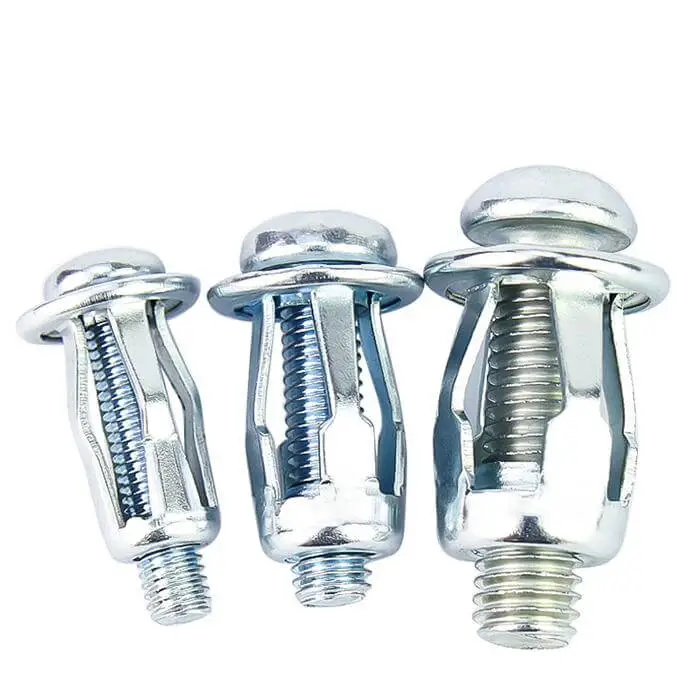
If your project requires selecting a Jack Nut size or finding a replacement product, you should verify whether the fastener originally installed is actually a Jack Nut.
Blind fasteners that look similar may have completely different installation mechanisms. Jack nuts, standard rivet nuts, and other blind-hole threaded fasteners all support single-sided installation. Once installed, they all form an internal threaded connection. The differences lie in their body structure, installation deformation method, and the configuration of the back side.
- The most distinctive feature of the Jack Nut is the longitudinal slotted structure of its body.
- Check that the installed Jack Nut forms extended support legs on the back of the panel.
How Is a Jack Nut Different from Other Blind Fasteners?
| Fastener Type | Main Structural Features | Typical Installed Structure |
|---|---|---|
| Jack Nut | Longitudinally slotted body | Multiple support legs expand behind the panel. |
| Standard Rivet Nut | Tubular metal body | The body deforms locally to form a blind-side bulge or upset head. |
| Plus Nut | Slotted, split body | Multiple wider support sections expand behind the panel. |
| Well Nut | Rubber body with a metal threaded insert | The rubber body deforms and expands under compression. |
How do you read a jack nut dimension table?
The key to understanding the Jack Nut size chart is to first understand what each size code represents. Then, based on the actual plate thickness, mounting hole diameter, and back clearance, you can find the part number that meets your installation requirements.
Below, we’ll use the actual product specifications of the Jack Nuts manufactured by Rivmate as an example. We’ll explain what each item represents to help you use the size chart to determine the correct Jack Nut part number.
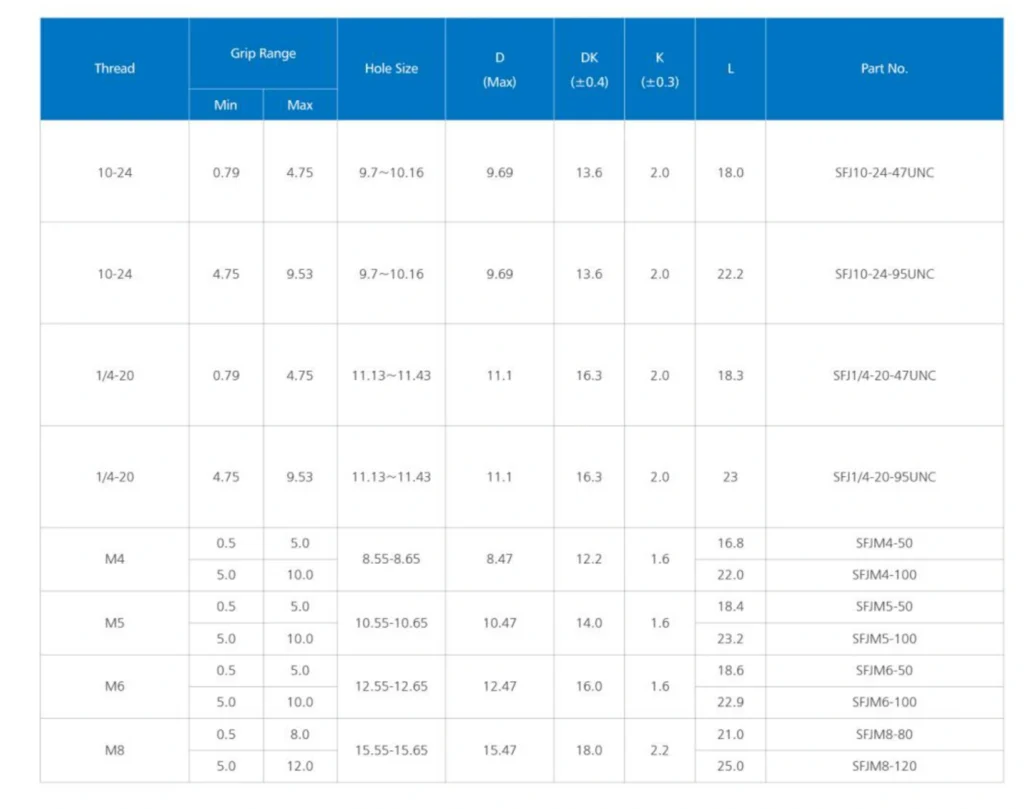
| Dimension Symbol | English Name | Meaning | Primary Purpose |
|---|---|---|---|
| Thread | Thread Size | Thread specification | Identifies the compatible screw or bolt. |
| Grip Range | Grip Range | Material thickness range | Determines the suitable panel thickness. |
| Hole Size | Mounting Hole Diameter | Required mounting hole diameter | Specifies the hole diameter required for installation. |
| D (Max) | Body Diameter | Maximum body outside diameter | Checks the external body dimensions. |
| DK (±0.4) | Head Diameter | Head flange diameter | Checks the head coverage area. |
| K (±0.3) | Head Height | Head flange height | Checks the head thickness. |
| L | Overall Length | Total product length before installation | Checks the uninstalled product length. |
| Part No. | Part Number | Product identification code | Identifies the exact product model. |
Which grip range fits a panel with thickness variation?
If the thickness of the sheet you are connecting varies, you should not select the grip range of the Jack Nut based on the average thickness or a single measurement point. The correct approach is to measure the actual minimum and maximum thicknesses of the sheet and select a product that covers the entire thickness range.
If the thickness of the sheet you are connecting varies, you should not select the grip range of the Jack Nut based on the average thickness or a single measurement point. The correct approach is to measure the actual minimum and maximum thicknesses of the sheet and select a product that covers the entire thickness range.
Ensure that the minimum clamping thickness of the Jack Nut is no greater than the minimum actual thickness of the sheet metal. The maximum clamping thickness must be no less than the maximum actual thickness of the sheet metal.
How can you confirm an unmarked replacement fits?
Step 1: Determine the Actual Thickness Range of the Sheet Material
You cannot rely solely on the supplier’s stated nominal thickness of 3.0 mm. Due to manufacturing tolerances, you must account for the actual maximum and minimum values.
| Inspection Item | Meaning | How to Determine |
|---|---|---|
| Nominal Thickness | Specified panel thickness | Check the material specifications or engineering drawings. |
| Minimum Thickness | Minimum actual thickness | Measure the material or calculate it based on the material tolerance. |
| Maximum Thickness | Maximum actual thickness | Measure the material or calculate it based on the material tolerance. |
| Thickness Variation | Range of thickness variation | Subtract the minimum actual thickness from the maximum actual thickness. |
| Total Grip Thickness | Total thickness to be clamped | For multi-layer materials, add the thicknesses of all layers to be clamped. |
Step 2: Select the Appropriate Grip Range Based on Thickness Variations
Once you have determined the maximum and minimum values, ensure that the product’s minimum clamping thickness is less than the sheet material’s minimum actual thickness. At the same time, the product’s maximum clamping thickness must be greater than the sheet material’s maximum actual thickness. Both conditions must be met simultaneously to ensure that the product’s nominal clamping range covers the entire thickness range of the sheet material.
| Evaluation Criteria | Selection Requirement | Evaluation Result |
|---|---|---|
| Minimum Actual Thickness | Must be no less than the product’s minimum grip thickness. | Prevents the panel thickness from falling below the specified operating range. |
| Maximum Actual Thickness | Must not exceed the product’s maximum grip thickness. | Prevents the panel thickness from exceeding the specified operating range. |
| Entire Thickness Range | The full thickness range must fall within a single Grip Range. | Proceed to the next stage of product selection and verification. |
| Part of the Thickness Range Falls Outside the Limits | Either the minimum or maximum actual thickness exceeds the product’s specified range. | Do not assume this part number is suitable for the entire product batch. |
What Can You Do When Panel Thickness Exceeds a Jack Nut's Grip Range?
If the grip range of the Jack nut provided by the supplier does not cover all sheet thicknesses, you can handle the situation as follows based on the actual circumstances.
| Actual Situation | Potential Issue | Recommended Action |
|---|---|---|
| Small Panel Thickness Variation Within One Grip Range | Different workpiece thicknesses may result in variations in installation deformation. | Select a model that covers the entire thickness range and verify the installation results. |
| Panel Thickness Spans Two Grip Ranges | A single part number cannot cover the entire thickness range. | Select different part numbers for each thickness range. |
| Maximum Panel Thickness Exceeds the Available Product Range | The product cannot accommodate the maximum panel thickness. | Look for a model with a larger grip range. |
| Minimum Panel Thickness Falls Below the Available Product Range | The product may not be suitable for the thinnest panel. | Look for a model with a lower minimum grip thickness. |
| Unclear Panel Thickness Tolerance | The minimum and maximum actual thicknesses cannot be accurately determined. | Confirm the material tolerance with the supplier and perform actual measurements. |
| Variation in Total Thickness of Multiple Layers | The actual grip thickness may differ from the specified thickness of a single material layer. | Measure the total grip thickness in the actual assembled condition. |
FAQs
Are M6 and 1/4-20 interchangeable?
M6 and 1/4-20 threads are not interchangeable because they are two different thread specifications. The pitch of an M6 × 1.0 thread is 1.0 mm. 1/4-20 UNC indicates 20 threads per inch, which converts to a pitch of approximately 1.27 mm. The nominal diameter of M6 × 1.0 is 6 mm, while that of 1/4-20 UNC is 6.35 mm. Although there is a slight difference in their respective diameters, the differences in their nominal diameters and pitches are significant, so they cannot be used interchangeably.
Does screw diameter determine drill size?
The screw diameter does not determine the mounting hole diameter of the Jack Nut. The screw diameter determines the internal thread size of the Jack Nut. However, the mounting hole diameter depends on the dimensions of the Jack Nut’s outer body and the specific installation design. These are two different dimensions, so the mounting hole diameter cannot be calculated directly based on the screw diameter.
What does grip range measure?
The clamping range of the Jack Nut specifically refers to the range of material thicknesses that can be clamped after the product is installed.
How do I size an insert for an existing hole?
First, measure the actual diameter of the existing hole. Then, select a model based on the mounting hole diameter requirements provided by the Jack Nut manufacturer. Compare the actual hole diameter with the manufacturer’s recommended diameter and allowable tolerances.
What happens if the panel is too thick?
If the panel thickness exceeds the Jack Nut’s maximum clamping range, the Jack Nut will be unable to unfold on the back side as originally designed. This prevents the support legs from forming the intended support structure, thereby compromising the stability of the connection.
Does the screw need clearance behind the insert?
Space must be reserved on the back of the Jack Nut for the screw. You also need to check the length and protrusion of the screw after it has been screwed in. For threaded structures with depth limitations, a screw that is too long will hit the bottom prematurely, preventing the connector from being properly tightened. For through-hole threaded structures, if the tip of the screw protrudes beyond the insert, it will interfere with the assembly of other components on the back.
Is a jack nut the same as an audio jack retaining nut?
Jack Nuts and audio connector retaining nuts are not the same product. Jack Nut threaded inserts feature a longitudinally slotted body and are primarily used in thin sheets or plastic panels. Audio connector retaining nuts are standard locking nuts. They are designed to mate with the threaded sleeve on the exterior of an audio connector to secure the connector to a device panel.
Which dimensions should I send to a supplier?
You need to provide more than just the thread specifications. You also need to provide information such as the mounting hole diameter, sheet metal thickness, clamping range, product external dimensions, and available space on the back.
Work with a IATF 16949 Certified Blind Rivet Manufacturer
Get High Quality Rivets Instead of Huck and Avdel Rivets

Rivmate Rivet
Rivmate is blind rivets manufacturers in china. The company is IATF 16949 certified and offers high-strength structural blind rivets that serve as alternatives to Huck and Avdel products.
Explore Rivmate Cases

Rivmate Rivet
Rivmate is blind rivets manufacturers in china. The company is IATF 16949 certified and offers high-strength structural blind rivets that serve as alternatives to Huck and Avdel products.

Hey There, I'm Allen!
I am the boss of Rivmate. For over two decades, we have specialized in the manufacture of blind rivets, providing our customers with reliable riveting solutions. Need riveting services? Feel free to contact us.