The key difference between open-end rivet nuts and closed-end rivet nuts lies in whether the tail section is enclosed. This indirectly affects their respective sealing capabilities and bolt length limitations. What they have in common is that they both support single-sided installation and provide a reliable threaded connection for thin sheets.
When selecting a model, you need to consider whether the joint requires sealing. Then, check the bolt length, installation space, and connection strength requirements.
Table of Contents
Open-End vs Closed-End: Key Design Differences
Open-end and closed-end rivet nuts operate on the same principle. The differences lie in their tail end design, bolt engagement method, and protective capabilities. Since these factors directly influence your choice when designing a joint, it is important to consider them carefully.
1. Differences in Tail End Design
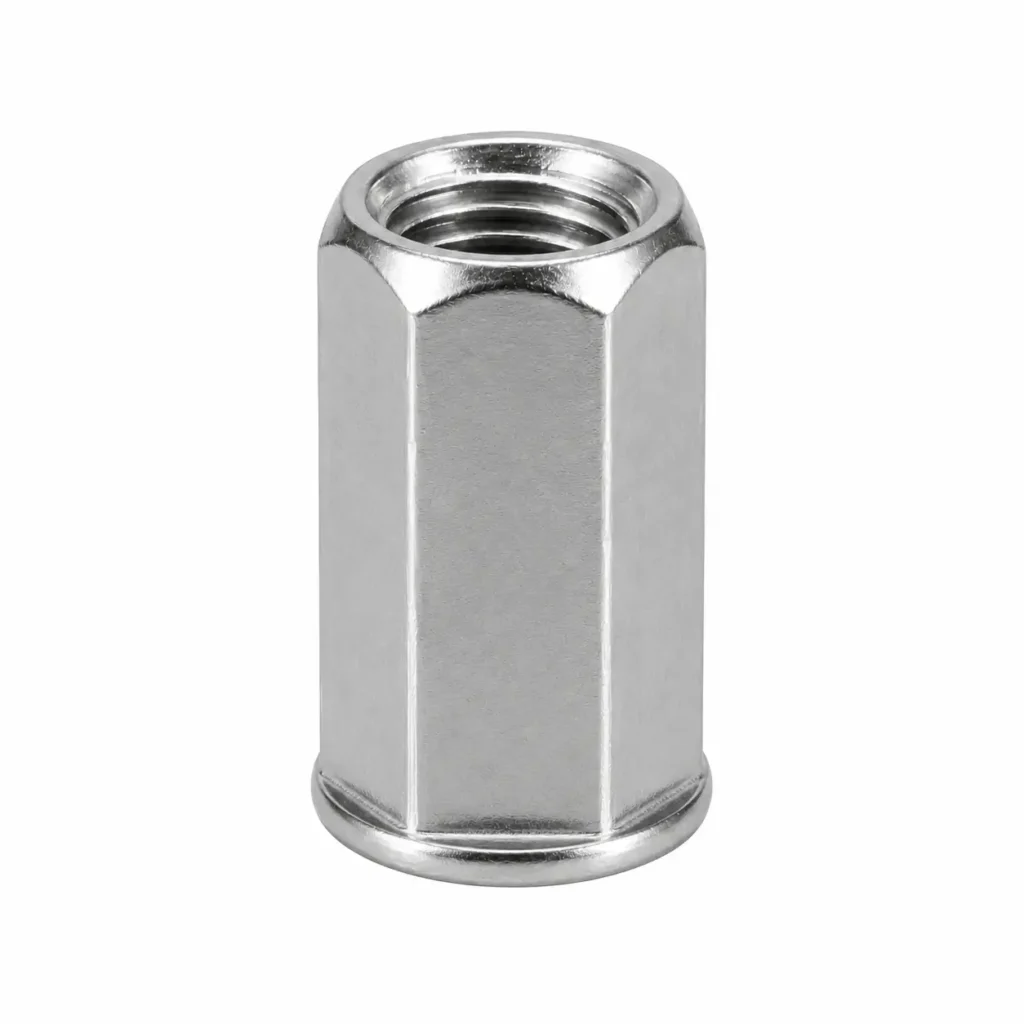
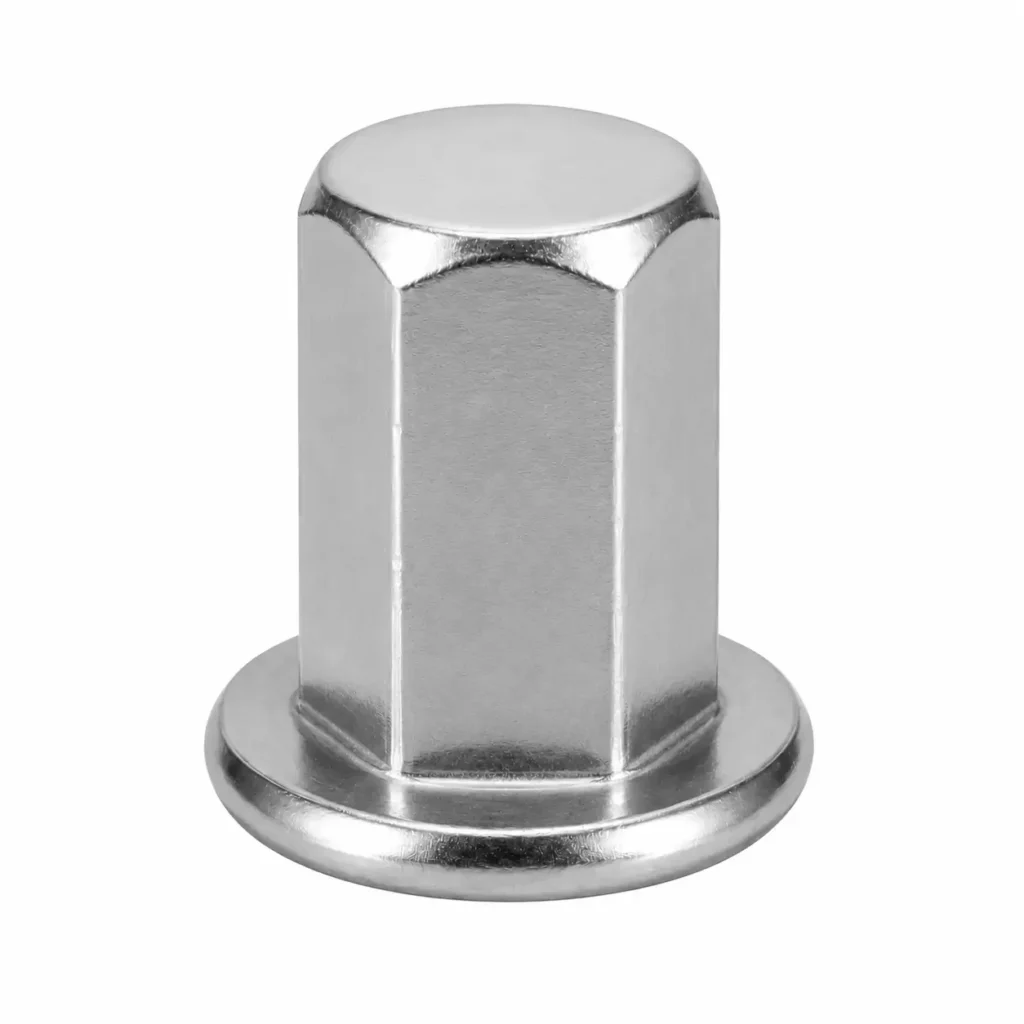
The tail end of an open-end rivet nut is open, allowing the bolt to pass through the internal threads and protrude from the tail end. The tail end of a closed-end rivet nut is completely sealed. The bolt can only enter a limited internal threaded space and cannot penetrate the bottom.
Open-end rivet nuts are suitable for projects requiring flexible adjustment of bolt length. Closed-end rivet nuts are recommended for projects that need to prevent dust and moisture from entering the structure through the tail end.
2. Differences in Bolt Installation Space
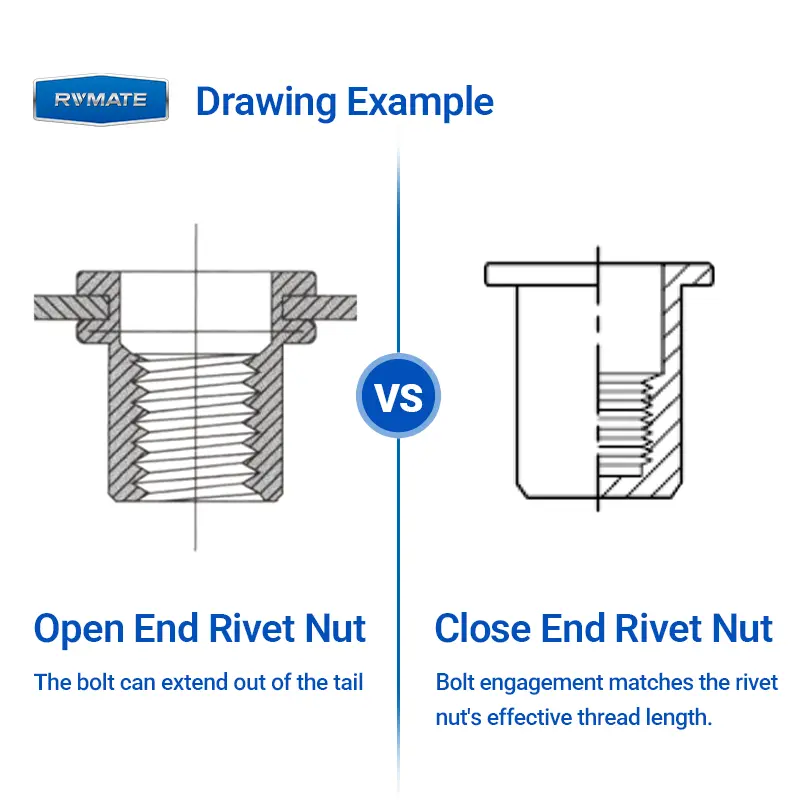
Open-end rivet nuts allow the bolt to protrude from the tail end. The length protruding from the tail depends on whether there is sufficient space on the back of the panel. The closed-type has a fixed internal depth. You need to check the bolt insertion length and the effective threaded engagement length to ensure the bolt length is appropriate. If the bolt is too long, it may hit the closed bottom prematurely, preventing the fastener from clamping securely.
3. Differences in Sealing Structures
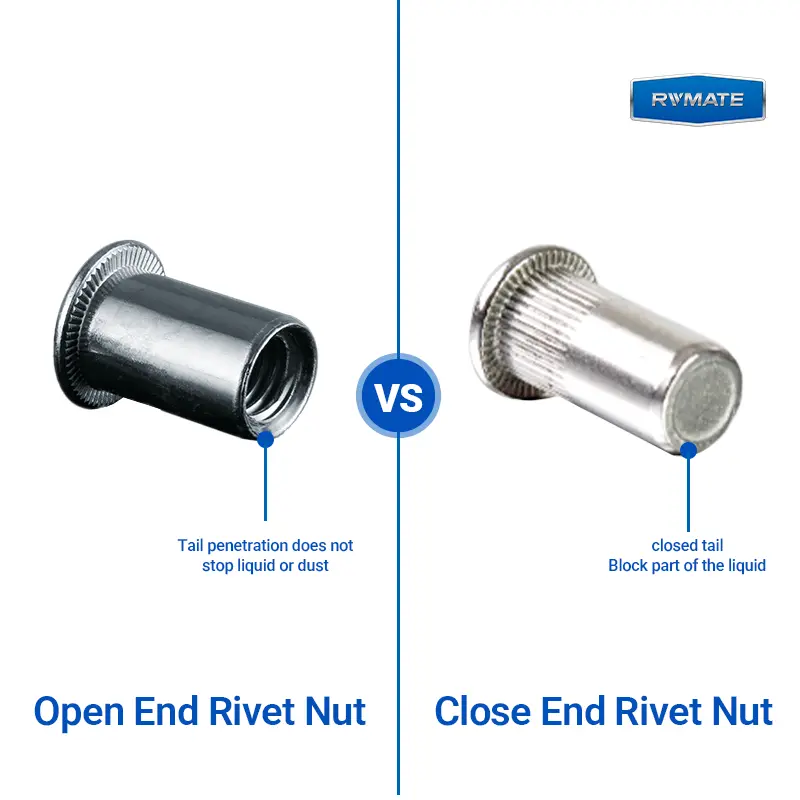
The open-type’s through-tail structure cannot prevent liquids or dust from entering. The closed-end design effectively blocks some liquids from entering. It is more suitable for equipment requiring protection against dust, moisture, or water splashes.
The closed-end design does not guarantee complete waterproofing. Moisture may seep in through the contact surface between the rivet nut head and the sheet metal. If the project has high waterproofing requirements, you may consider using sealing washers and conducting actual sealing tests.
4. Differences in Overall Length and Installation Dimensions
For the same thread specifications, closed-end rivet nuts require additional space for the closed tail section compared to open-end rivet nuts. Therefore, the overall length of some models is longer than that of open-end rivet nuts. When using closed-end rivet nuts, you must not only check the installation hole diameter but also confirm the available space on the back of the sheet metal.
Sealing Performance and Potential Leak Paths
Sealing Performance of the Threaded Channel
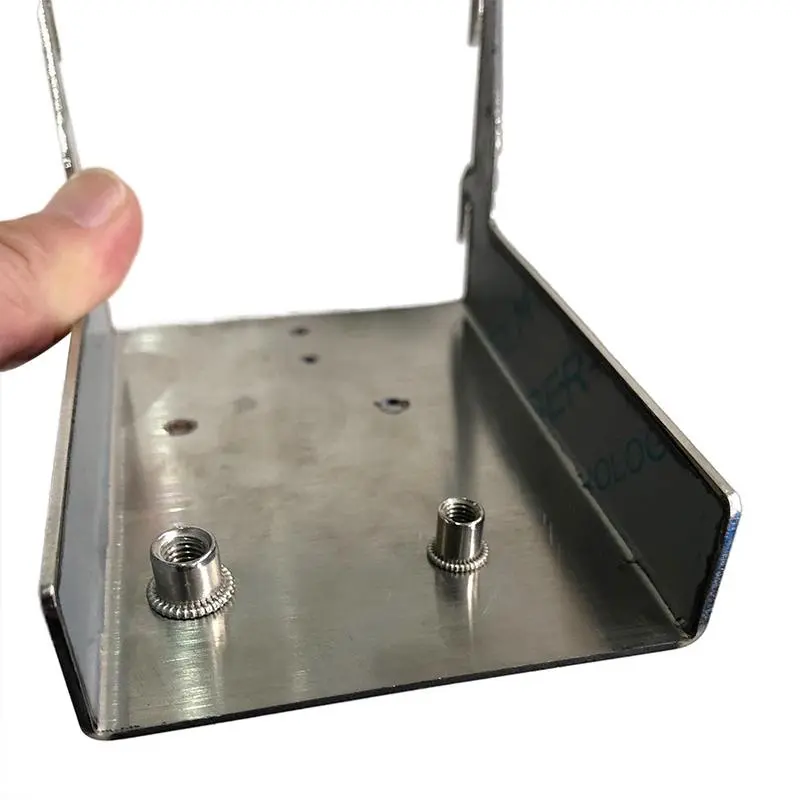
- The tail end of an open-end rivet nut is open. As a result, moisture, dust, or gas can pass through the rivet nut via the threaded gaps. A seal cannot be guaranteed by the threaded fit after the bolt is installed.
- Closed-end rivet nuts utilize their sealed tail ends to block this pathway, helping to prevent contaminants from entering the interior of the equipment.
Potential Leak Paths at the Rivet Nut Head
While the closed-end design blocks some potential leak paths, it cannot guarantee that the entire connection is completely watertight. Potential leak paths may exist where moisture seeps through the gap between the rivet nut flange and the sheet metal and enters the interior along the perimeter of the mounting hole. The risk of leakage increases when the sheet metal surface is uneven, the hole diameter is improper, or the installation is not sufficiently secured.
Bolt Length, Thread Engagement, and Bottoming Clearance
When comparing open-end and closed-end rivet nuts, the three most important factors affecting the connection are bolt length, thread engagement length, and bottom clearance. Open-end rivet nuts allow the bolt to pass through the tail, while closed-end rivet nuts are limited by their internal depth. You need to consider all these factors simultaneously to avoid an unreliable connection.
How Does Bolt Length Differ Between Open-End and Closed-End Rivet Nuts?
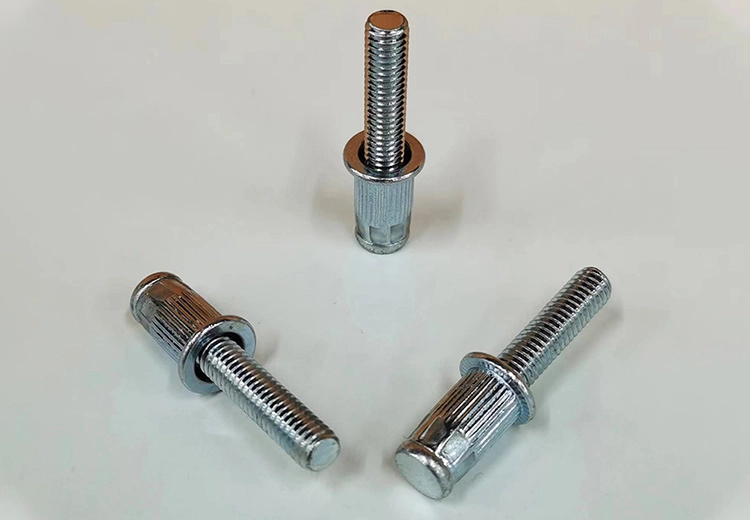
Bolt length refers to the distance a bolt can extend into the rivet nut. With open-end rivet nuts, the bolt can pass freely through the tail end. The choice of length is relatively flexible, making them particularly suitable for joining parts of varying thicknesses. However, with open-end rivet nuts, it is necessary to ensure that the protruding bolt does not interfere with the internal structure of the equipment.
Closed-end rivet nuts have limited internal space, so the bolt cannot pass freely through the tail end. Before selecting a closed-end rivet nut, you must consider the thickness of the parts being joined, the thickness of the washers, the height of the rivet nut head, and the available internal depth after installation.
Therefore, even for rivet nuts with the same thread specifications, the required bolt length may differ between the two types.
How Much Thread Engagement Is Required for Rivet Nuts?
Thread engagement refers to the actual effective axial length of contact between the bolt’s external threads and the rivet nut’s internal threads. Thread engagement directly affects the load-bearing capacity of the connection. If the engagement length is insufficient, thread slippage may occur when the connection is under load, potentially causing the bolt to pull out of the rivet nut.
When selecting an open-end type, the bolt can pass through the entire effective internal thread of the rivet nut to achieve full engagement. When selecting a closed-end type, you must ensure sufficient engagement length while preventing the bolt tip from contacting the bottom of the closed end.
The required engagement length for both closed-end and open-end rivet nuts depends on the thread specifications, rivet nut material, bolt strength, and actual load. Always refer to the manufacturer’s data on effective thread length and connection performance.
What Is Bottoming Clearance in Closed-End Rivet Nuts?
Bottoming clearance refers to the space maintained between the end of the bolt and the inner bottom surface of the closed-end rivet nut after the bolt has been tightened. Bottoming clearance prevents the bolt from bottoming out prematurely and ensures that the tightening force is effectively applied to clamp the joined parts.
If you do not properly control the bottoming clearance—for example, if the bolt is too long—the bolt will contact the bottom of the closed-end rivet nut before the connected parts are fully seated. Even if the torque has reached its peak, the connection will not achieve sufficient clamping force. Continuing to tighten the bolt may damage the internal threads, cause the rivet nut to rotate, or even destroy the closed-end structure.
Therefore, when selecting a closed-end rivet nut, first confirm its actual internal depth after installation. Then, allow for a reasonable clearance at the end of the bolt. The specific bottoming clearance must be determined based on product drawings, bolt length tolerances, and assembly conditions.
Comparing Load Ratings Using Manufacturer Test Data
The actual strength of a rivet nut is primarily influenced by the material, wall thickness, shank structure, thread dimensions, and installation conditions. A reliable method for comparing the load-bearing capacity of open-end and closed-end rivet nuts is to compare the load data provided by manufacturers under identical test conditions. It is inaccurate to judge this solely based on the tail structure.
Which Load Ratings Matter Most for Open-End and Closed-End Rivet Nuts?
When choosing between closed and open-end rivet nuts, you should focus on the following mechanical properties.
- Pull-Out Strength indicates a connection’s resistance to failure under axial tensile force. Different manufacturers define the focus of pull-out testing differently. For example, some emphasize the tensile failure resistance of the internal thread, while others test the load at which the rivet nut is pulled out of the mounting plate. You must ensure that data is compared under the same test conditions.
- Spin-Out Torque refers to the torque at which an installed rivet nut begins to rotate relative to the plate when torque is applied. This value is particularly important for equipment that requires repeated bolt installation and removal.
- Shear Strength reflects the connection’s ability to withstand lateral forces.
Installation Tool Setup and Setting Limits
The suitability of the installation tool also directly affects rivet quality and joint reliability. Both open-end and closed-end rivet nuts can be installed using the same tool. The key is to select the appropriate screw-in depth for the pull rod, nozzle position, and installation parameters to match the specific product.
| Installation Parameter | Open-End Rivet Nuts | Closed-End Rivet Nuts |
|---|---|---|
| Installation Tool | Manual, electric, or pneumatic-hydraulic rivet nut setting tools. | Generally compatible with the same types of setting tools, subject to tool and mandrel compatibility. |
| Mandrel Engagement Depth | The mandrel can extend through the open end. | Limited by the internal depth of the closed end. |
| Nosepiece Adjustment | Adjust according to the rivet nut dimensions and tool instructions. | Adjust according to tool instructions while considering the closed-end depth limitation. |
| Setting Stroke | Set according to the rivet nut specification and sheet thickness when using a stroke-controlled tool. | Also requires model-specific stroke settings when using a stroke-controlled tool. |
| Main Installation Risks | Insufficient thread engagement or excessive deformation. | Mandrel bottoming, thread damage, or excessive deformation. |
How to Adjust Mandrel Length and Nosepiece Position?
The threaded mandrel serves to transmit the installation force. The nosepiece supports the head of the rivet nut. The threaded mandrel and nosepiece determine the installation process.
For open-end rivet nuts, ensure the mandrel engages fully with the internal threads and verify that the protruding portion does not interfere with other components. When installing closed-end rivet nuts, adjust the mandrel according to the p
How to Set the Correct Stroke and Installation Force?
Most installation tools operate primarily through stroke control or force control.
| Control Method | Working Principle | Key Considerations |
|---|---|---|
| Stroke Control | Controls the distance the mandrel travels backward during installation. | Insufficient stroke may result in incomplete setting, while excessive stroke can cause over-deformation of the rivet nut. |
| Force Control | Controls the axial setting force applied by the installation tool. | Insufficient force may prevent proper bulge formation, while excessive force can damage the internal threads or sheet material. |
Choosing Materials for Corrosion Exposure
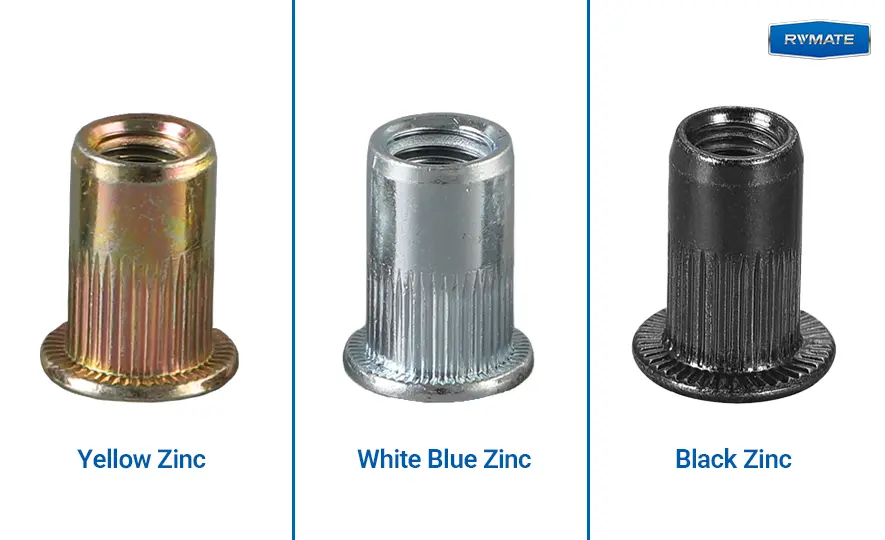
When comparing the corrosion resistance of open-end and closed-end rivet nuts, the performance depends on the tail design, the rivet nut material, the surface treatment, and the actual operating environment. Closed-end rivet nuts can only reduce the entry of moisture and contaminants into the equipment through the tail; they cannot prevent corrosion from occurring on the outer surface of the rivet nut. You should select the appropriate rivet nut based on the actual environment and the material of the sheet metal.
| Rivet Nut Material | Corrosion Resistance | Recommended Applications |
|---|---|---|
| Zinc-Plated Steel | The zinc coating provides corrosion protection for the underlying steel. | Indoor equipment, general sheet metal assemblies, and protected industrial environments. |
| Stainless Steel 304 | Offers good corrosion resistance in general humid conditions and many atmospheric environments. | Outdoor equipment and general humid environments. |
| Stainless Steel 316 | Generally provides better resistance to localized corrosion in chloride- containing environments than 304 stainless steel. | Coastal equipment and environments exposed to salts or certain chemical substances. |
| Aluminum Alloy | Protected by a naturally formed oxide layer. Actual corrosion resistance depends on the alloy and exposure conditions. | Aluminum structures, lightweight equipment, and moderately corrosive environments. |
When Each Design Fits the Application
When choosing between open-type and closed-type rivet nuts, the most important factors to consider are whether the connection requires sealing and whether there are any restrictions on bolt length.
In general, open-end rivet nuts are suitable for general sheet metal and mechanical assembly. They feature a compact design and are relatively low-cost. Closed-end rivet nuts are better suited for applications that require preventing moisture, dust, or other contaminants from entering the interior of the equipment through the threaded passage. Before finalizing the selection, it is essential to verify that the product model’s connection strength, installation space, and operating environment meet the project requirements.
| Application | Recommended Design | Why Choose It? |
|---|---|---|
| General Sheet Metal Assemblies | Open-End | No special sealing requirements. Offers flexible bolt-length selection and is generally more economical. |
| Machinery Covers and Brackets | Open-End | Suitable for conventional removable connections, provided there is sufficient clearance behind the panel. |
| Electrical Enclosures | Closed-End + Seal | Blocks the rear thread passage, while an under-head seal helps reduce the risk of leakage around the mounting hole. |
| Automotive Body Panels | Depends on Requirements | Select according to moisture exposure, vibration conditions, and available bolt clearance at the installation location. |
| Solar Mounting Structures | Depends on Requirements | Consider corrosion resistance, structural loads, and installation clearance. Outdoor use alone does not necessarily require a closed-end design. |
| Outdoor Equipment Housings | Closed-End + Seal (if required) | Helps reduce the risk of moisture entering protected spaces through the threaded passage and mounting interface. |
| Liquid-Tight or Airtight Enclosures | Validated Sealed Closed-End Design | Requires an appropriate sealing design and leak testing of the complete assembled connection. |
Note: These recommendations provide general application guidance and do not indicate that any specific product has passed load, corrosion resistance, or sealing tests.
Comparing Part Cost and Total Assembly Cost
| Cost Component | Open-End Rivet Nuts | Closed-End Rivet Nuts |
|---|---|---|
| Fastener Purchase Cost | The structure is relatively simple, so the part cost is generally more economical. | Material and manufacturing costs may increase due to the closed-end design. |
| Sealing Material Cost | If sealing is required, an additional sealing solution may be needed. | The closed end blocks the rear passage, but the head side may still require sealing components. |
| Installation Labor Cost | When compatible tools are used, no additional process is usually required. | The same type of tool can often be used, but installation parameters must be verified. |
| Tooling and Setup Cost | Uses compatible installation tools and mandrels. | Mandrel compatibility, engagement depth, and tool settings must be checked. |
| Quality Inspection Cost | Standard installation and performance checks are carried out according to connection requirements. | If sealing is required, additional leak testing may be needed. |
| Rework and Maintenance Cost | If the application is not suitable for an open-end design, leakage-related rework may occur. | Can reduce risks caused by the rear threaded passage, but cannot eliminate all leakage issues. |
| Inventory and Purchasing Cost | Standard configurations may be easier to source. | Depends on the specification, supplier inventory, and minimum order quantity. |
FAQs
Can a closed-end rivet nut be drilled open?
Yes, but we do not recommend doing this. Drilling through the bottom alters the product’s original structure; this is not the same as directly deforming an open-end rivet nut.
Can either design be installed from one side?
Both open-end rivet nuts and closed-end rivet nuts support single-sided installation.
Can open-end and closed-end inserts share the same hole size?
Whether the same mounting holes can be used depends on whether the actual installation dimensions and tolerance requirements of the open-end rivet nuts and closed-end rivet nuts are consistent. Selection should not be based solely on matching thread specifications.
Are closed-end rivet nuts available with left-hand threads?
Sealed rivet nuts have left-hand threads. Left-hand threads do not interfere with the sealed structure. You will need to confirm the specifications with the manufacturer before production.
Can a stud be used with a closed-end rivet nut?
Closed-end rivet nuts can be used with studs. You need to check in advance whether the external thread of the stud matches the internal thread of the rivet nut. Second, you must ensure that the insertion depth of the stud does not exceed the available depth inside the rivet nut.
Can installed rivet nuts be reused after removal?
Whether a rivet nut can be reused after removal depends on the method of removal. If repeated removal of the bolt does not affect the stability of the rivet nut, it can be reused. However, if the rivet nut is drilled out of the sheet metal, reuse is not recommended.
How can an installed insert be identified as open-end or closed-end?
The most straightforward way to determine whether installed rivet nuts are open-ended or closed-ended is to check whether their inner ends are open. Open-ended rivet nuts have a through-hole at the end after installation, allowing the bolt to pass directly through the entire body. Closed-ended rivet nuts have a closed structure at the end; the bolt can only be screwed into the nut to a certain depth and cannot pass through the end.
Can closed-end rivet nuts be powder coated after installation?
Closed-end rivet nuts can be powder-coated after installation. The internal threads must be protected during the coating process. Verify the compatibility between the surface treatment and the material.
Work with a IATF 16949 Certified Blind Rivet Manufacturer
Get High Quality Rivets Instead of Huck and Avdel Rivets

Rivmate Rivet
Rivmate is blind rivets manufacturers in china. The company is IATF 16949 certified and offers high-strength structural blind rivets that serve as alternatives to Huck and Avdel products.
Explore Rivmate Cases
Rivmate Rivet
Rivmate is blind rivets manufacturers in china. The company is IATF 16949 certified and offers high-strength structural blind rivets that serve as alternatives to Huck and Avdel products.

Hey There, I'm Allen!
I am the boss of Rivmate. For over two decades, we have specialized in the manufacture of blind rivets, providing our customers with reliable riveting solutions. Need riveting services? Feel free to contact us.