Like blind rivets, countersunk blind rivets are also a type of blind fastener. The entire installation process can be completed from just one side of the workpiece. The difference is that the head of a countersunk blind rivet is tapered. Before installation, a countersink hole must be pre-drilled so that the rivet head sits flush with or nearly flush with the surface of the workpiece.
Countersunk blind rivets are primarily used for connections where surface flatness, appearance, or assembly clearance are critical, such as automotive panels, electronic device enclosures, metal furniture, and industrial equipment covers.
| Item | Description |
|---|---|
| Fastener Type | Blind Rivet |
| Head Style | Countersunk Head |
| Installation Access | One-Side Access |
| Main Function | Creates a Flush or Nearly Flush Surface |
| Hole Requirement | Usually Requires a Countersunk Hole |
| Common Materials | Aluminum, Steel and Stainless Steel |
| Typical Applications | Automotive Panels, Equipment Enclosures, Metal Furniture and Industrial Equipment |
What Is a Countersunk Blind Rivet?
The most distinctive feature of a countersunk blind rivet is its “countersunk” design. “Countersunk” refers to a “countersunk” or “recessed” head. It describes the geometric fit between the rivet head and the installation hole.
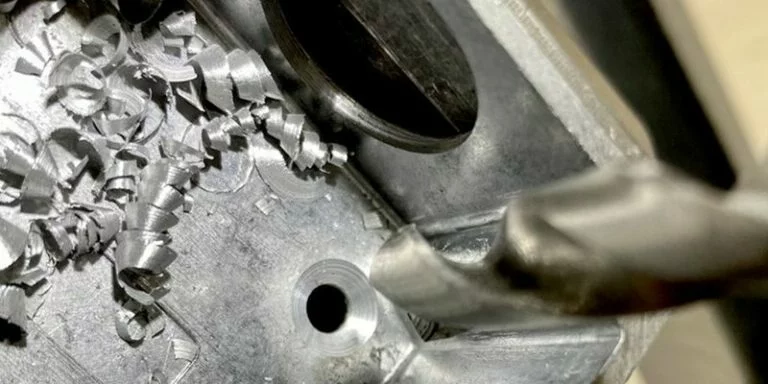
Before installation, you need to machine a conical countersink on the workpiece surface that matches the shape of the rivet head. After installation, the conical head fits into the countersink, preventing the rivet head from protruding noticeably from the material surface, as is the case with dome head rivets.
To achieve an ideal flush finish, it is essential to carefully control the following parameters:
- Rivet head angle;
- Countersink angle;
- Countersink diameter;
- Countersink depth;
- Mounting hole diameter;
- Workpiece sheet thickness.
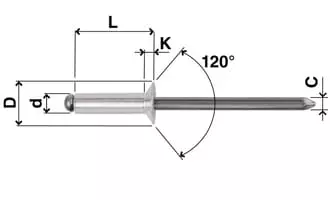
Based on our 15+ years of practical experience, I can offer the following conclusion:
If the countersink is too shallow, the rivet head will protrude above the workpiece surface; if the countersink is too deep, the rivet head may sink too far, reducing the effective thickness of the sheet metal. Furthermore, when the countersink angle does not match the rivet head angle, it may result in uneven contact at the head, a tilted rivet, or reduced joint stability.
How Does a Countersunk Blind Rivet Work?
All blind rivets operate on a similar principle, and countersunk rivets are no exception. In all cases, pulling on the mandrel causes the tail end of the rivet body to undergo plastic deformation on the back side of the workpiece, thereby clamping two or more layers of material together.
The difference is that the conical head of a countersunk blind rivet fits into a pre-machined countersink, causing the rivet head to sit flush with or nearly flush with the workpiece surface after installation.
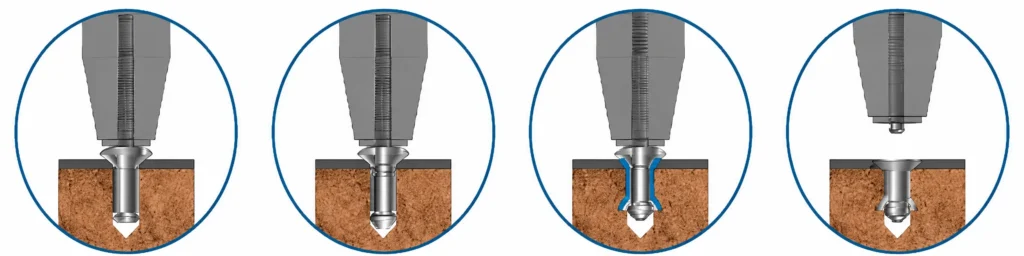
The installation process for countersunk blind rivets consists of the following five steps.
- Step 1: Drill mounting holes in all materials to be joined.
- Step 2: Pre-drill a tapered countersink in the workpiece surface.
- Step 3: Insert the countersunk mandrel rivet into the mounting hole so that the rivet body passes through all materials to be joined, ensuring the countersunk head enters the countersink properly.
- Step 4: Fit the matching riveting tool onto the mandrel and position the tool’s nozzle snugly against the rivet head. Upon activating the tool, the jaws will grip the mandrel and pull it outward.
- Step 5: Break the Mandrel and Complete the Joint
Why Are Countersunk Blind Rivets Used?
The primary reason for using countersunk blind rivets is that, once installed, they sit flush with or nearly flush with the surrounding material surface.
Therefore, countersunk blind rivets are primarily used in riveting applications that require single-sided installation as well as a smooth, low-profile, or aesthetically pleasing joint surface. If your application meets these criteria, then countersunk blind rivets are your best choice.
Of course, there are other reasons for using countersunk rivets; please refer to the table below for more information.
| Purpose | Practical Benefit |
|---|---|
| Maintain a Flush Surface | Reduces rivet head protrusion and creates a flush or nearly flush surface. |
| Reduce Component Interference | Prevents the rivet head from interfering with covers, slides, rails or adjacent components. |
| Improve Product Appearance | Creates a cleaner and more professional finish on exposed sheet metal and equipment enclosures. |
| Reduce Snagging Risks | Minimizes the risk of wires, fabrics, hoses or other materials catching on a protruding rivet head. |
| Fit Space-Restricted Assemblies | Reduces the additional head clearance required in compact assemblies. |
| Enable One-Side Installation | Allows riveting to be completed even when the back side of the workpiece is inaccessible. |
| Improve Assembly Efficiency | Uses a rivet tool to create a fast and permanent mechanical connection. |
| Create a Continuous Surface | Supports subsequent covering, painting, bonding or sliding assembly operations. |
Limitations of Countersunk Blind Rivets
Countersunk blind rivets offer the advantages of single-sided installation and a low profile, but they are not suitable for all fastening applications.
If you make a mistake during selection or installation, problems can easily arise. For example, the rivet head may protrude or sink, the sheet metal may crack, the joint may become loose, or the load-bearing capacity may be insufficient. Therefore, before purchasing and using countersunk blind rivets, you need to evaluate aesthetic requirements, structural loads, material properties, and processing conditions.
| Limitation | Possible Impact |
|---|---|
| Requires Countersinking | Adds machining time, tooling requirements and production cost. |
| Requires High Countersink Accuracy | Incorrect depth or angle may cause the rivet head to protrude, sink below the surface or tilt. |
| May Weaken Thin Sheet Metal | Removing material around the hole may cause cracking, deformation or head pull-through. |
| Less Suitable for Soft or Brittle Materials | May cause crushing, cracking, delamination or loss of clamping force. |
| Limited External Bearing Area | May not provide sufficient load distribution for some thin-sheet or oversized-hole applications. |
| Flush Installation Is Not Always Guaranteed | Precise dimensional tolerances and controlled installation procedures are required. |
| Sensitive to Hole Quality | Incorrect hole diameter, poor concentricity or burrs may affect rivet formation and joint stability. |
| Higher Inspection Requirements | Additional checks may be needed for countersink depth, angle and installed head height. |
| Material Compatibility Must Be Evaluated | Incorrect material combinations may cause galvanic corrosion, surface damage or premature joint failure. |
Countersunk Blind Rivet vs Dome Head Blind Rivet
| Comparison Factor | Countersunk Blind Rivet | Dome Head Blind Rivet |
|---|---|---|
| Head Shape | Conical head designed to fit into a countersunk hole. | Rounded head that remains above the workpiece surface. |
| Installed Profile | Creates a flush or nearly flush surface. | Creates a visible, raised head above the surface. |
| Hole Preparation | Usually requires an accurately machined countersunk hole. | Normally requires only a correctly sized straight hole. |
| Installation Process | Requires additional control of countersink angle, diameter and depth. | Simpler and faster to prepare for general-purpose riveting. |
| External Clearance | Suitable where the rivet head must not interfere with adjacent or moving components. | Requires sufficient clearance above the workpiece for the raised head. |
| Load Distribution | Provides a more limited external bearing area and requires careful evaluation on thin or soft materials. | Generally provides a larger external bearing area for standard sheet-metal connections. |
| Thin Sheet Suitability | May weaken thin sheet because material must be removed to form the countersink. | Generally more suitable for thin sheet because countersinking is not normally required. |
| Appearance | Offers a cleaner, smoother and more streamlined surface. | Leaves the rivet head visible but provides a conventional industrial appearance. |
| Risk of Snagging | Lower risk of catching wires, fabrics, hoses or sliding components. | The protruding head may interfere with or catch nearby materials. |
| Manufacturing Cost | May increase production cost because an additional countersinking operation is required. | Usually more economical because hole preparation is simpler. |
| Typical Applications | Automotive panels, equipment covers, enclosures, metal furniture and clearance-sensitive assemblies. | General sheet-metal fabrication, HVAC equipment, cabinets, appliances and industrial assemblies. |
| Best Selection Basis | Choose when surface flatness, appearance or external clearance is essential. | Choose when simple installation, load distribution and general-purpose performance are more important. |
When Should You Choose a Countersunk Head Blind Rivet?
When an application also requires a low-profile surface, countersunk blind rivets are the more suitable choice.
Countersunk blind rivets are the preferred choice in the following situations:
- The workpiece surface must be flush or nearly flush;
- There are slide rails, guide components, or moving parts near the rivet;
- A protruding rivet head may interfere with assembly;
- The surface area in question contains cables, fabric, or hoses;
- The product has high requirements for visual neatness;
- Subsequent processes such as covering, laminating, spraying, or bonding are required.
Tips: I’d like to specifically remind you that before making your selection, you must ensure the sheet metal is of sufficient thickness. You should also verify the rivet head angle, countersink angle, countersink depth, recommended hole diameter, and clamping range.
When Should You Choose a Dome Head Blind Rivet?
When an application does not require the rivet head to be flush with the workpiece surface, and greater emphasis is placed on ease of installation, cost control, and versatile joining performance, dome head blind rivets are a more practical choice.
Dome head blind rivets are the preferred choice in the following situations:
- The protruding rivet head does not interfere with other parts;
- The product has no strict requirements for a flush surface;
- The workpiece sheet metal is relatively thin and not suitable for countersinking;
- The goal is to minimize secondary processing after drilling;
- A simpler and more stable mass installation process is required;
- A relatively larger load-bearing area is needed on the outer side;
- The project is sensitive to processing costs and production cycle times.
Dome head blind rivets offer greater tolerance for sheet metal thickness and hole machining accuracy, and are better suited for high-volume, general-purpose sheet metal assembly.
For HVAC equipment, industrial cabinets, appliance housings, general mechanical components, and general metal structures—where surface protrusions are not an issue—dome head blind rivets provide a simpler and more cost-effective solution.
How to Install a Countersunk Blind Rivet Correctly?
Proper installation of countersunk blind rivets involves more than simply inserting the rivet into the hole and breaking off the mandrel with a rivet gun.
Tools Needed for Installation
- Drilling or punching equipment;
- Drill bits matching the recommended hole diameter;
- Countersink cutters or specialized countersinking tools;
- Deburring tools;
- Vernier calipers, depth gauges, or countersink inspection tools;
- Manual, pneumatic, or battery-powered riveting guns;
- Nozzles matching the mandrel diameter;
- Necessary personal protective equipment.
Tips:Based on our experience, when working with stainless steel or structural countersunk blind rivets, you’ll also need to ensure that the riveting tool has sufficient pulling force and stroke. In practice, standard small manual rivet guns may not be capable of properly installing high-strength rivets.
11 Steps for Properly Installing Countersunk Blind Rivets
- Step 1: Confirm the Rivet Specification: Before installation, first confirm that the selected rivet is suitable for the current joint.
- Step 2: Mark and Align the Hole Position: Mark the riveting positions on the workpiece and ensure that the holes in all materials to be joined are accurately aligned.
- Step 3: Drill the Correct Hole Diameter: The mounting hole should be slightly larger than the rivet’s nominal diameter.
- Step 4: Remove Burrs
- Step 5: Machine the Countersunk Hole: Use a countersink tool that matches the rivet head’s profile to machine a tapered countersink in the mounting surface.
- Step 6: Inspect the Countersink: Inspect the countersink before inserting the rivet.
- Step 7: Insert the Rivet Completely: Insert the countersunk blind rivet through all materials to be joined.
- Step 8: Select the Correct Rivet Tool and Nosepiece: The riveting tool must be compatible with the rivet’s diameter, mandrel size, material, and structure.
- Step 9: Keep the Rivet Tool Perpendicular
- Step 10: Pull the Mandrel Until It Breaks
- Step 11: Inspect the Installed Rivet
Common Countersunk Blind Rivet Problems
The installation quality of countersunk blind rivets depends not only on the rivet itself but is also influenced by a combination of factors, including the grip range, hole diameter, countersink angle, countersink depth, sheet thickness, riveting tool, and operating method.
In actual installation, the most common issues include protruding rivet heads, sunken heads, misaligned rivets, loose joints, sheet metal cracking, and abnormal breakage of the mandrel. When these problems occur, one should not simply replace the rivet but should instead inspect three key areas: rivet selection, hole machining, and installation procedures.
Quick Troubleshooting Table
| Common Problem | Possible Cause | Recommended Solution |
|---|---|---|
| Rivet Head Protrudes Above the Surface | The countersink is too shallow, the countersink diameter is too small, the head angle is incorrect, or the rivet is not fully inserted. | Check the countersink depth, diameter and angle. Remove burrs and make sure the rivet head is fully seated in the countersink. |
| Rivet Head Sinks Below the Surface | The countersink is too deep or too large, the sheet is too thin, or the workpiece material is too soft. | Reduce the countersink depth, verify the sheet thickness and use a depth-controlled countersinking tool. |
| Rivet Head Is Tilted | The rivet tool is angled, the countersink and straight hole are not concentric, the holes in the joined sheets are misaligned, or the hole is oversized. | Correct the hole alignment, secure the workpieces and keep the rivet tool aligned with the rivet axis during installation. |
| Rivet Rotates After Installation | The installation hole is oversized, the grip range is incorrect, the rivet body is not fully formed, or the tool has insufficient pulling force. | Verify the recommended hole diameter, total material thickness, rivet grip range and riveting-tool capacity. |
| Joint Remains Loose | The rivet is too long or too short, gaps remain between the workpieces, the grip range is incorrect, or the rivet is incompletely set. | Measure the total material thickness again, clamp the workpieces together before riveting and select the correct grip range. |
| Sheet Cracks Around the Hole | The sheet is too thin, the countersink is too deep, the material is brittle, machining damage is present, or the rivet diameter is too large. | Reduce the countersink depth, improve hole quality, or use a dome-head, large-flange or thin-sheet rivet. |
| Rivet Head Pulls into the Sheet | The sheet is too soft or thin, the countersink is oversized, the head has insufficient bearing area, or the installation hole is too large. | Add local support, reduce the countersink size or use a rivet head with a larger bearing area. |
| Mandrel Breaks Too Early | The tool is angled, the nosepiece is incorrect, the rivet is damaged, the holes are misaligned, or the grip range is unsuitable. | Inspect the tool, nosepiece, rivet quality and hole alignment. Confirm that the mandrel break load meets the specification. |
| Mandrel Does Not Break | The tool has insufficient pulling force or stroke, the jaws are worn and slipping, the nosepiece is incorrect, or the rivet is too strong for the tool. | Use a riveting tool with the correct pulling force and stroke, and inspect the jaws and nosepiece for wear. |
| Mandrel Breaks Too High | The rivet body is not fully formed, the grip range is incorrect, the tool stroke is insufficient, or the mandrel break point is abnormal. | Check the rivet specification, tool stroke and installation condition. Confirm the acceptable mandrel height through sample testing. |
| Workpiece Deforms Around the Rivet | The sheet lacks stiffness, too much material was removed during countersinking, the rivet diameter is too large, or the workpiece is not adequately supported. | Add installation support and optimize the rivet diameter, edge distance and countersink dimensions. |
| Corrosion Appears Around the Joint | The rivet and workpiece materials are incompatible, the coating is damaged, the exposed hole edge is unprotected, or the joint is used in a wet environment. | Select compatible materials and use an isolation coating, sealant or corrosion-resistant surface treatment. |
| Leakage Occurs Around the Rivet | An open-end rivet is used, the hole is oversized, the countersunk head does not seat evenly, or the sealing design is insufficient. | Use a closed-end or sealed countersunk blind rivet together with a validated sealing solution. |
Best Practices: Problems with countersunk blind rivets are generally not caused by a single factor.
When troubleshooting, follow this sequence:
First, check the clamping range; next, check the hole diameter and countersink; finally, check the riveting tool and operating procedure.
Where Are Countersunk Blind Rivets Used?
Countersunk blind rivets are designed for use on flush surfaces or in situations where the rivet head must not interfere with other components. The following are common applications for countersunk blind rivets.
Application 1. Automotive Panels and Components
The automotive industry is one of the most common application areas for countersunk blind rivets, which are particularly suitable for locations where surface flatness and assembly clearances are critical.
Common applications include:
- Interior trim panels;
- Interior door components;
- Seat frame attachments;
- Vehicle equipment housings;
- Lightweight body panels;
- Metal brackets near wiring harnesses;
- Sheet metal structures where adjacent components need to fit closely together.
Application 2. Electronics and Electrical Enclosures
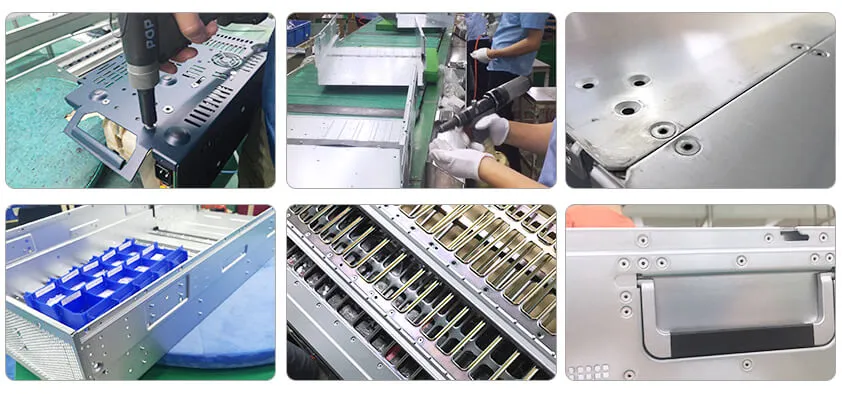
Electronic equipment, control boxes, and electrical cabinets have relatively compact internal spaces. Countersunk blind rivets can be used in locations where internal or external protrusions need to be minimized.
Common applications include:
- Electronic equipment enclosures;
- Electrical control cabinets;
- Power distribution panel fronts;
- Instrument enclosures;
- Communication equipment chassis;
- Server and network equipment enclosures;
- Internal partitions and mounting brackets.
Application 3. Metal Furniture and Cabinets
Metal furniture emphasizes appearance, tactile feel, and safety.
Countersunk blind rivets can be used for:
- Metal office cabinets;
- File cabinets;
- Storage cabinets;
- Tool cabinets;
- Metal tables and chairs;
- Display racks;
- Connections near drawer slides;
- Decorative panels and covers.
Application 4. HVAC Equipment and Sheet Metal Enclosures

In HVAC equipment, countersunk hollow-shank rivets can be used for enclosures and panel connections where a low-profile surface is required, such as:
- Air conditioning equipment enclosures;
- Air handling unit panels;
- Ventilation equipment guards;
- Fan housings;
- Access panels;
- Internal partitions;
- Control panels and electrical boxes.
Application 5.Appliances and Consumer Equipment
Certain household appliances and commercial equipment require a clean, uncluttered appearance while featuring compact internal spaces, making countersunk blind rivets essential.
Common applications include:
- Kitchen appliance housings;
- Commercial appliance panels;
- Laundry equipment housings;
- Vending machines;
- Fitness equipment housings;
- Cleaning equipment;
- Metal panels for outdoor equipment.
Rivmate Countersunk Blind Rivet Solutions
As one of top 3 blind rivet manufacturers in china, Rivmate has provided industrial customers worldwide with bulk supplies and custom solutions for countersunk blind rivets. Our technical team can recommend the appropriate rivet specifications based on your project requirements and application environment.
From sample confirmation and specification selection to mass production, Rivmate provides comprehensive engineering support and quality inspection. Please send us your drawings, material thickness, hole diameter, application details, and purchase quantity to receive a customized countersunk blind rivet solution and quote tailored to your project.
Is a Countersunk Blind Rivet Right for Your Application?
Whether countersunk blind rivets are suitable for your project depends on whether the application requires both single-sided installation and low protrusion or a flush surface.
If the back of the workpiece is inaccessible, and dome head rivets might affect appearance, assembly clearances, sliding components, or adjacent parts, then countersunk blind rivets are the appropriate choice. They allow for a permanent connection while keeping the rivet head flush with or nearly flush with the workpiece surface.
Do you know exactly which countersunk blind rivet is right for your project? If you’re unsure, our technical team will provide you with the most accurate riveting solution based on your specific application. Of course, if you’re purchasing countersunk blind rivets in large quantities, we can provide you with free rivet samples.
FAQs
How do countersunk blind rivets improve the aesthetic finish on metal panels?
After installation, the head of a countersunk blind rivet sits flush with or nearly flush with the surface of the metal sheet. This gives the metal sheet a smoother, cleaner appearance.
In addition, a flush rivet head facilitates subsequent painting, lamination, or surface treatment, reducing issues such as protrusions, dust accumulation, and scratches.
How do countersunk blind rivets perform in corrosion-resistant applications?
Countersunk hollow-shank rivets can be used in corrosive environments, but their specific performance depends on the material and surface treatment. For outdoor or humid environments, it is recommended to use 304 or 316 stainless steel rivets and take care to avoid contact between dissimilar metals to minimize electrochemical corrosion.
Compare countersunk blind rivets to threaded inserts.
Countersunk blind rivets are suitable for single-use, permanent fastenings; they can be quickly installed from one side and provide a smooth, flush surface. Threaded inserts, on the other hand, create stable internal threads in thin sheets, facilitating repeated bolt assembly and disassembly.
Choose countersunk pop rivets when a quick, non-removable connection is required; choose threaded inserts when maintenance or repeated disassembly is needed.
How do environmental factors affect the selection of countersunk blind rivets?
Ambient temperature, humidity, salt spray, chemical agents, and outdoor exposure all influence the selection of countersunk pop rivets.
In humid or corrosive environments, stainless steel or corrosion-resistant coated rivets should be the first choice; for high-temperature, vibration-prone, or outdoor applications, attention must also be paid to material strength, weather resistance, and electrochemical compatibility with the sheet metal.
Work with a IATF 16949 Certified Blind Rivet Manufacturer
Get High Quality Rivets Instead of Huck and Avdel Rivets

Rivmate Rivet
Rivmate is one of top 3 blind rivets manufacturers in china. The company is IATF 16949 certified and offers high-strength structural blind rivets that serve as alternatives to Huck and Avdel products.
Explore Rivmate Cases
Rivmate Rivet
Rivmate is one of top 3 blind rivets manufacturers in china. The company is IATF 16949 certified and offers high-strength structural blind rivets that serve as alternatives to Huck and Avdel products.

Hey There, I'm Allen!
I am the founder of Rivmate. For over two decades, we have specialized in the manufacture of blind rivets, providing our customers with reliable riveting solutions. Need riveting services? Feel free to contact us.