Rivet nuts can be used in wood. Rivet nuts are suitable for light-duty applications and connections that need to be repeatedly disassembled, such as hardwood, plywood, or high-density wood panels. However, when used with softwood, thin wood panels, or wood subjected to heavy loads, rivet nuts may damage the wood, crush the holes, or become loose after installation.
Therefore, you need to evaluate the situation based on the type of wood and the intended application. Check whether the wood can withstand the loads generated during the riveting process.
Table of Contents
Why Do Standard Rivet Nuts Loosen or Damage Wood?
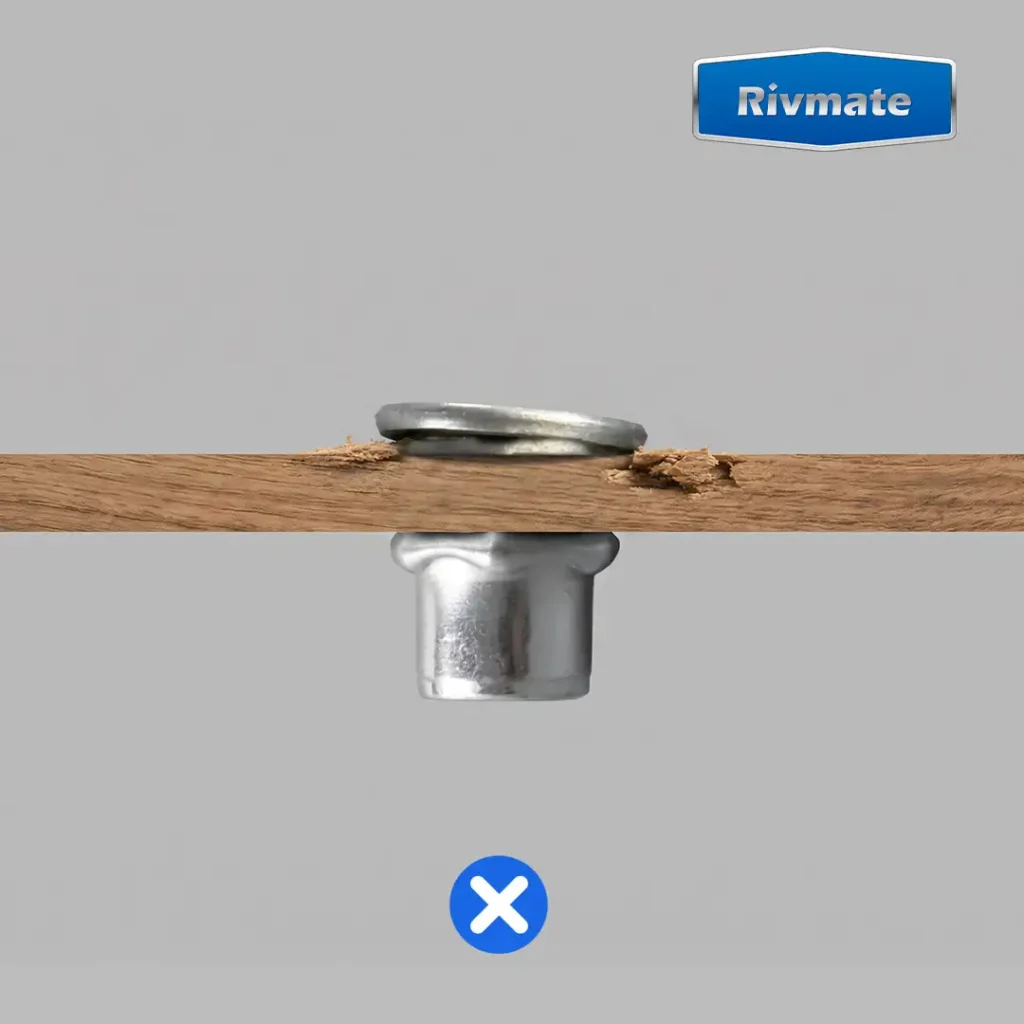
Installing standard rivet nuts can cause the wood to loosen or become damaged, primarily because the installation force generated by the rivet nut does not match the load-bearing capacity of the wood. Since some types of wood are soft, they are prone to deformation under compression, leading to connection failure.
Reason 1: The wood cannot withstand the localized pressure generated by riveting
During the installation of a rivet nut, the riveting tool pulls on the mandrel, causing the tail end of the rivet nut to deform and clamp down on the wood panel. This generates significant localized pressure. Metal sheet materials do not deform under such pressure. However, materials such as pine, medium-density fiberboard (MDF), and particleboard tend to shrink when subjected to pressure, causing the hole diameter to increase.
According to tests conducted by our technical team, natural solid wood, wood fiber composite panels, and wood particle composite panels have lower strength. After riveting, the holes in these materials tend to be stretched open. This reduces the clamping force, leading to issues such as the nut rotating, loosening, or even falling out.
Reason 2. Wood is prone to cracking or internal damage when subjected to pressure
Unlike metal materials, wood is not homogeneous; it has a natural fiber structure and grain pattern. When a rivet nut expands, if the installation location is close to the edge of the wood or the board is too thin, the expansion force may damage the wood fibers, causing the wood to crack.
Based on feedback from our customers, issues with rivet nut installation are influenced by many factors, including thin wood panels, mounting holes too close to the edge, oversized rivet nuts, and excessive pressure from installation tools. These factors increase the likelihood of the wood splitting.
Reason 3. Connection stability is affected by moisture absorption and long-term changes in the wood
Compared to metal materials, wood absorbs moisture and expands and contracts in response to changes in environmental humidity. Although rivet nuts are initially secure, if exposed to damp conditions and significant temperature fluctuations over the long term, dimensional changes in the wood may cause the hole walls to gradually loosen, reducing the rivet nut’s holding force.
TIPS: If you are using rivet nuts in outdoor wooden structures, damp environments, or applications involving long-term load-bearing, you must assess the stability of the wood; you cannot simply select rivet nuts based on the same criteria used for metal sheets.
Reason 4. Choosing the wrong type of rivet nut will reduce the effectiveness of the connection
Not all rivet nuts are suitable for wood. Some rivet nuts are not suitable for wooden structures. For example, round rivet nuts rely on the plastic deformation of metal to clamp the panels together. In softer materials like wood, they cannot form a reliable lock.
Which Fasteners Can Create Machine Threads in Wood?
In woodworking applications, the four most common types of fasteners that can form mechanical threads are as follows.
1. Threaded Inserts for Wood
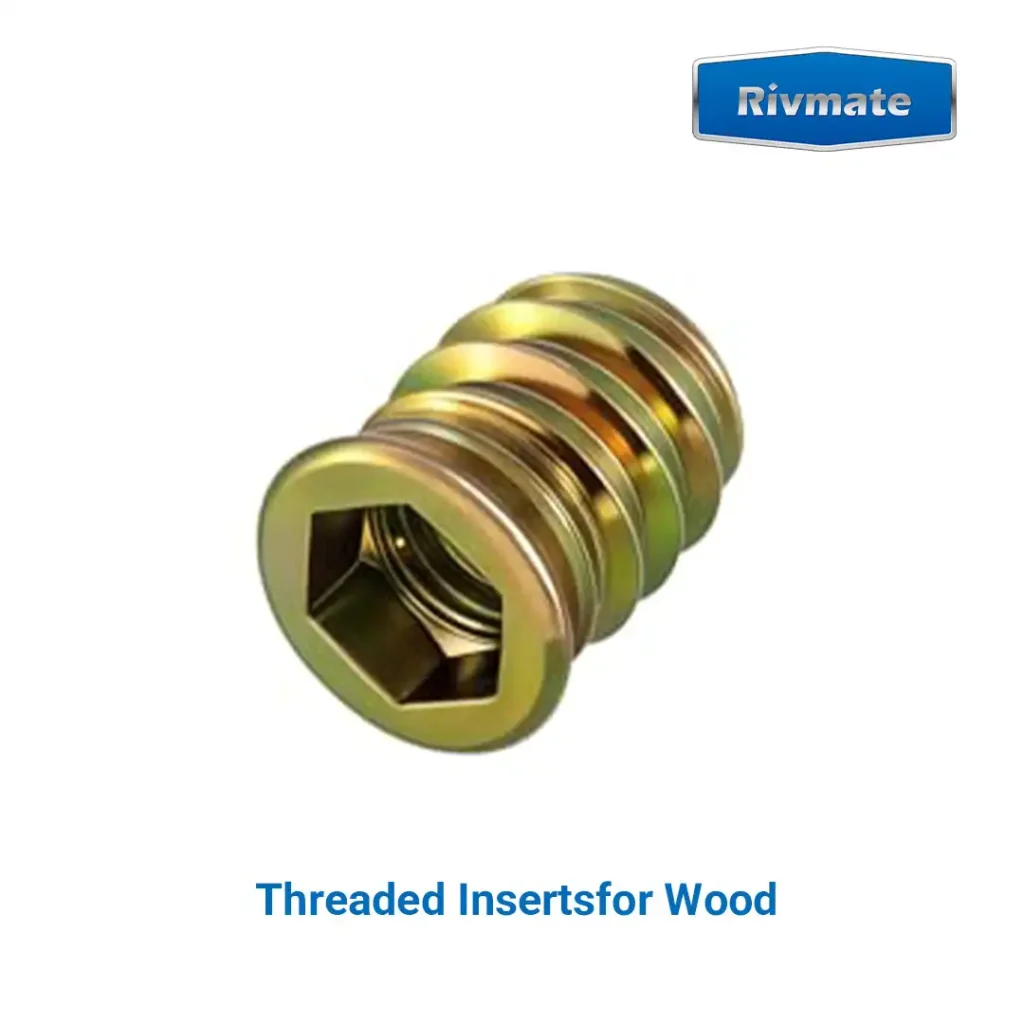
Threaded inserts for wood are commonly used in woodworking applications. They are typically made of brass, steel, or stainless steel. They feature coarse external threads or a special design that allows them to be screwed or pressed into the wood. The interior is equipped with standard mechanical threads, enabling standard bolts to be easily installed and removed.
2.Threaded Bushings
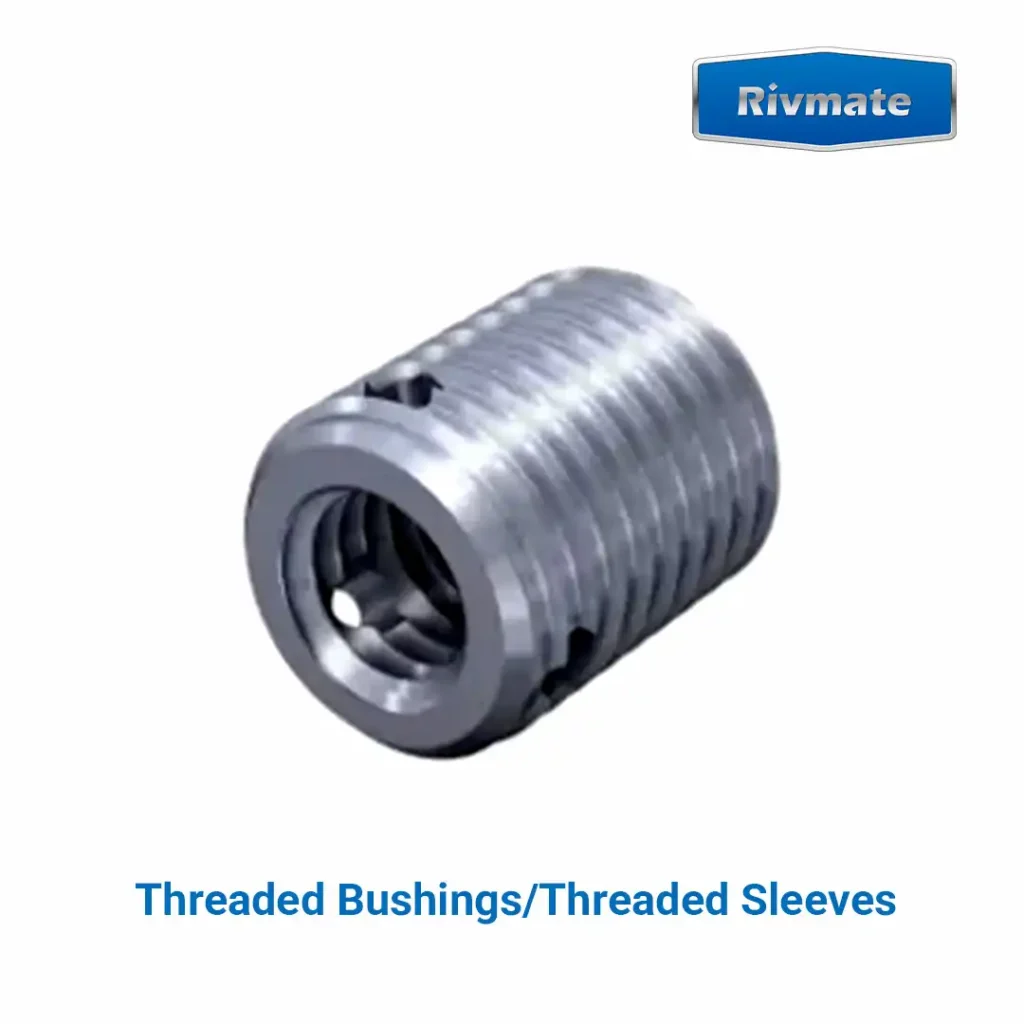
A threaded insert is a fastener resembling a metal sleeve, used to provide a more stable threaded connection in wood.It features a longer installation length, which increases the contact area with the wood and enhances tensile and torsional strength.
Common applications:
- High-end furniture joints
- Wooden structural components
- Products requiring repeated disassembly
TIPS: When using threaded inserts in softer woods, longer inserts provide better holding power than shorter ones. This is because they distribute the load more evenly, reducing localized stress on the wood.
3. T-Nuts
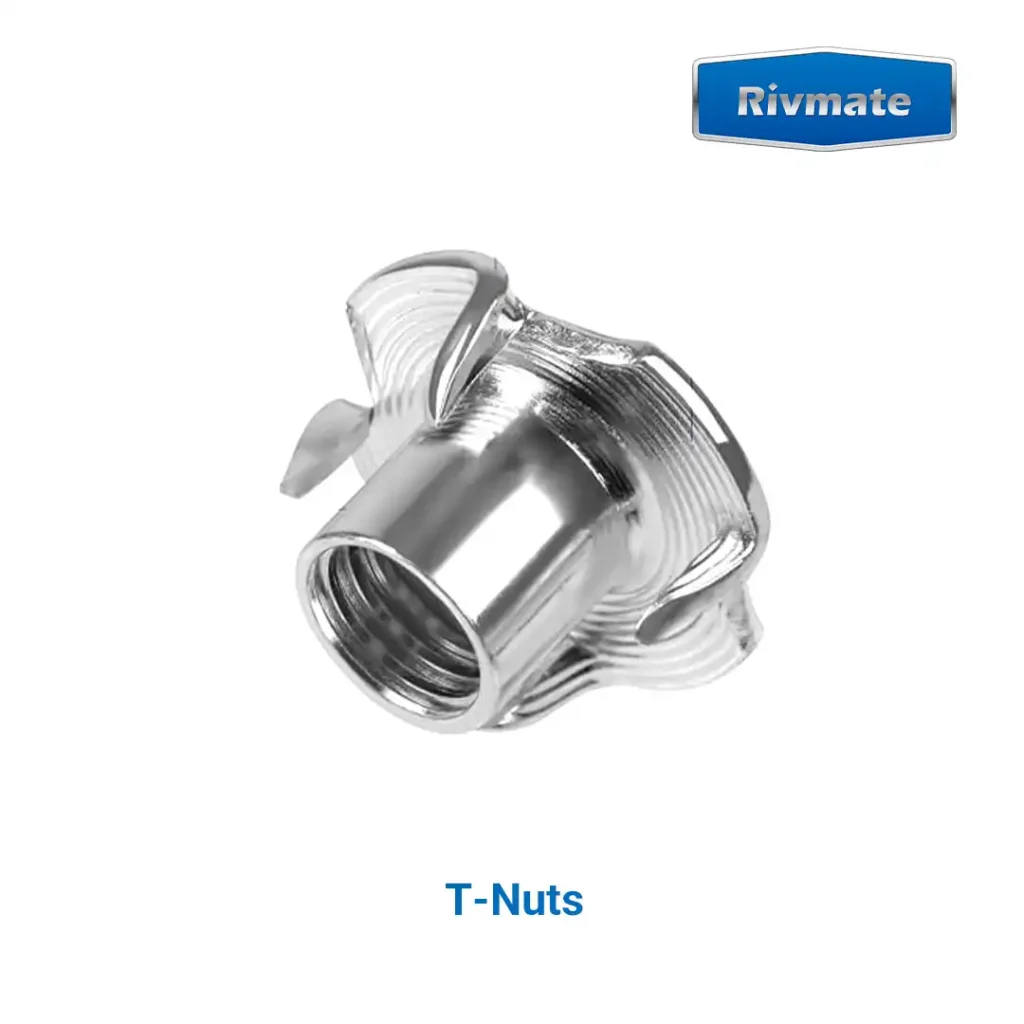
T-nuts are suitable for product designs where contact is possible on both sides. Installation is relatively simple. T-nuts must be installed from the back of the wood, with the metal tabs at the bottom embedding into the wood. When the bolt is screwed in, the T-nut provides a secure internal thread.
Common Applications
- Wooden furniture
- Fitness equipment
- Audio equipment
- DIY woodworking projects
4.Rivet Nuts
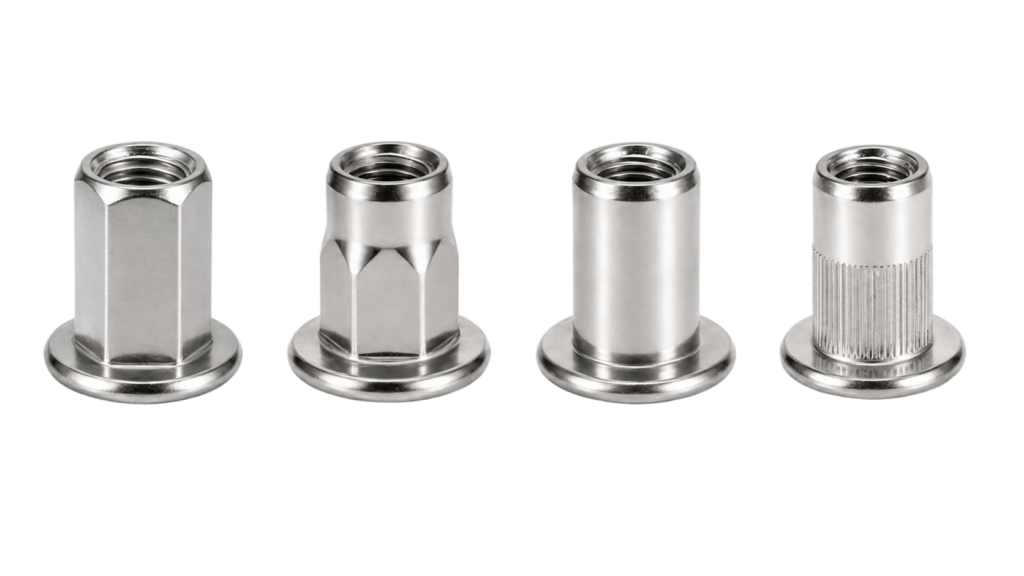
Rivet nuts can also provide mechanical threads, but they are not fasteners specifically designed for wood in the traditional sense.Rivet nuts work by using a tool to pull the mandrel, causing the tail to deform and clamp the material. Therefore, they are well-suited for steel sheets, aluminum sheets, plastic sheets, and composite materials.
In wood, rivet nuts are suitable for some light-duty and removable connections. These include:
- High-density wood panels
- Plywood
- Substrates of sufficient thickness
Rivet nuts are not suitable for connections where the material is prone to compression due to installation pressure. These include:
- Low-density woods such as pine
- MDF (medium-density fiberboard)
- Particleboard
- Thin wood panels
| Application Requirement | Recommended Solution |
|---|---|
| Furniture Requiring Repeated Assembly | Threaded Inserts for Wood |
| High-Strength Wood Structure Connections | Long Threaded Inserts or Reinforced Structures |
| Access Available from the Back Side | T-Nuts |
| One-Side Installation Required | Threaded Inserts for Wood or Tested Rivet Nuts |
| Metal and Wood Hybrid Structures | Rivet Nuts or Threaded Inserts Selected According to Load Requirements |
Rivet Nut Options by Solid Wood, Plywood and Hollow Panels
When using rivet nuts in wood, many factors can affect their installation performance and long-term reliability. These include the density and strength of the wood, the thickness and internal structure of the panel, as well as the tensile force and torque the joint must withstand. Below, I will analyze which types of rivet nuts are suitable for solid wood, plywood, and hollow panels.
①Solid Wood
Solid wood consists of continuous wood fibers and has a more stable overall structure than engineered wood. However, there are significant differences in strength and density among different types of wood.
Hardwood: For example, oak and maple have higher density and greater compressive strength.
Softwood: For example, pine has lower density and is more susceptible to compression.
Recommended Solution:
- Large-flange rivet nuts. The large flange increases the contact area with the wood surface, reducing pressure at any single point. This minimizes the risk of the wood surface being pulled in or crushed.
- Threaded inserts for wood. These are screwed into the wood via external coarse threads or a special design, generating less clamping force than rivet nuts. Consequently, they cause less damage to the wood.
②Plywood
Plywood is a composite wood panel formed by cross-laminating multiple layers of wood veneer. Compared to standard particleboard and MDF, its structural integrity is more stable.Due to its multi-layered structure, plywood typically offers better tensile strength than single-layer softwood, making it more suitable than other wood-based panels for installing rivet nuts in certain applications.
Recommended Solutions:
- Large Flange Rivet Nuts. These help distribute localized pressure and reduce indentations.
- Low Installation Force Rivet Nuts. Designed with lower deformation pressure, these prevent damage to the wood’s layered structure during installation.
③Hollow Panels
Compared to solid wood and plywood, hollow panels lack continuous internal material to support the expansion and clamping action of rivet nuts. Standard rivet nuts generate clamping force through deformation on the back side. For hollow panels, it is more appropriate to consider specialized fasteners designed for hollow materials. These include:
- Jack Nuts
- Specialized hollow-wall anchors
- Inserts with an expanded support surface
How Should You Install a Blind Insert in Plywood?
Step 1. Select Threaded Inserts Suitable for Plywood
Plywood is made by pressing multiple layers of wood veneer together with adhesive and cannot withstand excessive expansion forces. We recommend considering Large Flange Rivet Nuts, Low Installation Force Inserts, and Threaded Inserts for Wood.
Step 2. Confirm the plywood thickness and appropriate installation location
The installation location of the insert affects the connection strength. Avoid installing the insert too close to the edge of the panel. The clamping range of the selected insert must cover the total thickness of the plywood.
Step 3. Drill installation holes strictly according to the manufacturer’s technical specifications
Hole dimensions must be precise. If the hole is too small, it will not only increase installation resistance and pressure but may even damage the plywood. If the hole is too large, the insert may rotate or loosen after installation.
Step 4. Control installation pressure; do not over-rivet
Excessive deformation within the plywood may damage the material. During installation, monitor whether the insert is securely fastened.
Tips: If excessive force is applied during installation, the fastener may appear secure immediately after installation but could gradually loosen over time due to wood compression.
Step 5. Conduct tensile and torque tests after installation
Verify the compatibility of the threaded inserts through actual sample riveting tests.
When Should You Use a Through-Bolt, Screw or Bonded Insert Instead?
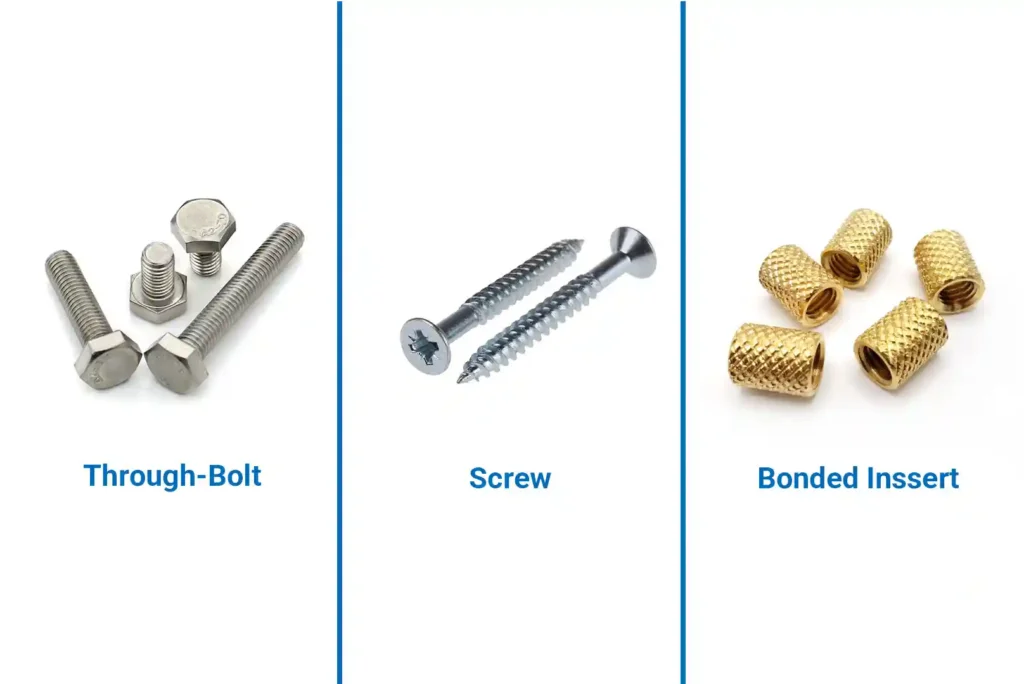
Many installation failures involving wood are not due to the quality of the rivet nuts themselves, but rather because the wood cannot withstand the clamping force generated by the rivet nuts. Therefore, through bolts, wood screws, or adhesive inserts are more suitable.
| Application Requirement | Recommended Fastening Solution | Why Choose This Solution | Key Considerations |
|---|---|---|---|
| Need maximum connection strength, such as heavy structures or long-term load-bearing joints | Through-Bolt | The bolt passes through the entire wood structure and clamps with a nut and washer. Load is distributed more evenly and does not rely on wood threads. | Requires access from both sides. The bolt and nut may remain visible. |
| Access to the back side is possible and a permanent connection is required | Through-Bolt or T-Nut | Mechanical locking structure can be used from the backside, providing a more stable connection than relying only on internal wood threads. | Requires reserved space for backside installation. |
| Normal wood fixing, such as furniture assembly, wood panels and one-time installation | Wood Screw | Wood screws directly cut into wood fibers, making installation simple and cost-effective. They are the most common wood fastening method. | Not suitable for frequent removal. Repeated installation may damage internal wood threads. |
| Need repeated assembly and disassembly, such as furniture repair or modular structures | Threaded Insert or Rivet Nut | Provides a metal internal thread in wood, allowing repeated screw installation and removal while reducing damage to the wood. | The correct product must be selected according to wood type and strength. |
| Thin or low-strength wood materials, such as plywood, hollow boards and composite panels | Bonded Insert | Fixed with adhesive bonding without creating large mechanical expansion forces, helping reduce damage to the base material. | Requires higher requirements for adhesive performance and surface preparation. |
| No access to the backside, only one-side installation is possible | Rivet Nut or Blind Threaded Insert | Allows installation from one side and is suitable for closed structures or areas with limited installation space. | The wood material must have sufficient strength, otherwise loosening may occur. |
| High vibration or high-load environments, such as equipment structures | Through-Bolt or Reinforced Structure | Provides a more stable mechanical connection and reduces the risk of long-term loosening caused by vibration. | The solution should be verified according to actual load conditions. |
How Do You Test the Connection Before Use?
- Inspect the appearance of the rivet after installation. Check for any damage to the wood around the rivet nut.
- Check whether the bolt rotates when screwed into the rivet nut.
- Apply light tension to the joint to check for any loosening.
- Test the joint’s ability to withstand repeated assembly and disassembly.
- Conduct riveting tests under actual humid or outdoor conditions to verify the reliability of the connection.
| Test Item | Inspection Purpose | Acceptance Criteria |
|---|---|---|
| Appearance Inspection | Confirm whether the installation causes damage to the workpiece | No cracks, no obvious deformation, and no surface damage |
| Rotation Test | Check whether the rivet nut remains securely fixed | The rivet nut should not rotate under specified torque |
| Pull-Out Test | Verify the load resistance of the rivet nut | No pull-out failure or abnormal deformation |
| Removal Test | Check repeated assembly and disassembly capability | Stable performance after multiple removal cycles |
| Environmental Test | Confirm long-term reliability under actual operating conditions | Meets the requirements of the actual application environment |
Frequently Asked Questions About Rivet Nuts in Wood
Can a Rivet Nut Be Installed in MDF?
Rivet nuts can be installed in MDF, but you’ll need to conduct a material evaluation and installation validation.
For low-load product connections, we recommend using Large Flange Rivet Nuts, Plusnuts, or Jack Nuts. If your application involves furniture, cabinets, or other items that require long-term stability and repeated assembly and disassembly, we recommend choosing threaded inserts or bonded inserts, as they are more suitable for MDF than standard rivet nuts.
Can Plusnuts Be Installed in Plywood?
Plusnut can be installed on plywood. You should take into account the plywood’s thickness, the number of layers, the load requirements, and the installation method.
What Is the Best Insert for Removable Bolts in Wood?
A threaded insert for wood is the best choice. It is a fastener specifically designed for wood connections. Once installed, it provides a stable internal metal thread within the wood, making it easy to remove the bolt.
How Close Can an Insert Be to a Wood Edge?
The center of the mounting hole for a threaded insert in wood must be at least twice the insert’s outer diameter away from the edge. You’ll need to adjust the specific safety distance based on the strength of the wood and the actual load.
Work with a IATF 16949 Certified Blind Rivet Manufacturer
Get High Quality Rivets Instead of Huck and Avdel Rivets

Rivmate Rivet
Rivmate is blind rivets manufacturers in china. The company is IATF 16949 certified and offers high-strength structural blind rivets that serve as alternatives to Huck and Avdel products.
Explore Rivmate Cases
Rivmate Rivet
Rivmate is blind rivets manufacturers in china. The company is IATF 16949 certified and offers high-strength structural blind rivets that serve as alternatives to Huck and Avdel products.

Hey There, I'm Allen!
I am the boss of Rivmate. For over two decades, we have specialized in the manufacture of blind rivets, providing our customers with reliable riveting solutions. Need riveting services? Feel free to contact us.