Whatsapp: +86 18962304392

Email: manufacture@world-rivet.com

Do Rivets Rust? Why Blind Rivets Rust and How to Prevent It?

Table of Contents

In the field of metal assembly, many users ask: Do rivets rust? Why do some rivets show signs of rust after a few years of use, while others remain stable for a long time? In fact, whether rivets rust depends on the material, structural form, and usage environment. This is also the issue that enterprises most often overlook when choosing fasteners. Especially in blind rivets, the residual mandrel in the structure can lead to “blind rivet corrosion”, causing potential problems such as water seepage and structural loosening. Therefore, understanding “why rivets rust” is the first step in choosing the right rivets and ensuring structural reliability.

Do Rivets Rust?

Whether rivets will rust or not depends entirely on the material and structural form. If you are concerned about rusting, you should give priority to choosing aluminum rivets, stainless steel rivets or steel rivets that have undergone anti-corrosion treatment, and avoid incorrect metal combinations.

Do Rivets Rust?
  • Steel rivets will rust.
    If it is ordinary carbon steel without galvanizing, nickel plating or protective coating, it will corrode rapidly in a humid or outdoor environment.
  • Stainless steel rivets hardly ever rust.
    The 304/316 material is self-protected by a chromium oxide film, which can resist corrosion for a long time and is suitable for coastal, high-humidity and industrial environments.
  • Aluminum rivets do not rust, but they will form an oxide layer.
    Alumina is a stable protective film that does not spread or flake off like rust and is harmless to the structure.
  • Copper rivets do not rust, but their surface will change color.
    It will develop a patina, which is a natural passivation process and does not affect its functionality.
  • Mixed metal rivets may cause electrochemical corrosion.
    For example: Aluminum plate + steel core rivets → In a humid environment, the steel core is more prone to rust. If blind rivets are used and the mandrel remains, it will further accelerate corrosion.

Why Blind Rivets Rust?

Why do blind rivets rust? This is not caused by a single factor, but is the result of the combined influence of environment + material + structural design.

①. Environmental Factors

The working environment of blind rivets is often not ideal. Metals are most prone to oxidation in the following environments: high humidity (such as HVAC, kitchen equipment, condensation systems); salt spray environments (coastal areas, road de-icing salt, shipping containers); frequent rain exposure or outdoor exposure. Under these conditions, the exposed parts of carbon steel blind rivets will rust rapidly, which is why stainless steel or aluminum materials are often chosen for outdoor engineering.

②. The material itself is not corrosion-resistant.

Ordinary blind rivets made of low-carbon steel and with thin coatings or no anti-corrosion treatment are very prone to rust. In contrast:

Aluminum rivets → will not rust (form a protective oxide layer)

Stainless steel rivets → High corrosion resistance

Therefore, material is the first factor determining lifespan.

③. Galvanic Corrosion

This is the most easily overlooked problem with blind rivets. When the material of the rivet is different from that of the base material, a potential difference is formed. In a humid or salt-containing environment, electrochemical corrosion will occur.

  • Aluminum plate + steel core rivets → The steel core rusts faster.
  • Stainless steel rivets + galvanized steel plate → The galvanized coating wears out faster.
  • Copper rivets + aluminum plate → The aluminum plate corrodes severely.

Rivmate Engineering Recommendation: Ensure that the rivets and the base material are at the same corrosion potential level, or use isolation washers / coatings.

④. Insufficient or Damaged Surface Coating

If the surface coating of blind rivets is uneven, too thin or scratched during transportation and installation, it can also lead to local rusting. Common coatings:

  • Galvanized (most commonly used, 60–120 g/m²)
  • Nickel-plated
  • Anodized (for aluminum materials)
  • Spray-coated finish

The damaged coating area = the first place to rust.

⑤. Open-end rivets have poor water resistance and are prone to moisture infiltration.

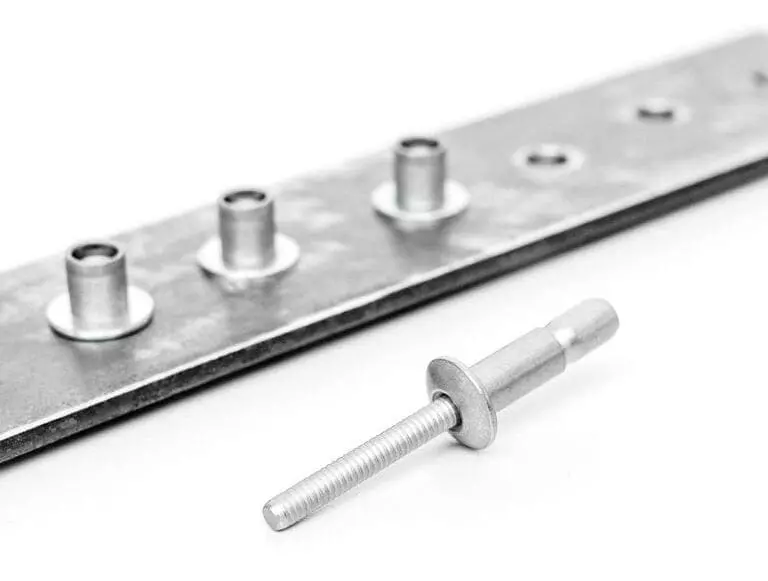
The tail of an open-end blind rivet is an open structure, which allows water vapor to enter the rivet through the core shaft breakage hole. Once the inner wall becomes damp, it is more prone to corrosion. If the core shaft remains, it will also accelerate oxidation. Therefore, open-end rivets are generally not recommended for use in damp environments such as exterior walls, roofs, and coastal areas.

⑥. Internal Corrosion Caused by Residual Core Shaft

In most cases, the mandrel of a blind rivet remains inside the rivet body. If the material is not corrosion-resistant or the environment is humid:

  • Rust inside the mandrel
  • Rust causes volume expansion
  • May lead to loose connection or rust stains on the surface

Blind Rivets, with their fully enclosed bottom structure, can avoid this problem and are the preferred choice for waterproofing projects.

What metal is completely rust proof?
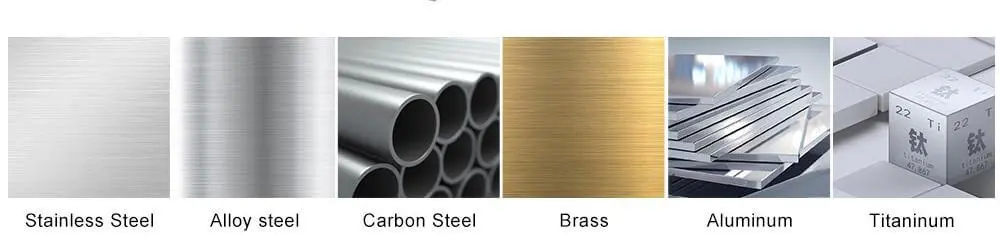
Custom Raw Material

The truth is that no metal is completely rust-proof. All metals have the potential to rust under the right conditions.

However, certain metals are highly resistant to rust because of their chemical properties and special surface treatments. Common metals are stainless steel, aluminium and copper. Their resistance to rust, in descending order, is stainless steel > aluminium > copper.

Closed End vs Open End Rivet

a. Open-End blind rivets are the most prone to rust.

When the core shaft of an open-type blind rivet breaks, the tail end of the rivet will form a completely exposed opening. This structure allows water, moisture and salt fog to more easily enter the interior of the rivet, causing the core shaft to be immersed in a humid environment for a long time. The remaining steel core shaft begins to corrode inside, and rust will gradually seep out along the surface of the rivet, forming red rust or black spots.

Therefore, the Open-End rivets have the weakest corrosion resistance among all blind riveting structures and are not suitable for use in roofs, exterior walls, coastal areas, or high-humidity environments. They are more suitable for dry indoor settings and scenarios with low corrosion risks.

b. The closed-end blind rivets have the best waterproof and anti-corrosion properties.

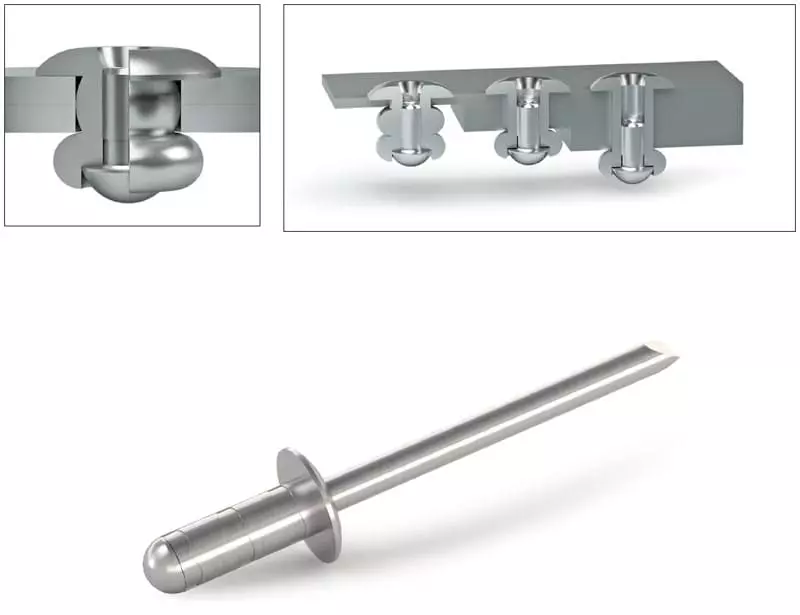
The tail of the closed-type rivet is completely sealed, and after riveting, the core shaft is locked in the metal sealing cavity. This structure can completely prevent rainwater, condensate water and water vapor in the air from entering the interior of the rivet, avoiding corrosion of the core shaft and also preventing the occurrence of electrochemical reactions inside.

The Closed-End rivets can achieve an almost 100% sealing effect. They are one of the most reliable blind riveting solutions for roofing systems, curtain wall structures, outdoor equipment, and marine environments. Their durability is significantly superior to that of ordinary open-type rivets.

c. Sealed Rivets with EPDM Washer offer stronger protection performance

Some blind rivets used in outdoor or roof systems are equipped with EPDM waterproof gaskets on the rivet heads. These gaskets can absorb the gaps in the uneven surfaces of the panels, forming a secondary sealing layer to prevent rainwater and wind pressure from entering the holes. When used in conjunction with the Closed-End structure, the overall waterproofing performance can approach the IP67 standard, significantly enhancing the corrosion resistance of outdoor systems.

This type of rivets is often used as an alternative to roof self-drilling screws, or for key structures such as metal facades and photovoltaic supports, and it maintains a stable performance over a long period of time.

Which type of blind rivets is the least prone to rust?

Arranged from weakest to strongest in terms of waterproof and anti-corrosion capabilities, it is as follows:

  1. Open-type blind rivets (most prone to rust)
  2. Common blind rivets (medium corrosion resistance)
  3. Closed-type blind rivets (excellent corrosion prevention capability)
  4. Closed-type + EPDM gasket (best, outdoor-grade waterproof)

How to Remove Rust From Rivets?

In daily engineering use, want to remove the rust on the blind rivets, the current method is divided into two main categories: physical removal and chemical removal. Next I will explain in detail the various methods of removing rust.

Mechanical Removal
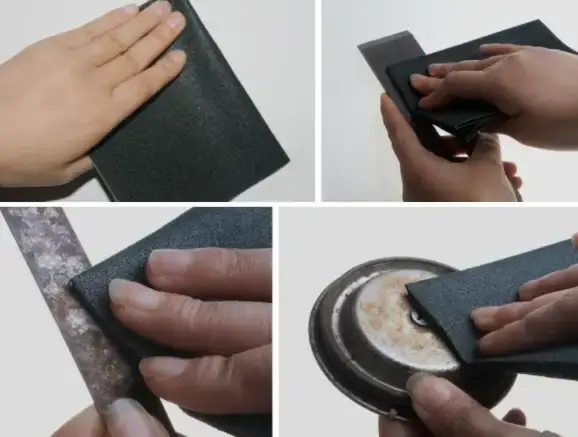
How to Remove Rust From Rivets - Mechanical Removal

If there are not many rusted rivets, you can use some items with high friction, such as wire brushes, sandpaper, grinding wheels and other tools to scrub or sand the surface of the rivets to remove the rust. This method is suitable for light rusting situations.

Chemical Removal

Rust can be effectively removed from rivets using chemical solutions or rust removers. Common rust removers include acid solutions, acid cleaners, and acid sprays. When using chemical rust removers, follow product instructions and use them safely.

Electrolytic Rust Removal

Electrolytic rust removal is a method of removing rust through an electrochemical reaction. The rivet is used as the cathode and is immersed in an electrolyte with an anode (such as an iron plate), which causes the rust to come off the surface of the rivet by the action of an electric current. This method is suitable for more serious rust cases.

Anti Rust Coatings

After the rust has been removed, an anti-rust coating such as anti-rust paint, coating or coating can be applied in order to prevent re-rusting. These coatings provide protection against re-rusting of rivets. The cost of maintenance is reduced.

How to Remove Rust From Rivets - Anti Rust Coatings

How to Prevent Rivets from Rusting?

In order to avoid losses due to the rusting of rivets, in practice, engineers use a variety of methods to prevent the rusting of rivets. Next, I will list the common rust prevention measures.

Choose Materials that Resist Rust
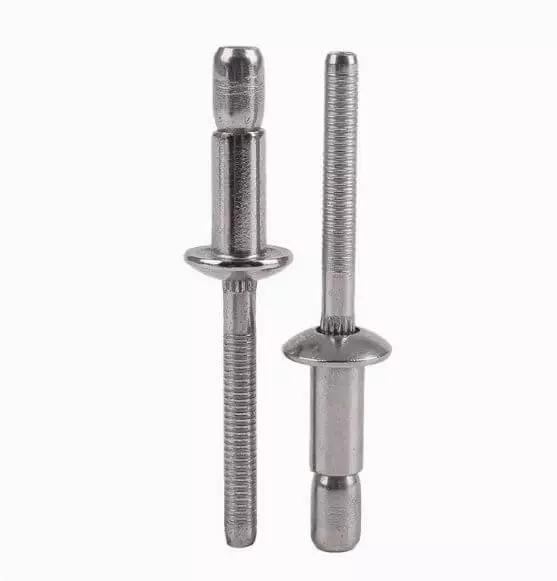
Stainless Steel Interlock Rivets

You’ve got to have a business that requires high levels of rust resistance, so when choosing raw materials at the outset, choose materials with good corrosion resistance, such as stainless steel (especially 316 stainless steel), galvanised steel, and so on. Rust-resistant materials can isolate a lot of rusting situations, and even if rusting occurs because of harsh environments, the process will be prolonged for a long time. These materials provide better resistance to rust and reduce the risk of rivets rusting.

Surface Treatment
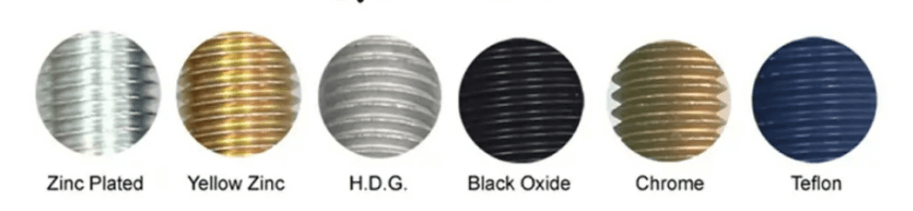
Surface Treatment of rivet

To achieve a good anti-rust effect, in addition to selecting rust-resistant performance strength raw materials. You can also carry out surface treatment of rivets, such as galvanising, electroplating, spraying anti-rust coatings, etc., to form a layer of protection, isolate the contact of oxygen and moisture, reduce the possibility of rust.

Protective Measures

If you have a project that requires a particularly high level of rust prevention, in addition to the above two measures, you can also take additional protective measures on rivets that are exposed to humid environments. For example, use waterproof tape, waterproof paint, protective sleeves, etc., so that you can effectively isolate the rivets from contact with moisture.

Regular Maintenance

In addition to preparing in advance to prevent rust, it is also important to check the condition of the rivets regularly while the project is already in operation. Any signs of rust can be detected and dealt with in a timely manner. Cleaning the surface of the rivets of dust and dirt and avoiding the accumulation of moisture will help to prevent rust and corrosion.

Use the Right Sealing Material
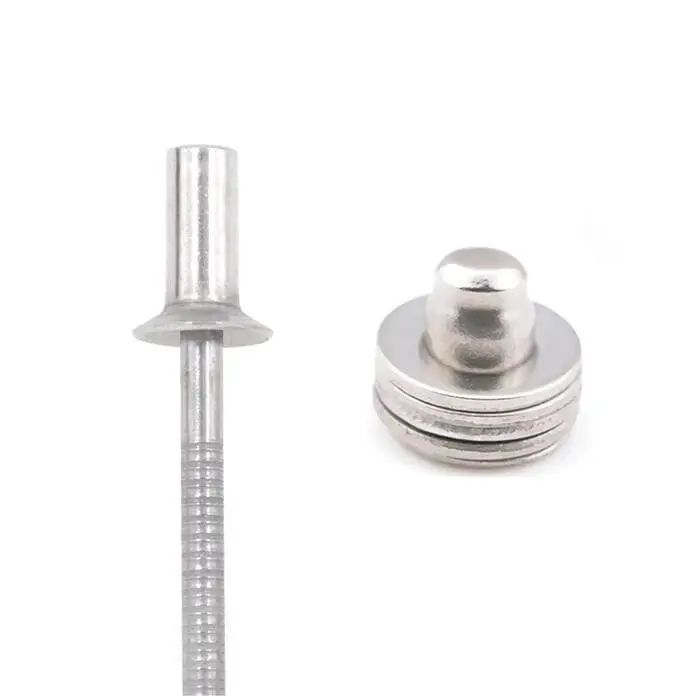
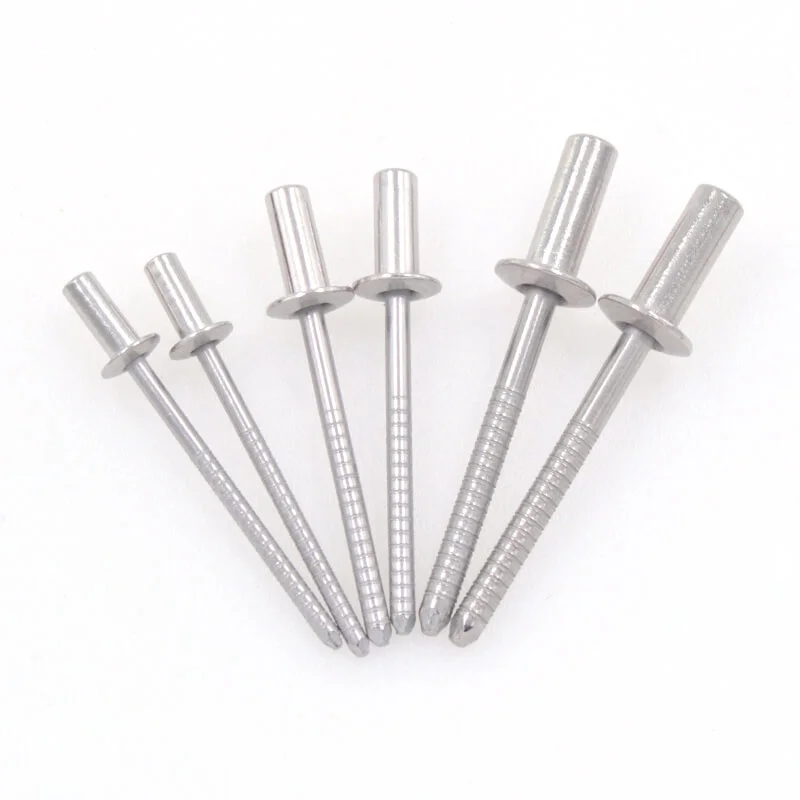
Rivmate Aluminum Sealed Type Blind Pop Rivet

In applications where sealing is required, ensure that the selection of a suitable sealing material is effective in preventing moisture from penetrating the contact surface around the rivet. For example, use closed rivets to complete the joints on your project.

FAQ: Rivet Rust & Waterproofing

Q1: Do rivets rust?

They are prone to rusting, particularly carbon steel rivets which are most susceptible to corrosion in damp or salt spray environments.

Q2: Do aluminum rivets rust?

It does not rust, but forms a harmless oxide film that actually protects the material.

Q3: Do stainless steel rivets rust?

Generally not, but slight corrosion may still occur under conditions of high salt spray or galvanic corrosion.

Q4: Do pop rivets leak?

Open-ended rivets may leak, whereas closed-ended rivets or those fitted with EPDM gaskets provide complete waterproofing.

Rivmate Expert Recommendations: How to Choose Rivets That Won’t Rust

Outdoor / High Corrosion Environment: Select Stainless Steel Closed-End Rivets

The outdoor environment has high humidity and is constantly exposed to rain and oxygen. Carbon steel rivets will rust rapidly, while stainless steel materials offer excellent corrosion resistance. The closed structure can also prevent water vapor from entering the interior, making it suitable for HVAC, outdoor cabinets, and facility supports.

Metal Roofing: Aluminum Rivets with EPDM Washer

The roof is exposed to wind, rain and temperature changes for a long time, thus having a high risk of water leakage. Aluminum has good corrosion resistance, and the EPDM gasket can achieve reliable sealing to prevent water leakage from the roof. It is a standard configuration in the metal roof industry.

Coastal Equipment: Select All-Stainless Rivets

The salt spray concentration near the seaside is very high, which is extremely corrosive to metals. Only Full SS Rivets, whose cap body and core shaft are both made of stainless steel, can ensure long-term durability and prevent failure due to galvanic corrosion or internal water accumulation.

General Interior Assembly: Select Aluminum Blind Rivets

The indoor humidity is low and there is no salt fog corrosion. The aluminum rivets are lightweight, cost-effective, and easy to install. They are the best choice for home appliances, furniture, and sheet metal assembly, offering both cost-effectiveness and stable performance.

Get Your Corrosion-Resistant Rivet Solution Today
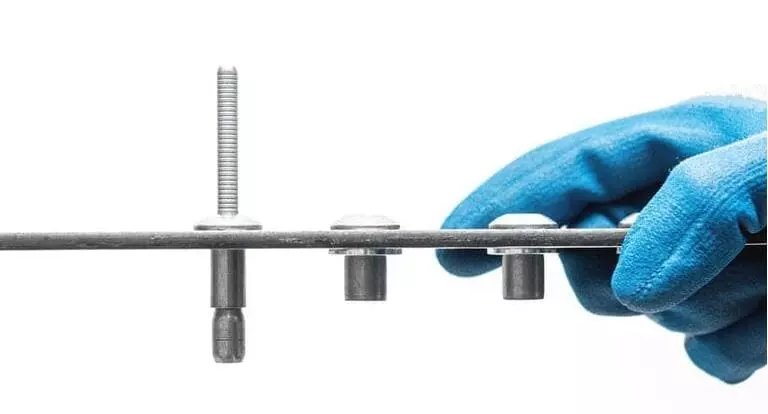
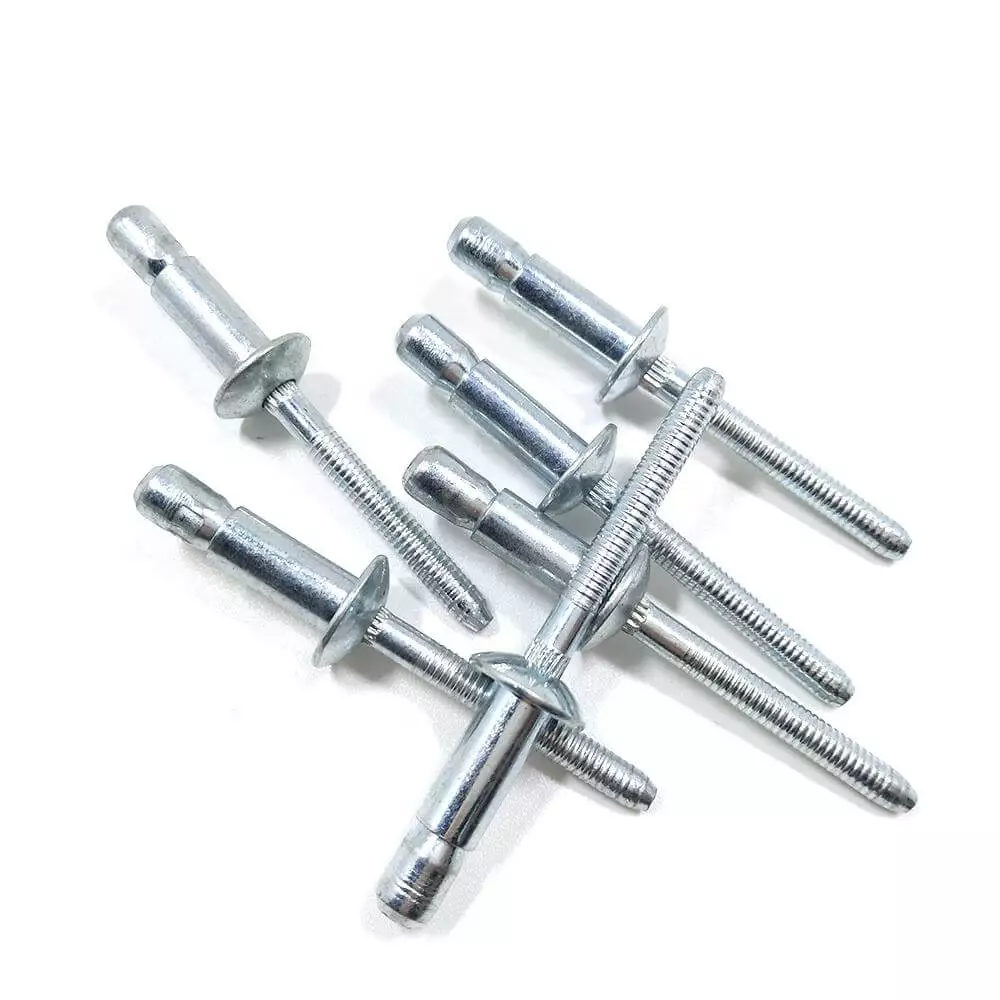
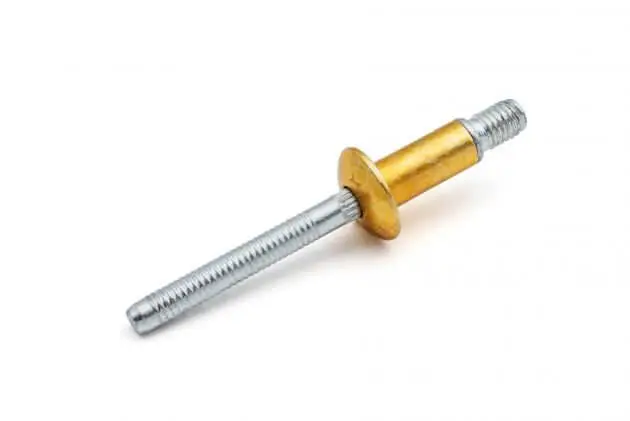
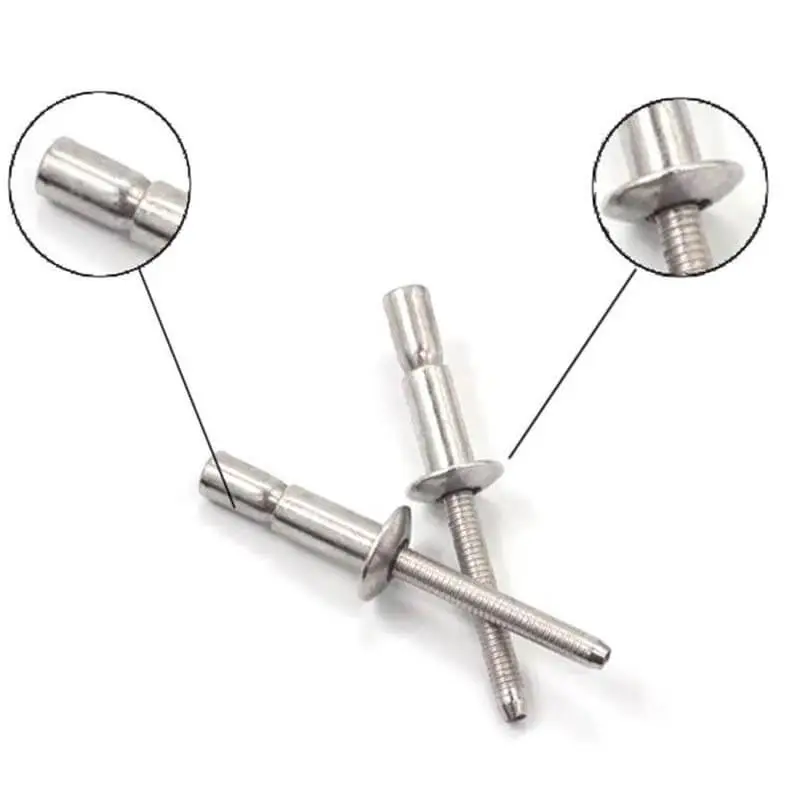
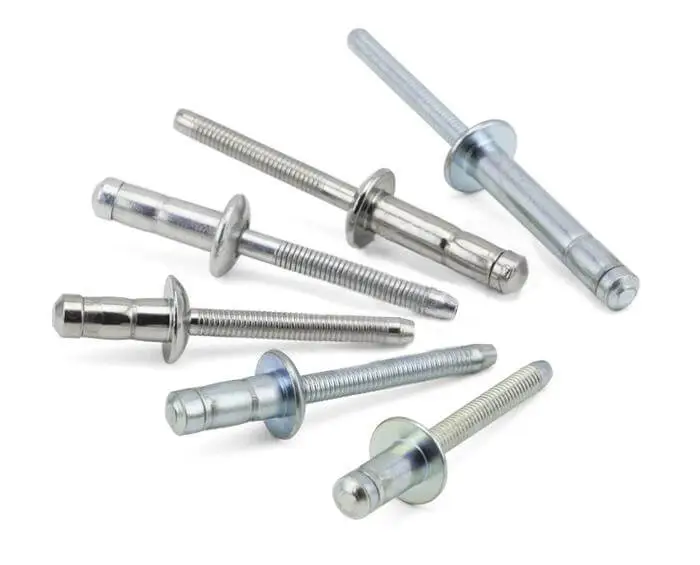
Special Tail Structure of Monobolt Rivets

If your project involves outdoor conditions, high humidity, salt spray, long-term vibration or high-intensity working conditions, then choosing the right anti-corrosion rivets is of utmost importance. The Rivmate engineering team can provide you with fast, professional and practical fastening solution support, including:

  • Free sample delivery (including various specifications such as stainless steel, aluminum, closed type, waterproof type, etc.)
  • Free evaluation of anti-corrosion options: Provide material suggestions based on environmental grades (indoor / outdoor / seaside / chemical)
  • Recommendations for board thickness / materials / clamping range matching to ensure reliable connection
  • OEM brand packaging and long-term stable supply capability, supporting cross-regional delivery

If you are looking for a truly rust-proof solution for rivets, please feel free to contact Rivmate for professional technical support and quotations.
Share:

More Posts

Get Rivets Quotes Now

Wholesale Blind Rivets from Rivet Manufacturer
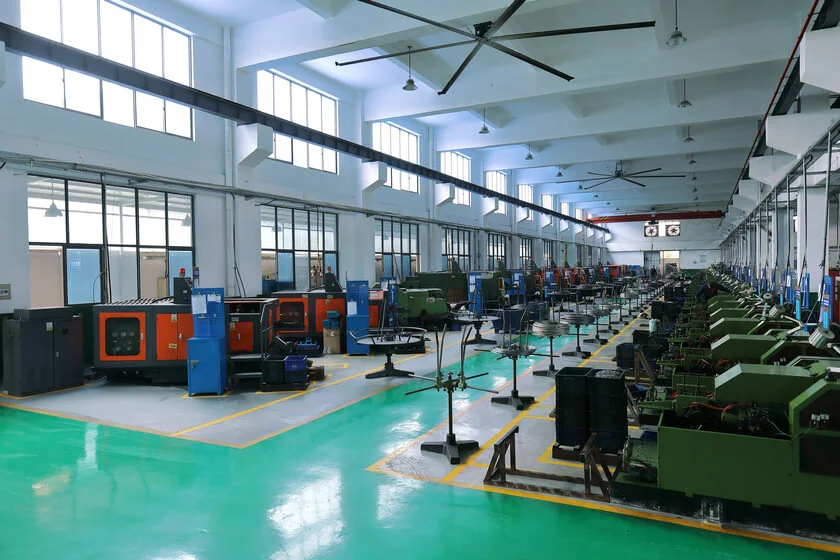
How Are Rivets Manufactured? - The Blind Rivet Production Process

Table of Contents

In modern manufacturing, rivets remain one of the most reliable and cost-effective methods for joining metals. From automotive bodies, appliance sheet metal to building curtain wall systems, various assemblies rely on blind rivets and Pop Rivets. For many engineers and purchasers, a key question often arises: How are rivets manufactured? How do they transform from a simple coil of metal wire into structural fasteners capable of withstanding high shear and tensile forces?

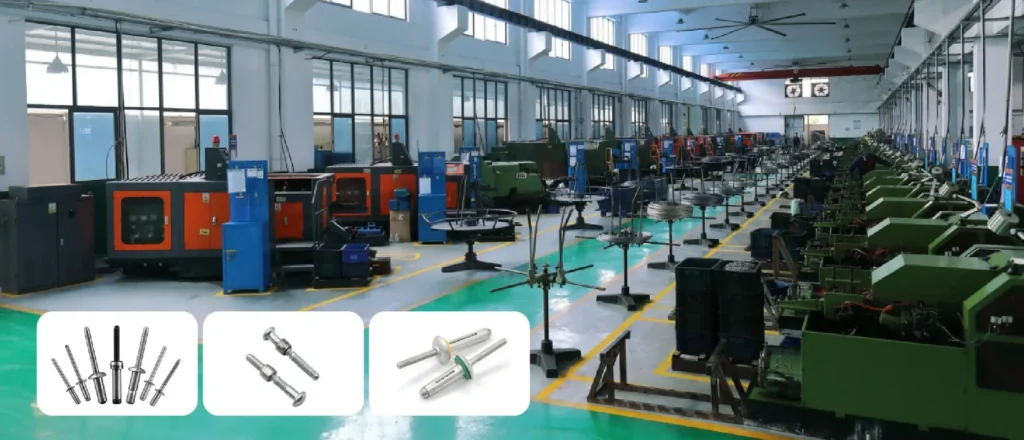
As a professional manufacturer of Blind Rivets, Rivmate possesses an ISO 9001 quality system, automated cold heading production lines, and a strict 100% strength testing process. Based on years of production and material research experience, this guide will reveal the manufacturing process and quality control logic of Blind Rivets in a clear and engineering-oriented manner.

Blind Rivet Manufacturing Overview

The manufacturing of Rivet is a highly engineered and highly automated process. The entire process starts from raw materials, goes through multiple cold heading, heat treatment, surface treatment and rigorous strength tests, and finally forms a rivet with stable mechanical properties. The following uses the industrial standard process to clearly show you the complete production path:

How Are Rivets Manufactured

① Raw Material Preparation

Rivets are typically made from aluminium, steel, stainless steel or copper wire. These wires must have:

  • Stable chemical composition
  • High purity
  • Good cold heading formability

All the wires used by Rivmate are accompanied by material certificates (Mill Certificate), including data on hardness, tensile strength and chemical composition.

② Cold Heading - The Core Process of Rivet Manufacturing

“Cold heading” is the most crucial step in rivet manufacturing. Wire is shaped into the basic form of the rivet body (Rivet Body) through high-speed impact and extrusion at room temperature. The cold heading machine performs multiple actions, including:

  • Wire Feeding
  • Cutting
  • Extrusion
  • Heading

Cold Forming - What is The Process of Making A Rivet?​

This process determines whether the rivet head is round, whether the shank is uniform and whether the strength is stable.

The advantages of cold heading over turning lie in: continuous material fibers → stronger rivets → lower costs → better consistency.

③ Head Forming

After cold heading, the head of the rivet will undergo a secondary heading process to achieve:

  • Standardized diameter
  • Smooth flange surface
  • Uniform meat thickness

The geometric accuracy of the head directly affects the fit and force-bearing performance of the Blind Rivet during assembly.

④ Shank Forming

This step ensures the stability of the shank size, including: the diameter tolerance of the shank, the verticality of the shank, and the basic size of the grip range. Modern rivet production usually corrects mold deviations through an automated detection feedback system, maintaining a tolerance of ±0.02 mm.

⑤ Annealing (Applicable to aluminum or special materials)

Some materials (such as aluminium) need to be annealed to improve plasticity and ensure more uniform expansion during installation. Stainless steel or steel core rivets usually do not undergo this step.

⑥ Cleaning & Degreasing

After the rivets are formed, the cold heading lubricant, metal powder and oil stains should be removed to ensure the adhesion of subsequent surface treatment.

⑦ Heat Treatment - A Crucial Step for Mandrels

The mandrel of a blind rivet must have precisely controlled breaking strength. Heat treatment determines the mandrel’s:

  • tensile strength
  • fracture groove stability
  • reliable breaking load (Break Load)

Insufficient heat treatment → premature fracture of the mandrel

Overheating treatment → Brittle fracture of the mandrel

Rivmate’s heat treatment line can control the hardness of the mandrel within ±2 HRC, ensuring the stability and consistency of each batch of rivets.

⑧ Surface Finishing

To enhance the anti-corrosion performance, various treatments will be carried out, such as:

  • Zinc Plating
  • Anodizing
  • Color Coated
  • DACROMET

The surface corrosion resistance can be verified by the ASTM B117 salt spray test. Rivmate’s regular materials can meet the salt spray requirements of 48 to 1000 hours.

⑨ Final Assembly

Assembly - What is The Process of Making A Rivet?​

The Body and Mandrel are combined through automated equipment. Key control points:

  • Insertion depth of the mandrel
  • Position of the fracture groove
  • Matching degree between the body and the mandrel

If the fit is too tight → difficult to install

If the coordination is too loose → the strength will decline.

Rivmate uses CCD cameras for online inspection to ensure that each blind rivet meets the specifications.

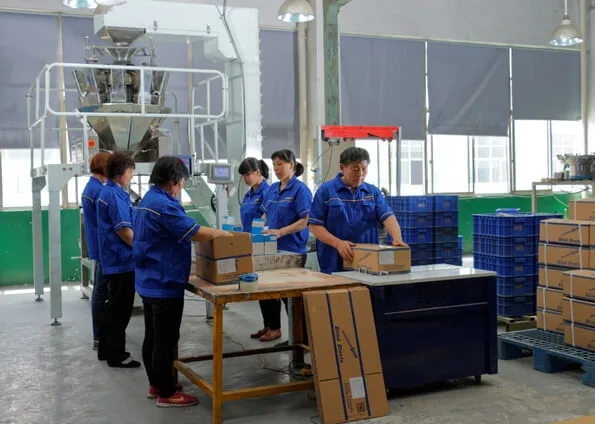
⑩ 100% Inspection and Packaging

Packaging - What is The Process of Making A Rivet?​

After each batch of rivets is completed, the following should be carried out:

  • Breaking force test
  • Verification of clamping range
  • Random inspection of dimensions
  • Appearance inspection
  • 100% core shaft residue detection (closed type)

The final packaging uses moisture-proof and shock-proof bags to ensure transportation stability.

Why Are Rivets Heated?

Heat treatment is a special treatment for blind rivets. Please note that not all blind rivets require heat treatment. You will need to judge the need for heat treatment based on your actual application.

There are many benefits to heat treating blind rivets:

  • Improve the wear resistance and deformation resistance of blind rivets.
  • Improved strength and tensile strength of blind rivets
  • Improving the toughness of blind rivets
  • Adjustment of material properties

Whether or not you want to heat treat your blind rivets, you can make a judgement in several ways.

If the application scenario of your business requires high strength of the Blind Rivet, which needs to withstand large tensile or shear loads. Then heat treatment is recommended.

In some application environments, the blind rivets will be subject to high friction or abrasion, at this time you need to heat treat them to improve their abrasion resistance and deformation resistance, so as to extend their service life.

If the blind rivets need to work in high temperature environments or extreme temperature conditions, heat treatment can make them have better heat resistance and high temperature resistance.

Of course, heat treatment can reduce the stress and improve the resistance to stress corrosion cracking of the blind rivets.

What Determines Rivet Quality?

To determine the quality of a Rivet, a comprehensive assessment must be conducted from four aspects: material, process, tolerance, and testing. The following indicators directly determine the strength, reliability, and actual assembly performance of the rivet.

a. Material Purity and Tensile Strength

High-quality rivets must be made from high-purity metal wires (aluminum, steel, stainless steel). The tensile strength of the material determines:

  • Whether the rivets expand evenly
  • Whether the rivets remain stable under shear force and vibration
  • Whether cracking occurs during installation

For example: The material strength of Rivmate is all accompanied by the original factory material certificate (Mill Certificate), ensuring the stability of each batch.

b. Precision of Cold Heading Dies

The cold heading die determines the shape and tolerance of the head and shank of the rivet. The more precise the die, the more stable the rivet will be, and the higher the flatness of the head will be.

The concentricity of the rod body will be better, and the force distribution after installation will also be more uniform. If the mold error is too large, it will directly lead to assembly jamming or insufficient clamping force.

c. Mandrel Break-Groove Tolerance

The core shaft fracture groove is the most sensitive position for the Blind Rivet. The stability of the tolerance determines:

  • Is the breaking force consistent?
  • Will the rivets break prematurely?
  • Is the assembly smooth?

The breaking force of high-quality rivets is stable within the range of ±10% of the set value. Rivmate ensures consistency by using CCD cameras to inspect the fracture grooves.

d. Head Geometry Consistency

The shape of the head determines the degree of fit between the rivet and the material, whether the force distribution is balanced, and the appearance (especially for household appliances and sheet metal). An unstable head shape may result in warping, slippage, uneven force distribution, and even failure of the seal.

e. Surface Coating Thickness

Surface treatment affects the anti-corrosion performance, rust prevention ability and salt spray lifespan. Galvanization usually requires 5–12 μm; anodizing is controlled at 7–15 μm depending on the application.

The surface is too thin → It is prone to corrosion

Too thick → Affects tolerance and assembly

f. Mandrel Insertion Depth

If the core shaft is inserted too deeply or too shallowly, it will cause problems such as unstable pull-out, jamming during riveting, and reduced strength. The insertion depth of the core shaft in high-quality products is usually controlled within ±0.05 mm.

g. Salt Spray Resistance Performance

This point must be paid attention to in outdoor projects and in high-humidity environments. Typical reference standards:

  • Ordinary galvanizing: 48 – 72 hours
  • High zinc coating treatment: 120 – 240 hours
  • Sealed stainless steel: 500 – 1000+ hours

Rivmate provides a salt spray test report in accordance with ASTM B117.

h. ISO Quality Control

If the factory manufacturing Blind Rivets does not have ISO 9001 or IATF 16949 certification, it usually cannot ensure stable quality. This is a mandatory requirement for industries with high standards (such as automotive, rail, and aviation).

Common Defects in Rivet Manufacturing

In the procurement of rivets, identifying manufacturing defects is of utmost importance.
These defects directly affect the tensile strength, clamping force, water resistance, and overall structural reliability of the rivets.
The following are the most common defects in the industrial sector, along with Rivmate’s preventive strategies in quality control.

Defect TypeDescriptionTechnical CauseRivmate Prevention Measures
Premature Mandrel BreakRivet does not fully expand; joint fails to lock properlyBreak groove too deep; unstable mandrel hardness; misaligned mandrel insertionCCD inspection of break grooves; mandrel hardness controlled at HV110–130; mandrel insertion tolerance ±0.05 mm
Off-Center Rivet HeadPoor appearance; uneven loading; reduced shear strengthWorn cold-heading dies; misfeeding during formingReplace dies every 80,000–120,000 cycles; automatic feed alignment calibration
Shank CracksRivet shank cracks during setting, causing joint failureMaterial impurities; excessive cold-heading stress; improper heat treatmentUse high-purity wire; multi-station cold heading; batch tensile testing
Uneven CoatingFaster corrosion; rough or inconsistent surface finishInadequate pre-treatment; inconsistent coating thicknessFully automated barrel/plating line; ≥72h salt spray resistance; anodizing thickness 7–15 μm
Poor Mandrel FitMandrel too loose (slips) or too tight (hard to break)Incorrect fit tolerance; uncalibrated assembly equipmentFit controlled under H9/h9 tolerance; daily calibration of assembly machines
Unstable Grip RangeJoint may loosen or under-clamp after installationInconsistent body wall thickness; unstable expansion ratio; break load variationControl body wall thickness ±0.03 mm; 100% break-load testing; batch installation validation

Rivmate Blind Rivet Manufacturing Capabilities

The production capacity of Rivmate is the fundamental source of stable quality. We adopt a fully digitalized process, with strict tracking from raw materials to the factory exit. The following key points directly reflect the factory’s strength and provide reliable basis for purchasing and engineering users.

Top Pop Rivets Manufacturer and Supplier in China
  • ISO9001 Quality System Assurance All Rivmate factories have obtained ISO9001 certification. Each batch of rivets has a traceable batch number, inspection records and process control forms. This ensures consistency in terms of size, strength and surface treatment.
  • Multi-Station Cold Heading Process The core rivets are formed in one process by a 4-6 station cold heading machine, with higher precision for the head, shank and fracture groove. The cold heading process can increase the metal density and significantly enhance the tensile and shear resistance properties.
  • Fully automatic assembly & 100% online inspection The production line of Blind Rivet adopts: automatic core insertion machine, online CCD appearance inspection, and online break load monitoring (Break Load Monitor). This ensures that the core insertion depth, break groove size and cap shape of each rivet meet the tolerance requirements.
  • Global customer coverage for OEM and engineering projects We provide long-term supply for multiple industries:
    • Automotive and rail transportation OEM
    • Metal roofing and curtain wall systems
    • Industrial equipment and cabinets
    • HVAC, electrical enclosures
    • Home appliance manufacturing

FAQ: How Are Rivets Manufactured

Q1. How are blind rivets made?

The blind rivets are formed from metal wire through a multi-station cold heading machine in a single process. The core shaft and the cap body are produced separately, then automatically inserted and assembled, and undergo strength testing, surface treatment and packaging.

Common materials include aluminium, steel, stainless steel and copper. The choice depends on strength, corrosion resistance and cost requirements.

  • Aluminum: Lightweight, corrosion-resistant
  • Steel: High strength
  • Stainless Steel: Corrosion-resistant, resistant to salt fog
  • Copper: Commonly used in electrical equipment

Q3. Are the rivets forged or machined?

Blind rivets are produced by cold forging rather than machining. Cold forging is achieved through high-speed stamping, which is highly efficient, cost-effective, and results in a continuous metal fiber flow, thereby enhancing the strength.

Q4. What is cold heading in rivet manufacturing?

Cold heading is a process where metal wire is shaped by impacting it with a mold at room temperature. This method enables the formation of the head and shank of a rivet without cutting the material. The advantages include:

  • High strength (the metal is not damaged)
  • Good dimensional consistency
  • High efficiency, suitable for mass production

Q5. How strong are pop rivets?

The strength depends on the material and diameter:

  • Aluminum Rivet: Tensile strength of 400–700 N
  • Steel Rivet: Tensile strength of 800–1,800 N
  • Structural Blind Rivet: Can reach up to 2,000–3,500 N

Purchasing cost of zinc plated blind rivets

Rivmate Rivet provides high quality sustainable riveting solutions. We are one of the leading blind rivet manufacturers in China, offering a large selection of standard blind rivets and high strength structural rivet solutions.

Our blind rivets are not only affordable but also of consistent quality. We provide our customers and partners with the best riveting solutions within their budget.

We offer a wide range of rivet types. So, if you are looking for the best Blind Rivet solution for any kind of project or business, feel free to contact us. Our engineers will get back to you as soon as possible.

📧 Product Inquiry: manufacture@world-rivet.com

🌐 Official Website: https://worldrivet.com/

Share:

More Posts

Get Rivets Quotes Now

Wholesale Blind Rivets from Rivet Manufacturer

Do Pop Rivets Leak? - The Comprehensive Guide

Table of Contents

In many industrial and structural assembly fields, blind rivets are widely used in outdoor equipment, sheet metal shells, marine structures, electrical enclosures, HVAC systems, and other types of working conditions due to their ease of operation, reliable connections, and suitability for single-sided installation. However, with the diversification of application environments, especially in scenarios involving high sealing requirements such as waterproofing, dustproofing and corrosion protection. Many engineers, assembly technicians and maintenance personnel ask the key question, “Do Pop Rivets Leak?

This question seems simple, but actually involves structural design, material compatibility, rivet type, installation process, tolerance control and other professional dimensions. Many connection structures in the actual operation of water seepage, condensation or even corrosion phenomenon, the root cause is often related to the rivets sealing ability is insufficient.

Do Pop Rivets Leak?

Custom Rivet Manufacturer in China - Custom Pop Rivets for your Project

Not all pop rivets are waterproof. Different rivet types vary significantly in construction, resulting in vastly different water resistance capabilities.

1) Standard Open-End Pop Rivets Will Leak

Open-end pop rivets feature an exposed tail end. After the mandrel breaks off, a through-hole remains, allowing rainwater and moisture to enter through gaps and openings. Consequently, open-end rivets cannot structurally achieve waterproofing and are suitable for indoor use or environments where sealing isn’t required.

(2) Closed-End Pop Rivets Prevent Leaks and Provide Complete Sealing

Closed-end blind rivets feature a sealed bottom. After the mandrel breaks, it remains locked within the cap, eliminating any potential water pathways. In roofing, exterior walls, HVAC, and similar industries, closed-end rivets deliver effective waterproofing. Rivmate testing confirms zero leakage even under high water pressure.

(3) Rivets with EPDM Gaskets Offer Superior Waterproofing

Some rivet heads incorporate EPDM waterproof gaskets. These gaskets fill micro-gaps between the hole and rivet to prevent water ingress and resist loosening due to thermal expansion and contraction. Such rivets are commonly used in outdoor panel overlaps, door/window systems, and equipment enclosures.

(4) Primary Causes of Pop Rivet Leakage

Leaks typically originate from three points: the mandrel breakout hole, the open end of the cap, and gaps between the hole and the rivet. Over-drilled holes, uneven panels, or insufficient clamping during installation can also cause leakage. Therefore, selecting the correct rivet design and ensuring proper installation quality are equally critical.

Why Some Pop Rivets Leak?

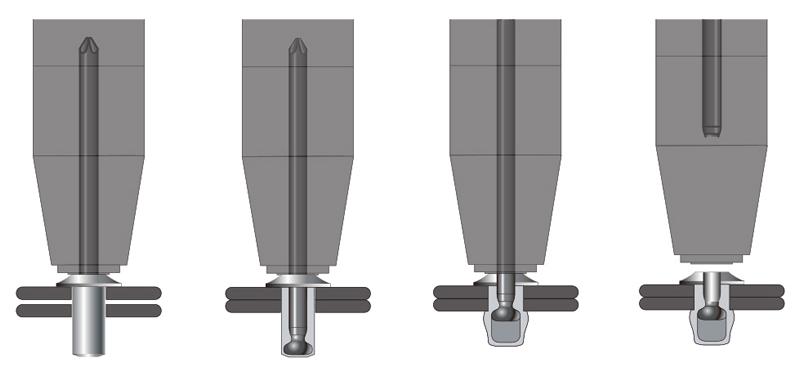
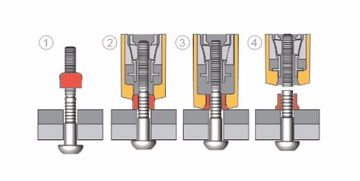
Blind rivets are blind riveted joints consisting of two parts: the rivet body and the rivet mandrel. during installation, the rivet body is inserted into a pre-drilled hole, and the rivet mandrel is pulled by the rivet gun, which causes the tail to plastically deform and compresses the connected sheet material. Once the tension reaches a certain threshold, the rivet mandrel breaks at the pre-determined position, remaining inside the rivet or falling off, thus completing the one-time connection.

Blind Rivets Sealing Principle

Structurally, standard open end blind rivets are not naturally waterproof. There are several main potential leakage paths:

Do Pop Rivets Leak - The Comprehensive Guide
  • The rivet mandrel channel runs through the entire rivet body: an open aperture is formed at the break after installation, and even if part of the rivet mandrel remains in the rivet, it does not completely seal the channel, and liquids or moisture can penetrate through it.
  • Tiny gap between the plate and the rivet: no matter how accurate the machining is, it is difficult to achieve 100% tight contact between the hole wall and the rivet body.
  • Material springback due to metal deformation in the expansion zone: The expansion and deformation of the rivet body tail during the riveting process can lead to a certain amount of material springback and the formation of micro-seam structures. This is more obvious in multi-layer material connection.
  • Thermal expansion and contraction and air pressure difference: environmental changes (such as high temperature → cooling) will lead to material contraction, triggering the original compression area to produce stress release, thus triggering leakage.

Therefore, unless a special structural design or additional sealing material processing, the standard pop rivet is not equivalent to waterproof rivet, which is why in the project with a clear sealing requirements, can not simply use conventional rivets, but must choose to have a closed structure or sealing gasket rivet type. At the same time, the sealing performance of the rivet not only depends on the rivet itself, but also need to take into account the quality of hole processing, installation process and material matching and other aspects.

What types of pop rivet are leak-proof?

What types of pop rivet are leak-proof - Closed-End Blind Rivet

Structural features: the bottom of the cap body of the rivet is completely closed design. Even after the rivet mandrel breaks, the interior will not form a through hole, effectively preventing water, gas, oil penetration through the rivet center shaft. Most closed type rivets also have high shear and tensile strength.

Application Scenarios:

  • Electronic housings, watertight housings, hydraulic equipment
  • Outdoor lighting, meter boxes, control cabinets
  • Any sheet metal structure that is sensitive to liquid or moisture penetration.

b. Sealed Blind Rivet with EPDM/NBR Washer

Structural features: In the ordinary blind rivet cap to add a ring of high elasticity waterproof washer (common materials for EPDM, nitrile rubber, etc.). In the riveting process, the washer will be pressed on the joint surface, sealing the hole, effectively preventing liquid penetration through the hole wall gap.

Application Scenario:

  • Air conditioner shells, refrigerator panels, outdoor hoods
  • Rain gutters, aluminum composite panel curtain walls, traffic signs
  • Structural components requiring primary sealing in low and medium pressure environments
Sealed Blind Rivet with EPDMNBR Washer
What are monobolt rivets

Structural Features: Combines a structural rivet with a sealing feature. Typically with a high tensile strength design (for high load connections), with a locking core mechanism and metal/glue encapsulation components to keep the entire rivet system highly dense and closed after the completion of the core break.

Application Scenario:

  • Heavy-duty equipment, watertight pressure chambers, truck compartment floors
  • Bridge components, ship structure, wind turbine nacelle outer cover
  • Composite joints that require high strength + corrosion resistance + sealing performance

Rivet Waterproof Performance Comparison Table

Rivet TypeLeak-Proof RatingTypical Use Case
Open-End Blind Rivet✘ NoBasic sheet metal, no waterproofing
Closed-End Blind Rivet✓ Partial (IP65)Control boxes, HVAC ducts, LED housing
Sealed Rivet with Washer✓ Good Surface SealOutdoor enclosures, appliance panels
Structural Sealed Rivet✓✓ Full Seal (IP67/IP68)Vehicle frames, marine, heavy equipment

How to choose a riveted joint that is not susceptible to water penetration?

Choosing the right type of rivet is only the first step when designing or repairing a structure that needs to be watertight, dusttight or corrosion resistant. The real realization of watertight riveted joints must also be combined with the actual use of the scene and the correct installation standards. The following are representative of the use of engineering practice and the corresponding practical suggestions:

1. Define the environment of use: outdoor exposure ≠ humid intervals ≠ waterlogged confinement.

Different environments have different definitions of “waterproof”. For example, an outdoor communication box only needs to withstand rain, so rubber gasket type rivets can be used. For an air conditioning enclosure that needs to prevent condensation from flowing back in, it is recommended to use closed type rivets. If it involves a long time underwater use (such as the hull of the ship, diving equipment), it must be used structural sealing type rivets + panel sealant composite program, and IP rating test.

2. Hole size control is key: interference fit is better than loose fit

Sheet Metal Blind Fasteners : A Complete Buying Guide

The sealing ability of blind rivets is highly dependent on the tolerance of the hole diameter. Recommended hole diameter should be slightly larger than the diameter of the rod 0.1-0.2 mm, to ensure that the deformation section fully affixed to the wall of the hole, to avoid the emergence of gaps. If the hole is too large, the deformation is not uniform, will lead to cap sealing failure, the gasket can not be fully compressed, thus forming a water seepage path.

Rivet hole diameter standard can refer to “ Metric Blind Pop Rivet Hole Size Chart ”. 

3. When selecting gasket type rivets, check the gasket material and compression status.

It is recommended to use EPDM or Nitrile Rubber (NBR) for the gasket, taking into account the weather resistance and resilience. When installing, use a rivet gun with clamping torque control or a tension feedback tool to ensure even pressure on the gasket. If a pneumatic rivet gun is used and no limit is set, it is easy to press through the gasket due to excessive core pulling, resulting in seal failure. 

4. Recommended auxiliary sealant for composite structures

For multi-layer metal, metal + plastic, coated sheet and other joint structures, even if closed type rivets are used, a ring of sealant (e.g. butyl, silicone) should be applied around the rivet holes before installation. This can enhance the watertightness of the interface, to avoid the risk of long-term leakage due to the rebound of the material, the warping of the inter-layer plate.

5. Establishment of installation process standardization

It is recommended that companies implement the following SOP process for products with waterproofing requirements:

  1. Rivet type and hole size preset table.
  2. Rivet position inspection + photo archive before sealing.
  3. Regular use of water spray test, air tightness test or salt spray test to verify the sealing performance.
  4. Set up installation feedback record mechanism (rivet gun feedback tension, broken core monitoring).

Choosing a waterproof pop rivet is just the foundation; ensuring the accuracy of the hole diameter, using the right gasket and sealant, and standardizing the installation process are the guarantees for building a truly watertight structure. For enterprises, this is not only about product performance, but also directly affects customer trust and later maintenance costs.

Where Waterproof Rivets Are Required?

Metal Roofing

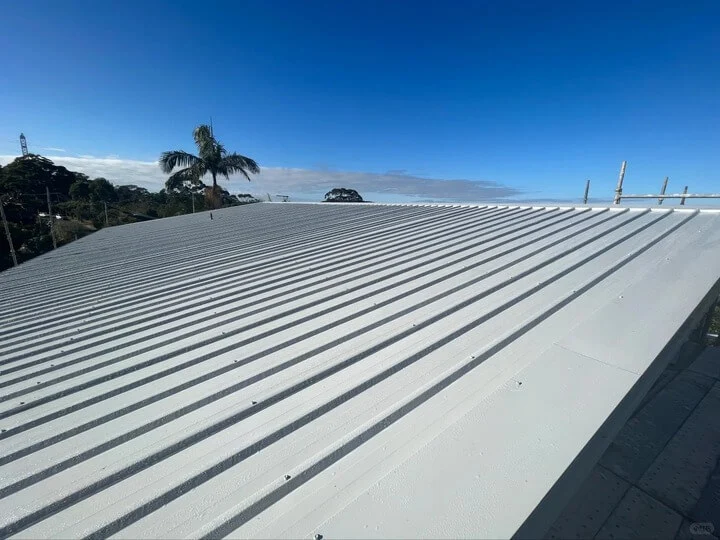
Roofing systems endure prolonged exposure to rainwater, wind pressure, and temperature fluctuations. Open-ended rivets allow rainwater to gradually seep through rivet holes and lap joints, leading to moisture penetration of insulation layers, corrosion of steel structures, and even leakage complaints. Therefore, metal roofs typically employ closed-head rivets + EPDM washers.

Blind Rivets for Roofing - Roofing Rivets - Rivmate Rivet

Cladding / Facade Systems

Curtain walls and metal cladding panels must not only prevent rainwater penetration into the wall structure but also block moisture intrusion into the insulation layer. Leakage around rivets can cause wall mold, insulation failure, and even compromise structural longevity. Professional facade systems therefore employ waterproof rivets or sealed riveting solutions.

HVAC Housings & Ducting

Condensation and pressure fluctuations exist inside and outside air conditioning units, heat exchanger housings, and ductwork. If rivets are not sealed, condensation can infiltrate the interior, corroding fans, motors, or control components. Waterproof rivets reduce maintenance frequency and enhance equipment reliability.

Truck Bodies / Trailers / Bus Panels

Bom Rivets Applications - Trucking & Trailers

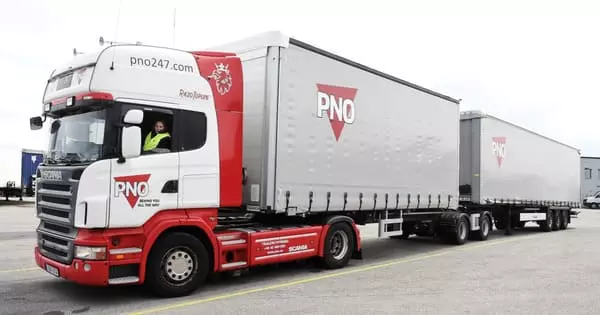
Truck bodies, trailers, and bus panels endure prolonged exposure to rainwater, muddy water, and road spray. Non-waterproof rivets allow water ingress into the sandwich layers, causing steel plate corrosion and wooden floor rot, shortening vehicle lifespan. Consequently, body manufacturers predominantly use closed-head or structural waterproof rivets.

Marine & Outdoor Equipment

Marine equipment, dock facilities, outdoor enclosures, and mounting brackets endure high salt spray and humidity. Water ingress at rivet points allows corrosion to rapidly spread around the hole. These applications typically require stainless steel waterproof rivets + sealing washers to ensure long-term stability.

Frequently Asked Questions About Pop Rivet Waterproofing

Q1. Do pop rivets leak?

Yes, they can leak. Most open-end pop rivets do not inherently possess a sealing structure. The hole left where the mandrel breaks allows water to seep in along that point.

Only closed-end rivets or rivets with sealing washers provide true waterproofing.

Q2. Are pop rivets watertight?

Not all pop rivets are watertight. Standard open-end rivets are not watertight; only closed-end rivets provide a water and vapor seal. For applications like roofing, exterior walls, or outdoor equipment, Closed-End Rivets + EPDM gaskets must be used to achieve a long-term seal.

Q3. How to waterproof a pop rivet?

Three most effective methods:

  • Use Closed-End Blind Rivets
  • Add EPDM / Neoprene waterproof washers to the rivet head
  • Enhance sealing at the hole with sealant or Butyl Tape

Combining these three methods achieves waterproofing close to IPX7 level.

Q4. What rivets are best for metal roofing?

Metal roofing requires waterproof rivets. Rivmate recommends:

  • Closed-End Blind Rivet + EPDM Washer
  • Prioritize Aluminum Cap + Stainless Steel Core (Al/SS) or all-stainless steel construction
  • UV-resistant EPDM washers enhance longevity

This represents the industry’s most versatile and reliable roofing fastening solution.

Conclusion: How to Choose Leak-Proof Pop Rivets?

Closed End vs Open End Rivet

To prevent water seepage, the key lies not in the “rivet brand” but in selecting the correct structural type. Different environments demand varying levels of waterproofing, so the rivet structure must match the application scenario. Below are the most practical selection principles engineers have identified based on extensive project experience:

1. Outdoor Environments → Use Closed-End Rivets

Outdoor structures endure prolonged exposure to rain and moisture. Standard open-end rivets are prone to water ingress through the hole at the mandrel break point. Closed-end rivets feature a fully sealed bottom, effectively blocking moisture penetration. They are the fundamental choice for all outdoor applications.

2. Roofing Systems → Closed-End Rivets + EPDM Washers

Metal roofs and exterior walls demand the highest waterproofing standards. We recommend closed-end rivets paired with EPDM waterproof washers. EPDM resists UV exposure, temperature fluctuations, and aging, maintaining reliable waterproofing for over a decade. This combination is the industry standard for roofing.

3. High-Strength Applications → Structural Waterproof Rivets

Structures like vehicle bodies, machinery housings, and control cabinets endure vibration and load. These scenarios demand not only waterproofing but also high shear resistance and vibration tolerance. Structural waterproof rivets feature mechanical locking mechanisms to ensure long-term stability without loosening, offering a safer solution.

4. Indoor Applications → Open-End Rivets (Highest Cost-Effectiveness)

For indoor sheet metal, enclosures, furniture hardware, and similar scenarios without waterproofing requirements, open-end rivets offer the lowest cost, fastest installation, and excellent compatibility. They provide stable connection performance in dry environments.

Get Waterproof Rivet Solutions for Your Project

Rivmate Rivet Factory in Jiangsu, China

If you’re seeking a waterproof rivet solution that is truly leak-proof, stable, reliable, and built for long-term use, Rivmate’s engineering team can provide comprehensive technical support. We not only supply samples of waterproof structural blind rivets but also perform hole diameter and clamping force verification based on your panel thickness and structural requirements, ensuring optimal riveting performance.

We simultaneously provide ISO-compliant test data, giving you greater confidence in project evaluation and quality validation. For projects requiring long-term supply or branded packaging, we also support OEM packaging, annual supply agreements, and inventory management services.

Contact Rivmate today and eliminate concerns about leaks, fatigue, or unstable assemblies in your projects.

📧 Product Inquiry: manufacture@world-rivet.com

🌐 Official Website: https://worldrivet.com/

reference

Share:

More Posts

Get Rivets Quotes Now

Wholesale Blind Rivets from Rivet Manufacturer

Blind Rivets Price Per Box : How Get Price Per Box of Rivets?

Table of Contents

Do you know how to determine blind rivets price per box? Do you know what factors affect the price of a box of rivets? Through this article, you will learn all this information.

What Determines the Price Per Box of Blind Rivets?

1. Material Type

Custom Raw Material

The rivet material is the primary factor determining the price of blind rivets. The raw material costs of aluminum, steel, stainless steel, and copper vary significantly. Aluminum is lightweight and easy to process, so it is the cheapest; carbon steel has a medium price but high strength; stainless steel has the highest cost because of the expensive material, high processing hardness, and high mold wear. Copper rivets are for special purposes, especially for electrical or corrosion-resistant applications, so they are also expensive. The material not only affects the price but also determines the tensile, shear, and corrosion resistance grades of the rivets.

2. Rivet Type

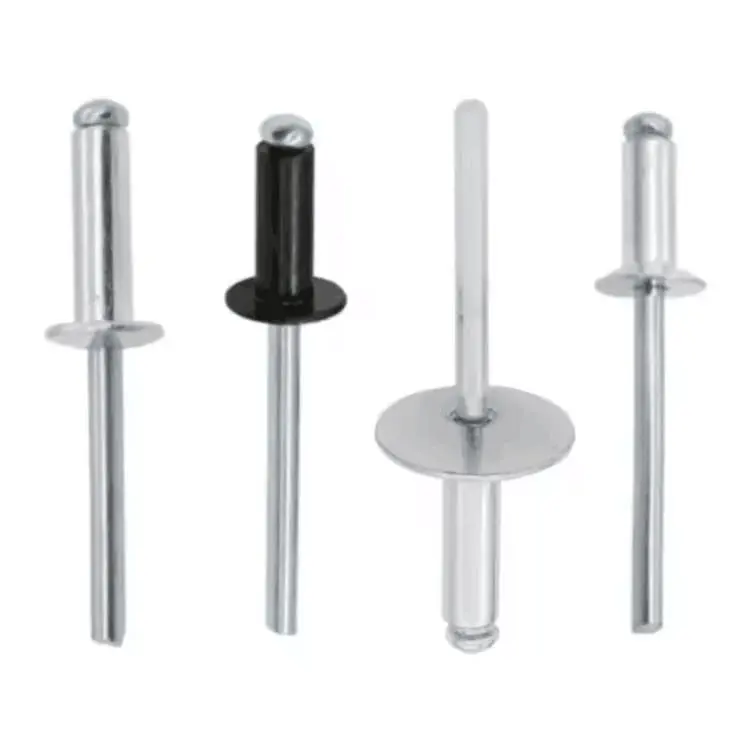
Large Flange Open Type Blind Rivets
open-type blind rivet
Rivmate Sealed Blind Pop Rivets
closed-type
Interlock Structural Rivet

The more complex the structure, the higher the price.

The open-type blind rivets have the simplest structure and high production efficiency, so they have the lowest price.

The closed-type requires a bottom sealing structure, which has more manufacturing processes and significantly higher costs.

Structural rivets (such as Monobolt, T-Lok) have internal mechanical locks and require higher processing accuracy, so their prices are nearly 3-6 times that of the open-type. The structural type directly affects the performance of the rivet in terms of waterproofing, vibration resistance, and strength. Therefore, the cost differences among different structures are in line with engineering logic.

3. Dimensions: Diameter & Length

The larger and longer the rivets are, the more materials are needed, the higher the processing load is, and the cost naturally increases. Common diameters include 3.2, 4.0, 4.8, and 6.4 mm. As the diameter increases, the weight of each rivet increases exponentially. Additionally, the diameter of the mandrel also needs to be increased accordingly, and the steel used for the mandrel and the process of breaking the rivets also require higher standards. Large-sized rivets are often used in structural components, so additional quality inspections are required, which is also part of the cost.

4. Pack Size

Blind Rivets Price Per Box
Big-Package for Rivmate Rivets

Blind rivets are usually packed in units of 250, 500, or 1000 pieces. The larger the quantity per box, the higher the price per box, but the cost per individual rivet is often lower because the labor for packaging and the materials for the outer box are spread out. If the rivets are packaged by an OEM factory (such as 5000 pieces/bulk), the price will be further reduced. If the purchaser requires colored box packaging or customized labels, there will be additional charges.

5. Quality Grade

Whether the blind rivets comply with ISO, DIN or aviation standards will directly affect the price. High-grade rivets must pass rigorous tests for tensile strength, shear strength, hardness, salt spray, and dimensional tolerance, and require continuous batch tracking (Traceability). All these require additional equipment and quality inspection procedures. The higher the quality grade, the lower the scrap rate, but the quality inspection cost is higher, so the price will also increase.

How Many Pieces of Blind Rivets Per Box?

There is no precise answer to this. This is because the package size is not consistent from one rivet supplier to another. The number of rivets in each box can also vary due to a number of factors. These include the following factors:

  1. Blind Rivet Sizes and Types
  2. Packaging specifications provided by the rivet manufacturer
  3. Customised requirements

If you want the box packaging of rivets to meet your own requirements, you can think of your rivet supplier to make the appropriate customisation requirements. If you don’t know the exact number of blind rivets in each box, you can directly ask your rivet supplier and they can provide the exact quantity information.

Next, I will give you a detailed overview of the number of rivets in the different cases of the Rivmate Rivet.

1.Blind Rivet Sizes and Types

If the size of your rivet supplier’s box package is fixed, then how many rivets are in a box is related to the size of the box.

For example, when the size of the box is 525mm*280mm*145mm, if the size of your rivets is 2.4*6/2.4*8, then the number of rivets in a box is 20,000.If the size of your rivets is 3*12, then the number of rivets in a box is 10,000.So in the case of a fixed size of the box, the bigger the size of the rivets, the number of rivets in a box will be the less.

2.Packaging Specifications

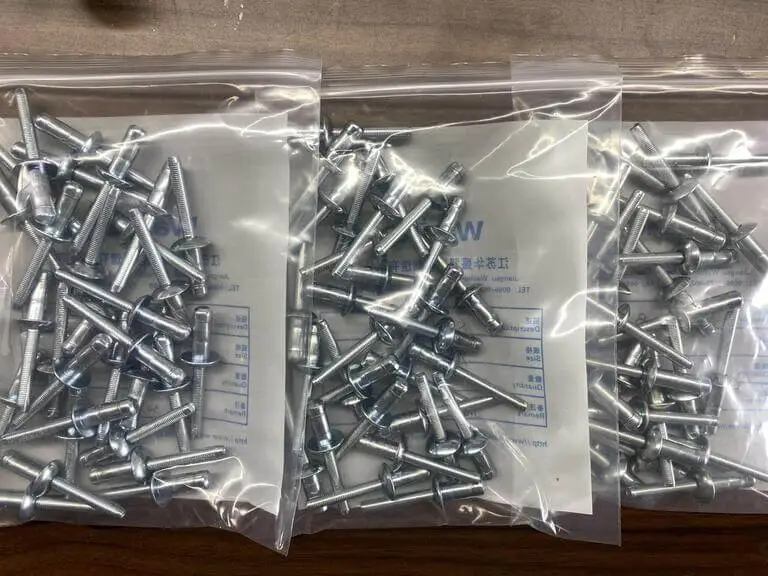
Blind Rivets Price Per Box - The Bags for Blind Rivets
Blind Rivets Price Per Box - The Small Box for Blind Rivets

Package sizes are not uniform across different rivet manufacturers. So the number of rivets per box packed by different rivet suppliers is also not consistent. Next I will use Rivmate Rivet as an example of rivet package size.

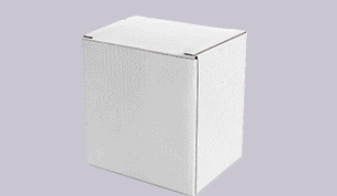
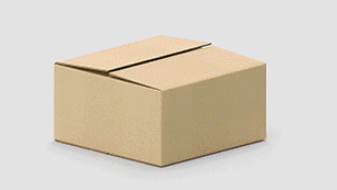
At Rivmate, rivets are generally packaged in both small box packaging and large box packaging. The small box packaging size is generally 130mm*100mm*130mm and 130mm*100mm*90mm. Depending on the length of the rivets to decide which size of box packaging to use.

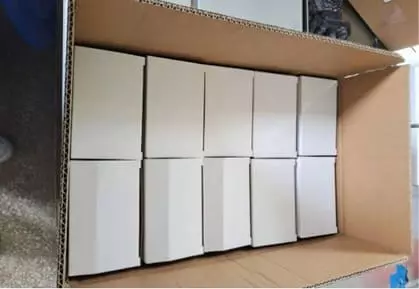
If you purchase up to 5,000 rivets, then Rivmate will package them in a combination of small and large packages. For example, if a small box of 130*100*130 can hold 2,000 rivets with a diameter of 2.4mm, then you can use a large package for the small box. A large package can hold about 10,000-20,000 pcs.

Blind Rivets Price Per Box - The Big Box for Blind Rivets

Blind Rivets Price Per Box: Industry Price Range Table

The following prices represent a global industry reference range, calculated based on material costs, processing difficulty, structural type and packaging quantity. These prices do not include brand premiums and can be used as a basis for estimating procurement budgets.

Material & Rivet TypePack Size (pcs/box)Industry Price Range (USD/Box)Notes
Aluminum Open-End Rivet1000 pcs$4 – $9Lowest cost; fasteners for general sheet metal
Aluminum Closed-End Rivet500 pcs$8 – $15Waterproof design increases production cost
Steel Open-End Rivet1000 pcs$6 – $12Higher strength; zinc-plated surface treatment
Steel Closed-End Rivet500 pcs$10 – $18Better corrosion and sealing performance
Stainless Steel Rivet (304/316)500 pcs$18 – $32Highest material cost and tooling wear
Colored / Painted Rivet500 pcs$12 – $22Extra coating steps; used in roofing & cladding
Structural Rivet (Monobolt / T-Lok)250 pcs$15 – $35High strength; mechanical-locking design
Large Flange Rivet1000 pcs$7 – $14Larger head area increases raw material usage
Peel-Type Rivet500 pcs$10 – $20For soft materials; complex forming process
Tri-Fold Rivet500 pcs$12 – $22Multi-leg expansion increases cost

How to Compare Blind Rivets Price Per Box?

When purchasing Blind Rivets, many users will notice that the quotations from different suppliers vary significantly. However, the price difference does not entirely reflect the quality; rather, it is influenced by multiple hidden factors.

①. Pack Size Must Match

The common packaging sizes offered by different manufacturers are 250 / 500 / 1000 pcs. If you only look at the “price per box” without considering the quantity, it can easily lead to misinterpretation. Before making a comparison, please ensure that you evaluate uniformly based on the cost per piece.

②. Check Material Grade & Strength Rating

Official suppliers will clearly indicate: Without these data, even if the price is very low, it is impossible to determine its reliability. The price of high-strength structural rivets must match their performance; otherwise, it would be considered “overpriced”.

③. Is Shipping Included?

In international procurement, the proportion of freight charges can reach 15–40%, especially for heavy steel rivets, stainless steel products, and small batch orders. Some suppliers include the freight charges in their quotations but do not disclose this information; while others offer low prices but have extremely high freight charges.

When making comparisons, it is essential to clarify whether the quoted price is FOB, CIF or DDP. Otherwise, it will be impossible to conduct a comparison on the same basis.

④. Hidden Costs: Brand & Distribution Markups

IATF 16949 Certificate - Rivmate Certificate

Common hidden costs include:

  • Brand premium (Price Premium)
  • Markup for multi-level distribution channels
  • Packaging and labeling charges
  • Certification fees, third-party testing fees
  • Storage management surcharge

Especially for cross-border procurement, some trading companies will add 10 to 30% as channel profits. Rivmate suggests: Give priority to factory direct supply or first-level agency to avoid multiple price hikes.

How to Get the Best Price for Blind Rivets?

To truly reduce the procurement cost of Blind Rivets, it is not just about pursuing the “lowest unit price”. From the perspectives of engineering and supply chain management, professional procurement will comprehensively consider multiple dimensions such as batch size, packaging, supply chain structure, standardization of specifications, annual plan etc.

a. Order in Bulk for Tiered Pricing

The cost of Blind Rivets includes material cost, processing cost, packaging cost and logistics cost. When the purchase volume increases, the average cost at the manufacturing end decreases. The larger the batch size, the lower the unit price, which is the most direct way to reduce the price. Discount reference:

30,000 – 50,000 pieces: 5 – 8% discount

More than 100,000 pieces: 10–15% discount

OEM customer: Negotiable annual strategic price

Small-Package for Rivmate Rivets

b. Optimize Packaging to Reduce Freight Cost

Transportation costs are usually calculated based on volume or weight. By adjusting the packaging method, it is possible to significantly reduce logistics costs. Example:

  • Change 1000 pcs/box to 500 pcs/box, which can reduce the voidage rate.
  • Use denser cardboard boxes → Reduce the volume weight.
  • Combine multiple boxes into an outer box → Reduce the international transportation cost.

By optimizing the packaging structure, Rivmate can typically help customers reduce transportation costs by 8-15%.

c. Buy Directly from Manufacturers

Blind Pop Rivet Manufacturer and Supplier in China

The prices of Blind Rivets vary significantly. One of the main reasons for this is: factory → trader → distributor → agent → customer. Each additional layer adds to the profit. Direct supply from the factory can reduce: middle markups, secondary warehousing costs, additional packaging fees and label costs. Usually, this can save 15–25% of the procurement cost.

d. Choose Standard Sizes to Avoid MOQ Fees

Non-standard specifications (such as color, material combination, and size) usually result in:

  • Higher minimum order quantity (MOQ)
  • Expedited fee
  • Mold or tooling cost
  • Longer delivery time leading to hidden inventory cost

It is recommended to preferentially use: 3.2 / 4.0 / 4.8 mm standard diameters; conventional combinations of aluminum, steel, and stainless steel; and mainstream lengths in the market (6 mm / 8 mm / 10 mm). This will ensure a more stable price and avoid additional costs.

e. Plan Annual Purchasing with Forecast

Many enterprises make monthly purchases but do not have annual forecasts. This prevents suppliers from preparing materials in advance, thereby increasing costs such as material price fluctuations, rush order production surcharges, and unstable logistics and warehousing expenses. If annual forecasts are provided, suppliers can prepare materials in advance and lock prices. Usually, this can result in: annual contract prices, fixed discounts (8–12%), priority production scheduling, and shorter delivery periods. For industries that have been using Blind Rivets for a long time, this is the most worthwhile strategy to implement.

How to Get an Accurate Price Per Box?

What Size Drill Bit for 18 Rivet

To obtain the precise quotation for each box of Blind Rivets, clear and complete engineering parameters must be provided. The price of Blind Rivets is not only determined by the material and size, but is also influenced by multiple factors such as plate thickness, structural requirements, waterproofing grade, and purchase quantity. To avoid price deviations, it is recommended that users prepare the following key information before making an inquiry:

1. Total Material Thickness:

This is the crucial data that determines the length of the rivet and the grip range. The greater the plate thickness, the longer the rivet and the higher the cost.

2. Rivet Diameter:

Common specifications include 3.2 / 4.0 / 4.8 / 6.4 mm. The larger the diameter, the more material is required, and thus the price will also change significantly.

3. Rivet Length:

For rivets of the same diameter, the longer the length, the higher the unit price. Precise length requirements can prevent duplicate quotations.

4. Material Requirements

The unit costs of different materials vary significantly:

Aluminum → The cheapest
Steel → Medium
Stainless Steel → The most expensive
Aluminum cap + steel core → Better overall cost performance

The material directly affects tensile strength, anti-corrosion performance and price.

5. Is waterproof sealing required?

If you choose to use closed-end rivets, the unit price will be 20-40% higher than that of open-end rivets. Additionally, if you require EPDM waterproof gaskets, this will also affect the total price.

6. Annual Consumption

The larger the purchase volume, the more likely the supplier is to offer a stepped discount. Rivmate’s experience is that: For a volume of over 100,000 units per year → The price can be reduced by 10–15%.

7. Packaging Requirements

The common packaging quantities of blind rivets include:

250 pcs / box
500 pcs / box
1,000 pieces per box

The packaging form will affect: the cost per box, the volume and weight for transportation, and the cost of the factory label. Clearly defining the packaging method can make the quotation more accurate and standardized.

Just send the above parameters to Rivmate: including plate thickness, diameter, length, material, waterproofing requirement, annual usage and packaging method. Our engineering team will provide the accurate price per box of Blind Rivets (Price Per Box) and technical advice within 4 hours.

Get Your Custom Blind Rivet Quote Today

Pop Rivet Distributor in China - Rivmate Rivet

Choosing the right blind rivets not only affects the cost, but also influences the structural stability, durability and maintenance cost. Rivmate offers complete technical and procurement support to industrial users, enabling you to obtain accurate prices, professional selection and high-quality samples in the shortest time. We can provide you with:

  • Technical Support: Provide engineering-level selection recommendations based on plate thickness, material, load, and environmental conditions.
  • Application Recommendations: Offer customized solutions for industries such as sheet metal, appliances, construction, automotive, HVAC, etc.
  • Free Sample Shipping: Allow you to evaluate the riveting effect in actual trial installation environments.
  • Multiple International Quotation Methods: Choose from EXW / FOB / CIF at will, meeting the needs of global supply chains.

If you are looking for the exact Box price of Blind Rivets or wish to assess the best specifications, please feel free to contact the Rivmate engineering team at any time. We will assist you in achieving the best balance between procurement and technology, ensuring that every rivet is a good value for money.

📧 Product Inquiry: manufacture@world-rivet.com

🌐 Official Website: https://worldrivet.com/

Share:

More Posts

Get Rivets Quotes Now

Wholesale Blind Rivets from Rivet Manufacturer

Best Rivets for Sheet Metal : 7 Types Rivets for Sheet Metal

Table of Contents

During industrial production, engineers in various industries use a number of unique fasteners to connect multiple sheet metals and components. What are the best rivets for sheet metal? Do you know the types of rivets used for sheet metal?

Different types of rivets usually have different designs, materials and properties. This article is a comprehensive guide to sheet metal rivets. By reading this article, you will learn about the seven most common types of rivets used for sheet metal assembly, as well as the best rivets for sheet metal.

What Are Sheet Metal Rivets?

In thin plate structures, choosing the right fasteners is of utmost importance. Especially within the range of 0.3–3.0 mm for the plates, screws often cannot provide a stable and reliable connection.

Why are thin plates not suitable for screws?

The thin plate itself has a small amount of material and low stiffness, so it will encounter various problems in environments subjected to force or vibration:

  • Easy to come loose: The thickness of the thin plate is insufficient, and the depth of the thread engagement is not adequate, resulting in a decrease in locking force.
  • Significant plate deformation: When tightening the screws, they are prone to being pressed in or deformed, affecting the appearance and structure.
  • Insufficient thread strength to provide adequate support: Only shallow threads can be formed on the thin plate, resulting in limited load-bearing capacity.
  • Prone to loosening: In vibration conditions (HVAC, mechanical equipment, vehicles), the probability of screws loosening is higher.

These issues indicate that: Screws are not the ideal fastening method for thin plates, unless additional processes such as rivets are employed.

Why is Rivets the Best Choice for Sheet Metal?

applications of self clinching fastener

The structural characteristics of rivets are naturally well-suited for thin plate applications, especially blind rivets.

  • Blind Installation No contact with the back side is required. It is highly suitable for closed structures such as boxes, shells, and pipes.
  • Provide stable and persistent clamping force The riveting process creates a constant pressure through mechanical deformation, which is more reliable than threaded locking.
  • No Thread Engagement Required No need for threaded engagement, so the material thickness is no longer a limitation.
  • Applicable to various material combinations (Metal + Plastic / Metal + Composite) The rivets can be used to connect steel, aluminum, stainless steel, plastic and even composite materials, and have a wide range of applications.

Key technical requirements for sheet metal connections

When selecting the appropriate rivets for sheet metal, relying solely on material names or hole diameter dimensions is insufficient. To ensure stable connection quality and long-term operational reliability, it is essential to comprehensively consider technical factors such as structural strength, material compatibility, process adaptability, and environmental resistance. The following are the four most critical technical considerations in thin-sheet metal riveting:

① Material thickness and deformation limits: Thin sheet metal connections are susceptible to issues such as insufficient sheet thickness and improper clamping. Therefore, it is necessary to select rivet types with matching clamping ranges and controllable deformation.

② Stress distribution and load transfer: Thin-sheet connections primarily experience shear loads, so stress distribution must be reasonable to prevent localized fatigue failure.

③Surface treatment and corrosion protection: Different metal combinations can cause electrochemical corrosion, so rivet materials must be compatible with the sheets and have corrosion-resistant treatment.

④ Process adaptability: Rivet types must match specific assembly methods, with corresponding technical standards for manual to fully automated production lines.

7 Types Rivets for Sheet Metal

1.Solid Rivets

Blind Rivet vs Solid Rivet - What are Solid Rivets
Solid Rivet

A solid rivet is a mechanical fastener that joins two or more materials. They consist of a cylindrical shaft with a head and a tail at the other end. Solid rivets are usually made of metals such as steel, aluminium or copper.

Solid rivets have the advantage of high strength and resistance to heat and corrosion. However, they are complicated to install and are not removable, which can create new challenges in routine maintenance.

The application scenarios of solid rivets are very wide. These include aerospace, automotive, construction, shipbuilding, electrical and electronic equipment.

2.Tubular Rivets

Tubular Rivets are made up of a hollow cylindrical rivet and a rivet cap. It works by expanding the rivet cap on the other side by hammering or mechanical pressure to form a tight connection.

Tubular Rivets are very simple and economical, making them suitable for high volume production and projects with limited financial budgets.

Tubular Rivets have a low strength, so will be more suitable for leather goods, textiles and other applications that require very little strength.

7 Types Rivets for Sheet Metal - Tubular Rivets
Tubular Rivets

3.Blind Rivets

1/4″ Inch Aluminum Open End Blind Rivets
Standard Blind Rivet

Blind rivet, also known as pop rivet, pull rivet. is a fastener that enables quick material connections. Its most important feature is that it can be installed on one side, making it ideal for use in limited spaces where access to the back of the material is not possible.

If you have a specialised rivet tool, you can appreciate how quickly a blind rivet can be installed. Using a blind rivet saves man hours and labour costs and is ideal for mass production and quick installations. But blind rivet is not perfect, it has its drawbacks. The strength of a standard blind rivet may not be up to the task for a high strength application, and this is when you want to opt for a structural blind rivet for the project.

Blind rivet has a very wide range of applications in automotive manufacturing, aerospace, furniture manufacturing, and metalwork. These include, but are not limited to, the joining of body structures, the joining of furniture components, and the assembly and fabrication of metal products.

4.Self Piercing Rivets (SPR Rivet)

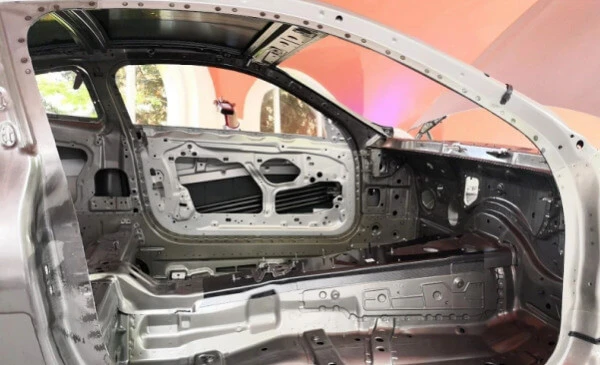
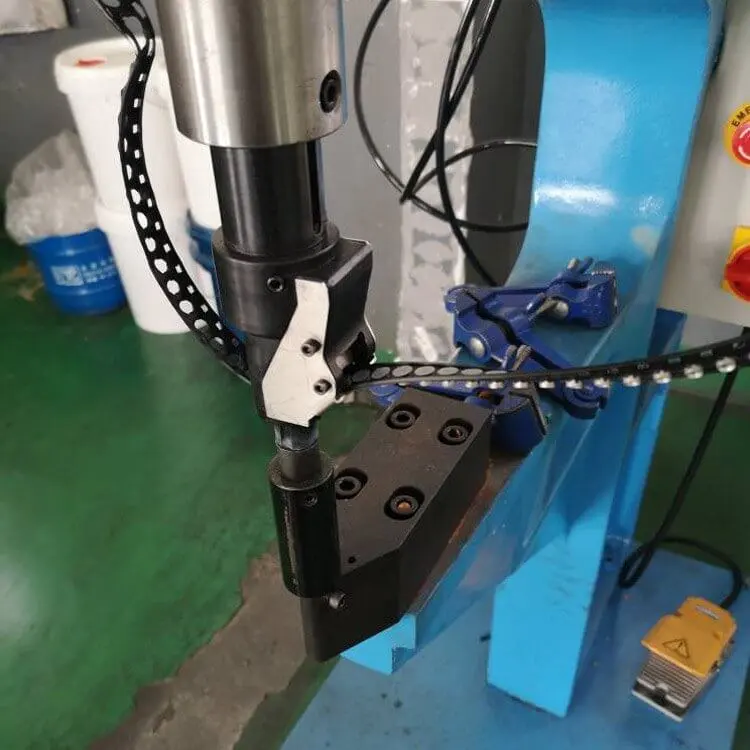
Self piercing rivet (SPR Rviet) is a type of rivet that does not require pre-drilling and is particularly suitable for non-penetrating materials.SPR Rivet consists of two parts: the rivet and the rivet sleeve. During installation, the rivet passes through the upper layer of the material and then the rivet sleeve is formed to achieve a stable connection.

The SPR Rivet is a type of rivet, but it does not require pre-drilling. Aluminium alloys, high-strength steels and composite materials are ideal for use with SPR Rivets. SPR Rivet does not require melting or heating and has a very low thermal impact on the material, preserving the properties and structural integrity of the material.

Self Piercing Rivets for Automotive
SPR Rivet

However, SPR Rivet requires specialised equipment and tools for its installation.

SPR Rivet is used extensively in the joining of metal components, including car doors, bonnets and chassis, as well as in the assembly of mobile phone and computer housings.

Rivmate SPR Rivet(Self piercing rivet)

5.High Strength Structural Rivets

Rivmate Monobolt Rivet - Mono-Lock Blind Rivet
Monobolt Rivet
Rivmate Multi Grip Blind Pop Rivet From China
Multi Grip Blind Rivet
Exploding Pop Rivets- Rivmate Tri Fold Grip Blind Rivet
Tri Fold Rivet
Rivmate Waterproof Bulb Tite Rivets
Bulb Tite Blind Rivet

High strength rivets is a category in blind rivet. The traditional Blind rivet has no way to withstand ultra-high strength applications, so structural rivets were invented. A high strength structural rivet is a rivet specifically designed to withstand high strength loads and provide a reliable connection. It generally has special construction and materials to meet the requirements for strength, durability and fatigue resistance.

Pop Rivet Distributor - Rivmate Hemlock Rivets
Hem Rivet
Wholesale Bom Rivet from china
Bom Rivet
pull through rivet
Pull Through Rivet
HuckLok Rivets - Mangnabulb Rivets - Rivmate
Hucklok Rivets

High strength structural rivets have good fatigue resistance in addition to providing a high strength connection. Compared to traditional bolting and welding, structural rivets allow for a lighter weight design, reducing overall weight without reducing the strength of the connection.

However, structural rivets must be installed using specialised equipment, although they are still very quick to install. Certain non-metallic materials cannot be used with structural rivets.

Structural rivets are often found in industrial applications where strength is required. These include automotive manufacturing, railway and transport engineering, solar energy projects, and more.

6.Lockbolt Rivets

Rivmate Lockbolt Rivet Fastener | Magna Grip Lockbolts
Lockbolt Rivet

The lockbolt rivet consists of a rivet and a collar. During installation, the rivet needs to pass through the material and then the collar locks the rivet to form a stable connection.

The lockbolt rivet provides an ultra-high strength joint that can withstand extremely high shear and tensile forces. lockbolt rivet has excellent resistance to vibration and loosening, making it ideal for joining in vibrating environments, which is why railways use a lot of lockbolt rivets for their connections. it can also be used to join a wide range of materials, including metals, plastics, and composites, etc.

7.Speed Rivets

Speed Rivet (BRV Series)
Speed Rivet (CBT Series)

Speed rivet is a rivet that can be fully mechanically and automatically installed. It is a non-structural fastener that often joins sheet metal materials.

Speed rivets are often made from lightweight materials such as aluminium alloys to reduce overall weight. And it’s low cost makes it ideal for high volume use.

However, Speed rivet is not as strong and is suitable for applications where strength is not required. It is also not removable. If the connection needs to be addressed. Then the rivet itself usually needs to be destroyed.

Rivet material matching strategy for sheet metal

In thin sheet metal riveting, the choice of rivet materials not only affects structural strength, but also directly affects corrosion performance, electrochemical reaction risk, and long-term stability of the connection. When the sheet metal and rivets belong to different metal systems, such as aluminum + stainless steel or carbon steel + copper, scientific matching is required. Otherwise, electrochemical corrosion, weakening of the connection point, or even material spalling may occur.

1. What type of rivets are recommended for aluminum sheets metal?

What Are Sheet Metal Blind Fasteners?

Aluminum sheets are lightweight and flexible, but their surface oxide film is sensitive. If the wrong type of rivet is selected, corrosion spread or localized damage may easily occur. The following rivet combinations are recommended:

  • Aluminum rivets: lightweight and compatible, with similar potential, they can prevent electrochemical corrosion and are the standard first choice.
  • Stainless steel rivets (especially 304/316): These can enhance connection strength but have a slight potential difference. They are recommended for aluminum sheets that have undergone anodizing or in neutral environments.
  • Galvanized steel rivets: Not recommended, as long-term use can accelerate corrosion of the aluminum sheet unless a sealed coating protection treatment is applied.

If aluminum sheets are exposed to outdoor or humid environments, prioritize the use of aluminum alloy rivets (6061-T6) or stainless steel pop rivets with anodized treatment.

2. Recommendations for Preventing Electrochemical Corrosion

When the sheet metal and rivets belong to different metallic systems, if their electrochemical potential difference is too large, microcells will form under the influence of an electrolyte medium (such as water vapor or salt fog), accelerating localized corrosion. Effective preventive strategies include:

  • Material compatibility matching: Prioritize the use of rivet materials with potential values similar to those of the sheet metal (refer to the Galvanic Series table).
  • Insulation and isolation measures: Use plastic washers, sealant, or corrosion-resistant coatings in the riveting area to prevent direct metal contact.
  • Surface protection treatment: Apply anodizing, Dacromet, electrophoresis, or nickel plating to both the rivets and the sheet metal to inhibit current pathways.
  • Structural design optimization: Avoid water accumulation and proximity of electrical connection points to control corrosion conditions at the source.

3. Considerations for Riveting Stainless Steel Sheets and Carbon Steel Sheets

When the riveting material is stainless steel or carbon steel sheet metal, both connection strength and corrosion risk must be considered.

  • Stainless steel sheet: It is recommended to use 304 or 316 stainless steel rivets to ensure compatibility and corrosion resistance. If carbon steel rivets are used, they must be galvanized or coated for protection and should not be used outdoors.
  • Carbon steel sheet metal: Galvanized steel rivets or carbon steel rivets can be used, but the integrity of the surface coating must be ensured. For higher strength connections, structural pop rivets can be selected.
  • Mixed material connections (e.g., stainless steel sheet metal + carbon steel rivets): This is a high-risk combination prone to localized corrosion pitting and is not recommended for use in high-humidity or highly corrosive environments.

How Long Should a Rivet Be for Sheet Metal?

How to Choose Rivets for Thick Material

Selecting the length of the rivet (Rivet Length) is one of the most crucial steps in thin plate assembly. If the rivet is too short, it cannot generate sufficient clamping force; if it is too long, it cannot be properly formed, resulting in loose connections or bent rivets.

1. Standard Rule of Thumb

The sheet assembly industry adopts a globally applicable formula:

Rivet Length = Total Material Thickness + 1.5 × Rivet Diameter

The total thickness of the thin plate + 1.5 times the diameter of the rivet = recommended rivet length

This formula ensures that the tail of the rivet will form a complete “rolled edge / mushroom head” during the riveting process, guaranteeing the clamping force and structural strength.

2. Why multiply by 1.5 × diameter?

Because the rivets require sufficient material to expand outward during the forming process, the volume of the expansion zone (bulb) is approximately 1.3–1.7 times the diameter (varying slightly depending on the material). If this is insufficient, the following issues will occur:

  • The tail end of the rivet is not fully formed.
  • The mushroom head on the back is too small.
  • The rivet is loose and the fatigue life has decreased.

3. Example: Length of Rivets Corresponding to Different Plate Thicknesses

Total Material ThicknessRivet Diameter (D)Calculated Length (Formula)Recommended Rivet Length (Industry Standard)
1.0 mm3.2 mm1 + 4.8 = 5.8 mm6 mm
1.5 mm3.2 mm1.5 + 4.8 = 6.3 mm6–7 mm
2.0 mm4.0 mm2 + 6 = 8 mm8–9 mm
3.0 mm4.8 mm3 + 7.2 = 10.2 mm10–11 mm

Best Rivets for Sheet Metal by Application

Aviation, Rail Transit, High Fatigue Structures

Recommendation: Solid Rivets

  • The strongest shear and tensile strength
  • The highest fatigue life in the industry
  • Suitable for skins, fuselages and structural components

Household Appliances, Light Sheet Metal, Consumer Electronics

Recommendation: Tubular Rivets

  • Low forming force, does not damage thin plates
  • Low cost, suitable for mass production
  • Used for chassis, interior components, and bracket fixation

Sheet metal chassis, metal cabinets, HVAC, thin plate assembly

Recommendation: Blind Rivets

  • Single-sided installation, suitable for thin plates that cannot be accessed on the backside
  • Stable clamping force, suitable for steel plates, aluminum plates, and stainless steel thin plates
  • Open type has waterproof performance

Automobile body, aluminum plate structure, combination of different materials

Self Piercing Rivets for Automotive Body Connections
Self Piercing Rivets for Automotive - High Cost Self Piercing Rivets Tool

Recommendation: SPR – Self-Piercing Rivets

  • No need for pre-drilling, it can directly penetrate the upper thin plate.
  • Aluminum + steel, and aluminum + aluminum can be firmly bonded.
  • Applied to vehicle manufacturing and lightweight structures.

High-Vibration, High-Load Mechanical Equipment

Recommendation: High Strength Structural Rivets

  • Internal lock core design, with strong vibration resistance
  • Stronger in tensile and shear strength, can replace welding/screws
  • Used in industrial machinery, rail transportation, pressure enclosures

Heavy machinery, truck chassis, steel structures

Lockbolt Fastener Rivets in Railway Applications

Recommendation: Lockbolt Rivets

  • Bolt-level strength, never loosens
  • Better vibration resistance than bolt connections
  • Suitable for thin plate + profile structures with extremely high loads

Mass Production Line, Takt Assembly Workshop

Recommendation: Speed Rivets

  • Installation speed is increased by 3 to 5 times
  • Suitable for batch assembly of metal casings, hardware components, and cabinets
  • Applicable to factory production lines with high efficiency requirements

Get Expert Support for Your Sheet Metal Riveting Needs

Rivmate - russia(Moscow) International Fastener exhibition 2025

Choosing the appropriate rivets for thin plates is not complicated, but to truly achieve reliable strength, reasonable cost, and stable lifespan, professional engineering assessment is still necessary. Different plate thicknesses, material combinations, and load conditions all affect the final performance of the rivets.

Rivmate engineering team can offer you:

  • Plate Thickness / Material Matching Recommendations (Prevent Slippage, Cracking, Insufficient Clamping)
  • Load and vibration environment assessment (to ensure long-term stability)
  • Specific application scenario selection plan (thin plates, enclosures, cabinets, automobiles, household appliances, etc.)
  • Free sample delivery (blind rivets, structural rivets, lock caps, lock rivets, etc.)


If you are looking to select the right sheet metal rivets for your project, please feel free to contact us at any time. Rivmate will provide you with the safest and most efficient fastening solution for your assembly structure.

📧 Product Inquiry: manufacture@world-rivet.com

🌐 Official Website: https://worldrivet.com/

Reference

Share:

More Posts

Get Rivets Quotes Now

Wholesale Blind Rivets from Rivet Manufacturer

Sheet Metal Blind Fasteners : A Complete Buying Guide

Table of Contents

Do you know which sheet metal blind fasteners you should use for your sheet metal business? Do you know how you should buy sheet metal blind fasteners that are high quality and affordable?  Through this article, you will learn the difference between different blind fasteners and how to choose them!

What Are Sheet Metal Blind Fasteners?

What Are Sheet Metal Blind Fasteners?

Sheet metal blind fasteners refer to single-sided installation fasteners specifically designed for thin plate structures. This type of fastening method does not require contact with the backside and is suitable for structures with limited space, thin plates, and a closed backside. They form a stable connection between thin plates through structural deformation, tensioning, or locking mechanisms.

In engineering practice, the core meaning of “blind” is that installers can complete the fastening by only accessing one side of the workpiece. Such fasteners are typically used for 0.3–3.0 mm metal sheets, such as steel plates, aluminum plates, and stainless steel plates, and are the most commonly used connection method in the sheet metal industry.

Why Use Blind Hole Fasteners for Sheet Metal?

Blind hole fasteners are the most commonly used fasteners in sheet metal applications. Blind Hole Fasteners have many unique advantages over other fasteners.

  • Sheet metal is usually only accessible from one side, and there is no way to solve this problem with traditional joining methods. Blind hole fasteners offer a great solution. It does not require backside access.
  • The installation process for blind hole fasteners is very quick. Compared to the installation of other fasteners, blind hole fasteners reduce assembly time and labour costs.
  • Blind-hole fasteners create a strong, tight connection that provides excellent vibration resistance.
  • Blind hole fasteners can be used with a variety of sheet metal materials including aluminium, steel and conforming materials.
applications of self clinching fastener
  • Conventional fastening methods (e.g. welding or bolting) may cause damage to sheet metal surfaces, including thermal deformation, surface scratches and distortion. Blind hole fasteners do not damage the surface of sheet metal.

Blind hole fasteners provide a practical and efficient solution for joining sheet metal components, minimising the risk of potential workpiece damage.

Common Types of Fastener Used to Join Sheet Metal

Depending on the requirements of your project or business, choices can be made based on factors such as the specific application, required strength, accessibility and aesthetics. Each method has its own installation, cost and overall performance considerations.

There are three common types of blind hole fasteners:

  1. Blind Rivet
  2. Rivet Nut
  3. Self Clinching Nut

a. Blind Rivet

Magna Lok Rivets for Sale - Bulk Huck Magna Lok Blind Rivets Wholesale
Blind Rivet

Blind Rivet, as one of the most commonly used assembly fasteners in sheet metal. It is a fast and easy way to connect two or more sheet metal pieces.

Because of its unique characteristics, Blind Rivet is widely used in sheet metal assembly and connection in electronic, electrical, telecommunication, mechanical and other industrial fields for various sheet metal materials and thicknesses.

b. Rivet Nut

The Rivet Nut creates an internally threaded connection on sheet metal that can be threaded to provide a connection point for other parts.
Rivet nut is also used in a very wide range of applications on sheet metal. In cases where sheet metal structures need to be strengthened and reinforced, the Rivet Nut can be used to mount reinforcements or add accessories.
The Rivet nut is a simple, cost-effective fastener solution for providing a secure attachment point. It is also suitable for a wide range of sheet metal materials and thicknesses.

Rivmate Flat Head Full Hex Body Rivet Nut - how do rivet nut works
Knurled rivet nut

c. Clinch Nuts / Clinch Studs

self clinching nuts
Self Clinching Nuts

Blind fasteners that provide a stable connection point in sheet metal are not only available as rivet nuts, but also as self clinching fasteners. self clinching fasteners provide a strong connection without the use of additional nuts, bolts or screws.
Self clinching fasteners are ideally suited for thin sheet metal and limited mounting controls that can be installed into the sheet metal by mechanical pressure or pressure equipment.Self clinching fasteners are used in sheet metal assemblies in the automotive, electronics, aerospace, electrical equipment and other industries.

How Do Blind Fasteners Work?

How to Install Pop Rivets? - Pull the Mandrel Until it Breaks
How Do Blind Rivet Fasteners Work?
How Do Blind Rivet Nut Fasteners Work?

Different types of blind fasteners work differently. Blind rivets and rivet nuts work in a very similar way, by using a tool to deform and expand the end of the fastener to tighten the connection.

How to install self clinching nuts?

Self-clinching nuts are made by pre-punching holes in thin plates and then pressing the nuts into the holes with a press. The annular knurl and undercut on the outer ring of the nut will be embedded into the metal sheet. During the riveting process, the sheet undergoes a slight plastic flow, filling the toothed grooves of the nut, thereby forming a permanent lock.

Performance Comparison of Sheet Metal Blind Fasteners

When choosing the appropriate blind fasteners, a systematic assessment must be made from the performance dimension. Different types of fasteners have obvious differences in structural strength, waterproofing ability, installation methods and costs.

Sheet Metal Blind Fasteners:Performance Comparison Table

What is the Best Fastener for Joining Thin Sheets of Metal
Performance AspectBlind RivetRivet NutClinch Nut / Clinch Stud
Tensile / Shear StrengthMedium to high; stable structureDepends on sheet thickness; moderate shear strengthHigh; excellent tensile and torque resistance
Vibration ResistanceHigh; connection does not loosenGood, but long-term vibration may affect threadsHigh; ideal for equipment structural parts
Waterproof PerformanceClosed-end type can be fully sealedAverage; requires O-ringAverage; not a sealing structure
RemovabilityNon-removableRemovable; suitable for maintenanceRemovable and structurally stable
Material Thickness Compatibility0.3–3.0 mm0.5–6.0 mm0.8–3.0 mm
Installation SpeedFastMedium (requires rivet nut tool)Medium (requires press machine)
CostLowMedium to highMedium

1. Tensile / Shear Strength

The overall strength of blind rivets is higher than that of Rivet Nut, especially for structural blind rivets, which are suitable for dynamic loads and vibration environments.

The tensile strength of the self clinch nuts and studs is the best, as they rely on the “embedding + interlocking” of the material.

2. Anti-vibration Stability

Blind rivets perform best in a vibrating environment due to their mechanical locking structure. The threaded part of the Rivet Nut may loosen due to vibration, and anti-loosening measures are required.

3. Waterproofing Capacity

If used for roofing, outdoor applications or HVAC enclosures, the closed-end type of blind rivets is the best choice. For other types, additional sealing measures are required.

4. Disassembly Capability

Rivet Nut and self-clinching parts provide threads and can be easily disassembled, which is something that blind rivets cannot achieve. They are suitable for equipment that requires maintenance or for electronic enclosures.

5. Compatibility of Material Thickness

  • Blind rivets are most suitable for thin plates (0.3 – 3 mm).
  • Rivet Nut offers a wider range of thickness requirements and is the best solution for providing threads on thin plates.
  • Self-clinching nuts/screws are suitable for steel plates ranging from 0.8 to 3 mm.

6. Installation Speed

Blind rivets are the fastest and they are suitable for large-scale and rapid manufacturing.

7. Cost Analysis

Blind rivets are the most cost-effective solution and are suitable for a large number of sheet metal parts. Although Rivet Nut and self clinch fasteners have higher unit prices, they meet maintenance requirements and have a lower life cycle cost.

How to Choose the Right Blind Fastener for Sheet Metal

When choosing suitable blind fasteners for thin plates, it is necessary to follow engineering logic rather than relying solely on empirical judgment. Different fasteners vary significantly in terms of force application, material compatibility, sealing ability and maintenance methods.

a. Material Thickness Compatibility

The thickness of the sheet material is the primary key factor in selection. Because the strength of the thin sheet is limited, the thinner the sheet, the less suitable it is for tapping or traditional screws, and the higher the failure probability.

  • 0.3–1.0 mm → Preferably use Blind Rivet or self-drilling blind fasteners
  • 0.8–3.0 mm → Use Blind Rivet / Clinch Nut / Clinch Stud
  • 1.0–6.0 mm → Use Rivet Nut (providing threaded capability)

How to Choose Rivets for Thick Material

b. Selection based on materials

The matching principles for different materials are different:

Steel plate→ All types of blind fasteners are applicable

Aluminum plate → Recommended aluminum rivets, light-load Rivet Nut

Stainless steel plate (SS) → Recommended stainless steel Rivet Nut / Clinch Nut (to avoid electrochemical corrosion)

Avoid the combination of “aluminum rivets + stainless steel plates” as it can cause electrochemical corrosion.

c. Need Threaded Connection

Need to be detachable/maintainable → Rivet Nut or Clinch Nut

No need for threads, for permanent connection → Blind Rivet is the best choice

Rivet Nut is usually the preferred choice for chassis enclosures and electrical control boxes.

Outdoors, roof, curtain wallClosed-End Blind Rivet

General indoor use → Either Blind Rivet or Rivet Nut can be used

According to the salt fog test data from Rivmate: The closed-end rivets remained free of rust after 1000 hours of testing.

e. Vibration & Dynamic Load

High-vibration structures (such as equipment casings, mechanical devices) → Blind Rivet / Structural Blind Rivet / Clinch Nut

Low vibration → Rivet Nut is sufficient

Reason: The threads are more likely to loosen under long-term vibration.

Best Blind Fasteners for Different Sheet Metal Applications

In real engineering and mass production, the selection of Blind Fasteners must be based on the specific application scenarios rather than solely considering the structural appearance or cost. Different scenarios have different load patterns, maintenance requirements, environmental conditions and production schedules.

Home Appliances Industry

Recommendation: Blind Rivets + Rivet Nuts The exteriors of household appliances are usually made of thin plates ranging from 0.4 to 0.8 mm in thickness, and the materials are mostly galvanized steel plates or aluminum plates. The thin plates have low strength and screws are prone to come loose, therefore:

Blind Rivet → A component used for permanent and maintenance-free assembly points

Rivet Nut → Used for structures that require later disassembly and assembly, such as motors, control boards, and filters.

This combination has become the industry standard in the fields of refrigerators, washing machines and air conditioners.

Sheet Metal Enclosures & Cabinets

Recommendation: Rivet Nuts + Clinch Nuts

The cabinet structure requires a large number of detachable threaded points, and the thickness of the boards is mostly between 0.8 – 2.0 mm. Therefore, the most suitable configuration is:

Rivet Nut → Suitable for thin plates and locations where the riveting process cannot be used.

Clinch Nut / Clinch Stud → High-strength, anti-twisting, long thread lifespan

For example, server enclosures, electrical cabinets, and communication equipment boxes all use this combination.

Outdoor Cladding and Building Exterior Finishing

Recommendation: Closed-End Blind Rivets

The curtain wall system has extremely high requirements for waterproofing and corrosion resistance. The advantage of the closed-type Blind Rivet lies in:

  • 100% sealed
  • The core shaft is locked and has excellent vibration prevention effect
  • Optional stainless steel material, resistant to salt spray for over 1000 hours
  • Stable installation, suitable for high-altitude construction

Therefore, it is widely used in aluminum panels, metal roofing, and structural facades.

Automotive Manufacturing

Self Piercing Rivets for Automotive Body Connections

Recommendation: SPR (Self-Piercing Rivets) + Structural Blind Rivets

The automotive body structure is subjected to multi-directional loads and complex working conditions, and requires high-strength connections:

SPR Self-Drilling Rivet (for lightweight aluminum sheets in vehicle body): No need for pre-drilling, one-sided installation, high strength.

Structural Blind Rivet (Suitable for Steel Plates and Composite Materials): Equipped with a mechanical locking core, it does not loosen and has excellent fatigue resistance.

HVAC & Ventilation Units

Recommendation: Sealed / Waterproof Blind Rivets

HVAC equipment involves condensate water, pressure fluctuations, and temperature cycling. The closed-end rivets or waterproof Blind Rivets with sealing gaskets are the most stable options.

Get Expert Guidance for Your Sheet Metal Fastening Needs

Rivmate - nashville fastener fair USA 2025

In thin plate structures, blind fasteners are almost an indispensable solution. They support one-sided installation, are compatible with thin materials, can achieve high-strength connections, and perform stably and reliably in terms of waterproofing, vibration resistance, and corrosion prevention. Whether you use blind rivets, rivet nuts, press rivets, or self-drilling blind fasteners, correct selection will significantly enhance product lifespan and assembly efficiency.

If you are looking to select the best Blind Fastener for your project, please feel free to contact the Rivmate Engineering Team. We can offer you the following: Free sample delivery (for mass production verification); recommendations on plate thickness and load selection. 

📧 Product Inquiry: manufacture@world-rivet.com

🌐 Official Website: https://worldrivet.com/

Reference

Share:

More Posts

Get Rivets Quotes Now

Wholesale Blind Rivets from Rivet Manufacturer

Blind Rivet vs Solid Rivet: Which Rivet is Best for Your Business

Table of Contents

What are the fundamental differences between Blind Rivet and Solid Rivet? What are the specific differences in terms of strength and installation methods? Different types of rivets directly affect the structural lifespan, safety, and production cost. Blind Rivet is a single-side installation blind riveting structure, while Solid Rivet is the most typical types of aircraft rivets in the aviation field, renowned for its extremely high fatigue life. As Rivmate, with the ability for structural testing and experience in aviation-grade rivets, we will provide professional assistance to help you make the right choice.

Understanding Blind Rivets and Solid Rivets

Before comparing blind rivet vs solid rivet, it is necessary to first understand the structural essence and installation methods of the two types of rivets. The working principles of the two types of rivets are completely different, and therefore their applicable scenarios also have significant differences.

What Are Blind Rivets?

Blind rivets are a type of riveting method that can be installed on only one side. They consist of a cap body and a mandrel. During installation, the mandrel is pulled backward by a riveting gun, causing the tail of the cap body to expand and clamp the material. Because the construction workers only need to touch one side of the riveted components, blind rivets are particularly suitable for enclosed cavities, back areas that are inaccessible, or thin plate structures that require rapid batch assembly.

Blind rivets are widely used in lightweight structures such as sheet metal, appliance shells, vehicle interiors, and HVAC equipment. They have a simple structure, stable installation, and controllable cost, and are one of the most commonly used riveting methods in modern manufacturing.

Pop Rivet Distributor - Rivmate Hemlock Rivets

What Are Solid Rivets?

A solid rivet consists of a complete metal rod and a rivet head. It is the most traditional and structurally strongest type of rivet. During installation, it requires dual operations: one side applies impact or compressive force, while the other side uses an anti-rivet block for support, causing the rivet tail to undergo plastic deformation and form a locking shape. Due to the fact that this “forging” method can achieve extremely high strength and consistency, Solid Rivet is widely used in aircraft fuselages, wing structures, bridge connections, railway vehicles, and heavy machinery

Blind Rivet vs Solid Rivet - What are Solid Rivets

Its fatigue resistance ranks among the best among all types of rivets, and it is one of the most important fastening technologies in the aviation industry.

How They Work: Blind Rivet vs Solid Rivet

Understanding the structural differences between the two types of riveting methods is crucial for determining which one is more suitable for your project. There are fundamental differences in installation methods, back-forming methods, and final structural performance between the two.

How to Install Pop Rivets? - Pull the Mandrel Until it Breaks

Blind rivets are fastened by the expansion force generated when the core shaft is pulled. During installation, the core shaft is pulled backward, causing the tail of the cap body to undergo plastic deformation, forming a stable “mushroom-shaped” expansion structure. This structure firmly clamps two or more pieces of material together. Its key features include:

  • Single-side installation, suitable for structures where the back side cannot be accessed.
  • No need for high-temperature construction, will not affect the heat treatment state of the material.
  • Installation is fast and can be achieved through batch automation. 

Therefore, blind rivets are widely used in industries such as sheet metal, HVAC, automotive parts, and home appliance casings.

Solid Rivet Working Principle

Solid rivets undergo plastic deformation of the rivet tail through external force hammering or the compression of an air-powered riveting gun. After the rivet tail is “molded”, a very tight and consolidated head is formed, with extremely high structural strength. Its characteristics include:

  • The construction must be carried out simultaneously on both the front and rear sides (hammering on one side, buckling on the other).
  • The deformation of the rivet tail is a process of metal cold forging, which can significantly enhance the fatigue resistance.
  • It is suitable for structures that can withstand high shear, high vibration, and high fatigue loads.

Therefore, solid rivets are the standard solution for high-load structures such as aircraft structures, bridges, vehicle side beams, and fuselage skins.

Differences Between Solid and Blind Rivets

Blind Rivet vs Solid Rivet : How to Choose the Best for your Business

In the discussion of “Blind Rivet vs Solid Rivet”, the performance differences are the aspect that users are most concerned about and has the highest search weight. There are significant differences between the two in terms of structural strength, fatigue life, waterproofing ability, vibration resistance performance, and process consistency. The following is the core comparison explanation.

Structural Performance Comparison: Solid Rivet vs Blind Rivet

Performance AspectBlind RivetSolid Rivet
Shear StrengthMedium to HighVery High (Aerospace Grade)
Tensile StrengthModerateExtremely High
Vibration ResistanceHighExcellent (Plastic deformation provides damping)
Fatigue LifeGoodBest in the industry
Waterproof CapabilityClosed-end type can be fully sealedRequires additional sealant
Weight ImpactLightweight (available in aluminum)Slightly heavier
Process ConsistencyHigh, easy to standardizeHighly dependent on worker skill and technique

1. Shear Strength

The shear resistance performance of Blind Rivet falls under the category of medium to high level, which can meet most industrial requirements such as sheet metal, mechanical enclosures, and roofing. However, its expansion locking structure limits the maximum load-bearing capacity.

Solid Rivet achieves overall integration through the cold forging deformation of the metal at the rivet tail. Its shear strength can reach the highest level in the industry. Therefore, it is widely used in aviation, rail transportation and structural frameworks.

The shear strength of solid rivets is 45–60% higher than that of blind rivets under the same diameter conditions.

The tensile strength of Blind Rivet mainly relies on the residual core shaft and the side wall support, thus it is rated as “medium level”. Solid Rivet, on the other hand, forms a single metallic unit and has a stronger tensile capacity, especially suitable for withstanding cyclic tensile or impact loads. The tensile strength of solid rivets is approximately 1.5–2 times that of blind rivets.

3. Vibration Resistance

Blind rivets have excellent vibration resistance properties, especially for structural blind rivets. However, Solid Rivet, due to its more thorough tail deformation and more uniform force distribution at the joint surface, can maintain extremely high stability in high-vibration environments.

The strong vibration areas such as the skin of the aircraft wing and the main beam joints have long confirmed the advantages of solid rivets.

4. Fatigue Life

The fatigue life of Blind Rivet is excellent and it is suitable for regular vibration or light-load conditions. Solid Rivet, on the other hand, is almost the “ceiling” of fatigue life in the industrial field. Thanks to its forged structural shape, it has no internal voids and the load distribution is extremely uniform.

The lifespan of solid rivets in high-frequency fatigue tests is approximately more than three times that of blind rivets.

The Closed-End Blind Rivet can achieve 100% sealing, which is its significant advantage. However, the Solid Rivet itself does not have a sealing function. If used in a sealing structure, additional sealant, adhesive layer, or special sealing sheet needs to be used. In scenarios such as HVAC, roofing, and exterior walls, the closed-end blind rivet is significantly more advantageous.

6. Weight Consideration

Blind rivets can be made of lightweight materials such as aluminum, stainless steel, and copper, resulting in a significantly lower overall weight. Solid rivets usually use aluminum alloy or steel, but due to their denser structure, they will slightly increase in weight. For the lightweight requirements of aviation or transportation equipment, a comprehensive balance needs to be achieved based on the specific conditions.

Why Are Blind Rivets Installed in Lieu of Solid Rivets?

If you’re an engineer, you’ll find that pop rivets are much more likely to show up in real industrial applications than solid rivets. Although a blind rivet is not as strong as a solid rivet, it can still provide a stable and strong connection.

So why do engineers prefer to use blind rivets over solid rivets? Because a blind rivet offers many advantages that a solid rivet does not.

Accessibility

The use of blind rivets is a reliable solution when access to the back side of the material being joined is not possible or difficult. Blind rivets can be installed from one side only, eliminating the need for backside access.

Efficiency and Speed

Fully Automatic Installation of Blind Rivets

Blind rivets offer a faster and more efficient installation process than solid rivets. They can be installed quickly using specialised tools, reducing total assembly time. In high-volume production environments, saving time is critical to productivity.

Ease of Installation

Blind rivets are relatively easy to install and require less skill and training.

Cost-effectiveness

Blind rivets are more cost-effective than solid rivets. Fewer tools and equipment are required to install blind rivets, reducing initial investment costs. In addition, blind rivets typically have lower material costs.

Vibration Resistance

Blind rivets have good resistance to vibration. The rivet core inside the blind rivet expands and grips the material tightly, reducing the likelihood of loosening or failure caused by vibration or dynamic loading.

How to Choose Between Solid Rivets and Blind Rivets

a. Strength Requirements

Automotive Blind Rivets Application - Blind Rivets on Car

Solid rivets are a better choice if your project’s strength requirements are very high, requiring maximum strength and structural integrity. For example, application scenarios such as wings, tails, etc. of aircraft in the aerospace industry.

Blind Rivets are mainly used for joining thin sheet materials, especially in applications where it is necessary to maintain a flat surface in the joint. Examples include automotive body assemblies, thin body panels, doors and other components. Shells and panels for avionics, joining of thin metal sheets, etc.

b. Workspace

The great thing about blind rivets is that they can be installed with access to only one side of the material. So if your project has limited access space and you need to complete the entire installation process on one side, then a blind rivet is best for your project! You can look directly to the blind rivet manufacturer and they will give you a professional recommendation!

How Do Blind Bolts Fasteners Work?
Blind Rivet vs Solid Rivet - Workspace for Solid Rivets

Solid rivets are required to be accessible on both sides for installation. So if you have a project that is fully accessible on both sides and requires a great deal of strength, then you should choose solid rivets for your project. This is the optimal choice!

c. Cost Considerations

You need to figure out what your project budget is. Blind rivets are typically more cost effective as they have a lower material cost and require fewer tools for installation. Solid rivets may have a higher material cost and require special tools and skilled labour for installation, which may increase the total cost.

d. Vibration Resistance

Seismic Performance Testing of Blind Rivets

If your application is subject to vibration or dynamic loads, then you need to consider the vibration resistance of the type of rivet you choose. Blind rivets are designed to make a stable connection through expansion, so they have good resistance to performance under vibration and are able to grip the material firmly. If this is a requirement for your project then solid rivets are not suitable to be chosen!

How to Find the Right Rivets

Choosing between Blind Rivet and Solid Rivet essentially depends on the structural requirements, installation environment and safety level. As a Rivmate engineering specialist who has been involved in structural connection testing for a long time, I suggest making the judgment based on the following four most critical dimensions:

1. If you are looking for fast installation speed, high assembly efficiency and low cost → Choose Blind Rivet

Blind rivets do not need to contact the back side and can be installed on one side in a narrow space. The construction speed is 2-4 times that of traditional solid rivets. The equipment requirements are low, the installation consistency is strong, and it is suitable for batch production scenarios. Especially applicable to: home appliance shells, thin sheet metal, building curtain walls, metal edge pieces. Its cost advantage is obvious, and it is the preferred solution for most OEM factories.

2. If you are seeking extremely high structural strength, fatigue life and safety level → Choose Solid Rivet

Solid rivets achieve an integrated metal connection through plastic deformation, offering top-level structural reliability. Their shear, tensile, and fatigue resistance are significantly superior to blind rivets. They are particularly suitable for:

  • Aviation structures (airframe, wing skins)
  • Heavy machinery equipment
  • Bridges or load-bearing structures
  • High cyclic fatigue environment

If the project involves safety levels, impact, or long-term vibration, Solid Rivet is a more reliable choice.

3. If single-sided installation, closed structure or on-site construction is required → Prefer Blind Rivet

Many applications cannot reach the back side, such as closed steel pipes and profile cavities. At this point, Solid Rivet cannot be used for construction, while Blind Rivet offers a perfect solution. The closed-end type can also achieve waterproof and airtight sealing.

4. If used in aviation, rail transportation, or heavy machinery structures → Must use Solid Rivet

These industries have strict requirements for structural integrity and fatigue life. The metal continuity and plastic deformation characteristics of Solid Rivet are essential for meeting safety standards. Rivmate suggests:

  • Aircraft skin → Solid aluminum rivets (such as 2117-T4)
  • Heavy-duty steel structure → Solid steel or stainless steel rivets
  • Railway vehicles → High-strength structural solid rivets

Get the Right Rivet Solution for Your Project

Rivmate Rivet Factory in Jiangsu, China

The difference between blind rivets and solid rivets lies fundamentally in their installation methods, structural strength, and applicable scenarios. Blind rivets are suitable for single-side installation, thin plate structures, and high-efficiency production; while solid rivets have an absolute advantage in terms of strength, fatigue life, and safety level, and are the standard choice in the aviation and heavy industry sectors.

If you are choosing the appropriate riveting method for your project, the Rivmate engineering team can offer you:

  • Free samples
  • Material and thickness matching suggestions
  • Strength and fatigue life assessment
  • Customized riveting solutions

Please feel free to contact us to obtain the Rivmate connection solution that is most suitable for your business.

📧 Product Inquiry: manufacture@world-rivet.com

🌐 Official Website: https://worldrivet.com/

Reference

Share:

More Posts

Get Rivets Quotes Now

Wholesale Blind Rivets from Rivet Manufacturer

Riveting vs Welding: How to Choose the Right Connection?

Table of Contents

Among the common metal joining methods, riveting and welding are the two most fundamental and frequently compared processes. Which one is better? Riveting vs welding – which should be used in practical projects? This blog will based on engineering practice, provide a comprehensive analysis of the differences between Riveting and Welding and help you make the most appropriate technical choice in different applications.

Riveting Test

Riveting is a method of achieving permanent connection through mechanical deformation. When the rivets are installed, they expand to create a clamping force, thereby securely fixing two or more pieces of materials together. Its key features include:

  • Thermal-free process: No heating or melting of materials is required.
  • Single-side installation (Blind Installation): Suitable for enclosed spaces or structures where the backside cannot be accessed.
  • Stable force application: The expanded head of the rivet bears the main shear force.
  • Applicable to thin plates, composite materials, and soft materials.

Riveting connections are particularly suitable for sheet metal assembly, roofing systems, transportation equipment and vibration conditions.

Types of Riveting Joints

The riveted joints have different designs. They are often selected as the appropriate design based on the assembly of the riveted joint, design considerations, and conditions of use. We can make a simple categorization. According to the number of rows and arrangement of rivets can be divided into the following two types.

  • Lap Joint
  • Butt Joint

1.Lap Joint

Lap joints are two overlapping materials joined together by rivets. This type of riveted joint is usually used when there is a need to overlap one material on top of another. An example would be the joining of sheet metal. The diagram on the right shows how Lap Joint, a type of riveted joint, is represented.

Riveting vs Welding - One Types of Riveted Joint - Lap Joint

2.Butt Joint

Butt Joints are often required to join three pieces of material. This type of riveted joint joins the ends of two materials together and then uses rivets to secure them.Butt Joints are often used in structural applications where a flush and strong joint is required. The diagram to the left clearly illustrates the connection characteristics of the Butt Joint.

Riveting vs Welding - One Types of Riveted Joint - Butt Joint

What is Welding?

What is Welding? Riveting vs Welding

Welding is a connection method that uses high temperature to cause local melting of metal materials and their fusion into a single entity. After welding, the connected area becomes an integral part of the base material. Its core characteristics include:

  • The melting of metals forms metallurgical bonding, resulting in a continuous structure and high strength.
  • It requires bilateral or complete contact with the space, and is usually not feasible to operate in a closed cavity.
  • High material requirements: The metal must have good weldability.
  • The heat affected zone (HAZ) may alter the material properties, and strict process control is necessary.

Welding is widely used in heavy machinery, steel structures, pipeline systems and vehicle manufacturing.

Types of Welding Joints

Riveting vs Welding - Types of Welded Joint - Butt Joint
Riveting vs Welding - Types of Welded Joint - T Joint
Riveting vs Welding - Types of Welded Joint - Edge Joint
  1. Butt Joint: A butt joint is formed when the ends of two workpieces are aligned in the same plane and welded together along the seam. This is one of the most common types of joints in welding.

  2. T-Joint: A T-joint is formed when one workpiece is placed perpendicularly to the other, creating a T-shape. Welding is done along the intersection of the two pieces. T-joints are commonly used for connecting two materials at a right angle.

  3. Edge Joint: An edge joint is formed when the edges of two workpieces are placed in contact with each other and welded along the edge. This joint is often used for joining plates or panels.

Riveting vs Welding - Types of Welded Joint - Comer Joint
Riveting vs Welding - Types of Welded Joint - Lap Joint

4. Corner Joint: Corner joints are formed when two workpieces meet at a corner, and welding is done along the corner. This type of joint is commonly used in box-like structures or frames.

5. Lap Joint: In a lap joint, one workpiece overlaps the other, and welding is done along the overlapping region. Lap joints are often used for joining sheet metal or thin materials.

Riveting vs. Welding: A Side-by-Side Comparison

Strength of Welded vs Riveted Ship:What Are the Differences?

Riveting vs welding, Which method is truly more reliable in terms of structural performance? To facilitate understanding, this section analyzes six key dimensions from an engineering perspective: strength, vibration performance, heat influence, corrosion, fatigue life, and structural deformation.

Riveting vs. Welding: Performance Comparison Table

Performance AspectRivetingWelding
Shear Strength★★★★☆ (Excellent for sheet-to-sheet lap joints)★★★★★ (Metallurgical fusion provides maximum strength)
Tensile Strength★★★☆☆★★★★★
Vibration Resistance★★★★★ (Joint does not loosen over time)★★★☆☆ (Welds may develop fatigue cracks)
Heat-Affected Zone (HAZ) RiskNonePresent — metal softening, annealing, hardness reduction
Corrosion Resistance★★★★☆ (Protected by plating or coating)★★☆☆☆ (Weld seams prone to pitting and corrosion)
Fatigue Life★★★★★ (Stress distributed across multiple joints)★★★☆☆ (Stress concentration at weld toes)
Distortion of PanelsNo thermal distortionHigh heat causes warping and distortion
Weight ImpactLightweight, minimal added materialAdditional weld material increases overall weight

1. Shear & Tensile Strength

The welding strength is high, capable of approaching or reaching the level of the base material, making it highly suitable for load-bearing structures. The shear strength of riveting is even better, especially suitable for interlayer connections between plates. Rivmate structural rivets (such as Monobolt) can achieve 80–90% of the weld strength.

Applicable logic: Thick plates → Welding; Thin plates → Riveting.

2. Vibration Resistance Performance

The riveted connection performs more stably under vibration conditions. The expansion body continuously provides clamping force, preventing loosening. Welding may result in weld seam fatigue cracks under continuous vibration, requiring reinforcement ribs or subsequent maintenance.

For example: Internal testing by Rivmate showed that after 500,000 vibration cycles, there were no cracks in the riveted samples; while the weld samples showed minor cracks.

3. Risk of Heat Affected Zone (HAZ)

Welding generates high temperatures, which alters the crystal structure of the metal and makes certain areas more brittle.

Riveting is a cold processing method with no heat-affected zone and does not change the properties of the base material.

For high-strength steel (HSS) or aluminum alloys, the issue of heat-affected zone (HAZ) during welding is particularly prominent.

4. Corrosion Resistance

Riveted connections can be uniformly electroplated or anodized before installation, ensuring stable corrosion resistance. However, due to the exposure of metals and high-temperature oxidation, spot corrosion and stress corrosion cracking are more likely to occur in welds. If used in outdoor or humid areas, the long-term corrosion resistance of riveted connections is superior.

5. Fatigue Life

  • The riveted connection has many connection points and can disperse stress well, showing excellent performance in long-term fatigue.
  • The welding is a continuous weld seam, with stress concentration. Fatigue cracks often start from the weld toe.

Engineering cases have confirmed that in the aerospace industry, riveting is widely used because its fatigue life is more controllable and stable compared to welding.

6. Distortion & Weight

Welding at high temperatures can cause thermal deformation, especially in thin plate structures. This effect is particularly pronounced. Riveting, on the other hand, has no heat impact and the plates are less likely to warp or sag. The riveted connection points are lightweight and offer more advantages in scenarios such as aircraft bodies.

Riveting vs Welding: How to Choose for Different Applications

Strength of Welded vs Riveted Ship

In actual engineering scenarios, there is no single answer to the question “Which is better, riveting or welding?” Various factors such as the materials, loads, vibration levels, and appearance requirements in different conditions will all influence the final choice.

Application-Based Selection Guide: Riveting vs Welding

Application ScenarioRecommended MethodReason
Thin Sheet Structures (0.3–2 mm)RivetingWelding concentrates heat and can cause burn-through or visible distortion; riveting keeps the sheet surface flat and stable.
High-Vibration Structures (Machinery, Vehicles)Riveting (Structural Blind Rivet)Weld seams may develop fatigue cracks under continuous vibration; structural rivets maintain long-term stability through mechanical locking.
Heavy-Load Steel Structures (Beams, Frames, Supports)WeldingHigh load-bearing structures require welding to provide integrated strength and satisfy high shear and tensile demands.
Composite + Metal Hybrid StructuresRivetingComposite materials cannot be welded; riveting is the only practical method for cross-material joining.
High-Appearance Requirements (No Thermal Deformation, e.g., Decorative Panels)RivetingNo heat-affected zone, avoiding warping, dents, burn marks, or welding blemishes.
  • The material is thin and prone to deformation
  • High vibration and high fatigue conditions
  • Requires precise appearance and is sensitive to heat
  • Involves composite materials, plastics or multi-layer structures
  • Requires on-site rapid installation and no need for welding equipment
  • The project aims for lightweighting

The characteristics of riveting are cold connection, stability and strong vibration resistance, making it suitable for sheet metal, household appliances, vehicle body panels, aerospace and outdoor equipment.

When to Use Welding

  • The structure needs to withstand heavy loads.
  • The material is thick (more than 3 mm).
  • An integrated whole structure is required.
  • High sealing requirements (for pipelines, pressure vessels).
  • There is a mature welding process and sufficient operation space.

Welding is suitable for scenarios with high load-bearing requirements such as heavy machinery, steel structures, vehicle chassis, and pressure pipelines.

Is Welding Cheaper than Riveting?

In practice, welding is more costly than riveting.

  • Welding usually requires specialized equipment such as welding machines, power sources, welding guns and protective gear. The economic investment in welding equipment may be higher compared to that required for riveting.
  • Consumables such as welding rods, wires, shielding gases and fluxes are usually used in the welding process. These consumables may increase the total cost of welding.
  • The operation of welding requires skilled welders who must be properly trained and certified. This is especially true for complex or large projects. Welding may also require additional time and effort for setup, positioning, and post-weld processing (such as grinding and finishing). So the labor cost of welding is also high.

Why are Aircraft Riveted and not Welded?

Why are Aircraft Riveted and not Welded? Riveting vs Welding

a. Aerospace-grade aluminum alloys are not suitable for welding

The fuselage of the aircraft extensively uses 2xxx and 7xxx series aluminum alloys. These materials have high strength but poor weldability. Welding will disrupt the original aging hardening mechanism, causing a significant decrease in the strength of the material in the heat affected zone (HAZ). Coarse grain formation, unstable hardness and the appearance of microcracks will reduce the overall reliability of the fuselage. Moreover, these aluminum alloys are prone to develop stress corrosion cracks after welding, which is particularly dangerous in the high-cycle pressure environment of aviation. Therefore, from the perspective of material nature, welding cannot meet the requirements for the long-term stability of the aviation structure.

b. The aircraft structure has extremely high requirements for fatigue life

Each takeoff and landing of an aircraft involves repeated changes in cabin pressure, which is a typical high-cycle fatigue condition. The weld seam is a location where stress concentration occurs, and cracks are prone to start expanding from the weld toe. In aviation applications, this poses extremely high risks. In contrast, riveting is a multi-point connection, with the load shared by tens of thousands of rivets. Stress can be dispersed, making fatigue cracks less likely to form and preventing rapid expansion within the structure. This is precisely the reason why the aviation industry still chooses riveting to this day.

c. Assembly can prevent thermal deformation and keep the skin flat

The fuselage skin of an aircraft is extremely thin, typically only 1–2 mm thick. The high temperature generated by welding can cause local contraction or expansion of the sheet, resulting in warping, dents, or misalignment. These geometric deformations not only affect the appearance but also damage the accuracy of the fuselage shape, thereby impacting aerodynamic performance and fuel efficiency. Riveting is a cold processing method that does not generate heat and does not damage the shape of the thin sheet, making it more suitable for installing large-area skins.

d. Assembly makes maintenance and replacement easier

Aviation structures need to be in service for a long time, and regular maintenance is inevitable. Once cracks appear in the welds, repair is difficult and must be done by using high-standard techniques and re-welding, which is costly and time-consuming. Riveting, on the other hand, has excellent maintainability. Damaged or loose rivets can be quickly drilled out and replaced without affecting the surrounding structure. For fuselage structures that require maintenance cycles of several decades, riveting has significant advantages in terms of maintenance efficiency and cost control.

e. Assembly can provide higher redundancy

Aircraft fuselage may use between 100,000 and 1,000,000 rivets. This multi-point fixation method inherently has redundancy advantages. If a rivet fails due to fatigue or corrosion, the overall structure can still maintain strength and stability. Welding is a continuous structure. Once a crack occurs at a certain point, the crack is likely to spread along the weld seam, leading to local or even overall failure. Redundancy is one of the most important principles in aviation safety design, and riveting naturally possesses this characteristic.

f. The assembly process is more controllable and the quality is more consistent

The welding quality is highly dependent on the skills of the operators, environmental conditions, and the precision of the welding equipment. Even with mature processes, welding is still difficult to maintain absolute consistency in large-scale production. Riveting has higher repeatability, easier parameter control, and a more standardized assembly process, making it suitable for the strict quality system requirements of the aerospace industry. Automated riveting equipment can also further ensure consistency and reduce human errors.

Get the Right Joining Solution for Your Project

Rivmate Hemlock Rivets

In the comparison between riveting and welding, there is no absolute “best process”; only the one that best suits your structural requirements.

  • If the structure is in a high-vibration, corrosive environment or has strict requirements for appearance and flatness, riveting is always more reliable.
  • When a project needs to bear extremely high loads or involves thick steel plates, welding remains the most stable method.
  • In scenarios involving composite materials, multi-layer structures, or those that cannot withstand heat effects, riveting is the only feasible option.

As a manufacturer specializing in fastening and assembly technologies, Rivmate can offer a complete range of riveting solutions, including blind rivets, structural rivets, riv nuts, and specialized installation tools. We can also provide professional engineering evaluations based on your materials, loads, and application requirements.

If you are evaluating the connection method of the project or need samples of the Rivmate fasteners for adaptation, please feel free to contact our engineering team directly:

📧 Product Inquiry: manufacture@world-rivet.com

🌐 Official Website: https://worldrivet.com/

Reference

Share:

More Posts

Get Rivets Quotes Now

Wholesale Blind Rivets from Rivet Manufacturer

Rivet vs Screw - Difference Between Rivet and Screw

Table of Contents

Rivet vs screw, which is better? Although they are both the most common mechanical fastening methods, their working principles are completely different; an incorrect choice may lead to loosening, water seepage, structural failure, or even safety risks.

Based on Rivmate’s long-term practical experience in riveting in industries such as aviation, construction, automobiles, and home appliances, this article will systematically analyze the key differences between rivets and screws, helping you make the most accurate and reliable choice of fastening methods in different scenarios.

What Are Rivets and Screws?

Rivet

The rivets achieve connection through plastic deformation. During the installation process, the tail of the rivet is stretched or compressed and expanded, forming a permanent mechanical locking force. Therefore, the rivet is a non-detachable connection method, suitable for thin plates, metal structures, and environments with high vibration. Its strength comes from “the clamping force generated after deformation”, rather than the friction of the threads.

The role of rivet nickel plating layer

Screw

The screw achieves locking through the friction between the thread and the material. After being tightened, the thread engages with the inner wall of the hole, forming a detachable connection. This makes screws particularly suitable for structures that require later maintenance or repeated installation. However, due to the reliance on friction for locking, screws are prone to loosening in environments with vibration and impact.

From an engineering perspective, rivets fall under the category of “plastic locking”, while screws belong to “friction locking”. This is the fundamental reason for the significant differences in performance between the two in terms of vibration resistance, water resistance, and long-term reliability.

Self-Drilling Screws

How Rivets and Screws Work

Understanding the working principles of Rivet and Screw is the core foundation for distinguishing the differences between them. Although both are used for mechanical connections, their internal force application methods are completely different, resulting in significant differences in structural strength, durability, and maintainability. Below, from an engineering perspective, we will provide a clear, concise, and professional explanation of the working mechanisms of both.

Rivet achieves clamping through plastic deformation. During installation, the riveting tool pulls the core shaft backward, causing the rivet tail to expand and compress the material. Its key features include:

How do Open End Blind Rivets Work
  • The expanded structure forms a permanent clamping force The tail end of the rivet is flared or expanded to form a stable mechanical lock.
  • Non-detachable connection Once the rivets are formed, they cannot be removed without damaging the material. This makes them highly suitable for long-term fixation or for structures that are not maintainable.
  • Applicable to thin plates, metal laminates and vibration environments The riveted structure is not prone to loosening under vibration. It is widely used in high-vibration environments such as aviation, automobiles, and roofing systems.

② The working principle of Screw: It relies on the friction of the thread for locking

Screw belongs to “detachable fastener“, and its working principle is completely different. Screws engage with the material through threads, creating friction or preload force, thereby achieving locking. The main features include:

  • The friction of the thread generates locking force The friction between the thread and the hole wall keeps it fixed. It is more stable in metallic materials and tends to slip in soft materials or thin plates.
  • Removable and Repairable The screws can be repeatedly tightened and loosened, making them ideal for structures that require regular maintenance.
  • Higher requirements for the hardness of the material If the material is too thin or too soft, the threads will not be able to provide sufficient locking force. Therefore, in thin plate applications, rivets are usually more reliable than screws.

Difference Between Rivets and Screws

Rivet vs Screw. Which Fastener are Stronger?

In real engineering selection, what users usually pay most attention to is not the structural principle itself, but the performance differences between the two under different working conditions. The comparison of performance dimensions can directly affect the reliability, maintenance cost and service life of the connection method.

Performance AspectRivetScrew
Vibration Resistance★★★★★ Excellent★★★☆☆ Moderate (requires anti-loosening measures)
Shear Strength★★★★☆ High★★☆☆☆ Medium
Waterproofing★★★★★ Closed-end types can be fully sealed★★☆☆☆ Requires washer; still prone to leakage
Removability★☆☆☆☆ Non-removable★★★★★ Fully removable
Long-Term Stability★★★★★ Maintenance-free★★☆☆☆ Needs periodic retightening

① Vibration Resistance

Rivet: Excellent performance, more stable structure

The rivets achieve “mechanical locking” through tail expansion, with uniform clamping force that does not rely on friction for stability. Therefore, they are less likely to loosen in long-term vibration conditions. They are suitable for high-vibration scenarios such as automobiles, rail transportation, roofing systems, mechanical equipment, etc. The Rivmate test shows that structural blind rivets do not loosen after 50,000 cycles of continuous vibration.

Screw: Medium, must adopt anti-loosening design

The screw maintains the locking force through the friction of the threads. Under continuous vibration, the frictional force decreases, increasing the risk of loosening.

  • Common anti-loosening methods: spring washers, nylon locking nuts, threaded sealants, etc.
  • If no anti-loosening measures are taken, the reliability of the screws will significantly decrease.

Conclusion: In high-temperature environments, Rivet should be the preferred choice.

② Shear Strength

Rivets are “solid metal structures” and have more stable bearing capacity when subjected to shear force. Especially for structural bolts (such as Monobolt, Hemlok, etc.), their shear strength can reach 1.5 to 3 times that of screws of the same specification.

Screw: Moderate shear resistance

The strength of the screw mainly depends on the area where the threads interlock. When subjected to lateral loads, the root of the thread is prone to fatigue or shear failure.

Conclusion: Scenarios that require the transmission of shear force are more suitable for Rivet.

③ Waterproofing Performance

Rivmate Sealed Blind Pop Rivets

Rivet: The closed-type rivet can provide a complete seal

The closed-end structure has a sealed tail end, which can prevent water vapor from entering. Combined with the EPDM gasket, it can achieve nearly 100% waterproofing. It is commonly used in:

  • Roof system
  • Exterior wall panels
  • Air conditioning housing
  • Ventilation equipment

Screw: Even with a washer, there is still a risk of water leakage

The screw itself does not have sealing capability. Even with the use of rubber gaskets, micro gaps may still occur in environments with thermal expansion and contraction or strong vibrations.

Conclusion: For outdoor environments, Rivet is the preferred choice; for structures prone to water seepage, Screw should be avoided.

④ Serviceability & Maintenance

Purchasing cost of zinc plated blind rivets

Rivet: Non-detachable, suitable for permanent connection

Once the rivets are formed, they can only be removed by breaking them. This type of rivets is highly suitable for structures that do not require maintenance.

Screw: Removable and Reusable

The most notable advantage of screws is their ease of maintenance. They are suitable for product casings, repair components, electrical equipment, etc.

Conclusion: To be maintained → Screw; Not to be maintained → Rivet.

⑤ Service Life and Long-Term Stability

Rivet: Long-term stability and maintenance-free operation

The expansion structure is not prone to loosening due to vibration and has a long service life. It is suitable for long-term exposure, outdoor use, and industrial environments.

Screw: Periodic Inspection Required

Screws are greatly affected by temperature changes and vibrations, and their service life depends on the quality of maintenance.

Rivmate statistics: In outdoor applications, screws need to be re-tightened on average every 12-18 months; rivets do not require any maintenance during a 10-year usage period.

Best Material Compatibility for Rivets and Screws

Can I Replace Rivets with Screws?

In engineering assembly, the material properties often determine the final choice of fastening method. The thickness, strength and machinability of different materials will directly affect the performance and long-term stability of Rivet or Screw.

The clamping method of the rivets relies on the expansion at the tail end. Therefore, a relatively low hardness of the material is required, and it can perform stably in the following materials:

The reasons why rivets are more suitable for these materials are:

  1. The rivets do not rely on the material’s own thread strength: The tail expansion structure provides the clamping force, and the material body does not need to bear the shear force.
  2. It will not “slip” due to the softness of the material: For example, plastic, thin aluminum sheets, etc., because the material is soft, screws tend to slip, but rivets will not.
  3. It is suitable for structures where the back cannot be accessed (blind installation), such as door panels, pipes, interior cavities of vehicles, and cavity structures of curtain walls. Screws often cannot be installed in these places.

b. Screws are more suitable for medium-thick metals and hard materials

The screw locking relies on the interlocking of the threads and the material. Therefore, the strength performance depends on the hardness and thickness of the material. The applicable materials include:

  • Medium-thick steel plate (> 1.5 mm)
  • Hard aluminum plate (> 2 mm)
  • Copper, brass
  • Wood
  • Engineering plastic (with self-drilling screw thread design)

Screws can perform well on these materials:

The material is thick enough to prevent the threads from being pulled off: The thread engagement depth is sufficient, and the locking force is stable.

The screws can be easily disassembled and reassembled, making them suitable for maintenance of structures such as equipment housings, electronic cavities, and mechanical covers.

c. Why do screws tend to "fail" when used on thin sheet materials?

On thin plates (< 1 mm), the thread engagement depth is insufficient. When the screw is screwed in, the force is concentrated in a very small area, resulting in: the thread being pulled apart; the plate deforming; ineffective locking cannot be achieved; loosening occurs during use. Especially for soft materials (such as aluminum, plastic), the thread slipping problem is more likely to occur.

d. Why are rivets more suitable for thin plates and soft materials?

The clamping force of the rivets comes from the expansion structure and does not depend on the hardness or thickness of the material. The features include:

  • Capable of locking securely on extremely thin materials (0.3 – 0.5 mm)
  • Suitable for multi-layer material combinations (such as metal + plastic)
  • Will not fail due to the softness of the material
  • Forms a long-term seismic structure that is more stable than screws

The Rivmate test indicates that when using screws in 0.8 mm sheet metal, the risk of loosening increases by approximately 47% within 6 months; however, when using blind rivets, there are no signs of loosening.

Advantages of Rivets Over Bolts

Why the selection of solar roof rivets is crucial?

High vibration resistance and high shear resistance

The rivets achieve mechanical locking through expansion at the tail end, without relying on frictional force of the threads. Therefore, they maintain long-term stability even under continuous vibration or impact conditions. Applications: Vehicles, rail transportation, roofing systems, mechanical equipment.

Can form a permanent connection

Once formed, it cannot be loosened by itself and does not require maintenance. It is highly suitable for structural components where “loosening is not allowed”.

Outstanding waterproof and sealing capabilities

Especially the closed-end blind rivets (Closed-End) can completely prevent water vapor from entering. They are commonly used in applications that require sealing, such as exterior walls, roofs, HVAC systems, and electrical control boxes.

Can be used on extremely thin materials

It can still be reliably fastened on thin plates as thin as 0.3–0.5 mm, which is something screws cannot achieve. It is suitable for household appliance shells, metal furniture, electronic devices, etc.

Non-detachable

Once installed, it must be removed by destructive means. It is not suitable for structures that require regular maintenance.

Special tools are required

For example, manual riveting guns, electric riveting guns, structural riveting guns, etc. Although the operation is simple, additional equipment is still required.

Maintenance requires damaging the connection points

During the removal process, the materials may be damaged, requiring the need to drill new holes or use larger-sized tools.

3. Advantages of Screws

Re-usable and Detachable

This is the greatest advantage of this screw. It is suitable for applications that require maintenance, updates or regular servicing.

The materials and specifications are extremely diverse

Different head types, thread types, surface treatments and materials can be selected, with high adaptability. It is widely used in the fields of machinery, electronics and furniture.

Installation is simple and the tools are universal

Any electric drill or electric screwdriver can be used for installation. The cost of the tools is low and the learning curve is also low.

4. Disadvantages of Screws

It is prone to loosening and requires an additional anti-loosening design

In a vibrating environment, the frictional force of the threads will gradually decrease. The following must be ensured:

  • Spring washer
  • Locking nut
  • Spacer plate
  • Thread sealant

But it is still not as stable as the rivets.

Not suitable for thin sheet materials

Thin plates cannot provide sufficient thread engagement depth, which makes them prone to slipping or loosening. This is especially true for soft materials such as aluminum plates and plastic plates.

The waterproofing ability is limited

Around the screw holes, a small gap is prone to form. Even with the use of a washer, there is still a risk of water seepage. It is not recommended for use in outdoor waterproof structures.

When to Use Screws vs. Rivets

applications of black anodized pop rivets

In actual engineering applications, the decision to use Rivet or Screw is not based on habit, but rather depends on factors such as material thickness, whether maintenance is required, environmental exposure conditions, load requirements, and sealing requirements.

Application ScenarioRecommended FastenerReason
Sheet metal, roofing, exterior cladding systemsRivet (Closed-End)Requires high sealing performance and vibration resistance to prevent leakage and loosening.
Appliance housings, metal cabinetsRivetThin material (0.3–1 mm); screws may strip threads. Rivets offer better stability.
Internal components requiring maintenanceScrewNeeds periodic disassembly; screws are fully reusable.
Pressure vessels, electrical enclosures, HVAC housingsRivet (Sealed Type)Requires airtight and watertight joints; rivets can provide complete sealing.
Furniture, wood, decorative materialsScrewEasy to install, suitable for thicker or softer materials, and supports removability.

Rivmate Expert Recommendations

Among various assembly scenarios, Rivet and Screw each have their own advantages. To assist users in making more efficient selections, the Rivmate engineering team, based on a large number of actual projects and material tests, has summarized the following concise, practical and directly applicable suggestions.

When you need to be waterproof, shockproof and want a long-term stable connection → choose Rivmate Blind Rivets

Blind rivets can be installed without the material’s back surface being accessible, and they achieve reliable locking through an expansion structure. The closed-type and structural-type rivets can also provide higher sealing and vibration resistance. Therefore, they are ideal choices for roof systems, exterior wall panels, HVAC enclosures, transportation equipment, and sheet metal structures.

When your structure requires disassembly, servicing or repeated maintenance → Choose Rivmate Stainless Steel Screws or Rivet Nuts

Screws and rivet nuts provide reusable threads, making them highly suitable for modular equipment, electronic enclosures, mechanical housings, and any applications requiring disassembly and maintenance. The stainless steel material also enhances corrosion resistance and overall lifespan, making it more reliable over the long term.

If the application scenario is complex and it is uncertain about the load, vibration or material compatibility → Contact the Rivmate engineering team directly

Complex working conditions usually require a more comprehensive data assessment, including material thickness, gripping range, environmental corrosion grade, shear and tensile strength requirements, etc. Rivmate engineers can conduct professional analysis based on your actual project and provide strength calculations and selection suggestions in accordance with ISO and DIN standards, ensuring that the final solution is safe, reliable, and cost-effective.

Get Expert Fastening Advice for Your Project

When choosing between Rivet and Screw, there is no single solution that is applicable to all structures. The correct approach is to make an engineering judgment based on factors such as material thickness, environmental conditions, load requirements, and maintenance methods. Whether you aim for higher water resistance, stronger vibration resistance, or a more flexible detachable structure, Rivmate can provide you with accurate and reliable advice.

If you are evaluating the appropriate fastening methods for your project, or need professional assessment of materials, strength, and clamping range, please feel free to contact the Rivmate engineering team. We can provide the following based on your application requirements:

  • Personalized selection suggestions
  • Material and structure assessment
  • Comparison scheme of rivets and screws
  • Analysis of engineering-level strength and lifespan
  • Sample and batch supply plan

📧 Product Inquiry: manufacture@world-rivet.com

🌐 Official Website: https://worldrivet.com/

Reference

Share:

More Posts

Get Rivets Quotes Now

Wholesale Blind Rivets from Rivet Manufacturer

Rivets vs Bolts:The Final Comparison Guide

Table of Contents

Rivets vs Bolts, which connection method is the safest, most efficient and most cost-effective choice? This guide will focus on engineering decisions and conduct a detailed comparison between Rivets and Bolts. Avoid common misunderstandings and ensure that the final selection can meet all the requirements of structural safety, durability and mass production processes.

What Are Rivets and Bolts?

3 8″ Blind Pop Rivets Wholesale

1. Structural Composition

A rivet is usually composed of two parts: the shank and the head. The structure before installation is simple, but the material requires high plasticity. Common materials include aluminum, steel, stainless steel and copper, and the choice of material depends on the application’s strength and corrosion resistance requirements.

2. Installation principle: Plastic deformation creates permanent connection

The core working principle of the rivet is plastic deformation. During the riveting process, the tool will stretch the rivet rod or compress the rivet tail, causing the tail end to undergo irreversible deformation. The deformed tail expands and compresses the material surface, and forms a second “riveted joint”.

This process creates a stable mechanical interlock between the material and the rivet. It does not rely on threads or friction, but on the geometric locking achieved through deformation. Therefore, it has extremely reliable shear resistance performance.

3. Why it is applicable to thin plates, soft materials, and multi-layer materials

The reason is very clear:

  • The rivets do not rely on the material’s inherent thread strength.
  • The distribution of riveting pressure is more uniform, reducing local stress concentration in thin plates.
  • They have high compatibility with aluminum plates, stainless steel plates, composite materials, and multi-layer laminates.
  • They perform particularly stably on plates ranging from 0.5 to 3 mm, making them the preferred connection method for automotive outer panels and aircraft skins.

For instance, the fuselage of an aircraft uses over 3 million rivets. The reason is that rivets perform extremely reliably under both shear loads and vibration conditions.

4. Once fixed, it cannot be disassembled and has excellent vibration resistance

After the rivet connection is formed, it becomes a permanent connection. It will not fail due to loosening of the threads, nor will it experience “micro-slip” under long-term vibration. This makes it a key fastening method for high-vibration conditions such as in aviation, railways, truck bodies, ship hulls, and bridges.

What are Bolts?

1. Composition of Structure

A bolt is usually composed of the following parts:

  • Bolt Shank
  • Threaded Part
  • Nut
  • Washer (used to distribute pressure and prevent surface damage)

The bolt system operates based on “controllable preload”, making the structure more complex but also more maintainable.

Threaded Bolts

2. Working Principles of Frictional Connections vs. Pressure-Resisting Connections

The core of the bolt is preload. When tightening the nut, the bolt will be stretched and the material will be compressed. There are two types of connections:

  • Frictional (friction joint): Transmits load through friction. For example, high-strength bolts in steel structures.
  • Bearing (bearing joint): The bolts directly bear the load and transfer it through the hole wall. Most mechanical structures fall into this category.

The threads bear the tensile load, while the holes bear the shear load. Therefore, they can withstand complex working conditions.

3. Advantages of the Detachable Structure

The greatest advantage of bolts is “removability”. This makes them suitable for structures that require maintenance, inspection, replacement or periodic upkeep. For example, mechanical equipment, tooling fixtures, thick steel frame structures. For structures with high lifecycle costs, removability is of great importance.

4. How to Generate Clamping Force

The bolt exerts torque, causing the screw to undergo axial stretching, thereby generating a clamping force. This clamping force presses the materials together and bears the load through friction or compression. The performance of the bolt is highly dependent on:

  • Torque control
  • Thread quality
  • Lubrication conditions
  • Gasket material
  • Correct operation by installation personnel

Research shows that only approximately 10–15% of the actual torque is converted into preload force, with the rest being consumed in friction. This is one of the reasons why bolt connections are more prone to loosening in vibrating environments.

Rivets vs Bolts: Performance Comparison

Rivets vs Bolts,The Difference of Rivets and Bolts
Performance MetricRivetsBolts
Tensile StrengthModerate; limited by material strengthHigh; capable of carrying large tensile loads
Shear StrengthStrong; widely used in aviation and sheet metalModerate; depends on preload and friction
Vibration ResistanceExcellent; no thread-loosening mechanismRequires anti-loosening methods
Material CompatibilityIdeal for thin sheets, soft materials, and compositesBest for thick sections and steel structures
Load DirectionSuperior in shear loadsSuperior in tensile loads
RemovabilityPermanent; cannot be removed without damageRemovable and maintainable

① Comparison of Tensile Strength

The bolts are usually stronger when used on thick materials. The reason is quite simple. Bolts rely on threads to withstand tension. The larger the diameter of the bolt shaft, the higher the tensile load it can bear. For example, the tensile strength of a common 8.8 grade carbon steel bolt can reach around 800 MPa.

In contrast, the tensile strength of common rivets (such as aluminum rivets) is usually within the range of 150–300 MPa. Stainless steel rivets can be increased to approximately 450–600 MPa, but this is still lower than that of high-strength bolts.

In thin plate structures, rivets are more stable. This is an engineering fact that is often overlooked:

  • The bolts need to create a stable clamping force within the material.
  • Thin plates are prone to being deformed by compression.
  • The threads may “pull through” or “slip” in the thin plates.

The rivets disperse the stress through the deformed “riveting head”. Therefore, on thin plates with a thickness of 0.5–3 mm, the structural stability of the rivets is significantly better than that of the bolts.

Thicker material, higher tensile load → The bolt becomes stronger

Thin materials, soft materials, composite materials → Bolts are more reliable

② Comparison of Shear Strength

The rivets exhibit greater strength under shear loads. This has been proven by a large amount of data in aerospace engineering. Over 70% of the stress points in aircraft structures are subjected to shear loads. Rivets bear the shear force through “geometric locking” rather than relying on friction. Typical aerospace rivets (such as A286 or Monel materials) have higher stability and lower risk of loosening in shear environments. Limitations of bolts in shear environments:

  • Ordinary bolts mainly bear shear force through friction.
  • If the preload is insufficient, the friction effect will weaken.
  • Vibration can cause loosening, reducing the bearing capacity.
  • When the friction force disappears, the direct pressure on the bolt and the hole wall will cause the hole to deform.

Therefore, in areas such as vehicle outer panels, aircraft skins, and bridge riveting, rivets are the preferred choice.

③ Vibration Resistance

The anti-vibration ability of the rivets is naturally stronger. The reasons are as follows:

  • The rivets have a non-threaded structure and there is no torque attenuation.
  • The deformed riveted joint forms a permanent clamping with the material.
  • It will not loosen in a long-term vibrating environment.

Therefore, the truck bodies, aircraft skins, and ship hull structures all extensively employ the riveting method.

The bolts require additional anti-loosening methods, such as spring washers, nylon locking nuts, double nuts, thread sealant (Loctite), and anti-loosening washers. In practical engineering, if the anti-loosening method is improperly selected, the bolts are highly likely to loosen due to vibration.

④ Material Compatibility

Rivets are suitable for:

  • Thin plate structure (0.5 – 3 mm)
  • Soft materials (aluminum, plastic)
  • Composite materials (CFRP, fiberglass)
  • Multi-layer material laminated structure

The rivets achieve mechanical locking through deformation, without relying on the thickness of the material or the strength of the threads. This makes it widely applicable in automotive outer panels, aircraft skins, and electrical enclosures.

Applications of Monobolt Blind Rivets for Commercial Vehicles

Bolts are suitable for:

  • Heavy structure (steel beams, mechanical framework)
  • High tensile load conditions (pressure vessels, frames)
  • Parts that need to be disassembled

The force exerted on the bolt depends on the thread, so higher requirements are imposed on the material thickness and hardness. In pressure-bearing components, bolts are far superior to rivets.

⑤ Load Direction

How the zinc layer protects the substrate through the action of a “sacrificial anode”?

Rivets → More suitable for shear loads

  • The rivets bear the shear force through their “cross-sectional area”.
  • The heads form a clamping effect on both sides.
  • They are mostly used in structures subjected to lateral forces.

Bolts → More suitable for tensile loads

  • The screw system is designed for stretching.
  • The greater the pulling force, the higher the clamping force.
  • It is suitable for large machinery and steel structure connections.

Lateral loads are secured with rivets; axial tension is held by bolts.

6. Permanent Connection vs Removable Connection

This is the crucial difference that users must clearly understand:

Rivet: Permanent Connection

  • Once installed, it cannot be disassembled (unless the rivet body is damaged)
  • Low maintenance cost
  • High stability
  • Suitable for long-term fixation of structures

Screw: Removable Connection

  • Easy to maintain and replace
  • Suitable for equipment, machinery, and adjustable structures
  • However, periodic checks for loosening are required

Application Comparison Across Industries

1) Aerospace Applications

In aircraft structures, more than 90% of the skin connections are made using rivets. This is because the materials used in aircraft are mostly aluminum alloy sheets or multi-layer composite plates, and such structures have extremely high requirements for shear strength and vibration resistance.

The rivets will undergo plastic deformation during installation, forming a tight mechanical lock. This structure will not loosen under long-term vibration and will not experience thread slippage or pre-tightening force attenuation like bolts.

Furthermore, the aircraft skin is usually made of multiple layers that are stacked together and have uneven thickness. Rivets can easily penetrate and fix multiple layers of materials, while bolts require precise holes and threaded structures, which are more costly to manufacture and prone to stress concentration. This is the fundamental reason why riveting has long dominated the aviation industry.

2) Automotive Engineering

The use of rivets or screws in car construction is very clear and logical:

The outer panels and thin structural components are fastened with rivets; while the chassis, engine and safety-critical parts are secured with bolts.

The body panels are mostly made of thin steel plates or aluminum plates. In these cases, rivets offer a more stable shear-bearing capacity, preventing loosening caused by frequent vibrations without damaging the material structure. In the chassis, suspension, and power system, the loads mainly exist in the form of tension or combined loads. In such cases, engineers choose bolts to provide strong preload and maintainability.

Applications of Interlcok Blind Rivets - Automotive

3) Construction & Structural Engineering

In construction and heavy steel structures, bolts are the absolute stars. This is because these structures require extremely high tensile strength and maintainability. Bolts achieve frictional connections through pre-tightening force and can withstand the high tensile and torque loads in large beam-column joints.

Steel structures typically use high-strength bolts (such as 8.8 and 10.9 grades) and require strict torque control to ensure the stability of the clamping force between the friction surfaces. Although rivets have stable performance, they are difficult to provide sufficient connection strength in thick structures and cannot meet the requirements for later maintenance or disassembly. Therefore, the construction industry almost uniformly adopts bolts as the main connection method.

4) Furniture, Electronics & Appliances

What is Metal Furring

In the lightweight manufacturing scenario, the materials are mostly thin sheet metals, plastics or composite shells. These materials have poor compatibility with the thread engagement of bolts, so engineers tend to use rivets for stable and long-term fixation. For example:

  • Household appliance casing
  • Electronic device stand
  • Thin sheet metal frame

The rivets in these structures can offer better vibration resistance and easier assembly. On the contrary, in furniture, the supporting components, load-bearing structures or positions that need to be disassembled multiple times, are usually secured with bolts, as bolts are maintainable, reusable and can provide reliable clamping force.

5) Outdoor Structures and Corrosive Environments

In outdoor or high-humidity environments, engineers usually need to consider the corrosion resistance of the materials.

  • Stainless steel rivets have excellent corrosion resistance and are the preferred choice for outdoor sheet metal, railings, solar brackets and other scenarios.
  • Galvanized bolts are commonly used in outdoor structures, but the coating will gradually deteriorate over time, especially in coastal and high-salt areas.
  • If the structure requires frequent maintenance, bolts are still more suitable, but they must be of higher-grade anti-corrosion grades (such as hot-dip galvanizing or stainless steel).
  • If the structure has higher requirements for vibration and permanent fixation (such as traffic signs, outdoor enclosures), rivets can provide better safety.

In an environment of corrosion, the selection of materials and the choice of connection methods are particularly crucial. This is why engineers often choose rivets as a reliable long-term outdoor connection solution.

How to Choose Rivets or Bolts?

In actual engineering, choosing between Rivets and Bolts is not merely a matter of material preference; it is a comprehensive judgment process involving “structure, load, maintainability, cost, and production method”. Here is a clear decision-making logic that helps users determine the appropriate connection method within just a few seconds.

Key Judgment Point 1: Material Thickness

How to extend the life of zinc plated rivets?

The thickness of the material is the most crucial engineering parameter.

Thin plates (≤ 3 mm) → Preferably use Rivets

The thin plate has insufficient thread engagement capability. The bolts may cause deformation. The rivets can provide a more stable clamping effect.

Medium-thick plates (3–10 mm) → Either option is acceptable, but it depends on the direction of the load

If the main method is cutting, Rivets is recommended.

If the main force is in the direction of stretching, Bolts are recommended.

Heavy plates (≥ 10 mm) → Preferably Bolts

The thick structure requires high preload force and greater tensile load-bearing capacity, and bolts have obvious advantages in this regard.

Key Judgment Point 2: Removability

  • Maintenance required/Disassembly required → Bolts The bolts are inherently reusable and can be used for maintenance, replacement or structural adjustments.
  • One-time permanent fixation → Rivets The rivets are suitable for structures that do not need to be loosened for a long time. There is no need to worry about thread wear or torque attenuation.

Key Judgment Point 3: Load Direction

The direction of the load determines the structural reliability of the connection method.

  • When the shear load is dominant → The rivets are more stable The head of the rivet provides a large area for bearing and is closely fitted to the surface of the plate.
  • The main load is tensile → The bolts are stronger The bolts can achieve a higher tensile load-bearing capacity through the application of preload.

(Engineering Case: Main shear of aircraft skin → Rivets; Main tensile force of steel beams → Bolts)

Key Judgment Point 4: Vibration Conditions

High-vibration environment → Rivets take priority: The rivets have a non-threaded loosening mechanism, ensuring long-term stability.

The bolts are available but anti-loosening measures must be used: If the user does not have sufficient maintenance conditions, it is recommended to directly choose Rivets.

Key Judgment Point 5: Material Type

  • Soft materials (aluminum, plastic, composite materials) → Rivets
    The soft material cannot provide the strength of a screw thread. Instead, the rivet can provide a more stable fixation.
  • Hard materials (steel, stainless steel) → Bolts
    More suitable for withstanding high preload force.

Key Judgment Point 6: Manufacturing Mode

Mass production, automation → Rivets

The riveting process is more efficient, highly repeatable, and suitable for assembly lines.

Small batch, requiring debugging or highly maintainable → Bolts

The adjustment is flexible and detachable.

Key Judgment Point 7: Corrosion Environment

Outdoor / Salt Spray Environment → Stainless Steel Rivets Have Clear Advantages (such as at the seaside, in transportation facilities, and in outdoor enclosures).

High-strength + Corrosion-resistant → Stainless steel or hot-dip galvanized Bolts (More suitable for long-term outdoor structures that can withstand large tensile forces)

Decision Summary

The following is the most intuitive decision logic. After reading it, users can make a judgment within 5 seconds.

If your structure meets the following conditions:

  • Thin plate
  • Predominantly subjected to shear load
  • Soft material or composite material
  • With vibration
  • No need for disassembly or assembly
  • Mass production
  • Outdoor corrosive environment (Stainless steel rivets are more stable)

Choose Rivets

Applications of Monobolt Blind Rivets for Building and Cabinets And Enclosures
Rivets vs Bolts,The Difference of Riveting and bolting

If your structure meets the following conditions:

  • Thick plate
  • Mainly subjected to tensile load
  • Requires long-term maintenance
  • Needs disassembly or replacement
  • Heavy-load structure
  • Steel structure frame
  • Installation torque must be controlled

Choose Bolts

FAQs

Q1. Are rivets stronger than bolts?

It does not solely depend on the “strength” itself, but rather on the direction of the load.

In the case of shear load, the rivets are usually stronger because the riveted structure is evenly distributed and can resist vibrations.

In the stretching load, the bolt is stronger because it can provide a greater preload. Common industrial conclusions:

  • Shearing → The rivets are more stable.
  • Stretching → The bolts are stronger.

Q2. When should I use rivets instead of bolts?

When your structure meets the following conditions, you should prefer to use rivets:

  • The material is thin plate (≤ 3 mm)
  • There is intense vibration
  • The load is mainly in shear form
  • Use soft materials or composite materials
  • The structure does not require disassembly
  • Requires large-scale automated production
  • Requires higher corrosion resistance (such as stainless steel rivets)

It can be disassembled, but cannot be reused. Usually, a drill bit or a removal tool for rivets is used to drill off the rivet head, and the remaining part will automatically come loose. The rivet is permanently connected, and disassembly means it is scrapped. Therefore, if maintenance and repeated assembly are needed, bolts should be chosen.

Q4. Can rivets hold heavy weight?

Sure, but it depends on the type of load. The rivets can withstand very high weights in the shear direction, so they are widely used in aircraft skins, vehicle exteriors, and bridge structures.

However, in terms of the stretching direction, bolts can usually bear greater loads. If the load is heavy and maintenance is required, it is recommended to use high-strength bolts.

Q5. Are bolts better for structural steel?

Almost exactly. Steel structures require high preload, maintainability and detectability, all of which are advantages of bolts. High-strength bolts (8.8, 10.9) are the industry standard for connecting steel beams and columns. Rivets are rarely used in modern large-scale steel structures.

Choose the Right Fastener With Confidence

If your structure is thin plate, soft material, multi-layered composite, subject to strong vibration, or does not require maintenance, then rivets are a more reliable, cost-effective and safer solution.

If your structure needs to bear heavy loads, be primarily subjected to tension, must be detachable, requires maintenance, or is a steel structure framework, then bolts offer greater preload force and higher controllability.

Contact us for more engineering guidance on fastener selection.

📧 Product Inquiry: manufacture@world-rivet.com

🌐 Official Website: https://worldrivet.com/

Reference

Share:

More Posts

Get Rivets Quotes Now

Wholesale Blind Rivets from Rivet Manufacturer

Submit Your Rivet Request

First order over $5,000 free riveting tools